TL;DR:
- Simple, slow, and repetitive French songs help beginners build vocabulary and pronunciation confidence.
- Children’s songs like “Frère Jacques” are effective for adults due to their memorization ease and foundational language.
- Active practice methods like lyric breakdown, shadowing, and recording enhance language retention through music.
Finding French songs that are genuinely fun and actually useful for beginners is harder than it sounds. Too many tracks move too fast, pack in slang, or use vocabulary that won’t help you hold a basic conversation. The good news is that the right song can do something no textbook really can: it makes words stick. When melody and meaning combine, your brain stores language more efficiently, so you recall phrases when you actually need them. This guide gives you a clear selection framework, a curated top 10 list, a side-by-side comparison table, and daily practice routines you can start using today.
Table of Contents
- How to choose the best beginner French songs
- Top 10 French songs for beginners
- Song-by-song comparison: Topics, tempo, and teaching value
- How to use French songs for speaking and vocabulary practice
- A fresh take: Why adult beginners shouldn’t skip children’s French songs
- Level up your French with music-based tools
- Frequently asked questions
Key Takeaways
| Point | Details |
|---|---|
| Choose songs wisely | Pick tracks with clear lyrics, slow tempo, and everyday vocabulary for best results. |
| Children’s songs work | Adult beginners benefit greatly from the repetition and simplicity of kids’ songs. |
| Practice actively | Sing along, repeat, and use lyric shadowing to enhance pronunciation and memory. |
| Compare before starting | Match song topics and difficulty with your goals for targeted learning. |
| Use music consistently | Daily song-based practice strengthens both vocabulary and speaking confidence. |
How to choose the best beginner French songs
Not every French song deserves a place in your study playlist. Some are poetic masterpieces that will confuse you for months. Others are simple, repetitive, and perfect for your first 100 hours of learning. Knowing what to look for saves you time and keeps motivation high.
Look for these qualities first:
- Slow to moderate tempo. When a singer rushes through verses, you can’t separate individual words. Tracks with a relaxed pace let you process what you hear.
- Clear, crisp pronunciation. Some French singers use heavy regional accents or swallow syllables intentionally for artistic effect. For learning, you want a singer whose words land crisply.
- Repetitive structures. Repetition is your best friend when you’re starting out. Songs that repeat the same phrase with small variations drill vocabulary without feeling like a grammar drill.
- Everyday vocabulary themes. Songs built around greetings, colors, numbers, animals, food, or weather give you words you’ll use tomorrow.
- Short length. A song under three minutes is much easier to loop and practice than a five-minute epic.
Learning French with music naturally supports vocabulary and listening skill development in ways that passive reading simply can’t match. The melody acts as an emotional anchor, making words feel connected to a feeling rather than just a definition on a flashcard.
It also helps to look for lyric videos on YouTube when you start a new song. Watching words appear in real time as the music plays is one of the fastest ways to link spoken French to written French. You’re building two skills at once: reading comprehension and listening comprehension.
One thing beginners often overlook is how much the benefits of song-based language learning extend beyond vocabulary. Rhythm teaches you natural sentence stress. Rhyme helps you predict word endings. Melody trains your ear to hear the difference between similar sounds like ou and u, which are notoriously tricky for English speakers.
Pro Tip: Don’t skip children’s songs because they feel too simple. “Frère Jacques,” “Alouette,” and “Un Éléphant qui se Balançait” were designed to be memorized quickly by young learners. That same cognitive efficiency works just as well for adult beginners. You’ll feel a little silly the first time, then you’ll realize you’ve memorized 15 new words in 20 minutes.
Top 10 French songs for beginners
Now that you know how to choose, here’s our handpicked list for getting started. Each song was selected because it teaches useful vocabulary, is easy to follow, and is genuinely enjoyable to sing. Materials that use songs to teach French are frequently used in educational settings to boost vocabulary retention, and every track below has stood up to that standard.
-
“Frère Jacques” — The ultimate beginner song. It teaches greetings, time of day (matin = morning), and verb forms in a simple call-and-response structure. Loop it five times and you’ve already practiced French vowels dozens of times.
-
“Alouette” — A classic folk song about a lark. It introduces body parts (la tête, le bec, les ailes) in a playful, cumulative format that builds memory through repetition. Each new verse adds a body part, so you’re reviewing everything you’ve already learned.
-
“Les Champs-Élysées” by Joe Dassin — One of the happiest songs in the French language. The vocabulary is simple, the tempo is approachable, and the chorus repeats often enough to sing along by your second listen. It teaches location words and joyful expressions.
-
“Comptine d’un autre été” (La Valse d’Amélie) by Yann Tiersen — Technically instrumental, but often paired with simple lyric cards and beginner-level poem readings in language classes. The melody is iconic and creates a strong emotional anchor for learning.
-
“L’Alphabet” (French Alphabet Song) — Knowing the French alphabet sound is critical for spelling and pronunciation. This simple song maps each letter to its French sound and takes under two minutes to learn. Master this early.
-
“Pomme de Reinette” — A children’s rhyme about apples and pears that introduces fruit vocabulary and simple sentence structure. The melody is catchy enough to replay in your head hours later, which means unprompted review.
-
“La Mer” by Charles Trenet — Slower and more melodic, this song teaches nature vocabulary (la mer = the sea, les nuages = clouds, les roseaux = reeds). It’s a beautiful piece of French cultural heritage and a gentle step toward more adult content.
-
“Sous le Ciel de Paris” by Édith Piaf — Piaf’s diction is extraordinarily clear. This song introduces city vocabulary, prepositions, and a sense of French cultural pride. Use methods for using French songs like lyric shadowing to get the most out of her precise consonants.
-
“Petit Papa Noël” by Tino Rossi — Perfect for beginners because it uses simple, emotionally resonant language about winter and family. Even if you encounter it outside the holiday season, it’s an excellent pronunciation exercise for soft French vowels.
-
“Au Clair de la Lune” — One of the oldest and most beginner-friendly French songs ever written. It uses only a handful of different words, making it ideal for absolute first-week learners who want a quick win. Pair it with vocabulary cards to learn vocabulary faster with music from day one.
Song-by-song comparison: Topics, tempo, and teaching value
Here’s how the songs stack up side by side for easy selection. Use this table to pick a song based on what you want to practice most right now.
| Song | Type | Main theme | Key vocab | Tempo | Pronunciation clarity |
|---|---|---|---|---|---|
| Frère Jacques | Children’s rhyme | Daily routines | Time, verbs | Slow | Excellent |
| Alouette | Folk song | Body parts | Anatomy, animals | Slow to medium | Excellent |
| Les Champs-Élysées | Classic pop | Joy, location | Places, emotions | Medium | Very good |
| Comptine d’un autre été | Instrumental | Atmosphere | Paired with poem texts | Slow | N/A (instrumental) |
| L’Alphabet | Educational | Alphabet | Letters, sounds | Slow | Excellent |
| Pomme de Reinette | Children’s rhyme | Fruit | Food, simple verbs | Slow | Excellent |
| La Mer | Classic chanson | Nature | Sea, sky, weather | Medium | Very good |
| Sous le Ciel de Paris | Classic chanson | City life | Prepositions, places | Medium | Excellent |
| Petit Papa Noël | Holiday song | Winter, family | Seasons, family terms | Slow | Very good |
| Au Clair de la Lune | Folk song | Night, nature | Basic nouns, requests | Slow | Excellent |
A solid workflow for using how to learn French with music effectively is to start with songs in the “Slow, Excellent” category before moving to medium-tempo tracks. This progression mirrors the same staged approach language teachers use in classrooms, and a workflow using music actually accelerates French vocabulary acquisition for beginners when followed consistently.
Notice that the table also separates listening comprehension value from speaking value. Songs like “Au Clair de la Lune” and “Frère Jacques” are perfect for speaking practice because their slow tempo gives you time to actually form the words in your mouth. “La Mer” and “Les Champs-Élysées” are better for trained listening because they carry slightly more complex sentence patterns.
If your goal is pronunciation accuracy, prioritize songs where pronunciation clarity is rated “Excellent.” If your goal is cultural connection and listening fluency, work toward the medium-tempo chanson tracks like Édith Piaf after you’ve built your foundation.
How to use French songs for speaking and vocabulary practice
Once you pick a song, here’s how to get the most from it in your practice. Passive listening is nice, but it won’t move the needle nearly as fast as active engagement.
Daily practice routines that work:
- Morning listen. Play your song of the week once every morning while getting ready. You don’t need to focus intensely. Let the melody settle into your memory over several days.
- Lyric breakdown sessions. Once a day, take five minutes to go line by line through the lyrics. Look up every word you don’t know and write it down. Group words by theme, like all the body parts from “Alouette” together.
- Shadowing. This is where you speak along with the singer in real time, matching their rhythm and pronunciation as closely as possible. It feels awkward at first, but it forces your mouth to form French sounds without overthinking each one.
- Record yourself. Sing or speak a verse, then play it back. Compare your vowels and rhythm to the original. This gives you immediate, honest feedback that no textbook can provide.
- Social singalongs. Practice with a friend, a language partner, or an online community. Singing together removes the pressure of formal conversation and replaces it with playful repetition.
Using language learning methods that blend lyrics and melody helps students internalize pronunciation and grammar naturally, which is exactly why the shadowing and recording techniques are so powerful. You stop translating in your head and start feeling the language rhythm.
When you break down lyrics, don’t just translate words. Look at sentence structure. Notice how French places adjectives after nouns (un chat noir = a black cat). Notice how verb conjugations change with subject pronouns. Songs give you grammar in context, which is far more memorable than a conjugation chart.
Learning French with music naturally also gives you a built-in sense of sentence rhythm, so when you eventually try to speak, your phrasing sounds more natural rather than clipped and robotic.
Pro Tip: Try the French song of the week feature to get a fresh, structured song-based practice session every week. Having a new track introduced with vocabulary cards and guided exercises takes the guesswork out of building your practice routine.
One underrated technique: record a 30-second clip of yourself after one week of practicing a song, then again after two weeks. The improvement you hear between those two recordings is enormously motivating and gives you proof that the method is working.
A fresh take: Why adult beginners shouldn’t skip children’s French songs
Most adult learners feel a wave of embarrassment when someone suggests singing “Frère Jacques.” It feels like a step backward. But this instinct is wrong, and it might be slowing your progress more than you realize.
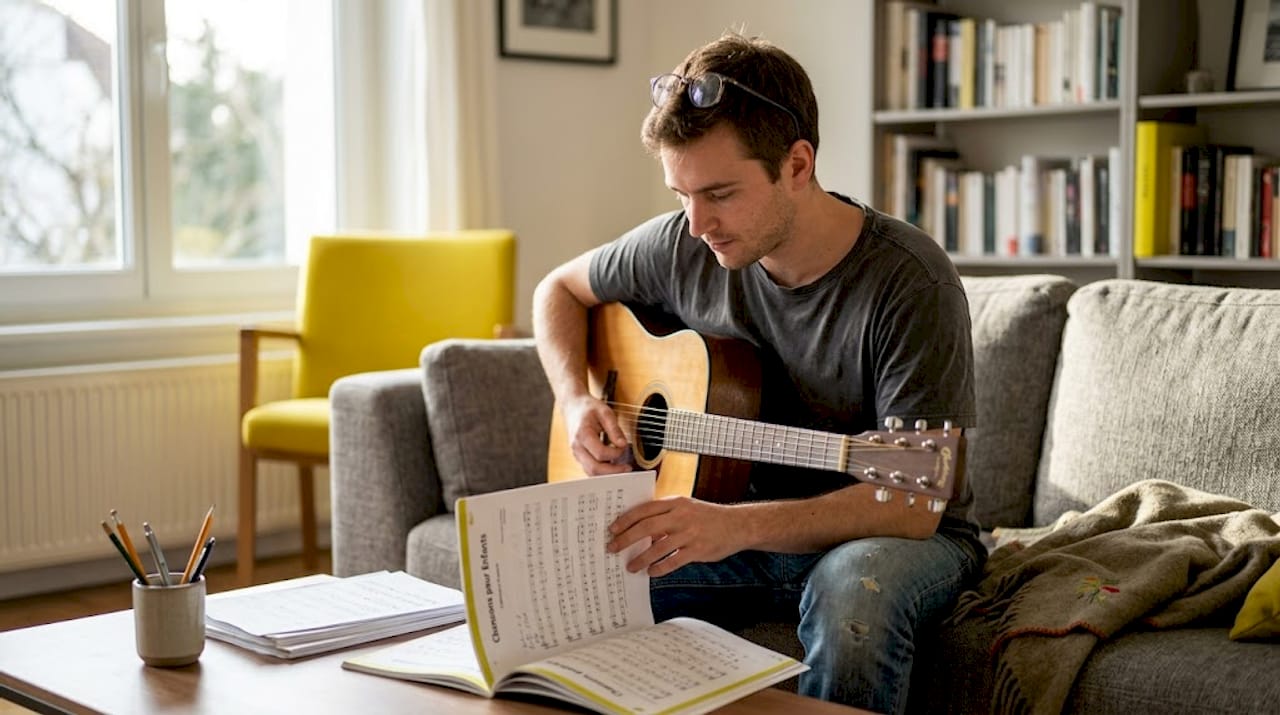
Children’s songs were engineered for rapid language acquisition. The vocabulary is concrete, the grammar is foundational, and the repetition is built in. When you sing about a lark’s body parts or a monk who won’t wake up, you’re drilling the exact same basic French that fuels real conversations: nouns, verbs, simple sentence order.
There’s another layer here too. Adult brains learn languages better when they feel safe making mistakes. Children’s songs remove the stakes. Nobody expects perfect French when you’re singing a nursery rhyme. That emotional safety allows you to experiment with sounds you’d never attempt in a formal conversation.
The reasons why song-based methods work have everything to do with memory encoding. When you attach words to melody and emotion, they settle into long-term memory more reliably than words you read once and highlight. Simple songs create simple, strong memories.
The fastest French learners we’ve seen at Canary aren’t the ones who started with complex chansons. They’re the ones who spent their first two weeks genuinely loving “Alouette” and then carried that confidence into harder material. Simplicity isn’t weakness. It’s strategy.
Level up your French with music-based tools
Ready to explore more songs and accelerate your French? Here’s how to keep the momentum going.
At Canary, you can learn languages with music through an interactive platform built around exactly the techniques this article covers: lyric-based learning, karaoke-style practice, vocabulary cards, and a community of learners who practice together. You’re never singing alone.
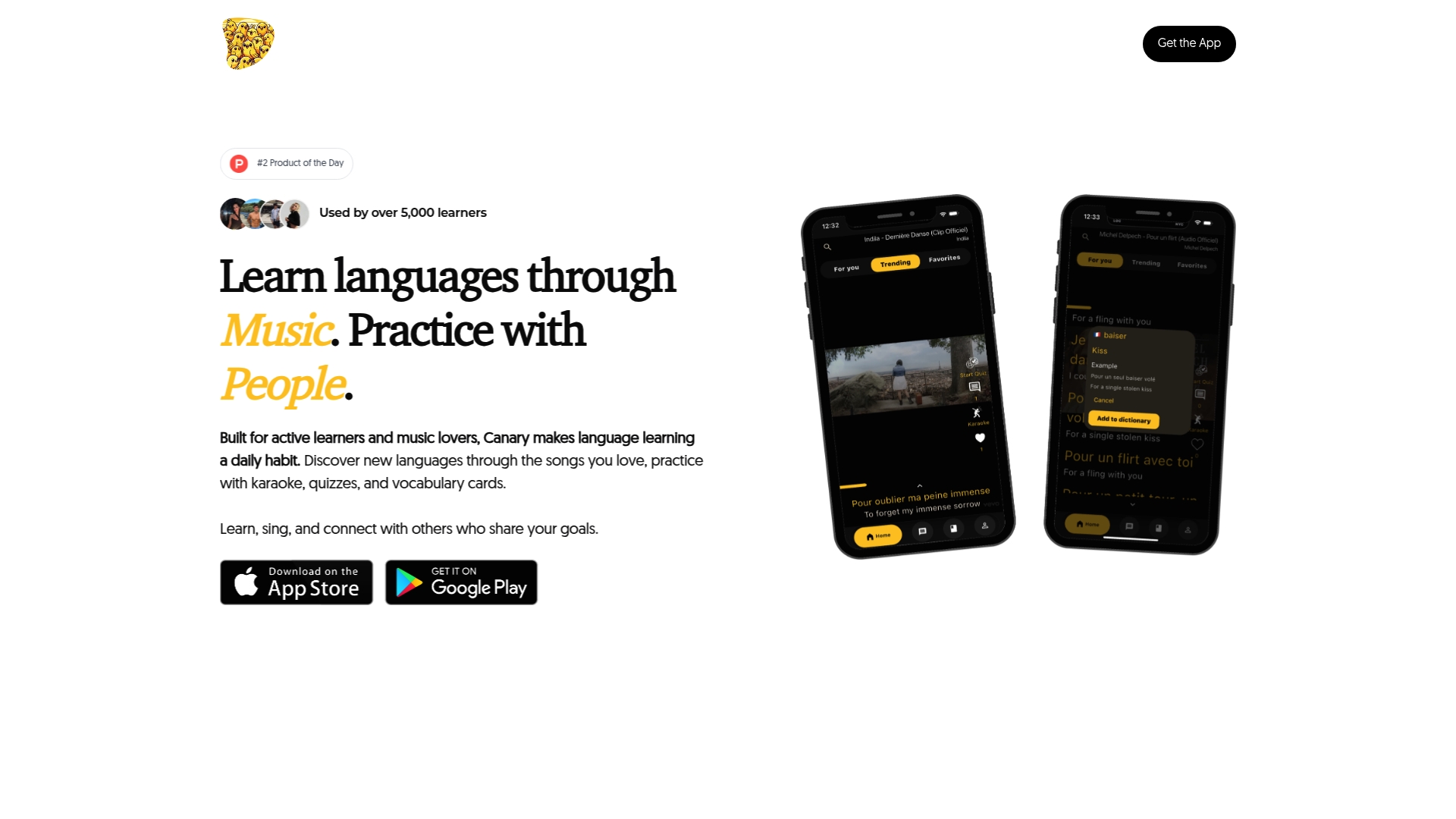
Every week, the weekly French song practice feature introduces a new track with guided exercises, themed vocabulary, and pronunciation challenges. It’s a structured, enjoyable way to build the daily habit that turns beginners into confident speakers. You can get started for free and explore the full song library today, no credit card needed.
Frequently asked questions
What makes a French song suitable for beginners?
Beginner songs feature slow tempo, clear lyrics, and repetitive vocabulary for easier understanding. As learning French with music naturally shows, songs that reinforce everyday words build both listening and vocabulary skills faster than grammar-heavy study.
Are children’s songs effective for adult French learners?
Yes. Repetitive language and simplicity make them perfect even for adult beginners. Educational settings regularly use song-based materials to boost vocabulary retention precisely because the format suits all ages.
How often should I practice with French songs to see results?
Aim for daily listening and singing sessions to quickly improve vocabulary and pronunciation. A consistent music-based vocabulary workflow accelerates acquisition far more than occasional long study sessions.
What learning methods pair well with beginner French songs?
Shadowing, lyric breakdown, and voice recording work well alongside listening. Blending lyrics and melody helps students internalize pronunciation and grammar naturally, making these active techniques especially effective.
Can I improve my speaking confidence by singing along?
Singing out loud improves accent and helps you remember phrases naturally. Methods that combine melody and language show that regular vocal practice builds the muscle memory needed for confident real-world speaking.