Start with the Spotify “Learn German - A1 - Absolute Beginner Level” playlist or a “German Music for Language Learning” YouTube list, turn on captions, and do one gap-fill exercise per song. That combination gets you both exposure and active recall in the same ten minutes. Deutsche Welle’s language team notes that music sharpens vocabulary and pronunciation fastest when the material actually matches your level, which is why absolute beginners should skip the radio hits and go straight for songs built for learners.
Three places to open right now:
- Spotify’s A1 Absolute Beginner playlist — slow, clear-voiced tracks built for first-time listeners.
- YouTube’s “German Music for Language Learning” — free, with captions you can toggle on and off.
- Munich Supercrew’s song catalog — tracks like “So gut” and “Eistee” written specifically for A1 grammar targets.
Key Takeaways
Music works for A1 German learners when the songs are built for their level, paired with captions, and repeated across a full week before moving on.
| Point | Details |
|---|---|
| Start with ready-made playlists | Open the Spotify A1 Absolute Beginner playlist or a YouTube “German Music for Language Learning” list today. |
| Choose songs with built-in grammar targets | Munich Supercrew tracks like “So gut” and “Eistee” pair simple lyrics with specific grammar practice. |
| Repeat before you rotate | Stick with 3 to 5 songs per week, adding gap-fills and sing-along tasks as you go. |
| Use captions every time | Reading lyrics while listening cuts confusion and speeds up vocabulary recognition. |
| Try a built-in music app | Singwithcanary pairs karaoke, quizzes, and vocabulary cards with the same song-based method for guided daily practice. |
Table of Contents
- Best A1 German Song Playlists for Beginners
- Individual A1 German Songs Worth Adding to Your Playlist
- Five Activities to Turn Any A1 Song Into a Real Lesson
- How Many Songs to Study Each Week
- Where to Find Reliable Lyrics and Worksheets
- Practice German Songs With Built-In Karaoke and Quizzes
- Frequently Asked Questions
- Sources
Best A1 German Song Playlists for Beginners
Your device and your goal should decide which playlist you open first. If you’re on your phone during a commute, YouTube’s captions make gist-listening painless. If you want something running in the background while you cook, Spotify wins on convenience.
The Spotify “Learn German - A1 - Absolute Beginner Level” playlist is built for exactly what its title says: no fast slang, no regional dialects, just clean pronunciation at a pace you can follow. A YouTube search for “German Music for Language Learning” surfaces channels that pair each track with on-screen lyrics, which matters more than people expect. Reading while listening cuts the guessing game in half.
For a slightly more advanced follow-up once A1 songs feel too easy, the Goethe-Institut’s “German Pop” Spotify playlist bridges you toward real contemporary music without the jump feeling brutal. Apple Music users can search “Learn German with Songs” for a similar compilation built around clear diction and repetitive choruses.
A few playback habits make all three platforms work harder for you:
- Turn on captions or lyrics every single time, even after you think you know the song.
- Drop playback speed to 0.75x for your first two listens if the lyrics move fast.
- Download playlists for offline listening. Repetition matters more than variety at A1.
Pro Tip: Play the same five songs on loop for a week before adding new ones. Your brain needs repeated exposure to move words from recognition to recall, and skipping around playlists resets that process every time.
Individual A1 German Songs Worth Adding to Your Playlist
Ready-made playlists are a great starting point, but a handful of individual tracks deserve special attention because they were written with specific grammar points in mind, not just simple vocabulary.
Munich Supercrew has built a small catalog aimed directly at A1 learners, and it shows in the song choices:
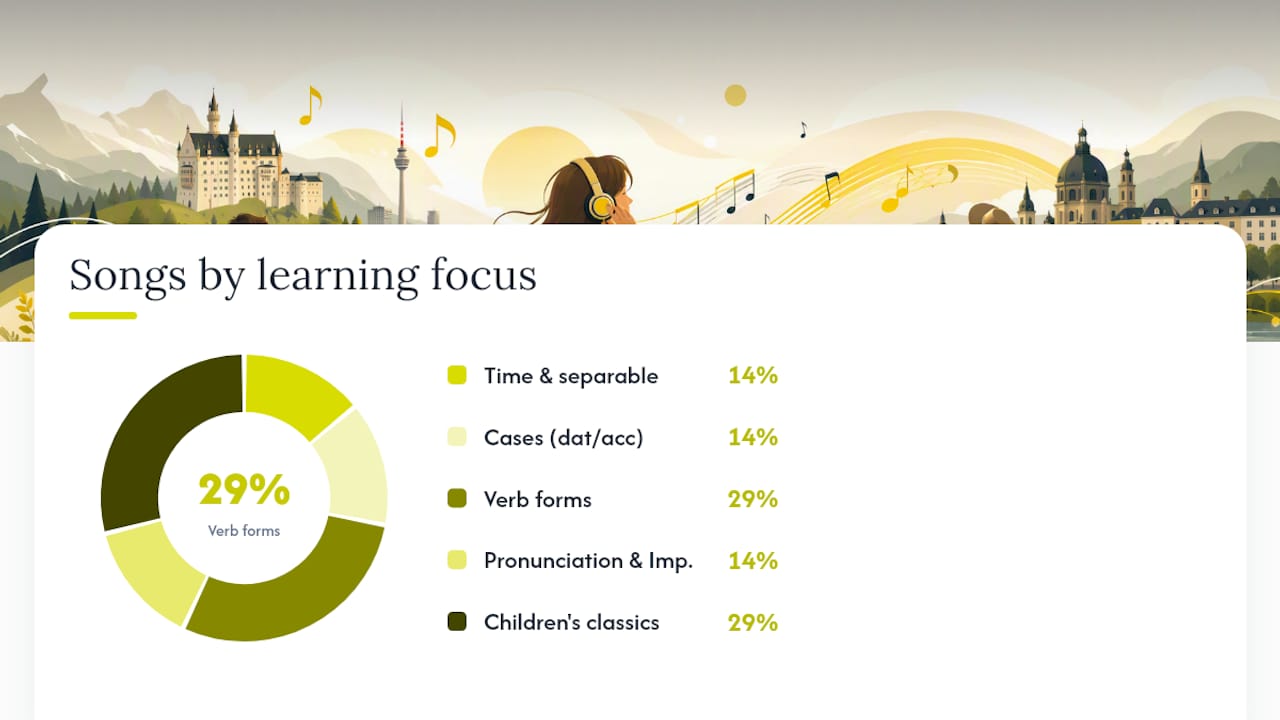
- “So gut” targets time adverbs and separable verbs, two of the trickiest early German patterns, with downloadable worksheets on the song page.
- “Eistee” practices prepositions that take dative and accusative cases alongside summer and food vocabulary, a natural entry point since the cases show up in everyday sentences.
- “Er sagt sie sagt” drills personal pronouns and present-tense verb conjugation through a simple back-and-forth structure that’s easy to sing along to.
- “Perfekter Kreis” works on pronunciation, especially umlauts and diphthongs, plus the imperative, and comes with a subtitled music video.
- “Perfekt mit dir” gently introduces basic Perfekt tense forms, which most learners don’t touch until later but can start recognizing early through song.
Two classics round things out for pure repetition and pronunciation drilling: “ABC Lied” (Germany’s alphabet song) and “Bruder Jakob” (the German version of “Frère Jacques”). Both were built for children, which is exactly why they work for adult beginners too. Slow, repetitive, and impossible to forget once it’s stuck in your head.
Five Activities to Turn Any A1 Song Into a Real Lesson
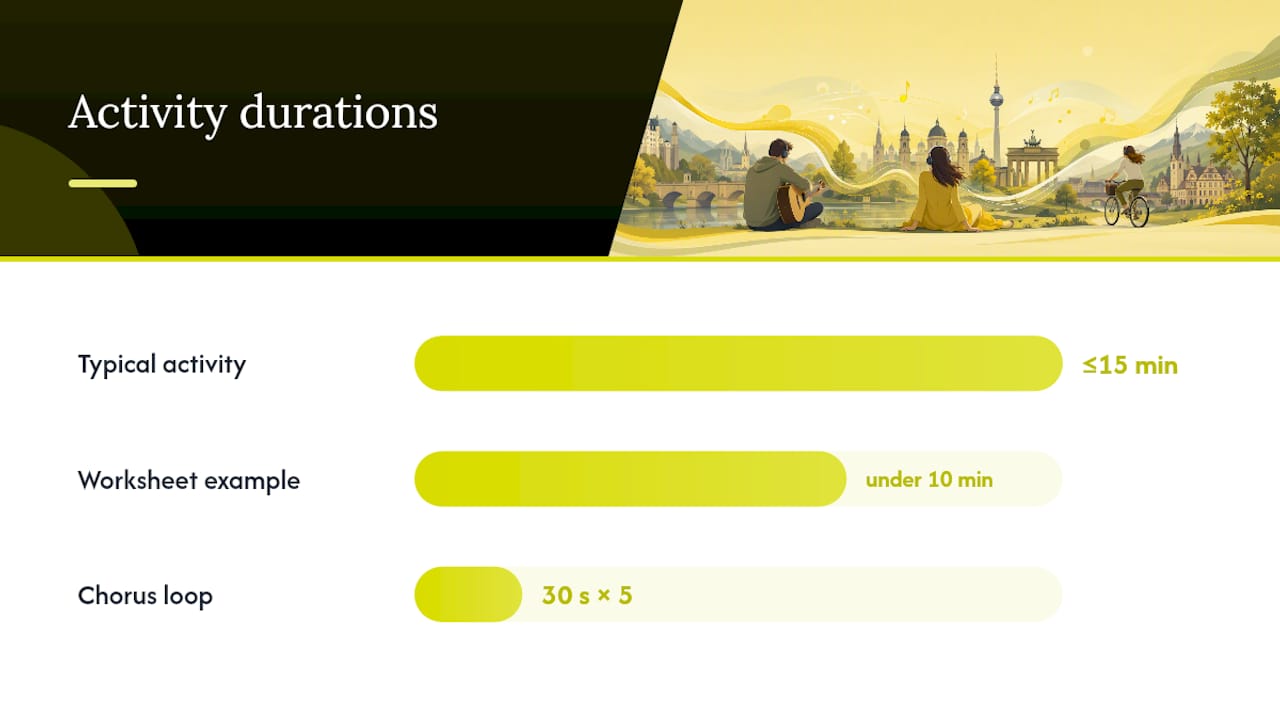
Passive listening only gets you so far. These five activities take fifteen minutes or less and convert a song you’ve heard fifty times into vocabulary you actually own.
- Listen for gist first. Play the song once with no lyrics or captions. Try to catch the general topic and mood before you look anything up.
- Do a targeted gap-fill. Pick one grammar point (separable verbs, prepositions, pronouns) and blank out five to eight words in the chorus tied to that pattern. Fill them in on your second listen.
- Sing along for pronunciation. Karaoke forces your mouth to move through sounds you’d otherwise skip past when just reading. It’s the fastest way to fix accent habits early.
- Shadow the vocals. Play the song and speak the lyrics half a second behind the singer. This trains rhythm and stress patterns that textbooks rarely teach.
- Build flashcards from the chorus. Choruses repeat, which makes them the highest-value five or six lines in any song for vocabulary retention.
Here’s a quick worksheet example using “So gut”: blank out the separable verb prefixes in the chorus, play the track twice, and have the learner reconstruct the full verbs from memory. It takes under ten minutes and hits grammar and listening at once.
Pro Tip: Loop just the chorus, not the whole song, when you’re short on time. Thirty seconds repeated five times beats one full play-through for building recall.
Canary’s ear training exercises follow a similar structure if you want a built-in version of this same approach.
How Many Songs to Study Each Week
Three to five songs per week is the sweet spot for A1 learners. Fewer than that and you’re not getting enough repeated exposure; more than that and nothing sticks because you’re always moving to something new.
A simple four-week starter plan:
- Week 1: Pick 3 songs. Listen daily, no active tasks yet, just gist and captions.
- Week 2: Add one gap-fill activity per song, focused on a single grammar point each.
- Week 3: Introduce sing-along practice on your strongest song. You should be able to sing the chorus and correctly fill five gap-fill blanks by now.
- Week 4: Rotate in two new songs while keeping one “review” track from week 1 in daily rotation.
Session length matters less than consistency. Ten to twenty minutes a day beats a single ninety-minute session once a week. Build the habit checklist: captions on, read the lyrics once before listening, do one active task after your second play, sing along on your third. Canary’s vocabulary building process uses spaced review that pairs well with this same rotation.
Where to Find Reliable Lyrics and Worksheets
Not every lyric site gets German right, especially fan-transcribed ones that miss regional spelling or slang. Stick to a short list of trustworthy sources instead.
- YouTube captions on official artist or label uploads, not reposts, give you the most accurate line-by-line text.
- Munich Supercrew’s song pages include downloadable PDFs and worksheets built specifically for A1 grammar targets, no hunting required.
- Goethe-Institut’s Deutschstunde portal offers a songbook with karaoke versions, chords, and full teaching materials for classroom or solo use.
- Deutsche Welle’s course resources pair songs with structured exercises rather than just raw lyrics.
To build your own gap-fill in under five minutes: copy the chorus, blank out five or six words tied to one grammar point, and quiz yourself after two listens.
Why Music Sticks Where Textbooks Don’t
Songs work for A1 learners because they’re built to repeat. A chorus you hear four times in one track does more for recall than a vocabulary list you read once. What most learners get wrong is chasing variety too early, hopping between playlists before any single song has had time to sink in. Slow down, repeat the same handful of tracks daily for a week, and let the repetition do the work your brain is actually built to use. Canary’s approach to pronunciation through music leans on that same principle.
Practice German Songs With Built-In Karaoke and Quizzes
Singwithcanary turns the manual worksheet process above into something you do inside one app, no separate lyric sites, PDF downloads, or homemade flashcards required. You get karaoke, gap-fill style vocabulary cards, and quizzes built directly around song lyrics, plus the ear training that helps fix pronunciation habits before they set in.
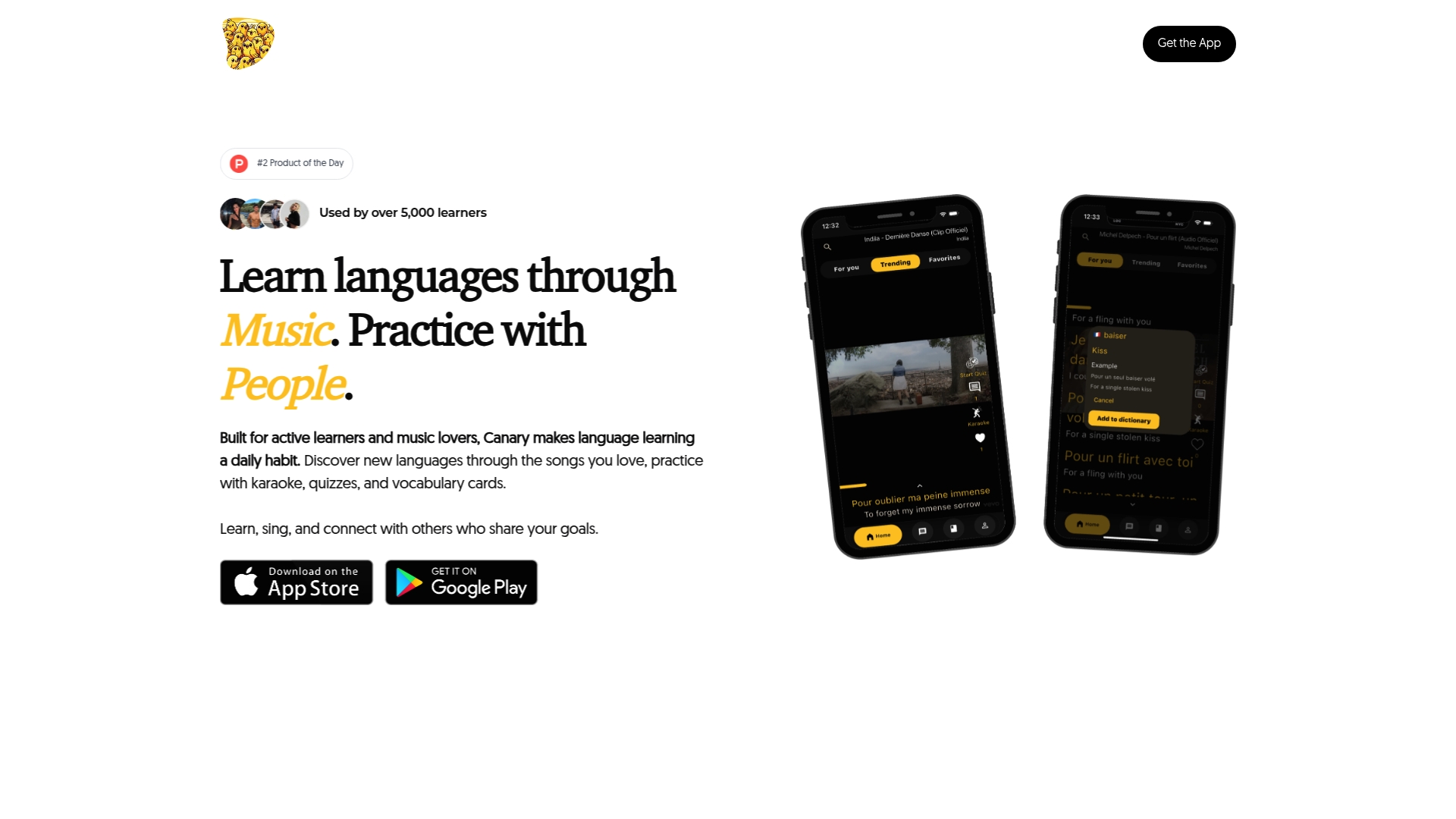
It fits best if you’re an adult learner who wants guided activities instead of assembling your own study plan from scratch, and who’ll actually show up a few times a week. The honest tradeoff: like anything built on repetition, it only works if you use it regularly, a single session won’t move the needle. Singwithcanary also adds a social layer other tools skip entirely, letting you practice pronunciation with native speakers rather than just a recording. Check out the Song of the Week feature for a ready-made weekly pick, or create a free account to try the karaoke and vocabulary tools with premium features unlocked as you go.
Frequently Asked Questions
What does “A1” actually mean for German songs? A1 marks the absolute beginner level on the Common European Framework scale. A1-appropriate songs use simple present-tense vocabulary, clear pronunciation, and heavy repetition instead of slang or complex sentence structures.
Can I learn German just by listening to songs? Songs work best as one part of your routine, not the whole thing. Pairing music with active tasks like gap-fills, flashcards, or ear training exercises builds recall far faster than listening alone.
How long should I study with one song before moving on? A full week of repeated listening, with at least one active task added by day three or four, gives most beginners enough exposure to recognize and recall the key vocabulary.
Are children’s songs like “Bruder Jakob” too simple for adult learners? Not for A1. The slow pace and heavy repetition that make children’s songs work for kids are exactly what adult beginners need for pronunciation and basic vocabulary drilling.
Where can I find accurate German lyrics for practice? Official YouTube uploads with captions, Munich Supercrew’s song pages, and the Goethe-Institut’s teaching materials are more reliable than fan-transcribed lyric sites, which often contain errors.
Sources
- Learn German with music
- SO GUT | Munich Supercrew
- Learn German with songs - Deutschstunde Portal
- Learn German - A1 - Absolute Beginner Level
- EISTEE | Munich Supercrew