TL;DR:
- Active engagement with song lyrics enhances vocabulary, pronunciation, and cultural understanding more than passive listening.
- Structured lyric activities like gap-fills, translation, and discussion foster deeper long-term language retention.
- Choosing appropriately challenging songs with clear vocals and relevant themes optimizes language learning progress.
Millions of language learners put foreign songs on repeat and wait for fluency to arrive. It doesn’t. Passive listening is significantly less effective than song-based learning built around structured tasks. The difference isn’t what you hear. It’s what you do with what you hear. Contextual learning with lyrics means actively engaging with every word, phrase, and cultural reference in a song rather than letting it wash over you. This guide covers exactly how to do that, with proven strategies for building vocabulary, sharpening pronunciation, and gaining real cultural insight through the music you already love.
Table of Contents
- What is contextual learning with lyrics?
- How contextual lyric-based activities accelerate language learning
- Choosing the right songs for effective learning
- Practical steps and best practices for learning with lyrics
- Why most lyric-based learning fails (and what actually works)
- Take the next step: Tools for lyric-driven language mastery
- Frequently asked questions
Key Takeaways
| Point | Details |
|---|---|
| Active lyric tasks matter | Engaging deeply with lyrics through analysis and activities accelerates language gains. |
| Song selection is crucial | Choose songs that fit your skill level for the best vocabulary and confidence results. |
| Practice with purpose | Intentional, routine-based lyric learning outperforms background music exposure every time. |
| Cultural insight bonus | Song lyrics offer a window into idioms, history, and authentic language as it’s used. |
What is contextual learning with lyrics?
Contextual learning means acquiring language through meaning-rich situations rather than isolated drills. When you apply that idea to song lyrics, you’re treating each line as a living piece of the language. You’re not just memorizing words. You’re learning how they sound in rhythm, how they carry emotion, and how native speakers actually use them.
The gap between passive listening and engaging lyric-based learning is significant. Here’s a side-by-side look:
| Approach | What you do | What you gain |
|---|---|---|
| Passive listening | Play songs in the background | Familiarity with sounds, little retention |
| Contextual lyric learning | Analyze, annotate, discuss lyrics | Vocabulary, grammar, pronunciation, cultural insight |
| Gap-fill exercises | Fill missing words while listening | Active listening and spelling accuracy |
| Lyric discussion | Talk about meaning with others | Critical thinking and conversational fluency |
Song-based listening paired with active noticing tasks consistently drives better outcomes than simply playing music and hoping something sticks. The key word is active. Your brain builds stronger memory traces when it has to work. A word you’ve looked up, sung aloud, and discussed is far more likely to stay with you than one you’ve heard forty times in the background.
Contextual lyric activities include:
- Lyric analysis: Breaking down a verse line by line to understand grammar patterns and vocabulary choices
- Gap-filling (cloze): Listening and writing missing words, which trains your ear and spelling at once
- Translation practice: Translating lines yourself before checking a reference version
- Discussion: Talking about what a song means, who wrote it, and why certain words were chosen
Exploring song-based learning methods reveals a consistent pattern: the more deliberate your engagement, the sharper your results. And the beauty of using songs is that the emotional hook is built in. Music makes you want to understand. That motivation is a powerful engine for deeper processing. Active lyric-centered approaches used by vocal coaches reinforce exactly this: intentional listening rewires how you absorb a language.
How contextual lyric-based activities accelerate language learning
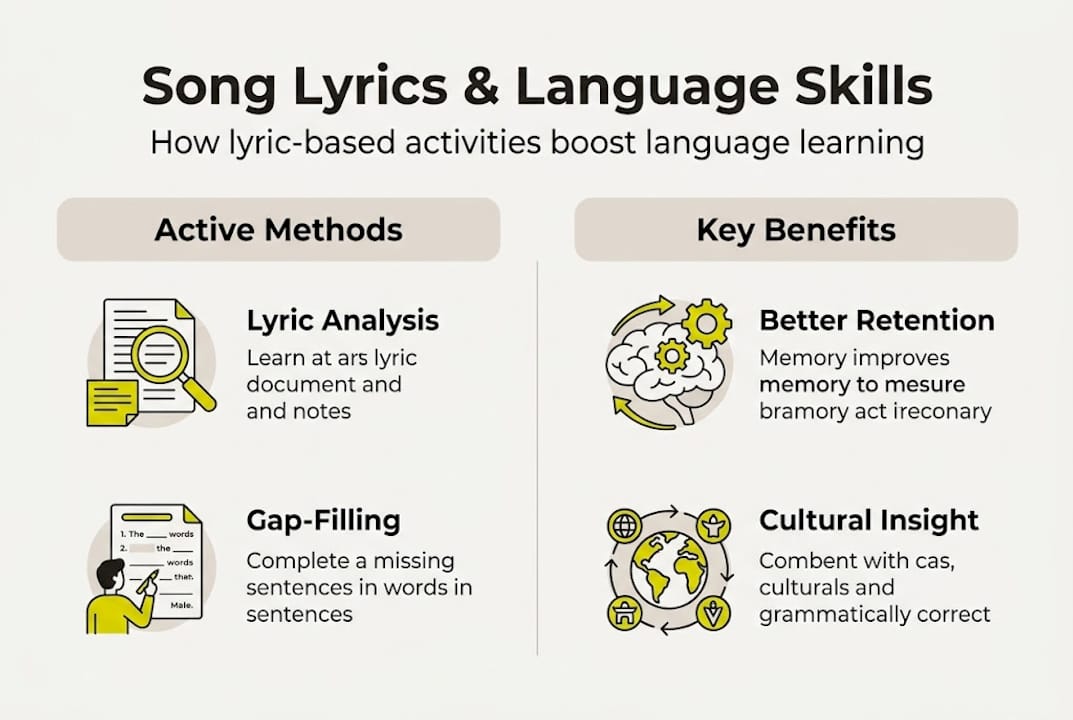
Active lyric engagement works because it hits multiple cognitive channels at once. Sound, meaning, rhythm, and emotion all combine to encode a word more deeply than a flashcard ever could. Here’s a step-by-step breakdown of the most effective activities:
- Cloze (gap-fill) listening: Remove every seventh word from a printed lyric sheet and fill in the blanks while listening. This forces you to process both sound and syntax simultaneously.
- Lyric translation: Translate a full verse yourself, then compare with a professional translation. The differences reveal how idioms, tone, and grammar shift between languages.
- Dictation: Listen to a song line and write exactly what you hear, then check against the real lyrics. Especially useful for identifying phonemes you’re mishearing.
- Annotation: Write notes directly on the lyrics about grammar patterns, unknown words, and cultural references.
- Group discussion: Talk through a song’s themes, imagery, and vocabulary with other learners or native speakers.
“Active noticing, not entertainment, is what leads to measurable language progress.”
Lyric analysis, dictation, gap-filling, and group discussion consistently produce stronger retention than passive listening in research settings. And active mapping of lyrics to meaning is what separates learners who plateau from those who keep advancing.
Culturally loaded lyrics are especially valuable springboards. A song about a local festival, a historical event, or a regional dish gives you language and context in one package. You’re not just learning a word for “longing.” You’re learning what Portuguese speakers mean when they sing about saudade. That depth sticks.
The emotional and motivational effects of music are real, too. Songs reduce anxiety and build momentum. Pair that emotional boost with music-based language activities that demand active thinking, and you have a system that’s both enjoyable and highly effective. The importance of active learning cannot be overstated when it comes to long-term retention.

Pro Tip: Don’t just sing along. After each listen, pick two lines that surprised or confused you, write them out, and annotate them before moving on.
Choosing the right songs for effective learning
Active methods only work when the material matches your level. Pick a song that’s way above your head, and you’ll feel lost and frustrated. Pick one that’s too easy, and you won’t grow. The sweet spot is roughly 85% comprehensible input: most of the song is understandable, but there are still enough new words to challenge you.
Comprehension and lyric familiarity directly affect how motivated you stay and how much you retain. And lexical frequency analysis of popular song lyrics shows that matching vocabulary lists to proficiency levels is a practical, data-driven way to assess whether a song is right for you.
Here’s a rough benchmark table to guide your selection:
| CEFR level | Recommended lyric vocabulary | Practical song type |
|---|---|---|
| A1-A2 | 90%+ from Oxford 3000 top 500 | Children’s songs, slow pop |
| B1 | 80-90% Oxford 3000 | Mainstream pop, folk |
| B2 | 70-80% Oxford 3000 | Rock, storytelling ballads |
| C1+ | Below 70% high-frequency words | Jazz, poetry-driven lyrics, rap |
Beyond vocabulary level, think about clarity of pronunciation. A track with crisp, well-enunciated vocals teaches you far more than a heavily produced song where words are swallowed or distorted. Slower tempos also give your brain more processing time, which matters especially at beginner levels.
Support materials raise the ceiling on what you can work with. Translations, glossaries, and transliterations (especially useful for non-Latin scripts) mean you can tackle songs a level above your comfort zone without getting completely lost. This is where a good step-by-step song selection guide becomes essential.
Pro Tip: Before committing to a song for a study session, run its lyrics through a frequency checker. If more than 20% of the words are unknown, save it for later and find something more accessible first. Check out tips for choosing songs to build a smarter playlist.
Practical steps and best practices for learning with lyrics
Here’s a structured routine you can apply to any song, in any language, at any level:
- Pick your song using the benchmarks above. Prioritize clear vocals and themes you care about.
- Listen for gist. Play the full song once without reading anything. What’s the mood? What’s the basic story?
- Read the lyrics. Follow along on a second listen. Notice where your ear and the text match or don’t.
- Highlight new words. Mark vocabulary you don’t know. Look each one up and write a short note in context.
- Do a gap-fill. Cover specific words and try to fill them in from memory or from listening again.
- Discuss or journal. Write three sentences about the song’s meaning or record yourself explaining it aloud.
- Repeat with a new section. Move to the next verse and repeat the cycle.
Contextual learning works best with active mapping of lyrics to meaning and sound, not just surface-level familiarity. That’s why the routine above keeps pulling you back to the text.
Do:
- Work through the whole song, not just the chorus
- Use a dedicated notebook or app for lyric annotations
- Practice singing the lines aloud after studying them
- Explore the role of context in language learning to reinforce what you gain from lyrics
Don’t:
- Skip verses because they seem harder
- Treat a translation as a final answer without checking your own version first
- Use music as background noise during this focused study time
Common mistakes include focusing only on the chorus (missing most of the vocabulary and grammar a song offers) and choosing songs that are too complex for your current level. Advanced learners can push further by using real-time sing-along apps that show lyrics with instant feedback, which is how music speeds up language learning far beyond what passive exposure could achieve. Building a daily song-based practice habit, even 15 minutes a day, compounds into serious fluency over time.
Why most lyric-based learning fails (and what actually works)
Here’s the uncomfortable truth: most people who try to learn a language through music aren’t really learning. They’re enjoying music. Those are different things, and confusing them is the most common reason lyric-based learning fails.
The failure point isn’t motivation. It’s structure. A playlist on loop gives you repeated exposure, but repetition without reflection is just noise. The breakthrough happens when you treat a single song line as three things at once: a vocabulary card, a discussion prompt, and a cultural artifact. That shift in mindset changes everything.
Our experience at Canary confirms it. The learners who make the most measurable gains with proven song-based methods are the ones who add deliberate reflection, annotation, and peer interaction to their practice. They don’t just listen more. They engage differently. Music is the vehicle. Active attention is the engine.
Take the next step: Tools for lyric-driven language mastery
You now have the framework. The next step is putting it into daily practice with the right tools around you.
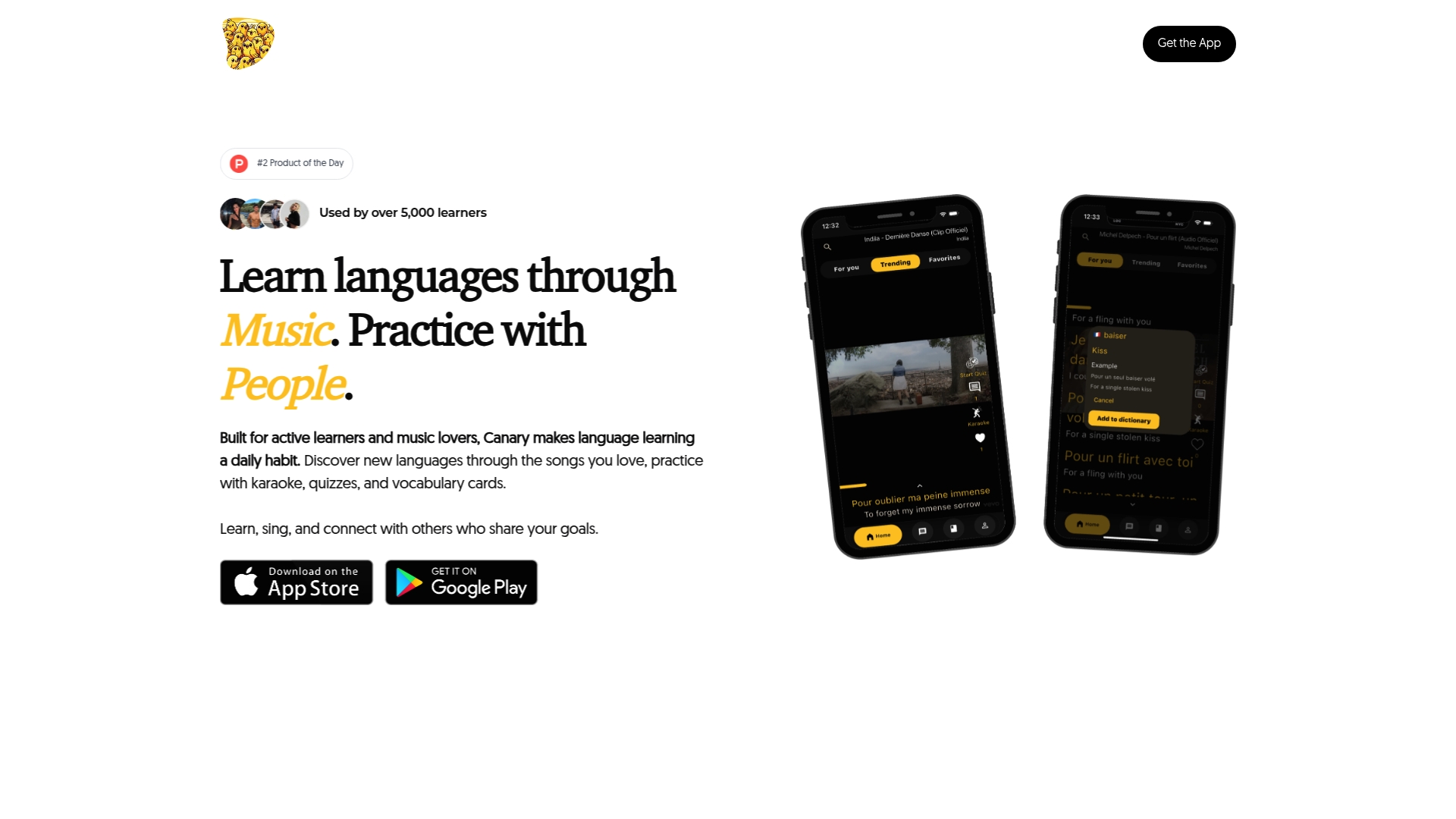
Canary is built for exactly this kind of learning. When you learn languages with music through Canary, you get curated song lessons, built-in gap-fill exercises, vocabulary cards pulled directly from real lyrics, and a community of learners from around the world to practice with. You can explore the full benefits of song-based learning inside the platform or dive into language-specific tools like the Spanish lyric learning tools if that’s your target language. Every feature is designed to move you from passive listener to active learner.
Frequently asked questions
Does listening to songs really help language learning?
Yes, but the gains come from lyric-focused activities, not background listening. Active tasks outperform passive listening significantly in research on music-mediated language learning.
How do I pick songs at my level?
Choose songs where most of the vocabulary is already familiar, and use frequency word lists or CEFR benchmarks to assess fit. Lexical coverage benchmarking helps you match songs to your actual proficiency level.
What’s the best way to study lyrics for vocabulary gains?
Gap-filling, annotation, and discussion are the most effective techniques because they force you to actively connect lyrics to meaning and pronunciation. These structured lyric tasks consistently produce stronger retention than casual listening.
Are there drawbacks to only using music for language learning?
Relying on music without deliberate lyric tasks leads to shallow memorization and slow progress. Music as pure entertainment simply doesn’t carry the cognitive load needed for lasting language gains.
Can music help with pronunciation and accent?
Absolutely. Matching the rhythm, stress, and vowel sounds of a song in a real sing-along trains your mouth to produce sounds more accurately than reading alone ever could.