TL;DR:
- Music-based routines improve language learning through rhythmic memory and emotional engagement.
- Consistent practice with clear goals, variety, verification, and social interaction ensures progress.
- Tracking intelligibility, vocabulary, and pronunciation with partner feedback boosts confidence and skill.
Practicing a language every day sounds great in theory, but the reality often looks like a half-finished app streak, a grammar workbook gathering dust, and a creeping sense that you’re going through the motions alone. Music-based language learning shows measurable gains for learners through mechanisms like rhythmic memory and emotional engagement, which is exactly why building your daily workflow around songs and community is one of the smartest moves you can make. This guide shows you how to structure that workflow from scratch, so every session feels less like homework and more like something you actually look forward to.
Table of Contents
- What you need for successful daily language practice
- Step-by-step daily workflow: Practice with music
- The community loop: Practice speaking with partners
- How to benchmark your progress and troubleshoot setbacks
- Why most music-based language routines fail—and how to do better
- Ready to level up your language practice?
- Frequently asked questions
Key Takeaways
| Point | Details |
|---|---|
| Music boosts practice | Regular practice with music increases motivation and aids memory for new language. |
| Community speeds growth | Practicing with others strengthens pronunciation and provides real feedback. |
| Track real progress | Use intelligibility and vocabulary tests—not just feelings—to measure improvement. |
| Variety keeps it fun | Switching up songs and partners helps maintain daily engagement and learning. |
| Structure supports success | A repeatable daily routine with both solo and social elements yields sustainable gains. |
What you need for successful daily language practice
Now that you understand why music and community matter, let’s get you set up with the essentials for your workflow. Think of this as your starter kit. You don’t need to be tech-savvy or musically talented. You just need the right combination of tools, time, and intention.
The educational benefits of music in language learning are well documented, but those benefits only kick in when you show up consistently. That means making setup so simple that there’s no excuse to skip.
Here’s your core checklist:
- Music source: Spotify, YouTube, or a dedicated app with lyric support
- Device: Smartphone, tablet, or laptop (whatever you’ll actually use daily)
- Song selection: At least three songs at your target language level ready to go
- Regular time slot: A fixed 20 to 30 minute window in your schedule
- Practice partner or community app: For the social loop (more on this below)
- Notebook or vocab app: For logging new words and phrases from lyrics
The table below gives you a clear overview of the tools and what each one contributes to your learning.
| Tool | Purpose | Minimum setup |
|---|---|---|
| Song lyrics app | Pronunciation and reading | One song downloaded |
| Vocabulary card app | Word retention between sessions | 10 target words per song |
| Language exchange app | Speaking and real interaction | One active partner |
| Recording app | Self-monitoring and progress tracking | Built-in phone mic is fine |
| Calendar reminder | Consistency habit formation | One recurring daily alarm |
One of the most underrated parts of setup is the community loop. A practice partner or community can be integrated into the same daily workflow by adding short, structured speaking sessions with exchange partners, which transforms solo study into real communication practice.
For vocabulary-boosting tips for music lovers, the key is connecting the words you hear in a song to real-life contexts as quickly as possible. Don’t just write down a word. Write down the lyric it came from and one sentence you’d actually use it in.
Pro Tip: Choose songs you genuinely enjoy, not just songs that seem “educational.” Emotional connection to music dramatically increases how well you retain the vocabulary and pronunciation patterns embedded in it. Set a calendar reminder for the same time every day, even if it’s just 15 minutes during your commute.
Step-by-step daily workflow: Practice with music
With your tools ready, you’re set to dive into your daily music-driven routine. The structure below is designed to move you through warmup, active learning, and reflection in under 30 minutes while keeping things varied enough that you don’t burn out.
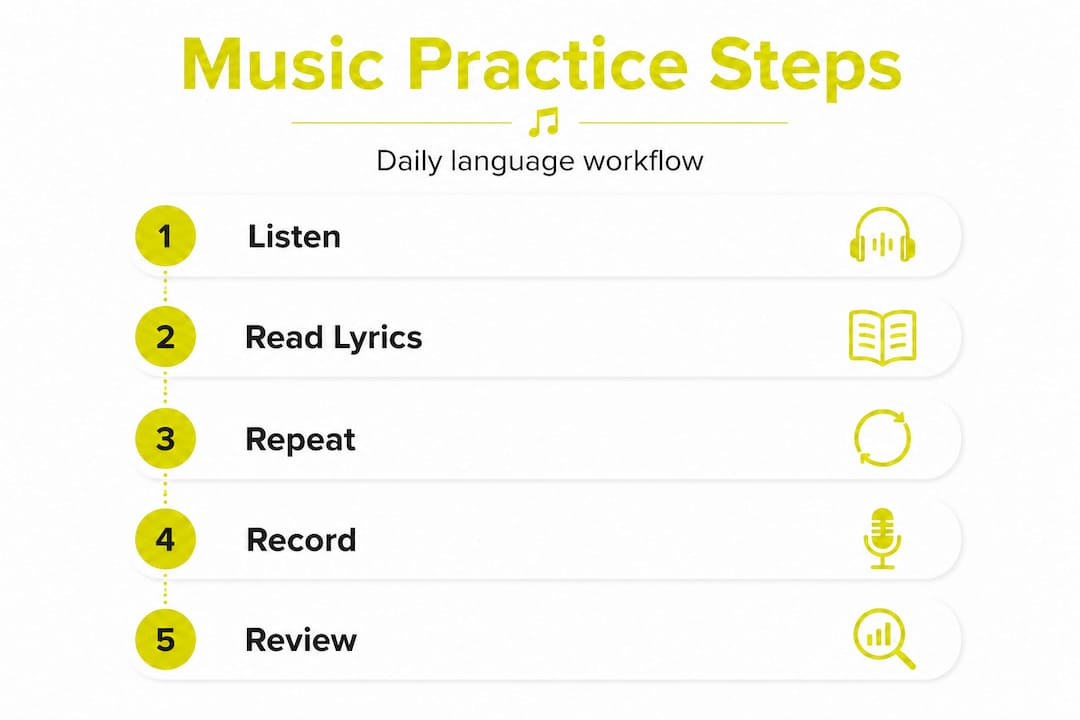
Here is your eight-step daily sequence:
- Warmup listen (3 minutes): Play your chosen song without reading lyrics. Just absorb the melody, rhythm, and overall feeling.
- Lyric scan (3 minutes): Read through the lyrics in the target language and mark any unfamiliar words.
- Vocabulary card sprint (4 minutes): Add marked words to your vocabulary app or notebook with a brief definition and a note on how they were used in context.
- Chorus shadowing (5 minutes): Focus on the chorus only. Play it, pause it, and repeat the phrases aloud, mimicking the singer’s exact intonation and stress.
- Full song karaoke (5 minutes): Sing or speak the whole song along with the track. Don’t aim for perfection. Aim for fluency and rhythm.
- Partner interaction (5 minutes): Send a voice note to your partner using a word or phrase from today’s song in an original sentence. Ask them to do the same.
- Reflection note (2 minutes): Write one sentence about what felt difficult and one about what clicked. This takes seconds but anchors your learning.
- Weekly recording (1 minute, once per week): On one day per week, record yourself singing or speaking a section of the song. Save it for comparison.
This structure draws directly on what song-based daily language routines do best: they combine listening, speaking, vocabulary work, and social interaction in a single session. That’s a lot of ground covered in under 30 minutes.
The table below compares three core techniques used in this workflow so you can understand what each one targets.
| Technique | What it trains | Best for |
|---|---|---|
| Lyric memorization | Vocabulary, reading, and recall | Building a strong word bank |
| Chorus shadowing | Intonation, stress, and fluency | Pronunciation and rhythm |
| Call-response with a partner | Real communication and correction | Confidence and accuracy |
Research consistently shows that rhythmic and prosodic entrainment through music boosts both memory support and oral fluency. In plain terms: singing a phrase locks it into your memory far better than reading it on a flashcard. When you add rhythmic repetition, your brain starts to treat those phrases as natural patterns rather than foreign constructions.
For boosting pronunciation with music, shadowing is the highest-return technique in this list. Most learners underuse it because it feels awkward at first. Push through that discomfort. Within two weeks, you’ll notice a real shift in your natural speaking rhythm.
Pro Tip: Record yourself once per week and listen back with specific focus on three elements: word stress, sentence-level intonation, and clarity of individual sounds. Don’t judge the whole recording. Pick one thing to improve for next week and go from there.
The community loop: Practice speaking with partners
Solo practice is great, but combining it with social interaction accelerates your results. Here’s how to make the community loop a natural part of your workflow without it feeling like a scheduled obligation.
The simplest way to connect with a practice partner is through a language exchange. You spend half the session speaking their language and they spend half speaking yours. Exchange partners using voice notes and calls to practice pronunciation and vocabulary in real interaction is one of the most effective and underused strategies available to independent learners.
Here are several practical ways to build your community loop:
- Voice notes: Record a short message using vocabulary from today’s song and send it to your partner. It’s low pressure and easy to fit into a busy schedule.
- Short video or audio calls: Once or twice a week, do a live five to ten minute call focused on the song you’ve both been working with.
- Group listening parties: Organize a small group of learners to listen to the same song and discuss the lyrics together in the target language.
- Duet challenges: Pick a song, each record your own version, and swap. Give each other one pronunciation note and one vocabulary observation.
- App-based communities: Use platforms that connect learners around music to find partners who share your taste and language goals.
Giving and receiving feedback takes a little practice. The most useful feedback is specific, not general. Instead of “your accent sounds good,” try “you stressed the second syllable in that word more naturally this time.” That level of detail is what actually moves your pronunciation forward.
Joining language communities built around music gives you built-in accountability and a shared reference point. When everyone in the group is working with the same song, conversations flow more naturally and feedback is easier to give.
“Pairing music with real conversation is like having two teachers at once: the song models the language perfectly, and your partner shows you how native speakers actually use it in the moment.”
Rotate your partners regularly. Different speakers expose you to different accents, vocabulary preferences, and communication styles. That variety is not a distraction. It’s training for the real world, where no two speakers sound exactly the same.
How to benchmark your progress and troubleshoot setbacks
Once your workflow is active, keeping track of real progress and staying motivated is essential. Feeling engaged is not the same as improving. You need concrete evidence that your skills are moving forward.
Here’s what to actually track:
- Intelligibility: Can your partner understand you easily without guessing? Ask them directly once a week.
- Prosody: Does your spoken rhythm sound natural? Compare your weekly recordings to the original singer.
- Vocabulary recall: How many words from last week’s song can you use spontaneously in a sentence today?
- Pronunciation accuracy: Are specific sounds getting cleaner over time? Flag problem sounds and track them individually.
Watch for these red flags that your workflow needs adjustment:
- You’re singing along fluently but can’t explain what the lyrics mean
- Your vocabulary list is growing but you never use the words in conversation
- Your partner sessions feel repetitive and you’re dreading them
- Your recordings sound the same week after week with no noticeable improvement
- You’re missing more than two sessions per week consistently
When one of these appears, it’s not a sign of failure. It’s a signal to troubleshoot. For benchmarking language learning outcomes, it’s worth prioritizing metrics like intelligibility and standardized fluency indicators rather than self-reported engagement, because how fun something feels and how much it’s actually improving your skills don’t always align.
The benefits of learning languages with music are real, but they require active measurement to make sure you’re capturing them. Build in a five-minute weekly check-in where you ask yourself three questions: Did I use any new words this week in real conversation? Did my partner understand me more easily? Am I improving at any specific pronunciation target?
Pro Tip: Use both self-assessment and partner feedback as your benchmarks. Your own ear will miss things your partner catches immediately. Their feedback, combined with your recorded evidence, gives you the most objective picture of where you actually stand.
Why most music-based language routines fail—and how to do better
Here’s a hard truth about music-based language learning that most guides won’t say out loud: the biggest risk isn’t boredom. It’s the illusion of progress.
When you’re singing along to your favorite song in another language, it feels productive. It’s enjoyable, it’s immersive, and you’re clearly doing something. But enjoyment and acquisition are not the same thing. Many learners spend months singing the same ten songs without meaningfully expanding their vocabulary, improving their accent, or gaining the ability to hold a real conversation. They feel good about their practice but can’t point to measurable gains.
The routines that actually work share three things: variety, verification, and accountability. Variety means regularly introducing new songs, new genres, and new partners so your brain never gets too comfortable. Verification means using the benchmarks we discussed: intelligibility scores, weekly recordings, vocabulary tests, and partner feedback. Accountability means having someone else in the loop, whether that’s a language exchange partner, a community group, or even a friend who asks you about your progress.
Building music-powered study habits that stick requires treating fluency as the goal, not fluency with your favorite song. The song is a vehicle, not the destination. When you internalize that distinction, you stop asking “did I enjoy today’s session?” and start asking “did I come out of today’s session more capable than I went in?”
The learners who make the most consistent progress are also the ones who don’t go it alone. Social motivation is a legitimate and powerful force. When someone is waiting for your voice note, when you’ve committed to a weekly call, when your group has a song challenge posted for Friday, you’re far more likely to show up. And showing up, consistently and with intention, is what actually produces fluency.
Ready to level up your language practice?
With a smart, sustainable workflow set up, you’re ready for even bigger language breakthroughs. Canary is built specifically for learners like you who want to learn languages with music and connect with a global community at the same time.
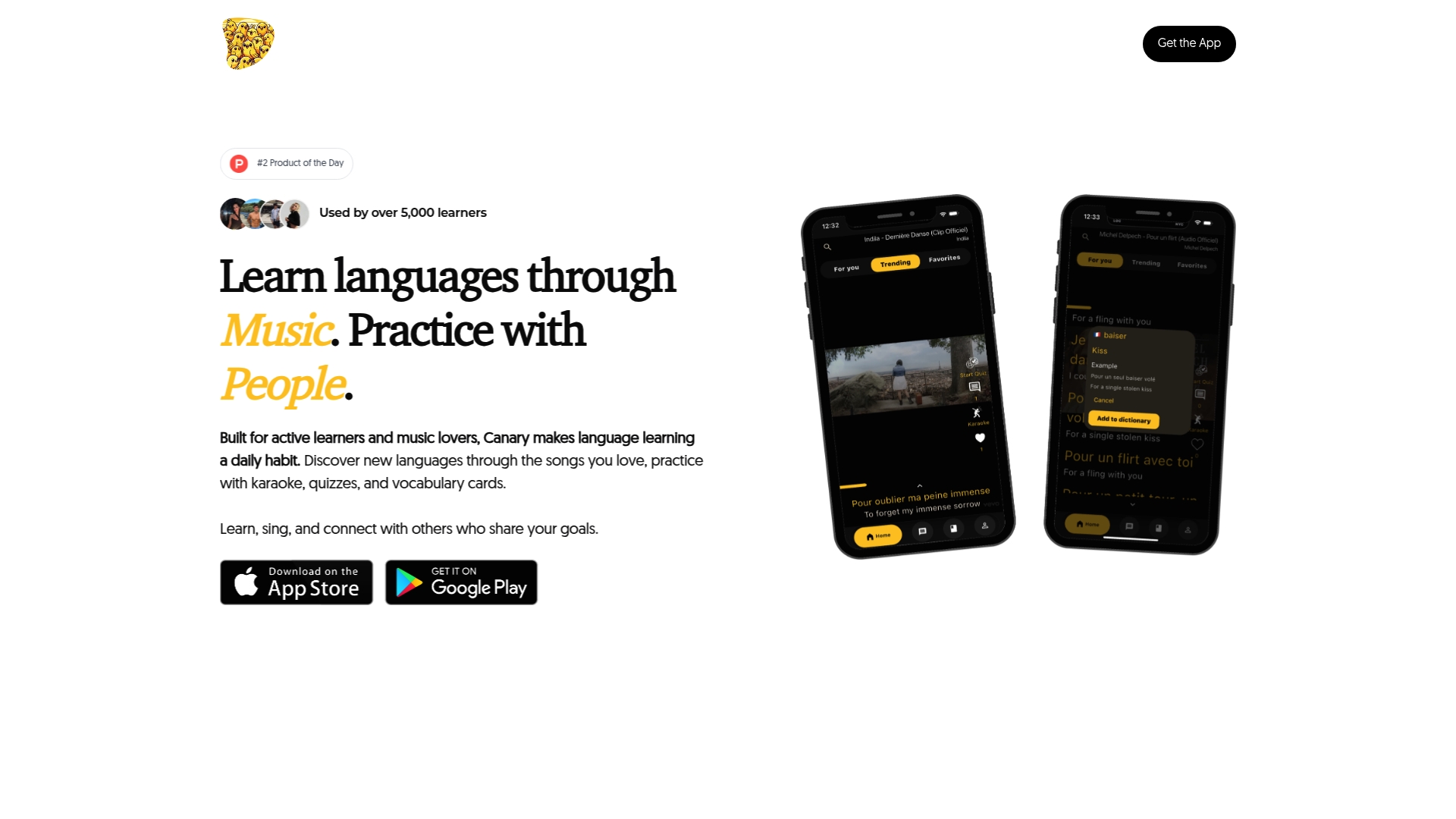
Every feature on the platform is designed to support the exact workflow you’ve just built: karaoke-style lyric practice, vocabulary cards pulled directly from song lyrics, pronunciation tools, and a community of learners who are doing the same thing you are. You can try a song of the week to jumpstart your routine with a curated learning experience, or explore the benefits of song-based learning to go deeper on the research behind what you’re doing. Your next practice session is one song away.
Frequently asked questions
Why does music help with daily language practice?
Music supports memory, motivation, and pronunciation through mechanisms like rhythmic repetition and emotional engagement, making daily practice both measurable and enjoyable over time.
How do I choose songs for daily language learning?
Pick songs at your current language level that feature clear pronunciation and frequently repeated phrases, since repetition is what drives vocabulary retention and natural pattern recognition.
What should I track to measure my progress?
Monitor your intelligibility, vocabulary recall, and prosody, and always combine self-assessment with partner feedback because intelligibility and fluency indicators give you the most accurate picture of real improvement.
How do I stay motivated when practicing every day?
Use variety by rotating songs and genres regularly, set small weekly goals, join community challenges, and make sure your sessions include social interaction so there’s someone else invested in your progress.
Do I need a language partner for daily practice?
Solo practice builds a strong foundation, but adding a speaking partner significantly accelerates pronunciation improvement and keeps engagement levels high over the long term.