TL;DR:
- The fastest path to language fluency combines cultural awareness, music-based practice, and social feedback. Short, daily sessions with songs and conversation improve vocabulary, pronunciation, and intercultural understanding. Consistent, small efforts over time lead to genuine communication skills.
The fastest path to real fluency combines three things: cultural awareness, music-led practice, and regular social feedback. Prioritize pragmatics and register (how people actually speak, not just what words mean), lyric-based drills that train your ear and vocabulary at the same time, and weekly exchanges with native speakers who can tell you when something sounds off. Sustained exposure and social interaction over months is what separates people who plateau from people who actually communicate.
- Cultural awareness: Learn what’s polite, what’s rude, and what’s just weird in your target culture before you worry about grammar.
- Music-led practice: Song choruses pack high-frequency vocabulary into short, repeatable units you can shadow, sing, and analyze.
- Social feedback: A conversation partner who corrects you in real time is worth more than a hundred solo study hours.
Pro Tip: Pick one chorus from a song in your target language right now. Listen once, write down every word you don’t know, then sing along twice. That’s a complete 10-minute session.
Table of Contents
- What are the best cross-cultural language learning tips you can use today?
- Why culture and language must be learned together
- How music-based techniques accelerate your language learning
- How to build a weekly routine that you’ll actually stick to
- How do you track progress and get useful feedback?
- How Singwithcanary puts these techniques into practice
- How should you adapt your strategy to different cultural communication styles?
- What are the most common cross-cultural challenges, and how do you get past them?
- What role do apps and technology play in cross-cultural language learning?
- How can cultural festivals and events sharpen your language skills?
- Key Takeaways
- Why starting small is the real secret to cross-cultural fluency
- Singwithcanary makes the music-first routine easy to follow
- Useful sources and further reading
What are the best cross-cultural language learning tips you can use today?
Short, frequent sessions beat long, infrequent ones. Microlearning aligns with the forgetting curve and fits into a real schedule. Here’s a daily micro-task checklist you can copy into your notes app:
- Listen to one song in your target language (full play, no pausing).
- Write down 3–5 words from the chorus you didn’t catch.
- Look up one idiom or cultural reference from the lyrics.
- Send a voice message to a language partner using one new phrase.
- Record yourself saying the chorus once, then play it back.
For conversation habits, two things matter most. First, always start the session in your target language — whichever language you open with tends to become the default for the whole exchange. Second, ask for a specific kind of correction: “Tell me when I use the wrong register, not just wrong grammar.” That one instruction changes the quality of feedback you get.
Here’s a lyric micro-drill, step by step:
- Pick the chorus of any song you like in your target language.
- Play it at 75% speed and write out what you hear (even if it’s wrong).
- Look up the actual lyrics and compare.
- Circle every word you didn’t catch or didn’t know.
- Sing the chorus twice, exaggerating the stressed syllables.
- Use one phrase from the chorus in your next conversation.
Pro Tip: Use music-fueled language exchange sessions where you and your partner each bring one song — you teach yours, they teach theirs. You get vocabulary, cultural context, and conversation practice in one go.
Why culture and language must be learned together
Grammar gets you understood. Culture gets you accepted. Digital tools that integrate cultural context improve both language competence and intercultural sensitivity — learners who skip the cultural layer often produce sentences that are technically correct but socially awkward.

Register is the clearest example. In Japanese, using casual speech with a senior colleague isn’t just informal — it signals disrespect. In French, “tu” versus “vous” carries real social weight that no grammar rule fully explains. In American English, directness is valued; in many East Asian communication styles, an indirect “maybe” often means “no.” Misreading that costs you the relationship.
Do/Don’t examples:
- Do use softeners when declining in high-context cultures (“That might be difficult” instead of “No”).
- Don’t assume silence means agreement — in several cultures, it signals discomfort.
- Do notice how songs address the listener: formal or informal, intimate or distant.
- Don’t translate idioms word-for-word and expect them to land.
Songs are one of the best cultural context tools available. Lyrics carry slang, generational references, and emotional register that textbooks never touch. Pair them with short films, local podcast interviews, and TEFL-informed cultural sensitivity practices to build a fuller picture.
How music-based techniques accelerate your language learning
Lyrics work best with explicit analysis — note unfamiliar words, research the usage, and practice lines in context. Here are six techniques, each with a short drill:
- Chorus shadowing: Play the chorus, pause after each line, repeat it aloud matching the singer’s rhythm and intonation. Do this three times per session.
- Slow-karaoke: Drop playback to 70–80% speed. Sing along and focus on consonant clusters you normally blur over.
- Morpheme spotting: Pause the song and identify prefixes, suffixes, or verb conjugations in one line. Write them out.
- Rhythmic chunking: Break a lyric line into two or three natural phrase chunks. Practice each chunk separately, then string them together.
- Genre register comparison: Find the same topic (love, loss, work) in two different genres — a pop song and a folk ballad, for example. Compare how the vocabulary and formality shift.
- Cultural reference drill: Pick one cultural reference in the lyrics (a place name, a historical event, a slang term) and spend five minutes researching it. Then explain it to your language partner.
A language’s most frequent words account for a high share of real-world usage, and song choruses are dense with them. That’s why chorus-focused work gives you more vocabulary return per minute than most textbook exercises.
Pro Tip: For ear training, listen to the same song three days in a row before looking at the lyrics. Your brain will start filling in gaps on its own — that’s active phoneme recognition, and it transfers directly to real conversation.
How to build a weekly routine that you’ll actually stick to
The perfection trap is the single biggest reason adult learners quit. Experts recommend prioritizing clarity over complexity — frequent, imperfect conversation beats infrequent, polished performance every time. Structure your sessions to reward communication, not correctness.
| Day | Activity | Time |
|---|---|---|
| Monday | Lyric drill (chorus shadowing + word list) | 15 min |
| Tuesday | Conversation partner exchange | 30 min |
| Wednesday | Film or podcast in target language | — |
| Thursday | Lyric analysis + cultural reference research | 15 min |
| Friday | Voice message to partner using new phrase | 10 min |
| Saturday | Full song karaoke + vocabulary card review | — |
| Sunday | Weekly review: recordings, word list, one reflection note | 15 min |
Session structure tips:
- Split a 30-minute exchange evenly: 15 minutes in your target language, 15 in your partner’s.
- Set one communicative goal per session (“I’ll use three new words from this week’s song”).
- When you make a mistake, note it and move on — don’t stop to apologize or over-explain.
- End every session with one sentence you’re proud of. Write it down.
The language immersion, music, and social practice combination works because it keeps you in contact with the language across multiple modalities every day, not just once a week.
How do you track progress and get useful feedback?
Self-recording is the most underused tool in language learning. Record yourself speaking for 60–90 seconds on the same topic once a month. Play back recordings side by side and listen for changes in fluency, rhythm, and pronunciation — not just accuracy.
| Milestone | Typical indicator | Benchmark context |
|---|---|---|
| Basic conversation | Can sustain 5-minute exchange on familiar topics | Achievable within weeks of consistent daily practice |
| Functional proficiency | Handles unexpected questions without long pauses | Months of regular social practice |
| Professional-level fluency | Intensive programs require hundreds of hours | Defense Language Institute-style training: several months intensive |
Feedback collection methods:
- Ask your partner: “Did anything I said sound unnatural?” (not just “Was that correct?”)
- Use in-app feedback loops where available — written corrections after voice sessions.
- Track vocabulary recall: how many words from last week’s song can you use in a sentence today?
- Measure conversation duration: if you’re speaking longer before pausing, that’s real progress.
Structured exchanges with timed turns and agreed correction methods produce more usable feedback than open-ended chat. Agree upfront: “Correct me on register and pronunciation, not every grammar slip.”
Pro Tip: For language practice with natives that actually moves the needle, bring a specific lyric or phrase to each session and ask your partner to say it naturally. Then compare your version to theirs.
How Singwithcanary puts these techniques into practice
Singwithcanary is built around the exact workflow described above. Every feature maps directly to a technique in this article:
- Karaoke mode: Chorus shadowing with real-time lyric display and slow-speed playback.
- Lyric annotation cards: Vocabulary cards built from song lines, with cultural notes attached.
- Social practice rooms: Live sessions with native speakers and other learners, structured around songs.
- Ear training drills: Listen-before-reading exercises that build phoneme recognition.
- Weekly song feature: A curated song each week with pre-built vocabulary lists and cultural context notes.
The workflow looks like this: pick a song from the weekly feature, run a 15-minute karaoke session with slow mode enabled, review the lyric cards, then join a social room to use the new phrases in conversation. That’s the full loop — input, analysis, output, feedback — in under an hour.
Interactive language platforms work best when they combine structured input (lyrics, vocabulary) with unstructured social output (conversation, voice messages). That’s the design principle behind Singwithcanary.
How should you adapt your strategy to different cultural communication styles?
Not every learner or target culture approaches communication the same way, and your learning strategy should reflect that. High-context cultures (Japan, Korea, many Arab-speaking countries) rely heavily on implication, shared knowledge, and non-verbal cues. Low-context cultures (Germany, the Netherlands, the United States) favor explicit, direct statements.
If you’re learning a high-context language, spend more time on films and songs that show social situations — not just vocabulary. Notice what’s not said. If you’re learning a low-context language, practice stating your point directly without softening it into ambiguity. Culturally immersive learning means adjusting your input sources to match the communication style of the culture, not just the grammar of the language.
Learning preferences vary too. Some learners absorb language through listening and repetition; others need to write things down before they stick. The weekly routine above is designed to hit both — karaoke and shadowing for auditory learners, lyric cards and vocabulary lists for visual ones.
What are the most common cross-cultural challenges, and how do you get past them?
Indirect communication trips up more learners than grammar ever does. When a native speaker says “that’s interesting” in a flat tone, they may mean the opposite. When someone in a face-saving culture says “I’ll try,” they’re often declining without saying no. These aren’t deceptions — they’re culturally encoded politeness strategies, and you won’t catch them from a textbook.
The fix is exposure plus reflection. Watch short films or interview clips where you can see facial expressions and body language alongside the words. After each exchange session, note one moment where you weren’t sure what was really meant. Bring it up with your partner: “When you said X, did you mean Y?” That single habit builds pragmatic awareness faster than any drill.
Face-saving is the other major hurdle. In many cultures, correcting someone publicly is deeply uncomfortable — which means your language partner may not correct you even when you ask. Build trust first. After a few sessions, ask for written corrections after the call rather than in the moment. It’s less confrontational and often produces more honest feedback.
What role do apps and technology play in cross-cultural language learning?
Apps accelerate exposure, but they can’t replace human interaction. The most effective technology for cross-cultural learners does three things: delivers authentic cultural content (not just grammar exercises), connects you with real speakers, and gives you feedback on how you actually sound.
Digital tools with cultural context lead to measurable improvements in intercultural communication skills — the key word being “cultural context.” An app that teaches vocabulary without cultural notes is a dictionary with a progress bar. The difference shows up the moment you try to use the language with a real person.
Music-based apps occupy a specific and useful niche here. Songs are authentic cultural artifacts — they carry slang, emotion, generational references, and social norms that no curriculum writer would think to include. Pairing lyric work with social features (voice rooms, partner matching, community challenges) closes the gap between input and real-world use.
How can cultural festivals and events sharpen your language skills?
Festivals are one of the most efficient immersion tools available, and most American cities host them year-round. A Spanish-language film festival, a Lunar New Year celebration, a Diwali market, a Bastille Day street fair — each one gives you hours of authentic language exposure in a context where making mistakes is low-stakes and native speakers are genuinely happy to talk.
Go with a specific language goal. Before you attend, learn five phrases relevant to the event (“What does this dish mean?” “Who is this song about?” “How do you celebrate this at home?”). Use them. The TEFL-informed approach to festival-based projects suggests treating each event as a mini field research session — observe, ask, reflect, and bring what you learned back to your next practice session.
Online festivals and cultural events work too. Many cultural organizations stream performances, cooking demonstrations, and panel discussions with subtitles. Watch them in your target language, take notes on phrases you hear, and bring one observation to your next exchange session.
Key Takeaways
Combining cultural awareness, music-led drills, and structured social feedback is the most direct route to cross-cultural fluency — and it works in sessions as short as 15 minutes a day.
| Point | Details |
|---|---|
| Culture before grammar | Learn pragmatics, register, and social norms early — they determine whether you sound natural, not just correct. |
| Chorus-first music practice | Song choruses pack high-frequency vocabulary into short, repeatable units ideal for shadowing and ear training. |
| Start exchanges in your target language | Opening in your target language sets the session default and maximizes your practice time. |
| Track intelligibility, not just accuracy | Monthly self-recordings and conversation duration are better progress signals than grammar test scores. |
| Singwithcanary for the full loop | Singwithcanary combines karaoke mode, lyric cards, and social practice rooms to run the complete input-to-output workflow in one app. |
Why starting small is the real secret to cross-cultural fluency
The conventional advice is to “immerse yourself fully” — move abroad, think in the language, never speak your native tongue. That’s fine if you can do it. Most people can’t, and the advice sets up a false binary: total immersion or nothing.
What actually works is smaller and more repeatable. One chorus. One exchange session. One cultural reference researched and explained. The learners who make the most progress aren’t the ones who study hardest in a single month — they’re the ones who show up consistently for a year. The top language learning challenges almost always come down to inconsistency and the perfection trap, not lack of talent.
Music is the best entry point because it removes the pressure. You’re not trying to have a conversation — you’re just singing along. But the vocabulary sticks, the pronunciation improves, and by the time you sit down with a native speaker, you already sound like someone who’s been listening for months. Because you have been.
Start with the sample weekly routine above. Pick one song this week. Record yourself once. Send one voice message. That’s enough.
Singwithcanary makes the music-first routine easy to follow
If the weekly routine above sounds like something you’d actually do, Singwithcanary is built to run it for you. Every week, a curated song gives you a ready-made chorus to shadow, a vocabulary card set to review, and cultural notes that explain what the lyrics actually mean in context. The karaoke mode lets you slow the track down, sing along with the lyrics on screen, and record your attempt for comparison. Then the social rooms connect you with native speakers and fellow learners to use what you just practiced in real conversation.
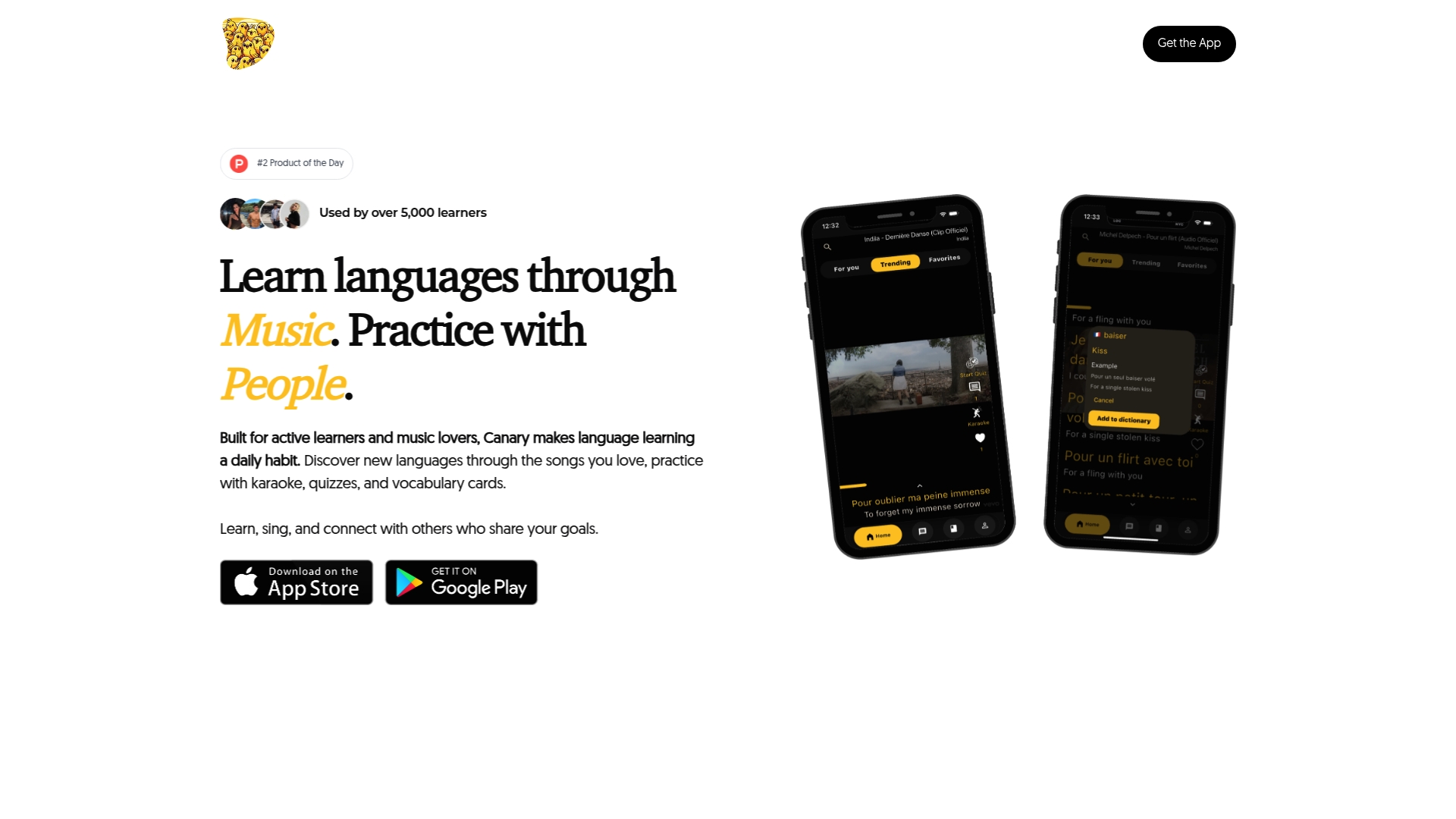
The fastest way to start: open Singwithcanary, pick the song of the week, enable slow mode, and record one chorus. That’s your first session done. From there, the app guides you through the full loop — lyric analysis, vocabulary review, and a social practice session with real speakers. Sign up free and run your first music-first session today.
Useful sources and further reading
Drills and techniques
- What’s the best way to learn a new language? — BBC Future: covers microlearning, spaced repetition, vocabulary frequency, and DLI-style timeline benchmarks.
- How to do a Language Exchange: A Step-by-Step Guide — Preply: structured exchange techniques, timed turns, and how session language defaults form.
- The Dos and Don’ts of Language Exchange — Tofugu: lyric-analysis method and explicit vocabulary research applied to song lines.
Cultural competence
- Cross-cultural Language Learning: Interpretative Engagement — ERIC: academic research on pragmatics, noticing, and meta-pragmatic awareness in cross-cultural interaction.
- Cultural Sensitivity in the TEFL Classroom: Best Practices — TEFL Institute: classroom-level cultural competence practices adaptable for self-directed learners and festival projects.
- What is cultural sensitivity: A guide for TEFL teachers — TEFL Institute: foundational guide to cultural sensitivity for anyone teaching or learning across cultures.
Academic background and immersion
- Globalizing Language Learning with Multicultural Sensitivity — IJLUL: research on how digital tools with cultural content improve intercultural communication skills.
- Mastering Language Exchange: Benefits, Tips & Best Practices — Cultured Wanderer: practical guide to avoiding the perfection trap and structuring exchanges for communicative confidence.
- How to Immerse Yourself in a Language (Without Leaving Home) — Magnetic Memory Method: sensory learning tips and memory techniques for home immersion.