A short, active music routine practiced every day reliably improves vocabulary, pronunciation, and speaking confidence. Research summarized from McGill and Harvard studies confirms that music elevates mood and reduces stress by triggering dopamine and oxytocin release, which directly lowers the anxiety that holds most language learners back from speaking. The Center for Music Learning adds a critical condition: the routine only works when each session has a specific, measurable intention. Here is a starter routine you can run today.
A short starter routine can be practiced daily to improve language skills.
- Warm-up (2–3 min): Play one familiar song in your target language. Hum along. This primes your brain and signals that study time has begun.
- Active lyric study (5–10 min): Read the lyrics of one verse. Look up two or three unfamiliar words. Write them down.
- Shadowing (5–8 min): Play the verse again and repeat each line aloud, matching the singer’s rhythm and pronunciation as closely as you can.
- Spaced recall (3–5 min): Close the lyrics. Write or say the words you just studied from memory.
Pro Tip: Run an A/B test your first two weeks. Study one session with music, the next in silence, then compare how many words you recall. If the silent session consistently beats the music session, switch to instrumental-only tracks for focused work.
Key Takeaways
Consistent, goal-directed daily music routines outperform passive listening for vocabulary retention, pronunciation accuracy, and speaking confidence across 2–4 weeks of practice.
| Point | Details |
|---|---|
| Start with 15 minutes | A 2-min warm-up, one verse of lyric study, shadowing, and a recall test fits any schedule. |
| Test music vs. silence | Run A/B sessions for 2–4 weeks and compare recall scores before committing to music full-time. |
| Silent self-test every session | Close lyrics immediately after practice and write recalled words to prevent the illusion of competence. |
| Commute time counts | Subvocal shadowing and mental rehearsal deliver real gains without audio or disturbing others. |
| Singwithcanary | Combines karaoke, lyric quizzes, vocabulary cards, and community practice in one music-first platform. |
Table of Contents
- Why does music actually help you learn a language?
- What are the core elements of an effective daily routine?
- Sample routines for 15, 30, and 60 minutes
- How do you pick songs and build playlists that actually teach?
- How do you measure progress and run a real A/B test?
- When is music hurting your study instead of helping?
- How do you practice music-based routines on a commute or in a quiet space?
- The evidence and expert sources behind these recommendations
- Music in my own daily study practice
- Singwithcanary puts a complete music-based routine in one place
- Sources
Why does music actually help you learn a language?
Music works on language learning through three overlapping mechanisms, and understanding them helps you use music more deliberately rather than just as pleasant background noise.
The mood effect is the most immediate. Music raises dopamine and oxytocin levels, which reduces anxiety and makes you more willing to attempt speaking, a behavior most learners avoid when stressed. Lower anxiety means more practice attempts, and more attempts compound into faster gains. The educational benefits of music on language acquisition go beyond mood: music also modulates attention, helping you stay focused on a lyric segment long enough for memory consolidation to occur.
The memory mechanism matters too. Melody acts as a retrieval cue. Words learned inside a song are encoded with both semantic and melodic tags, giving your brain two paths to recall the same item. That redundancy is why vocabulary from songs tends to stick longer than vocabulary from a word list.
Finally, music primes the articulatory system. Singing or shadowing a lyric forces your mouth and breath to produce sounds in the target language’s actual rhythm, which is something flashcards never do.
What are the core elements of an effective daily routine?
Every effective music-based language practice session contains six elements. You do not need all six every day, but skipping the same one repeatedly will create gaps.
- Warm-up: One familiar song, 2–3 minutes. Builds the habit cue. Short daily rituals beat infrequent long sessions for retention every time.
- Focused lyric work: Isolate one verse or chorus. Read, annotate, and look up unknowns.
- Shadowing or subvocal practice: Repeat each line aloud or silently, matching rhythm and intonation.
- Vocabulary extraction: Pull 2–5 new words into a flashcard app or notebook.
- Spaced recall: Test yourself on yesterday’s words before adding today’s.
- Mental rehearsal: Replay a lyric segment in your head without audio, hearing the pronunciation internally.
Daily practice checklist:
- One warm-up song played
- One verse studied with annotations
- Shadowing completed on at least one line
- New words logged
- Yesterday’s words tested from memory
Pro Tip: Immediately after your session, close everything and write down every word you studied without looking. Passive listening creates an illusion of competence; the silent self-test reveals what you actually retained.
Sample routines for 15, 30, and 60 minutes
Pick the routine that fits your available time. Each follows the same core structure, scaled to fit.
15-minute routine:
- Warm-up with one familiar song (2 min).
- Read one verse, mark two unknown words (5 min).
- Shadow a couple of lines aloud.
- Write the two words from memory (2 min). Done.
30-minute routine:
- Warm-up (3 min).
- Study two lyric segments with pronunciation drills (10 min).
- Shadow the full chorus (8 min).
- Spaced recall on this week’s vocabulary (5 min).
- Record yourself saying one sentence using a new word (4 min).
60-minute routine:
- Warm-up (3 min).
- Deep lyric analysis: grammar, idioms, cultural context (15 min).
- Full song shadowing with attention to stress and intonation (15 min).
- Extended spaced practice using a flashcard app (10 min).
- Journal two sentences using today’s new words (7 min).
- Live karaoke or speaking practice with a partner or through a platform like Singwithcanary (10 min).
How do you pick songs and build playlists that actually teach?
The wrong song wastes your session. A track with mumbled lyrics, heavy autotune, or a tempo so fast you cannot parse individual words gives you almost no usable input.
Selection criteria that matter:
- Lyrical clarity: Choose singers who enunciate. Acoustic or folk tracks in your target language tend to be cleaner than heavily produced pop.
- Language level: Pick songs slightly above your current level, not far above. You should understand roughly 70–80% without help.
- Tempo: 60–90 BPM for shadowing work; faster tracks for warm-up or break music.
- Repetition: Choruses repeat naturally, which means built-in spaced practice. Prioritize songs with strong, memorable hooks.
- No ads: Use downloaded playlists or a premium tier. An ad mid-session breaks concentration and ruins the priming effect.
For focused study, ambient instrumental playlists on Spotify work well as background during vocabulary extraction or journaling. Vocal tracks belong in the active shadowing and lyric-study phases. YouTube and Apple Music both host curated study playlists organized by mood and focus level, and My Good Brain’s playlist guidance offers a useful framework for matching playlist type to study phase.
Pro Tip: Loop a 15–30 second lyric chunk rather than replaying the whole song. Repetition at the segment level drives pronunciation accuracy faster than full-song replays.
How do you measure progress and run a real A/B test?
Anecdote is not evidence. A structured A/B test tells you whether music is helping your specific learning style or quietly costing you recall points. Treating music as a priming tool and testing it against silence is the most honest way to find out.
A/B test protocol:
- Choose one song and one set of 10 target vocabulary words.
- Study Session A with music playing. Log your recall score immediately after.
- Study Session B the next day with the same words in silence. Log your recall score.
- Alternate for 2–4 weeks, at least 3 pairs of sessions per week.
- Compare average recall scores, pronunciation self-ratings (1–5), and confidence ratings (1–5).
Session log template:
| Date | Music (Y/N) | Words recalled | Pronunciation rating | Confidence rating |
|---|---|---|---|---|
| Day 1 | Y | 7/10 | 3 | 3 |
| Day 2 | N | 8/10 | 4 | 3 |
The Center for Music Learning recommends setting a specific intention before each session (“I will correctly shadow the stress pattern of this chorus”) and then rating whether you achieved it. That intention-to-outcome loop is what separates deliberate practice from pleasant repetition. Expect to see measurable recall improvements after 2–4 weeks of consistent daily sessions.
When is music hurting your study instead of helping?
Music becomes a liability the moment it competes with the cognitive task rather than supporting it. The signs are specific.
Red flags to watch for:
- Your recall score is consistently lower in music sessions than in silent ones.
- You catch yourself singing along instead of shadowing (enjoyment, not practice).
- You cannot complete the silent self-test at the end of the session.
- You are choosing songs you love rather than songs that teach.
- You are using music with ads that interrupt the session.
Corrective actions:
- Switch to instrumental-only tracks for any task requiring reading or writing.
- Reserve vocal tracks strictly for shadowing and pronunciation drills.
- If recall drops three sessions in a row with music, drop it entirely for one week and retest.
- Break lyrics into small chunks and practice those segments rather than replaying the full song passively.
The goal is deliberate practice, not comfortable repetition. If the session feels easy, it is probably not working.
How do you practice music-based routines on a commute or in a quiet space?
You do not need audio to get high-value language practice. Berklee’s mental rehearsal techniques include inner singing, score-following, and subvocal shadowing, all of which transfer directly to language learning and work in any quiet environment.
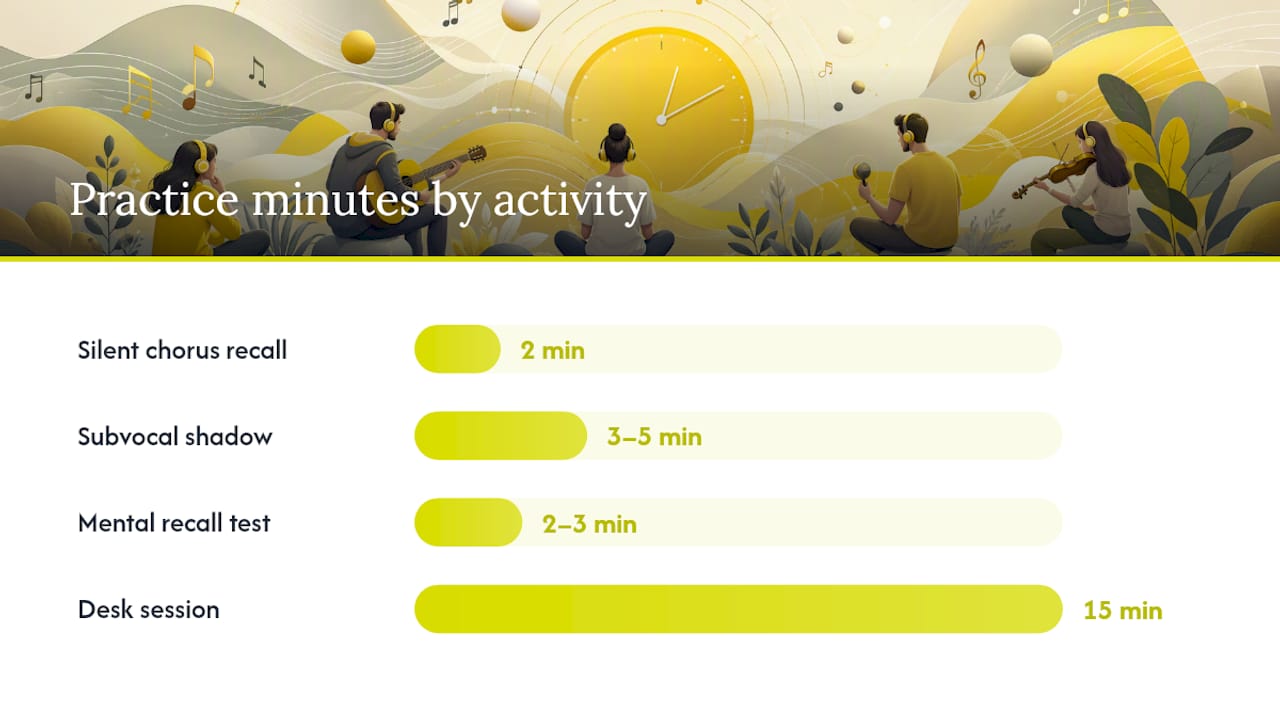
Commute micro-routine (5–12 minutes):
- Recall the chorus of yesterday’s song silently in your head (2 min). Hear the pronunciation internally.
- Subvocal shadow: mouth the words without sound, matching the rhythm you remember (3–5 min).
- Mental recall test: list the vocabulary words from your last session without any audio cue (2–3 min).
For daily practice without being in a target-language environment, these silent techniques are often more effective than passive listening because they force active retrieval rather than passive recognition.
Pro Tip: Use headphones with an ambient or transparency mode. You can listen to a lyric loop at low volume while staying aware of your surroundings, which makes commute sessions practical and safe.
These micro-routines slot into the daily routine as a supplement, not a replacement. A 10-minute commute session plus a 15-minute desk session adds up to a 25-minute day without any extra scheduling.
The evidence and expert sources behind these recommendations
These routines draw from applied learning research, music practice methodology, and cognitive science.
Primary sources used:
- McGill and Harvard research on dopamine, oxytocin, and mood effects on learning (via Open.edu.au)
- Center for Music Learning: intention-to-outcome matching and self-assessment in practice
- Berklee Online: mental rehearsal and deep listening techniques
- Bulletproof Musician: illusion of competence and silent self-testing
- Musical-U: short daily rituals and habit formation
- National University: A/B testing music versus silence
The evidence here is practical and translational, not clinical. None of these recommendations constitute medical or therapeutic advice. The research consistently points in the same direction: short, goal-directed, daily sessions with active retrieval testing outperform long, passive, music-only listening by a wide margin.
Music in my own daily study practice
The routine that works for me is simple and takes 20 minutes most mornings. I start with one song I already know well, just to prime the session, then move to one new verse in the target language with the lyrics open. Shadowing the chorus three times, then closing the lyrics and writing every word I can recall, is the core of it. After two consistent weeks with that structure, the vocabulary retention difference compared to my old passive-listening habit was obvious: words from songs stayed retrievable days later without review, while words from lists faded within 48 hours.
The go-to playlist type for focused lyric work is acoustic or stripped-back recordings, where every syllable is audible. For background during vocabulary card review, Singwithcanary’s song-of-the-week format works well because the song is already annotated and the vocabulary is pre-selected, which removes the curation step entirely.
Singwithcanary puts a complete music-based routine in one place
If you want a ready-built version of everything described above, Singwithcanary is the most direct path. Instead of assembling your own lyric annotations, flashcard decks, and shadowing tracks from scratch, the platform delivers them together around a single song.
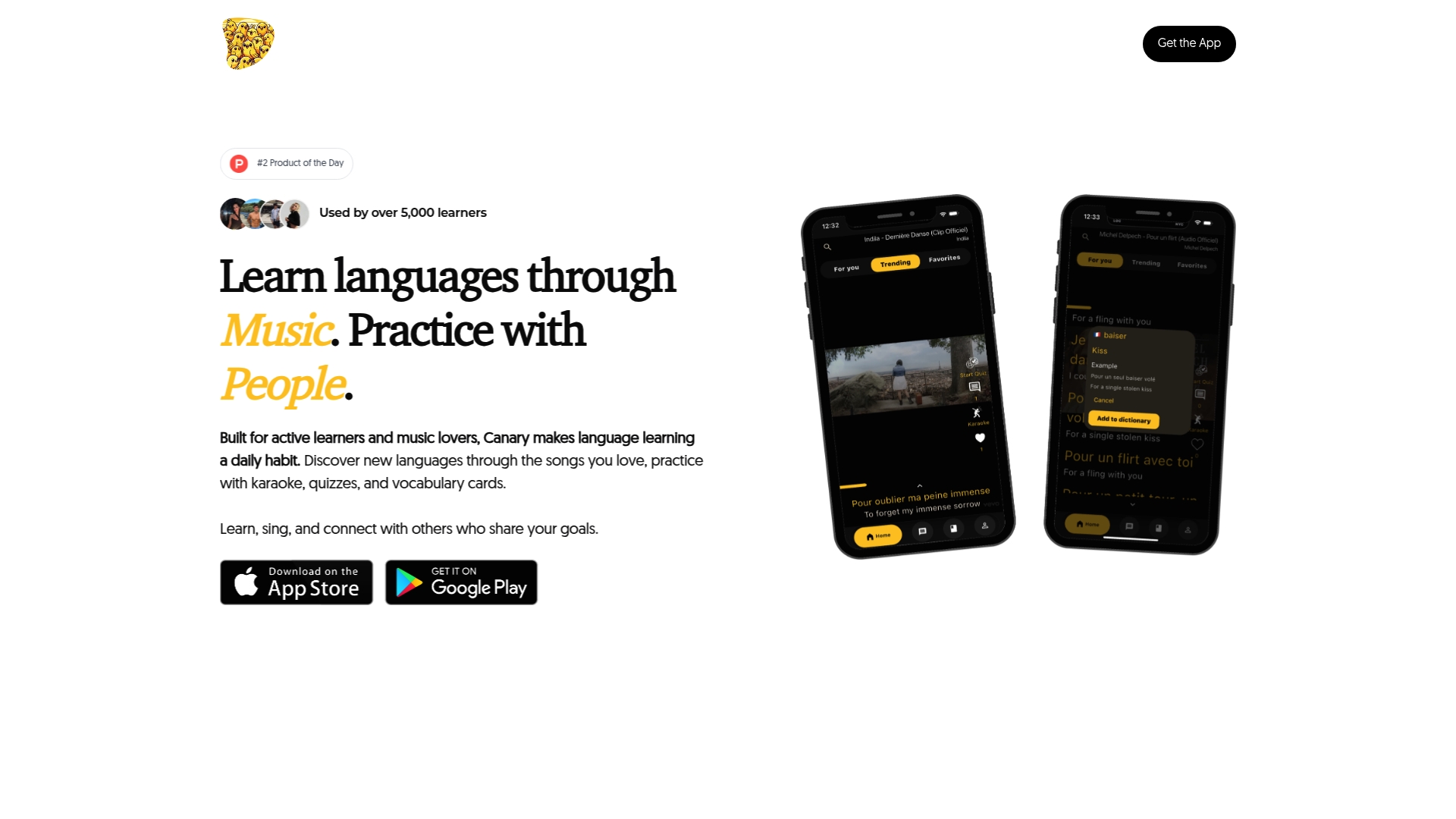
Key features that map directly to the routines in this article:
- Karaoke mode: Real-time pronunciation feedback while you sing along, replacing manual shadowing drills.
- Lyric quizzes: Vocabulary extraction built into the song, no separate flashcard app needed.
- Vocabulary cards: Spaced repetition tied to the song’s actual lyrics, not generic word lists.
- Community practice: Live sessions with other learners and native speakers for the speaking component of the 60-minute routine.
- Song of the week: A curated, pre-annotated track updated weekly so you always have fresh material without hunting for it.
Users consistently highlight faster accent improvement and stronger vocabulary retention compared to traditional apps. Start your free trial on Singwithcanary and try the song-of-the-week as your first session.
Sources
The sources and playlists below are the primary references for this article.
Research and practice guides:
- What’s the best music for studying?
- Intelligent Music Practice | Center for Music Learning
- Mental Practice Techniques: A Comprehensive Guide for Musicians - Berklee Online Take Note
- Can music help you study and focus?
- 5 rules studying music effectively
Playlists:
Singwithcanary: