TL;DR:
- Ear training for French combines musical interval recognition with phoneme awareness, reinforcing pronunciation and comprehension skills. Using song-based practice with solfège and gradual difficulty helps build an interconnected mental map, accelerating fluency. Integrating music into language learning enhances retention, cultural understanding, and authentic pronunciation.
Most people hear “ear training” and picture a musician hunched over a piano, trying to name a note in isolation. That’s a narrow view. Defining ear training for French learners is a much richer project: it covers how you perceive pitch relationships in music, how you recognize the nasal vowels and lilting rhythm of spoken French, and how those two skill sets reinforce each other in ways conventional language study never touches. If you love music and you’re learning French, you’re already closer to fluency than you think.
Table of Contents
- What is ear training in music and how does it relate to French learning?
- Separating musical ear training and French language ear training
- The French solfège tradition: a structured pathway for ear training
- Practical song-based methods to enhance French ear training and pronunciation
- Measuring progress and avoiding pitfalls in French ear training with music
- Why typical language or music training misses the mark — and how integrated song-based ear training breaks new ground
- Explore interactive tools to supercharge your French ear training with music
- Frequently asked questions
What is ear training in music and how does it relate to French learning?
To build a foundation, let’s clarify what ear training involves musically and linguistically.
Ear training is the systematic practice of identifying musical relationships in real time, primarily relative pitch, not absolute pitch. Relative pitch means you’re not memorizing that a specific sound vibrates at 440 Hz. You’re learning to hear the distance between two notes, whether a melody jumps a fifth, whether a chord feels stable or unresolved. That skill is transferable in ways most learners don’t expect.
Solfège maps scale degrees to syllables: do, re, mi, fa, sol, la, ti. It gives your brain a verbal hook for every sound relationship. This is also what French language learning needs, a system to attach spoken sounds to something memorable in your long-term memory.
Here’s why these two disciplines meet so naturally for French learners:
- Phoneme recognition in French (hearing the difference between un and in, for example) requires the same focused auditory attention as recognizing a minor third versus a major third in music.
- Liaison and elision (the way French words blend at their edges in speech) mirrors how musicians learn to hear phrase connections within a melody.
- Rhythmic feel in French, where syllables carry roughly equal weight, is easier to internalize when you’ve trained your ear to feel rhythmic patterns in songs.
- Long-term memory anchoring works for both: just as ear training boosts language skills by creating lasting auditory memory traces, musical interval training locks patterns into your recall permanently.
The overlap isn’t coincidental. Both French and music ask you to stop passively hearing and start actively listening.
Separating musical ear training and French language ear training
Understanding these distinctions prepares you to approach your practice effectively.
Musical ear training and language ear training are genuinely different disciplines, but they are best treated as parallel tracks reinforced through songs. Music training focuses on intervals (the gap between two pitches), chord qualities (major, minor, diminished), and rhythmic patterns. Language training focuses on phonemes, the individual sound units that change meaning in French.
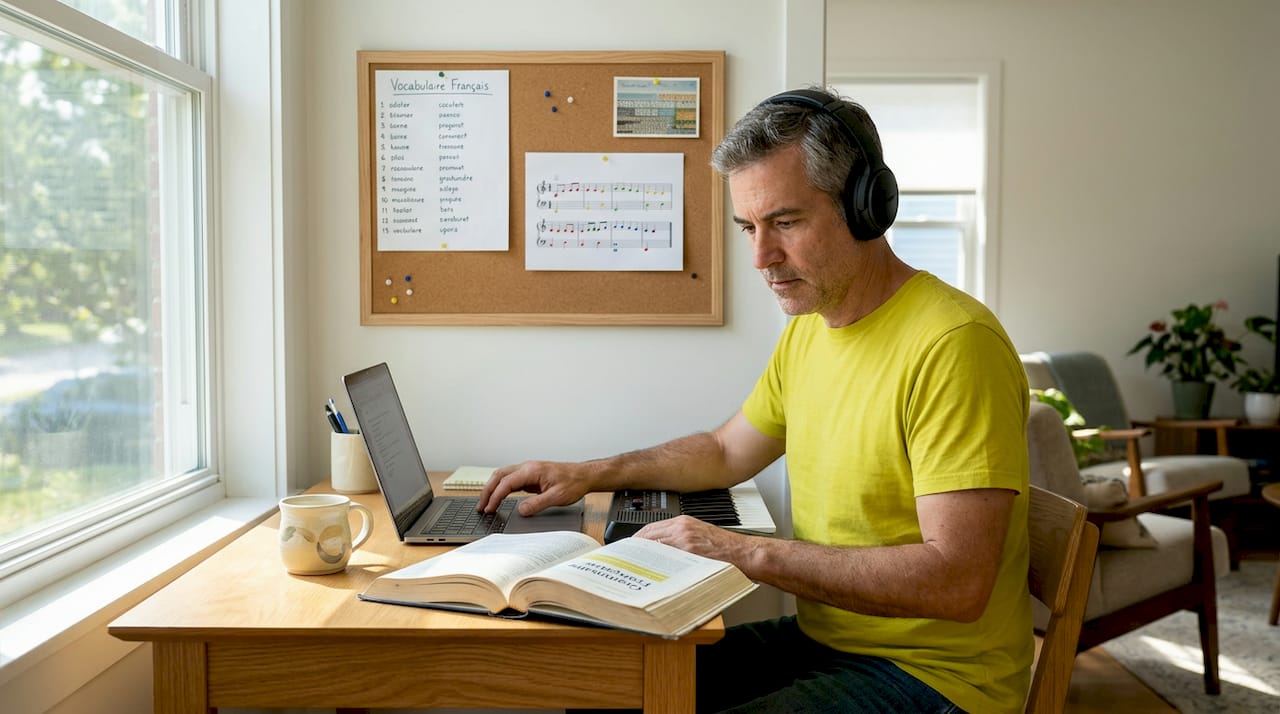
French has sounds with no English equivalent. The front-rounded vowels like u (as in tu) and the four nasal vowels (an, in, on, un) are perceptually invisible to untrained ears. A musician who’s never explicitly practiced these will sail through an interval drill and completely miss what a French speaker is saying. The reverse is also true: a French student who’s never done rhythmic dictation will struggle to feel the natural pacing of French song lyrics.
This is where song-based ear training proves its worth. A song gives you both contexts simultaneously.
- Musical context: intervals, melodic contour, rhythm, phrase structure
- Linguistic context: phoneme exposure, vocabulary in context, natural speech melody
One of the most common mistakes learners make, confirmed by French learners themselves, is jumping to native-speed audio before mastering simpler musical and phoneme targets. Your ear needs a ladder, not a leap.
Pro Tip: Pick one French song at 70% speed for your first week of ear training. Write down only what you can clearly hear. Then speed it back up. You’ll often surprise yourself with what your ear locked in.
The French solfège tradition: a structured pathway for ear training
With this structured tradition in mind, let’s explore how to apply these principles practically.
France has a long-standing solfège tradition that goes far beyond naming notes. French solfège offers a methodical, progressive curriculum that builds interval recognition first, then expands into rhythm, harmony, and musical context layer by layer. It was designed to develop full musical intelligence, not just pitch memory.
The progression looks like this:
- Unisons and stepwise motion (seconds): the easiest intervals to recognize by sound
- Thirds and fourths: the melodic backbone of most Western songs
- Fifths, sixths, and octaves: increasingly wide leaps that require sharper auditory focus
- Rhythmic dictations: training the ear to hear durations, not just pitches
- Harmonized melodies: layering chord awareness onto melodic recognition
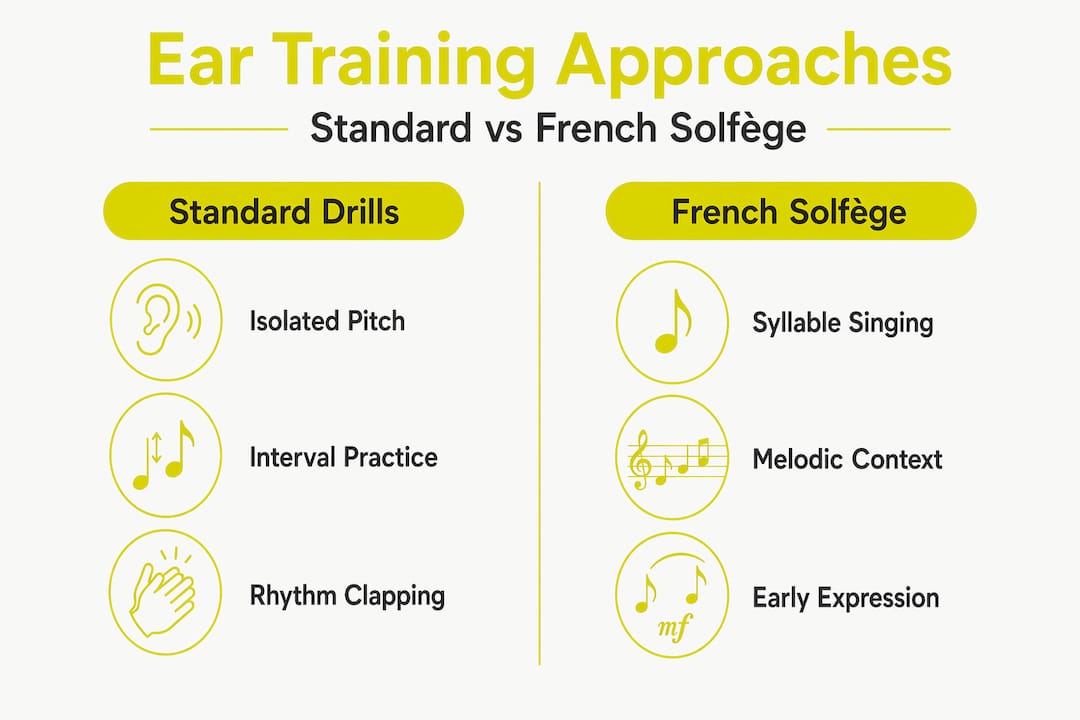
What makes the French approach stand out is that it integrates musical expression early. You’re not just clapping rhythms in isolation. You’re singing them, feeling them, and connecting them to real music. That makes the educational benefits of music available much sooner.
| Skill area | Standard drill approach | French solfège approach |
|---|---|---|
| Pitch recognition | Isolated note ID | Interval relationships in context |
| Rhythm | Clapping exercises | Sung rhythmic dictation |
| Harmony | Chord naming | Contextual harmonic analysis |
| Expression | Rarely included | Built in from the start |
Pro Tip: Use French solfège syllables when you sing along to French pop songs. Swap the lyrics for do re mi on a phrase you can’t quite nail phonetically. It forces your ear to focus on the melodic shape rather than the words, which often unlocks the pronunciation afterward.
Practical song-based methods to enhance French ear training and pronunciation
These methods prepare you to develop solid musical and language ear skills together.
The best ear training for French speakers isn’t sitting with headphones doing abstract interval drills. Consistent practice singing intervals, reproducing patterns, and analyzing harmonies anchors aural memory and musical ear skills over time. Songs are the ideal delivery vehicle because they wrap all of that in something enjoyable.
Here’s a step-by-step method to get started:
- Choose a song with clear enunciation. Édith Piaf, Georges Brassens, and Stromae all have strong, clear diction. Avoid heavily auto-tuned pop where vowels are distorted.
- Listen once without looking at lyrics. Write down every word or sound you recognize. This builds honest self-assessment.
- Follow the lyrics while listening. Pay specific attention to liaison: where does les enfants become lez-enfants in the singer’s mouth?
- Sing with solfège syllables on a single phrase. Remove the words and sing the melody on do re mi. This isolates musical shape from linguistic effort.
- Return to the lyrics and sing out loud. Focus on nasal vowels. Physically hum them. Feel them resonate in your nasal cavity.
- Record yourself and compare. Play your version next to the original. The gap between them is your ear training homework.
Specific sounds to target:
- Nasal vowels: an/en, in/ain, on, un (four distinct sounds, not interchangeable)
- Liaison: consonants that link across word boundaries in connected speech
- Elision: vowel drops like je becoming j’ before a vowel
- The French r: a uvular fricative, nothing like English r
Pair this with resources that directly connect music-infused language practice to pronunciation feedback, and you’ll accelerate considerably. Songs also boost vocabulary retention because repeated lyrical exposure creates contextual, emotional memory rather than rote memorization.
Measuring progress and avoiding pitfalls in French ear training with music
With a clear path and awareness of challenges, learners can confidently advance their skills.
Progress in ear training is rarely linear. You’ll hit plateaus. You’ll suddenly understand a song you’ve been struggling with for three weeks, seemingly out of nowhere. That’s normal. Setting clear milestones and varying your exercises prevents frustration from building during those flat stretches.
Here’s how to structure measurable goals:
- Month 1: Reproduce a simple 4-bar melody by ear and identify three distinct French phonemes in a slow song
- Month 2: Transcribe at least 50% of a verse from a mid-tempo French song without looking at lyrics
- Month 3: Sing a full verse with accurate nasal vowels and liaison, confirmed by recording comparison
- Month 4: Analyze the chord structure of a simple French chanson and identify at least two harmonic movements
Common pitfalls to sidestep:
- Rushing to native-speed content before intermediate phoneme clarity is in place
- Only using passive listening (music in the background) without active focused sessions
- Skipping recording yourself, which removes your most honest feedback loop
- Marathon sessions instead of daily short ones: 10 to 15 minutes daily beats two hours once a week
| Practice habit | Effective | Less effective |
|---|---|---|
| Session length | 10-15 minutes daily | 60-90 minutes weekly |
| Feedback method | Self-recording + comparison | Passive listening alone |
| Content difficulty | Gradual escalation | Native-speed from day one |
| Variety | Songs + dictation + solfège | Single repeated exercise |
Pro Tip: Track your practice in a simple voice memo journal. Record one sentence in French at the start of each week. After a month, play them back in sequence. Hearing your own voice improve is the most motivating data point you can generate.
The benefits of song-based language learning extend beyond the music itself: learners who use songs report stronger retention, better accent accuracy, and higher motivation than those who stick exclusively to textbook drills.
Why typical language or music training misses the mark — and how integrated song-based ear training breaks new ground
Here’s an uncomfortable truth most language teachers won’t say out loud: conventional language learning is tone-deaf. Literally. Standard French courses teach you grammar, vocabulary, and reading. They almost never teach you to hear French the way a musician hears a melody, as a system of relationships, rhythms, and patterns that carry meaning beyond individual words.
Standard music ear training has its own blind spot. It teaches you intervals and chord qualities, but it doesn’t care whether you can distinguish tu from vous or whether you’re nailing the nasal on in bonjour. It’s optimized for musical comprehension, full stop.
The real insight here is that French phonology is musical. French is a syllable-timed language with consistent vowel lengths and a melodic rising pattern at the end of phrases. It literally rewards musical ears. When you train both skills together, you’re not doubling your workload. You’re building one interconnected mental map where each element reinforces the other.
Learners who approach French through song-based ear training advantages consistently report something interesting: they start dreaming in French sooner. The musical memory hooks are deep enough that the language activates even outside conscious practice.
The other thing integrated training gives you is cultural context, which is what makes French feel like French. You’re not just learning phonemes in a vacuum. You’re absorbing how Françoise Hardy phrases a lyric, how Stromae builds rhythmic tension, how la vie en rose sounds like exactly what it means. That emotional-cultural layer is the difference between a French speaker who is technically correct and one who sounds genuinely fluent.
Stop treating music practice and language practice as two separate to-do list items. The best version of both disciplines is the same activity.
Explore interactive tools to supercharge your French ear training with music
If you’ve made it this far, you already know the theory. The next step is getting actual reps in, with tools that make the process feel more like a concert and less like homework.
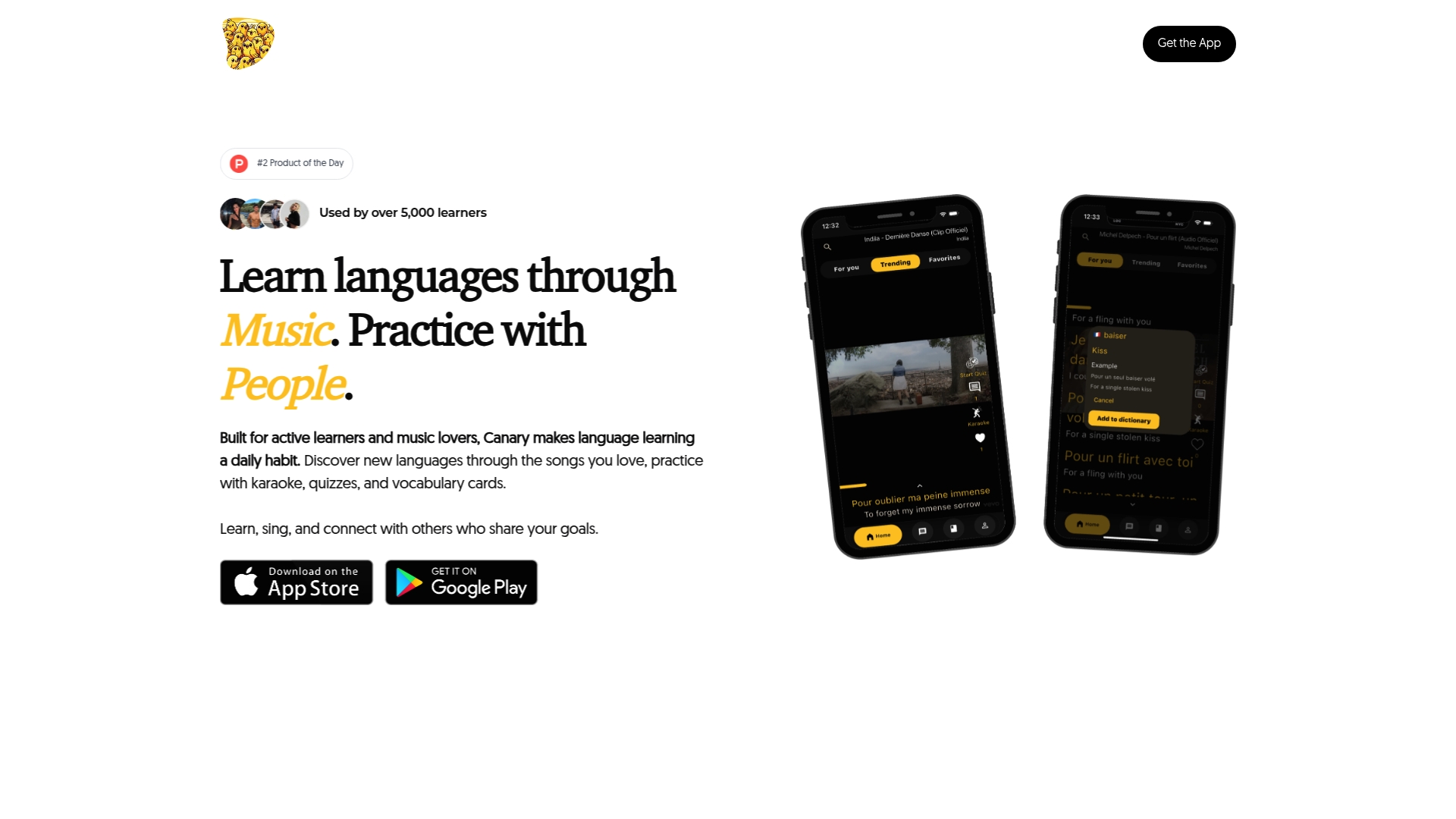
Canary is built for exactly this intersection of music and language. It’s a platform where you learn languages with music through karaoke-style exercises, vocabulary cards pulled directly from song lyrics, and pronunciation practice tied to real French tracks. Every feature is designed to build the kind of ear you’ve been reading about here. You can engage with music-infused language practice that targets pronunciation feedback and gradual difficulty, and the platform’s approach to music and vocabulary retention means the words you learn stick. Plus, the community element means you practice with real people from around the world, turning ear training into a social, culturally rich experience.
Frequently asked questions
What exactly is ear training when learning French with music?
Ear training combines music listening skills like recognizing intervals with language listening skills such as hearing French phonemes, helping you improve pronunciation and comprehension. Both skills work best together when practiced through songs.
How does solfège help me improve my French pronunciation?
Solfège trains your ear to distinguish sound relationships by linking syllables to pitches, and that same auditory precision helps you hear and reproduce French vowel and consonant nuances more accurately.
Can listening to French songs really enhance my vocabulary retention?
Yes. Songs provide repetitive, contextualized exposure to vocabulary, and music boosts retention by embedding words in emotionally memorable musical moments rather than isolated flashcard lists.
How do I start if I struggle with fast French audio in songs?
Begin with simple, short musical patterns and clear phoneme contrasts, and build a ladder of difficulty from slow, clear audio to full native-speed songs as your ear adapts.