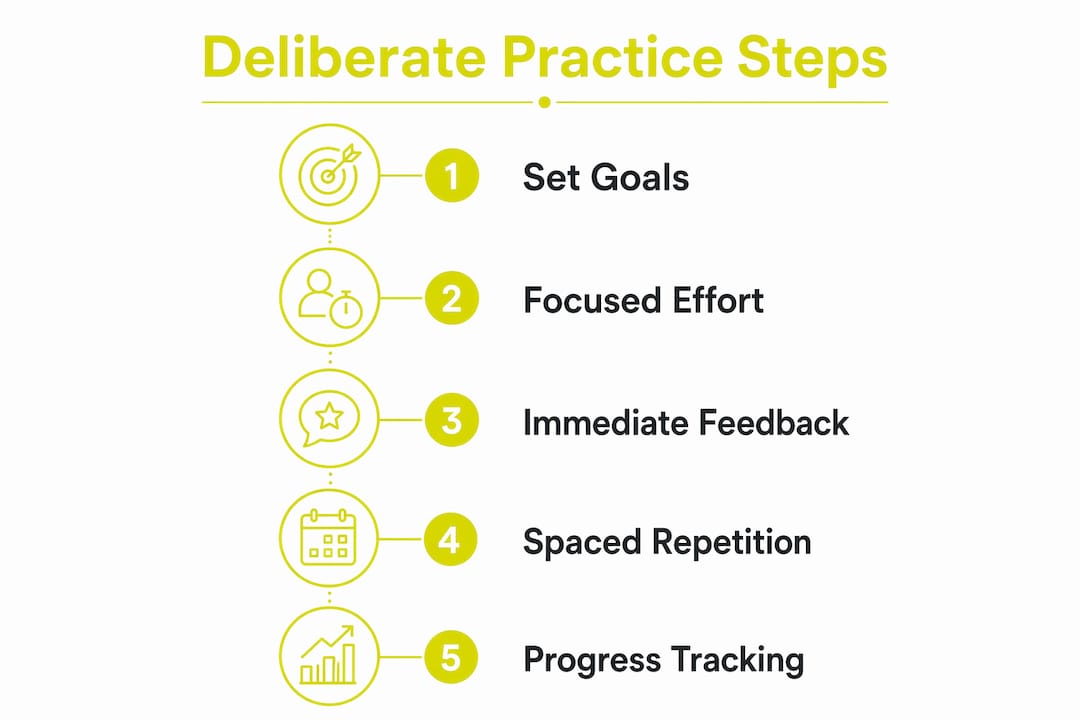
Deliberate practice in language acquisition is not just studying harder. It is a specific, research-backed training method built on five core criteria: a focused goal, full attention, immediate formative feedback, repeated engagement with similar tasks, and adaptive difficulty that keeps you working at the edge of your current ability. Psychologist K. Anders Ericsson, whose framework underpins most of the modern research on expert performance, defined it as practice “specially designed to improve the current level of performance” rather than simply accumulating time with a language. The difference between a learner who plateaus at intermediate and one who reaches genuine fluency often comes down to whether their practice meets these criteria.
A typical effective practice session combines roughly 30 minutes of high-frequency language focus, 15 minutes of spaced-repetition flashcards, and 15 minutes of conversation or shadowing. That structure is not arbitrary. Each component targets a different cognitive process: input processing, memory consolidation, and real-time production under pressure.
Core criteria for deliberate practice in language learning:
- Focused goal: A specific, measurable target for each session (e.g., mastering 20 new verbs in context, not “study Spanish”)
- Full attention: No multitasking; the task demands your complete cognitive engagement
- Immediate feedback: Correction or confirmation arrives during or right after each attempt, not days later
- Repetition: The same or closely related tasks are repeated until the skill is consolidated
- Adaptive difficulty: Tasks stay just beyond your current comfort zone, preventing both boredom and overwhelm
This framework distinguishes deliberate practice from casual exposure, like watching TV in your target language or chatting with friends. Those activities have value, but they do not systematically push you past your current ceiling.

Core principles and cognitive mechanisms that make focused practice work
Deliberate practice compels the brain to move beyond autopilot. Casual language use activates existing neural pathways; deliberate practice restructures them, forcing the brain to build new connections rather than coast on what it already knows. That restructuring is effortful by design.
Attention and effort
Concentration is what separates deliberate practice from routine performance. Ericsson’s research found that even expert performers could only sustain true deliberate practice for a limited number of hours per day before concentration degraded. For language learners, this means a focused 45-minute session beats two distracted hours. The cognitive engagement required is genuinely tiring, and that fatigue is a signal the session is working.
Immediate feedback
Feedback is the mechanism that converts effort into improvement. Without it, you can repeat errors indefinitely and entrench bad habits. Formative feedback delivered immediately after each performance attempt, whether from a teacher, a peer using a rubric, or a self-monitoring checklist, allows the learner to adjust before the error solidifies. Ipsative feedback, which compares your current performance to your own past performance rather than to a fixed standard, is especially useful for tracking incremental progress.
Spaced repetition and retrieval
Memory consolidation does not happen during learning. It happens during retrieval. Research consistently shows that actively recalling information is more effective than reviewing it passively. Spaced repetition systems exploit this by scheduling reviews at increasing intervals, just as memory begins to fade. For vocabulary, this means a word studied on Monday, reviewed on Wednesday, then again the following Monday, sticks far better than a word reviewed three times in one sitting.
Key cognitive principles at work:
- Desirable difficulties: Conditions that feel harder in the moment (interleaved practice, spaced retrieval) produce stronger long-term retention and transfer
- Cognitive load management: Breaking new material into small chunks prevents overload; the brain can hold roughly seven new pieces of information in working memory at once
- Blocked vs. interleaved practice: Blocked practice (drilling one skill repeatedly) builds short-term performance; interleaved practice (mixing skills) builds durable learning
Neuroscientific support
Studies on expert pianists found that deliberate practice quantity was ten times higher for experts than for amateur peers, with the key differentiators being motivation to improve, well-defined tasks, feedback, and repeated performance opportunities. The same principles transfer to language learning. Applying deliberate practice to second language listening, for example, is expected to reduce the central cognitive load over time as skills become more automatic, freeing up mental resources for higher-level comprehension.
Pro Tip: Set a concentration timer for 25 minutes, then take a genuine 5-minute break before the next block. This is not a productivity hack; it is a cognitive load management strategy grounded in how working memory actually functions.
What critics get right about the limits of deliberate practice
Deliberate practice is not a complete theory of language learning, and the scholars who study second language acquisition (SLA) have said so clearly. Understanding these criticisms helps you use the framework more intelligently rather than applying it mechanically.
The main criticisms and challenges:
- Motivation sustainability: Deliberate practice is effortful and often not enjoyable in the moment. Sustaining it over months or years requires strong intrinsic motivation, which many learners struggle to maintain without external support or a compelling personal reason to learn.
- Overemphasis on structure: A purely structured approach can crowd out the communicative, spontaneous language use that builds real fluency. Drilling grammar rules in isolation rarely transfers to natural conversation.
- Feedback access: Immediate, expert feedback is the hardest criterion to meet outside a classroom. Most self-study learners lack a qualified coach who can correct them in real time.
- Cognitive load risks: Pushing too hard at the edge of ability without adequate recovery leads to burnout, not expertise. The research on expert performers notes that concentration limits daily practice hours.
- Mechanical drilling without context: Repeating decontextualized sentences or vocabulary lists can produce test performance without genuine communicative competence.
- Insufficient alone: Deliberate practice alone is rarely enough to develop expertise. SLA researchers argue it must be integrated with metacognitive instruction, planning, monitoring, and evaluation to give learners real control over their progress.
The most important takeaway from these criticisms is that deliberate practice is a component of effective language learning, not the whole system. Balanced practice requires managing effort, avoiding burnout, and weaving in communicative context alongside structured drills. The sections on motivation and metacognition below address how to build the scaffolding that makes deliberate practice sustainable.
Effective deliberate practice techniques with real examples
The five criteria above are principles. These are the actual methods that put them into practice for second language learners.
Shadowing
Shadowing means speaking simultaneously with a native speaker recording, matching rhythm, intonation, and stress in real time. It is one of the most research-supported techniques for improving speaking proficiency because it forces you to process and produce language at the same time, activating both perception and motor production. Brief daily sessions of 10–15 minutes are more effective than occasional longer ones. Start with slow, clear recordings and increase speed as your accuracy improves.
Spaced repetition flashcards with cloze deletion
Standard flashcards test recognition. Cloze deletion flashcards, where a key word is removed from a sentence and you must supply it, test production in context. Apps built on spaced repetition algorithms schedule each card at the optimal interval for your memory. The vocabulary retention research is clear: sets of seven cards or fewer, practiced multiple times before moving on, outperform large batches reviewed once.
Short, frequent conversation sessions
Frequent short conversations multiple times per week activate vocabulary retrieval more effectively than longer weekly sessions. The goal is not comfort. It is retrieval under pressure, which is exactly the condition that consolidates language into long-term memory. Even a 10-minute conversation with a language partner forces you to access vocabulary and grammar in real time, exposing gaps that flashcards cannot reveal.
Isolated and contextualized practice activities
These four activities each target a different cognitive process:
- Reading aloud: Connects written form to spoken production; improves pronunciation and prosody
- Dictation: Trains listening accuracy and spelling simultaneously; immediate self-correction is built in
- Retelling: Forces you to reconstruct meaning in your own words, which deepens processing
- Memorization of short texts: Builds fluency by giving you pre-loaded chunks of authentic language
Recommended daily practice structure
A well-designed session balances input, output, and review. One evidence-based structure combines 30 minutes of focused language input (reading or listening at a challenging level), 15 minutes of spaced-repetition vocabulary review, and 15 minutes of output practice such as shadowing or conversation. Rotating the output activity daily, speaking one day, writing the next, prevents over-reliance on any single skill.
Pro Tip: Record yourself speaking for 60 seconds on a topic, then listen back and note three specific errors. This self-monitoring loop gives you the immediate feedback that deliberate practice requires, even when no teacher is present.
How motivation, goal-setting, and metacognition sustain your practice
Deliberate practice without motivation is a short-term experiment. The research on advanced language proficiency identifies three ingredients that separate learners who reach fluency from those who plateau: consistent practice, long-term sustained motivation, and a positive identity as a user of the language.
Motivation and learner autonomy
Learners who focus on domains they personally care about become agents of their own learning, setting their own goals and tracking their own trajectory. Intrinsic motivation, the kind that comes from genuine interest rather than external pressure, is the most reliable predictor of long-term practice persistence. A learner studying Spanish to follow their favorite podcast will practice more consistently than one studying for a required exam, even with identical ability levels.
Goal-setting aligned with personal interests
Effective goals are specific, personally meaningful, and tied to a real use case. “I want to understand 80% of this podcast episode by the end of the month” is a deliberate practice goal. “I want to improve my Spanish” is not. Specific goals create a feedback loop: you can measure whether you hit them, which sustains motivation and informs what to practice next.
Metacognitive strategies
Metacognitive instruction combined with deliberate practice produces better outcomes than either approach alone, particularly for listening expertise. Metacognition means thinking about your own learning process, not just executing it.
Practical metacognitive techniques:
- Planning: Before each session, write down the specific goal and the activity you will use to reach it
- Monitoring: During practice, notice when you are confused or making repeated errors; adjust the task difficulty in real time
- Evaluating: After each session, rate your performance honestly and decide what to change next time
- Self-testing: Use recall-based review rather than passive re-reading; quiz yourself before you feel ready
Identity and long-term persistence
Identity construction is one of the most underappreciated factors in advanced language learning. When a learner shifts from thinking “I am learning French” to “I am a French speaker,” the motivation to practice changes qualitatively. Positive social engagement with other speakers of the language reinforces this identity, increasing both practice frequency and enjoyment. Joining a community of learners or native speakers, whether online or in person, accelerates this shift.
Pro Tip: Write a one-sentence “language identity statement” and put it where you practice: “I am a Spanish speaker building fluency through daily use.” It sounds simple, but framing practice as identity reinforcement rather than remediation changes how you approach difficult sessions.
How deliberate practice looks different across speaking, listening, reading, and writing
The five core criteria apply to all four language skills, but the specific activities, feedback mechanisms, and challenge levels look quite different depending on which skill you are targeting.
Speaking
Speaking practice demands real-time production under cognitive pressure. Deliberate practice for speaking means shadowing, structured conversation with a partner who can correct you, or recording yourself and analyzing the playback. The feedback loop is immediate and concrete: you either produced the correct sound, stress pattern, or grammatical structure, or you did not. The challenge is finding a qualified listener who can give you accurate, specific feedback rather than polite encouragement.
Listening
Listening is widely considered the hardest of the four skills to teach and practice deliberately. The input arrives at native speed, with no pause button in real life. Deliberate listening practice involves working with audio slightly above your current comprehension level, predicting content before listening, monitoring comprehension during, and evaluating gaps afterward. These three steps, planning, monitoring, and evaluating, are precisely the metacognitive strategies that research shows are necessary to develop listening expertise. Dictation exercises are particularly effective because they force precise attention to every word rather than global meaning.
Reading
Reading allows more learner control than listening because you set the pace. Deliberate reading practice means choosing texts at the upper edge of your current level, not comfortable texts you can skim. Active reading strategies such as annotating unfamiliar vocabulary, summarizing paragraphs in your own words, and predicting what comes next all increase cognitive engagement. The benefits of social language practice extend to reading too: discussing a text with another learner forces you to articulate your understanding, which deepens processing.
Writing
Writing is the skill where deliberate practice most closely resembles its original formulation in expert performance research. You produce output, receive feedback (from a teacher, peer, or self-evaluation rubric), revise, and repeat. The iterative revision cycle is built into the skill itself. Effective deliberate writing practice involves writing on a specific topic with a clear linguistic goal, such as using the subjunctive correctly five times, getting feedback on that specific goal, and rewriting with the corrections applied before moving to a new topic.
How technology can support your deliberate practice routine
Technology does not replace the core criteria of deliberate practice, but it can make several of them dramatically easier to meet, especially for self-study learners who lack access to a daily teacher or coach.
Spaced repetition software such as Anki uses algorithms to schedule vocabulary reviews at the optimal interval for each individual card, automating the spacing that would otherwise require manual planning. This directly addresses the repetition and adaptive difficulty criteria.
Speech recognition tools built into language learning platforms give immediate phonetic feedback on pronunciation, filling the feedback gap that most self-study learners face. The accuracy varies by tool and language, but even imperfect automated feedback is better than no feedback at all.
Authentic audio and video platforms make it possible to find listening material at almost any difficulty level in almost any language. The key is selecting content that is genuinely challenging, not comfortable, and using active listening strategies rather than passive consumption.
Interactive platforms that combine adaptive difficulty with immediate feedback and social interaction address multiple deliberate practice criteria simultaneously. Platforms that incorporate music, karaoke, and vocabulary quizzes add an engagement layer that helps sustain motivation over time, which is one of the hardest problems in long-term language learning.
Language exchange apps connect you with native speakers for conversation practice, solving the feedback access problem for speaking. The quality of feedback depends on the partner, but structured exchanges where you agree in advance to correct each other’s errors come closest to the deliberate practice ideal.
One underused technology for deliberate practice is simple audio recording. Recording yourself, listening back critically, and targeting specific errors in the next attempt is a complete deliberate practice loop that requires no special software.
How to design a deliberate practice session that actually works
The research on expert performance is clear that quality of practice matters more than quantity. A well-designed session has a specific goal, a defined activity, a feedback mechanism, and a plan for repetition. Here is how to build one.
Duration and intensity
Concentration is the limiting resource, not time. Most learners can sustain genuine deliberate practice for 45–90 minutes per day before cognitive fatigue degrades the quality of attention. Spreading that time across two sessions, one in the morning and one in the evening, tends to produce better retention than one long block. The practice structure mentioned earlier balances focused input, spaced repetition, and output activities, fitting within effective practice duration and covering key principles: input, output, and review with feedback.
Frequency
Short, frequent sessions multiple times per week outperform longer, infrequent ones for vocabulary activation and fluency development. Daily practice, even 20 minutes, beats a three-hour weekend session. Habits are powerful: once a practice routine is established, the decision cost drops and consistency follows.
Structuring difficulty
Each session should target a skill level just above your current ability. Too easy and there is no cognitive engagement; too hard and working memory overloads and nothing consolidates. A practical test: if you are getting everything right on the first attempt, increase the difficulty. If you are getting less than half right, reduce it. The target zone is roughly 60–80% accuracy on new material, which signals genuine challenge without overwhelming frustration.
Tracking progress
Deliberate practice without records is deliberate practice without feedback at the session level. Keep a simple log: date, goal, activity, self-rated performance (1–5), and one specific observation about what to adjust next time. Reviewing this log weekly reveals patterns, like which skills are improving and which are stalling, that inform how to allocate practice time.
Session design checklist:
- Write the specific goal before you start
- Choose one activity that directly targets that goal
- Build in a feedback mechanism (teacher, partner, recording, or self-check)
- Plan the repetition: how many attempts, over how many days
- Log the outcome and adjust difficulty for the next session
Common misconceptions that undermine deliberate practice for language learners
Several widespread beliefs about language learning directly contradict what the research on deliberate practice shows. Recognizing them saves months of wasted effort.
“More time equals more progress.” Time spent is not the variable that predicts improvement. Quality of attention and the presence of feedback do. Passive exposure, listening to a podcast while cooking, counts as input but not as deliberate practice. It has value, but it will not push you past a plateau.
“Immersion is enough.” Living in a country where the language is spoken accelerates learning, but only if the immersion includes deliberate practice components: focused goals, feedback, and adaptive challenge. Plenty of people live abroad for years and never move past functional survival language because they never push beyond their comfort zone.
“Deliberate practice means drilling grammar rules.” Mechanical drilling of decontextualized rules is one of the least effective forms of practice. The research supports contextualized repetition, where you encounter and produce the same structure across different meaningful situations, not rote recitation of conjugation tables.
“You need talent to reach advanced proficiency.” The expert performance research that underlies deliberate practice was built specifically to challenge the talent narrative. Ericsson’s studies across music, chess, sports, and medicine consistently found that accumulated deliberate practice explained performance differences better than innate ability. Language learning follows the same pattern.
“Deliberate practice is only for beginners.” The intermediate plateau is precisely where deliberate practice becomes most critical. At the intermediate level, casual use feels comfortable enough that learners stop pushing themselves. Deliberate practice is the mechanism for overcoming that plateau by forcing engagement with material that is genuinely difficult.
“Enjoyment and deliberate practice are opposites.” Deliberate practice is effortful, but it does not have to be joyless. Choosing practice domains aligned with personal interests, using music, games, or topics you genuinely care about, makes the effort sustainable. The goal is not to make practice easy. It is to make the effort feel worth it.
Singwithcanary puts deliberate practice into a format you will actually use
Most learners know what deliberate practice requires. The harder problem is building a daily habit that delivers focused goals, immediate feedback, and adaptive challenge without feeling like homework.
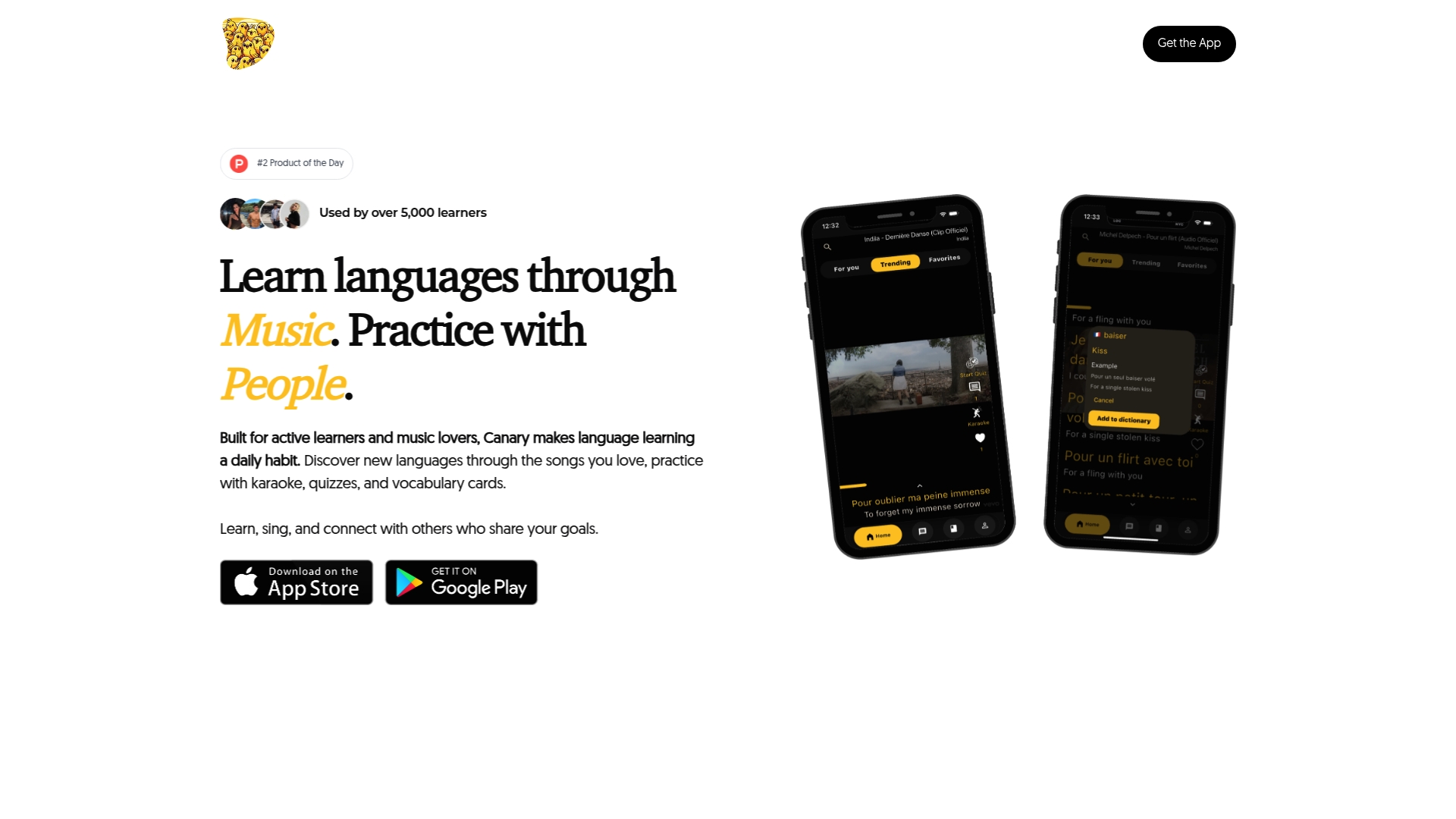
Singwithcanary takes the core mechanics of deliberate practice and wraps them in music and social interaction, two of the most reliable drivers of intrinsic motivation and consistent engagement. Instead of drilling vocabulary in isolation, you encounter words in song lyrics, test them through karaoke and quizzes, and practice pronunciation with real speakers from around the world. The feedback is immediate: you hear the gap between your production and the original, and you repeat until it closes. That is the deliberate practice loop, built into a format that learners return to daily because they want to, not because they scheduled it.
For learners who have stalled at intermediate or who struggle to maintain a consistent practice habit, Singwithcanary offers a path that combines the structure the research demands with the engagement that sustains it long-term. Start learning with music and see how song-based deliberate practice fits into your routine.
Key Takeaways
Deliberate practice in language acquisition works because it combines focused goals, immediate feedback, and adaptive difficulty into a structured loop that forces the brain to build new skills rather than coast on existing ones.
| Point | Details |
|---|---|
| Five core criteria | Effective sessions require a focused goal, full attention, immediate feedback, repetition, and adaptive difficulty. |
| Metacognition multiplies results | Combining deliberate practice with planning, monitoring, and evaluating produces better outcomes than deliberate practice alone. |
| Frequency beats duration | Short, frequent sessions multiple times per week outperform longer, infrequent ones for vocabulary activation and fluency. |
| Identity sustains motivation | Shifting from “language learner” to “language user” identity increases practice frequency and long-term persistence. |
| Singwithcanary | Combines song-based deliberate practice with immediate feedback and social interaction to build a daily habit that sticks. |