The most effective engaging speaking activities list for ESL classrooms combines low-prep conversation starters with structured communicative tasks that push learners to actually use the language, not just study it. Here are five to try first:
- Two Truths and a Lie — zero prep, instantly lowers anxiety, works at any level
- Information Gap — forces real communication between partners; great for intermediate learners
- Describe and Draw — no materials beyond paper; builds precise vocabulary fast
- Structured Debate — best for advanced groups; develops argument and fluency together
- Story Spine — collaborative narrative activity that works across all proficiency levels
Each of these targets a measurable classroom goal: fluency, pronunciation accuracy, or conversation strategies. The British Council confirms that active “use” — finding real opportunities to speak — is the single most powerful driver of speaking improvement, which is exactly what these activities are designed to create.
Key Takeaways
A structured, varied speaking practice routine, anchored in real communicative tasks and supported by daily habit, produces faster and more durable fluency gains than any single activity alone.
| Point | Details |
|---|---|
| Start with low-prep activities | Two Truths and a Lie, 20 Questions, and Story Spine need zero materials and immediately lower speaking anxiety. |
| Match task to objective | Use fluency tasks (Roleplay, Story Spine) for output practice; accuracy tasks (Dictogloss) when you want to address errors. |
| Correct errors after, not during | Delayed feedback and recasts preserve speaking flow; address common errors as a class once the task ends. |
| Daily short practice beats long sessions | A focused 15-minute routine (warm-up, drill, conversation, review) produces measurable gains faster than occasional longer sessions. |
| Singwithcanary extends practice outside class | Song-based karaoke and vocabulary cards reinforce pronunciation and fluency between classroom sessions. |
Table of Contents
- 20 teacher-ready speaking activities, organized by prep level
- 1. Two Truths and a Lie
- 2. Describe and Draw
- 3. 20 Questions
- 4. Hot Seat
- 5. Opinion Polls
- 6. Story Spine
- 7. Information Gap
- 8. Structured Roleplay
- 9. Jigsaw Activity
- 10. Debate: Structured Argument
- 11. Dictogloss
- 12. Describe a Process
- 13. Agree or Disagree Carousel
- 14. Telephone Story
- 15. Mini Presentation (1–2 Minutes)
- 16. Teach-a-Class
- 17. Interview a Partner
- 18. News Broadcast
- 19. Collaborative Story Creation
- 20. Socratic Seminar
- How to choose and adapt activities for your class
- Classroom management, error correction, and quick formative assessment
- Why structured speaking practice works
- An instructor’s perspective on sequencing activities across a semester
- Music-based practice to supplement your classroom speaking work
- Sources
20 teacher-ready speaking activities, organized by prep level
The 20 activities below are grouped loosely from no-prep to project-style. Each card gives you the how-to, level, group size, time, materials, and one quick variation.
Low-prep / no-prep quick wins (Activities 1–6)
1. Two Truths and a Lie
Each student states two true facts and one false one about themselves. Classmates ask follow-up questions and vote on which statement is the lie. Edutopia notes this game consistently lowers speaking anxiety and raises voluntary participation.
- Level: Beginner–Intermediate
- Group size: Pairs or whole class
- Time: 10–15 minutes
- Materials: None
- Objective: Fluency, question formation
- Variation: Require students to use a target grammar structure in each statement (e.g., past simple)
2. Describe and Draw
Student A describes an image or scene without showing it; Student B draws what they hear. Swap roles and compare drawings. The GCU blog highlights this as one of the most adaptable activities across K–8 and adult ESL.
- Level: Beginner–Intermediate
- Group size: Pairs
- Time: 10–20 minutes
- Materials: Paper, pens, a simple image for Student A
- Objective: Precise vocabulary, giving directions
- Variation: Use abstract shapes for beginners; complex scenes for advanced learners
3. 20 Questions
One student thinks of a person, place, or object. The class asks yes/no questions to identify it within 20 guesses. Simple, zero-prep, and surprisingly effective for question formation.
- Level: Beginner
- Group size: Whole class
- Time: 5–10 minutes
- Materials: None
- Objective: Question formation, vocabulary
- Variation: Restrict the category (only food, only jobs) to target specific vocabulary sets
4. Hot Seat
One student sits facing the class and answers questions in character as a historical figure, book character, or job role. Works beautifully as a warm-up.
- Level: Intermediate–Advanced
- Group size: Whole class
- Time: 5–15 minutes
- Materials: Optional: character card
- Objective: Fluency, improvisation, vocabulary in context
- Variation: Give beginners a prompt card with key phrases they can use
5. Opinion Polls
Students form a question on a given topic, then circulate and poll five classmates, recording answers. They report findings to the class. Forces natural, repeated conversation.
- Level: Beginner–Intermediate
- Group size: Whole class
- Time: 15–20 minutes
- Materials: Notepad or worksheet
- Objective: Question formation, reporting speech, interaction
- Variation: Assign a specific grammar target (e.g., “Do you prefer…?” vs. “Would you rather…?”)
6. Story Spine
Give students a sentence starter sequence: “Once upon a time… Every day… Until one day… Because of that… Until finally… And ever since then…” Each student adds one sentence to build a collaborative story.
- Level: All levels
- Group size: Small groups of 4–6
- Time: 10–15 minutes
- Materials: Sentence starter strips (or write on the board)
- Objective: Narrative skills, cohesion, fluency
- Variation: Introduce a vocabulary word that must appear in the story
Pro Tip: For the no-prep activities above, keep a printed “emergency activity card” with the Story Spine starters and 20 Questions rules on your desk. When a lesson runs short or a planned activity falls flat, you have a ready fallback that still hits real communicative goals.
Core communicative tasks (Activities 7–14)
7. Information Gap
Each partner holds different information (a half-completed map, schedule, or diagram). They must speak to fill in the missing pieces without showing their sheet. This is one of the purest communicative tasks available because neither student can succeed without actually talking.
- Level: Beginner–Intermediate
- Group size: Pairs
- Time: 15–20 minutes
- Materials: Two versions of a worksheet (A and B)
- Objective: Asking for clarification, precise description, interaction strategies
- Variation: Use a simple floor plan for beginners; a complex timetable for intermediate learners
8. Structured Roleplay
Assign realistic scenarios: a job interview, a customer complaint, a doctor’s appointment. Give each student a role card with their goal and two or three key phrases. ESLSpeaking’s catalogue shows that roleplay consistently develops pragmatic competence alongside fluency.
- Level: Intermediate–Advanced
- Group size: Pairs or triads
- Time: 20–30 minutes
- Materials: Role cards
- Objective: Pragmatic fluency, register, conversation strategies
- Variation: Add a “complication card” mid-roleplay to push advanced learners
9. Jigsaw Activity
Divide the class into expert groups, each studying a different aspect of a topic. Regroup so each new group has one expert from each original group. Each expert teaches their piece. This is one of the best group language learning ideas for building both fluency and content knowledge simultaneously.
- Level: Intermediate–Advanced
- Group size: Groups of 4–5
- Time: 30–45 minutes
- Materials: Reading or listening input per expert group
- Objective: Explaining, summarizing, interaction
- Variation: For beginners, provide a graphic organizer to guide the explanation
10. Debate: Structured Argument
Assign positions on a clear, low-stakes topic (e.g., “Should school uniforms be required?”). Give students five minutes to prepare three points, then run a timed debate. Debate Ladder recommends organizing practice around a clear purpose and no more than three key points before rehearsal to sharpen clarity and delivery.
- Level: Advanced
- Group size: Teams of 2–4
- Time: 30–45 minutes
- Materials: Topic card, timer
- Objective: Argumentation, fluency, opinion language
- Variation: Give intermediate learners a phrase bank (“I agree because…”, “On the other hand…”)
11. Dictogloss
Read a short text aloud at normal speed twice. Students take notes, then reconstruct the text in pairs from memory. The reconstruction conversation is where the real speaking practice happens.
- Level: Intermediate–Advanced
- Group size: Pairs, then whole class
- Time: 20–30 minutes
- Materials: A short text (100–150 words)
- Objective: Accuracy, grammar, listening-to-speaking bridge
- Variation: Use a news headline for advanced learners and ask them to expand it into a full story
12. Describe a Process
Students explain how to do something they know well: cook a dish, fix a bike tire, set up a phone. No notes allowed after a two-minute prep. Forces spontaneous, organized speech.
- Level: Intermediate
- Group size: Pairs or small groups
- Time: 10–15 minutes
- Materials: None (or optional: a simple object)
- Objective: Sequencing language, fluency, vocabulary
- Variation: Beginners use a picture sequence; advanced learners field questions after
13. Agree or Disagree Carousel
Post five opinion statements around the room. Students rotate in pairs, spending two minutes at each station discussing whether they agree or disagree and why. The movement keeps energy high.
- Level: Intermediate
- Group size: Pairs, whole class
- Time: 15–20 minutes
- Materials: Five printed statements posted on walls
- Objective: Opinion language, fluency, interaction
- Variation: Replace opinion statements with images or news photos for a more open-ended discussion
14. Telephone Story
Whisper a short story to the first student; they pass it along the chain. The last student tells the class what they heard, then compare it to the original. Funny, low-stakes, and a genuine lesson in listening and speaking precision.
- Level: Beginner–Intermediate
- Group size: Whole class (10–30 students)
- Time: 10–15 minutes
- Materials: A prepared short story (3–5 sentences)
- Objective: Listening accuracy, pronunciation, narrative
- Variation: Use a complex sentence with target vocabulary for intermediate groups
Project-style and high-engagement activities (Activities 15–20)
15. Mini Presentation (1–2 Minutes)
Each student prepares and delivers a short presentation on a topic they choose. Peers use a simple feedback form. The constraint of one to two minutes forces clarity and prioritization, skills that transfer directly to real-world communication.
- Level: Intermediate–Advanced
- Group size: Whole class
- Time: 45–60 minutes (full class set)
- Materials: Timer, peer feedback form
- Objective: Organized speech, fluency, pronunciation
- Variation: Beginners present with three images as visual support
16. Teach-a-Class
Students research a micro-topic and teach it to the class in five minutes. They must explain, give an example, and field one question. This is the highest-stakes speaking task on this list, and the one that produces the most noticeable fluency gains.
- Level: Advanced
- Group size: Individual, whole class audience
- Time: 5–10 minutes per student
- Materials: Optional: whiteboard or slides
- Objective: Fluency, explanation, interaction
- Variation: Pair students for the teaching segment to reduce anxiety
17. Interview a Partner
Student A interviews Student B using a prepared question list, then introduces their partner to the class. Builds both question formation and listening skills in a single task.
- Level: Beginner–Intermediate
- Group size: Pairs, then whole class
- Time: 20–25 minutes
- Materials: Question list (teacher-prepared or student-generated)
- Objective: Question formation, reporting speech, fluency
- Variation: Ask advanced learners to create their own questions without a prompt list
18. News Broadcast
Small groups produce a two-minute “news broadcast” on a topic from class or current events. One student anchors, others report. The format gives every student a defined speaking role.
- Level: Intermediate–Advanced
- Group size: Groups of 3–4
- Time: 30–45 minutes (prep + performance)
- Materials: Optional: a simple script template
- Objective: Formal register, fluency, pronunciation
- Variation: Record the broadcast on a phone for self-review
19. Collaborative Story Creation
Groups of three to five build a story together, with each student contributing one paragraph. The catch: each new paragraph must begin with the last word of the previous one. This forces active listening and creative language use. Explore more collaborative speaking tasks that increase participation across group sizes.
- Level: Intermediate–Advanced
- Group size: Small groups
- Time: 20–30 minutes
- Materials: None
- Objective: Narrative skills, cohesion, vocabulary
- Variation: Give beginners a story map with character, setting, and problem pre-filled
20. Socratic Seminar
Students sit in a circle and discuss an open question (a text, a dilemma, a quote) without teacher intervention. The teacher observes and takes notes for delayed feedback. This is the closest classroom equivalent to real conversation.
- Level: Advanced
- Group size: 8–15 students
- Time: 30–45 minutes
- Materials: A shared text or prompt
- Objective: Critical thinking, fluency, conversation strategies
- Variation: Assign discussion roles (questioner, summarizer, devil’s advocate) for intermediate groups
Quick-prep checklist for any activity:
- Print or write materials the day before (not five minutes before class)
- Set a visible timer students can see
- Assign roles before the activity starts, not during
- Decide your error-correction approach in advance (see Section 4)
- Plan a one-sentence debrief question to close the activity
How to choose and adapt activities for your class
Picking the wrong activity for the moment is the most common reason a speaking lesson falls flat. Here is a practical decision framework.
Decision criteria:
- Time available: Under 10 minutes? Use Two Truths and a Lie or 20 Questions. Under 20 minutes? Information Gap or Opinion Polls. A full 45-minute period? Jigsaw, Debate, or Mini Presentation.
- Class size: Pairs work for any size. Whole-class activities need noise management above 20 students. Groups of 3–5 are the sweet spot for project tasks.
- Speaking anxiety level: Start with low-stakes games (Two Truths and a Lie, Telephone Story) before moving to presentations or debates. Lowering the affective filter first produces better output later.
- Learning objective: Fluency tasks (Story Spine, Roleplay) tolerate errors. Accuracy tasks (Dictogloss, Describe a Process) invite correction. Match the task to the goal.
CEFR-like level mapping:
The British Council’s speaking resources organize practice by level and provide phrase banks for A1 through B2. Here is a quick mapping for the activities above:
- A1–A2 (Beginner): 20 Questions, Two Truths and a Lie, Describe and Draw, Telephone Story, Interview a Partner (with question list)
- B1 (Intermediate): Information Gap, Opinion Polls, Describe a Process, Agree or Disagree Carousel, Dictogloss, Story Spine
- B2–C1 (Advanced): Structured Debate, Jigsaw, Teach-a-Class, Socratic Seminar, News Broadcast, Collaborative Story Creation
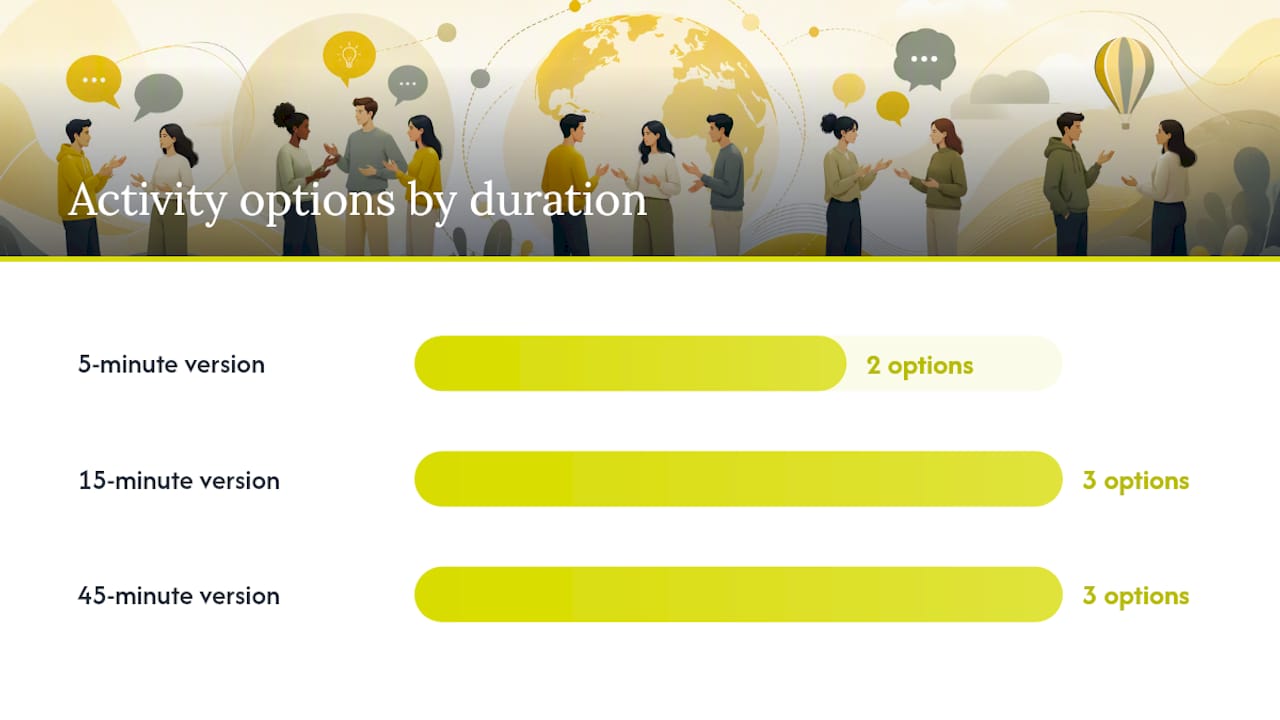
Time adaptations:
- 5-minute version: Run Two Truths and a Lie with just three students sharing, or use Hot Seat with one volunteer.
- 15-minute version: Opinion Polls (circulate and report), Story Spine (one round), or Describe and Draw (one swap).
- 45-minute version: Jigsaw, Structured Debate, or Mini Presentations with peer feedback.
Age and cultural sensitivity: Younger learners (K–8) respond better to game-framed tasks with physical movement, like the Carousel or Telephone Story. Adult learners often prefer realistic scenarios in Roleplay and Debate. For culturally mixed classes, avoid opinion topics tied to religion, politics, or family structure unless the class has established strong trust. Swap those prompts for neutral topics like technology, food, or travel. For beginner learners, simple language learning methods that emphasize repetition and low-stakes interaction are a useful starting reference.
Classroom management, error correction, and quick formative assessment
Good speaking activities fail without good classroom management. Here is what actually works.
Setup and time management:
- Arrange desks in pairs or clusters before students arrive; rearranging mid-class eats five minutes and breaks momentum.
- Use a visible countdown timer (a phone projected on screen works fine) so students self-manage pace.
- For pair rotation, use a simple A/B system: all A students stay seated, B students rotate one seat clockwise every round.
- Keep noise manageable by setting a “conversation volume” norm on day one: students should hear their partner but not the group next to them.
Error correction that preserves fluency:
The goal during fluency tasks is output, not perfection. Three approaches work well together:
- Recasts: Repeat the student’s sentence correctly without flagging the error. (“I go yesterday.” → “Oh, you went yesterday? Where did you go?”) The student hears the correct form in context.
- Delayed feedback: Note errors during the activity on a clipboard, then address the most common ones as a class after the task ends. This keeps the speaking flow intact.
- Peer correction prompts: After a presentation, ask the audience: “Did you notice anything you’d say differently?” This distributes the correction load and builds metalinguistic awareness.
Preply’s public speaking guidance adds that recording students and having them review their own speech is one of the most effective self-correction tools available, and it costs nothing.
Pro Tip: Reserve explicit grammar correction for accuracy-focused tasks like Dictogloss. During fluency tasks like Roleplay or Story Spine, write errors on a sticky note and address them in the final five minutes. Students speak more freely when they know correction is coming later, not mid-sentence.
Peer and self-assessment prompts:
Drop these into any activity as a closing reflection:
- “What was one thing your partner said well?”
- “What would you change about your own performance?”
- “Which word or phrase did you use today that you hadn’t used before?”
Simple speaking rubric (photocopy or screenshot):
| Criterion | 1 (Developing) | 2 (Approaching) | 3 (Meeting) |
|---|---|---|---|
| Fluency | Frequent long pauses; halting | Some pauses; mostly continuous | Speaks continuously with natural rhythm |
| Accuracy | Many errors that impede meaning | Some errors; meaning mostly clear | Few errors; meaning always clear |
| Interaction | Rarely responds to partner | Responds but does not extend | Responds and builds on partner’s ideas |
| Pronunciation | Frequently unclear | Mostly clear with some difficulty | Clear; listener rarely needs to ask for repetition |
This rubric works for peer assessment, teacher observation, or self-rating. For a social language practice framework that extends these principles beyond the classroom, the linked guide covers how to structure conversation exchanges and community practice.
Why structured speaking practice works
The evidence here is consistent and practical. The British Council states plainly that “use” — actively finding opportunities to speak with others — is the most powerful lever for improvement. Classroom activities are valuable, but only when they function as bridges to real conversation rather than substitutes for it.
Debate Ladder’s speaking guide adds a concrete delivery target: a natural speaking pace of 130–150 words per minute with deliberate pauses reduces filler words and improves listener comprehension. Teaching students to pause intentionally is one of the highest-return micro-skills you can address in a single lesson.
Tutoroo’s step-by-step framework shows that a focused 15-minute daily routine, split into warm-up, targeted drill, live conversation, and brief review, produces measurable gains faster than occasional long sessions. The structure matters as much as the time.
One actionable rule: Organize every speaking task around a single communicative goal and no more than three scaffolded supports (a phrase bank, a prompt card, a model sentence). More than three supports and students stop speaking; fewer than one and beginners freeze.
Building a daily language learning habit is what separates learners who plateau from those who keep improving, and the activities in this list are designed to make that habit feel worth keeping.
An instructor’s perspective on sequencing activities across a semester
The activities in this list work best when they are sequenced, not scattered. Here is how I think about building a speaking module that actually moves learners forward.
The pattern that works across proficiency levels is: warm-up → targeted drill → communicative task → reflection. Each phase serves a different function. The warm-up lowers anxiety and activates vocabulary. The drill builds a specific micro-skill (question formation, sequencing language, opinion phrases). The communicative task puts that skill into real use. The reflection closes the loop so students notice their own progress.
A three-session micro-sequence teachers can copy directly:
Session 1: Two Truths and a Lie (warm-up, 10 min) + Information Gap (core task, 20 min) + self-assessment prompt (5 min homework: “Write three sentences about what you said today that surprised you.”)

Session 2: Hot Seat (warm-up, 10 min) + Structured Roleplay (core task, 25 min) + peer feedback using the rubric above (10 min)
Session 3: Story Spine (warm-up, 10 min) + Mini Presentation (core task, 30 min) + class debrief on what made presentations clear or unclear (10 min)
For a 10-week mini-unit, rotate through the three subsets in this article: weeks 1–3 use low-prep activities to build confidence, weeks 4–7 introduce core communicative tasks, weeks 8–10 move into project-style work. The low-prep variant of this schedule simply replaces project tasks with a second round of communicative tasks for classes that need more scaffolding before performing.
What most teachers underestimate is how much the reflection step matters. Students who articulate what they did well, even in one sentence, retain the skill longer. The debrief is not a nice-to-have; it is where the learning consolidates.
Music-based practice to supplement your classroom speaking work
Speaking fluency and pronunciation improve faster when learners hear the language in rhythm. That is the core insight behind music-infused language practice, and it is why song-based learning transfers so naturally to the classroom activities above.
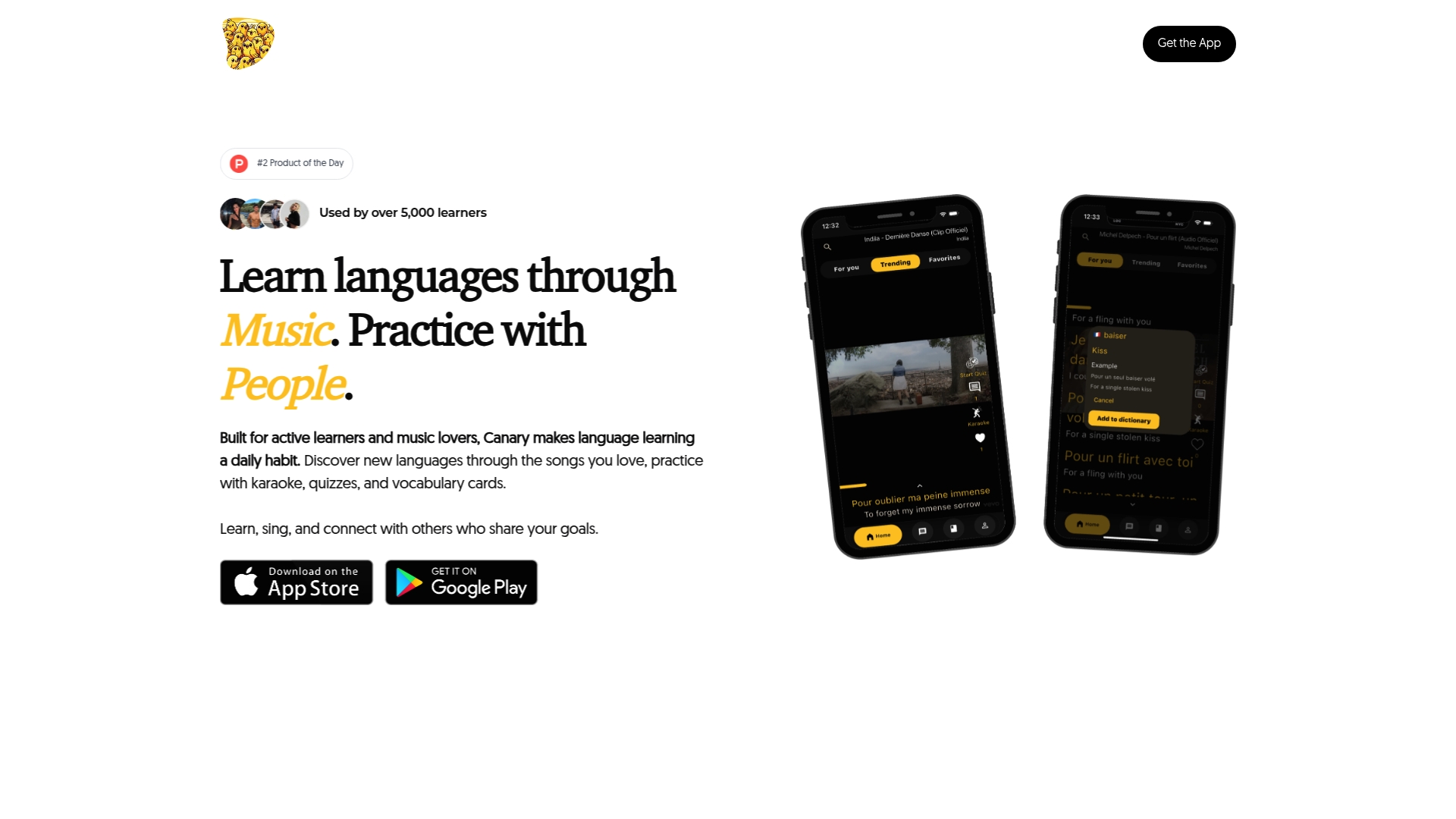
Singwithcanary is built around exactly this connection. Instead of drilling vocabulary in isolation, learners practice pronunciation and ear training through song lyrics, karaoke, and vocabulary cards tied to real music. The rhythm of a song slows down the language just enough for a learner to catch sounds they miss in fast conversation, which makes it a practical bridge between classroom speaking tasks and real-world fluency.
A simple class-to-home homework assignment using Singwithcanary:
- After a fluency activity in class (Story Spine, Roleplay, or Collaborative Story Creation), assign one song on the Singwithcanary Song of the Week page.
- Ask students to listen once for meaning, then sing along twice focusing on pronunciation and rhythm.
- Have them write down three words or phrases from the lyrics they want to use in next class’s speaking activity.
That three-step task takes 15 minutes, costs nothing, and gives students a pronunciation model they can replay as many times as they need. Sign up for Singwithcanary to access the full song library, karaoke features, and social practice tools that let learners connect with speakers around the world between class sessions.
Sources
- How to Speak Better: A Practical Guide That Actually Works — Debate Ladder
- 12 ESL Speaking Activities | GCU Blog
- 12 Fun Speaking Games for Language Learners | Edutopia