Six musical icebreakers cover the four core language skills you actually want to practice in a short social session. Here’s the shortlist, each runnable in 5–10 minutes with a small group or inside an app like Singwithcanary:
- Chorus Gap-Fill — listening and vocabulary; 5 min; 2–6 learners
- Karaoke Shadowing — pronunciation and intonation; 7 min; 2–4 learners
- Lyric Substitution — speaking and creative production; 8 min; 3–6 learners
- Sing and Share Rotation — fluency and social connection; 10 min; 4–8 learners
- First-Line Recall — vocabulary and memory retrieval; 5 min; 2–5 learners
- Lyric Translation Duel — vocabulary and reading comprehension; 8 min; pairs or triads
Each one targets a single language point per session. That focus is the whole trick.
Key Takeaways
Short, focused musical icebreakers built on micro-sequences are the most reliable way to practice listening, pronunciation, vocabulary, and speaking in a social language session of ten minutes or less.
| Point | Details |
|---|---|
| Pick one language target | Each icebreaker works best when it focuses on a single skill: listening, pronunciation, vocabulary, or speaking. |
| Keep it under 10 minutes | Short micro-sequences repeated across sessions outperform long single-sitting immersion for retention. |
| Use the pre/while/post structure | Warm up before listening, task during, and produce or discuss after — this three-stage pattern drives comprehension gains. |
| Adapt by task load, not song | Slow playback, add a word bank, or restrict to the chorus for beginners; remove scaffolding for advanced learners. |
| Singwithcanary runs these natively | Karaoke mode, lyric sync, vocabulary cards, and social sessions give you the full icebreaker infrastructure in one app. |
Table of Contents
- Why does music actually help you learn a language faster?
- Nine musical icebreaker templates you can run right now
- How do you run these in a virtual group or inside an app?
- How do you pick songs that actually work for language practice?
- How do you adapt the same icebreaker for different levels and group sizes?
- A 10-minute icebreaker session you can copy right now
- Why music-first icebreakers suit adult learners in particular
- Singwithcanary puts these icebreakers inside a social practice workflow
- Sources
Why does music actually help you learn a language faster?
Music aids three things that most study methods miss: prosody (the rhythm and melody of speech), memory encoding through repetition, and the social reward that makes you want to open the app again tomorrow. Research on music as pedagogy in ELT finds that short, repeatable micro-sequences combining lyric exposure, retrieval practice, and rhythmic support are the most reliable way music improves vocabulary, prosody, and speaking confidence.
The mechanism maps cleanly onto three skills:
- Prosody → pronunciation: Melody forces you to hit the right stress and rhythm. Singing along or shadowing a model singer improves diction in ways that reading a transcript alone never does.
- Repetition → vocabulary retention: A chorus repeats four or five times per song. That’s spaced retrieval built into the format. Lyric-focused tasks like gap-fills push that passive exposure into active recall.
- Social reward → willingness to speak: Singing with someone else lowers the stakes. You’re performing together, not being evaluated alone.
Keep each task brief. The educational benefits of music for language learning compound fastest when sessions are short, focused, and repeated across days rather than crammed into one long sitting.
Nine musical icebreaker templates you can run right now
These nine templates follow the pre-listen / while-listen / post-listen framework that research consistently links to comprehension gains. Each one targets one language skill.
1. Chorus gap-fill
Purpose: Listening and vocabulary. Time: 5 min. Group: 2–6. Materials: lyrics with 5–8 blanked words, audio.
Play the chorus while learners fill blanks. Compare answers aloud. Replay once to confirm. Easier: blank only content words. Harder: blank function words or whole phrases.
2. Karaoke shadowing
Purpose: Pronunciation and intonation. Time: 7 min. Group: 2–4. Materials: karaoke mode or lyric scroller with audio.
Play part of the song. Learners shadow the singer line by line, matching stress and melody. Record a 20-second clip and compare. Karaoke shadowing reduces anxiety because the melody scaffolds the sounds you’re not yet confident producing. Easier: chorus only. Harder: switch to spoken delivery after singing.
3. Lyric substitution
Purpose: Speaking and creative production. Time: 8 min. Group: 3–6. Materials: printed or shared lyrics.
Each learner swaps two words in the chorus with their own choices and reads the new version aloud. Group votes on the funniest or most accurate substitution. Easier: provide a word bank. Harder: require the substitution to change the meaning entirely.
4. Sing and share rotation
Purpose: Fluency and social connection. Time: 10 min. Group: 4–8. Materials: question cards adapted to adult topics.

Pairs take turns: one sings a line, the other answers a related question card (e.g., “What does this lyric remind you of?”). Rotate partners every 90 seconds. Pair-rotation formats build quick social connection and work well in app-based group chats. Easier: pre-read the question before singing. Harder: answer in full sentences without notes.
5. First-line recall
Purpose: Vocabulary and memory retrieval. Time: 5 min. Group: 2–5. Materials: audio only, no lyrics visible.
Play the intro. Pause. Each learner writes the first full line from memory. Compare, discuss unknown words. Easier: play twice before writing. Harder: write the second line too.
6. Lyric translation duel
Purpose: Vocabulary and reading comprehension. Time: 8 min. Group: Pairs or triads. Materials: lyrics in target language.
Each learner translates one verse independently, then reads their version aloud. Discuss word choices that differ. Easier: allow dictionaries. Harder: no aids, timed two minutes.
7. Phoneme spotlight
Purpose: Pronunciation of a specific sound. Time: 6 min. Group: 2–4. Materials: lyrics with target phoneme highlighted.
Identify one tricky sound in the song (e.g., the English “th” or a nasal vowel in French). Learners find every instance in the lyrics, practice saying those words, then sing the line. Easier: teacher marks the words. Harder: learners find them first.
8. Lyric sequencing
Purpose: Grammar and reading order. Time: 7 min. Group: 2–4. Materials: lyric strips cut or shuffled in a shared doc.
Learners receive shuffled lines and reconstruct the verse in order before listening. Play the song to check. Easier: provide the first line. Harder: shuffle two verses together.
9. New verse writing
Purpose: Speaking fluency and production. Time: 10 min. Group: 3–5. Materials: song structure as a template.
Using the song’s rhyme scheme and rhythm, each learner writes one new line. The group assembles a new verse and reads it aloud together. Song-based language activities that involve production rather than just reception accelerate fluency gains noticeably.
Pro Tip: Chain two of these templates back-to-back using the same song. Run gap-fill first (while-listen), then karaoke shadowing (post-listen). Same song, two skills, under twelve minutes total. That micro-sequence habit is what Frontiers research identifies as the most reliable driver of measurable gains.
How do you run these in a virtual group or inside an app?
The minimum tech you need: shared audio playback, a way to display lyrics in sync, a private recording option, and a chat window for sharing links. Timestamped lyric tools and karaoke-style scrollers make shadowing and line-by-line practice far easier than pasting static lyrics into a chat.
| Problem | Quick fix |
|---|---|
| Audio latency in group call | One host plays audio; others mute and listen through their own stream |
| Mic feedback during shadowing | Use push-to-talk or record a clip instead of singing live |
| Lyrics out of sync | Use a timestamped lyric file or the app’s built-in lyric scroller |
| Learner drops out mid-session | Assign a co-host; keep activities self-contained so latecomers can rejoin |
| Missing lyrics for a song | Use the app’s lyric card feature or a licensed karaoke source |
Designate one host to control tempo, trigger replays, and call time. Keep each activity self-contained so a learner who joins two minutes late can still participate. On privacy: if you record clips for pronunciation feedback, confirm everyone consents before sharing outside the group.
How do you pick songs that actually work for language practice?
The core rule: clear diction, a repeated chorus, manageable tempo, and lyrics you’d be comfortable reading aloud in a group. Songs that fail on any one of those four points create friction that eats your session time.
A quick vetting checklist before you queue a song:
- Repetition: Does the chorus repeat at least three times? More repetitions mean more retrieval practice built in.
- Target vocabulary: Do the lyrics contain words your group is actively studying or likely to encounter in conversation?
- Speech rate: Can a learner at your group’s level parse the words at full speed, or will you need to slow playback?
- Cultural references: Flag any idioms or references that need pre-teaching so they don’t derail the activity.
- Lyric appropriateness: Read the full lyrics before the session. Use clean edits or instrumentals when content is borderline.
On copyright: use short excerpts (one verse plus chorus), rely on licensed karaoke sources or your app’s built-in lyric features, and avoid distributing full lyric sheets outside the session. Aural training tools that include licensed song libraries sidestep most of these concerns entirely.
How do you adapt the same icebreaker for different levels and group sizes?
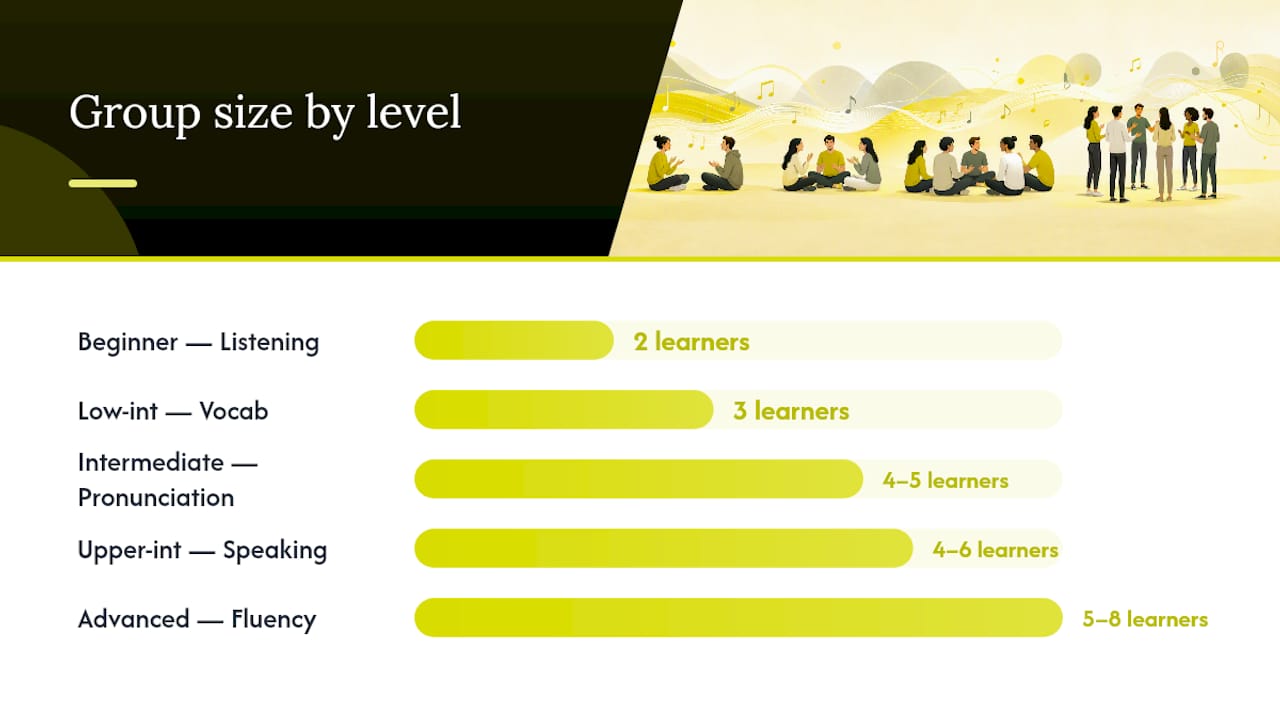
Use task load and support as your main controls. More cues and repetition for beginners; less scaffolding and freer production for advanced learners. The song stays the same; the task changes.
| Level | Group size | Target skill | Key adaptation |
|---|---|---|---|
| Beginner | Pairs | Listening | Chorus only; vocabulary bank provided; two listens before writing |
| Low-intermediate | Triads | Vocabulary | Gap-fill with partial words shown; one listen |
| Intermediate | 4–5 learners | Pronunciation | Shadowing with lyric scroller; record and compare |
| Upper-intermediate | 4–6 learners | Speaking | Lyric substitution with no word bank; spoken delivery after |
| Advanced | 5–8 learners | Fluency/production | New verse writing; timed; no model provided |
For music-based language games adapted to adult learners, the most effective single adjustment is slowing playback to 80% speed for beginners rather than switching songs entirely. Same vocabulary, same cultural context, just more processing time.
A 10-minute icebreaker session you can copy right now
This blueprint chains a gap-fill chorus into a paired speaking task. One song, one language point, ten minutes.
- 0:00–1:00 — Warm-up. Share the song title and ask: “What do you think this song is about?” One sentence each, no pressure.
- 1:00–4:00 — Guided listening / gap-fill. Distribute lyrics with 6 blanked words in the chorus. Play the song. Learners fill blanks individually.
- 4:00–7:00 — Sing-along / shadowing. Play the chorus. Everyone sings or mouths along, matching the singer’s stress and rhythm.
- 7:00–9:00 — Paired micro-task. In pairs, each learner picks one word from the gap-fill and uses it in a sentence about their own life. Partner responds with a follow-up question.
- 9:00–10:00 — Quick sharing. One pair shares their sentence with the group. Host notes any pronunciation wins or interesting word choices.
Optional homework: Before the next session, find one more song that uses the same target word and share the lyric line in the group chat. That single retrieval task, done 24 hours later, is what converts short-term recall into lasting vocabulary. For more on blending music and language study into a daily habit, the micro-sequence principle applies here too.
Why music-first icebreakers suit adult learners in particular
Adults come to language learning with a specific demand: they want to feel the payoff immediately. Music delivers that in a way grammar drills never do. You finish a karaoke shadowing round and you’ve already said something in the target language, out loud, with another person. That’s communicative payoff in under seven minutes.
The affective filter argument matters here too. Adults carry more self-consciousness about making mistakes than children do. Singing alongside someone else distributes the exposure. You’re both imperfect, you’re both following the same melody, and the song absorbs the awkwardness that would otherwise shut the conversation down. Repeatability compounds this: the same song can run three sessions in a row without feeling stale, because each session targets a different skill.
App features that support these advantages directly include community practice rooms, karaoke playback with lyric sync, and the ability to replay a line as many times as you need without social pressure. Those aren’t nice extras. They’re the infrastructure that makes the low-stakes, high-repetition loop actually work.
Singwithcanary puts these icebreakers inside a social practice workflow
Singwithcanary is built around exactly the features these activities need: karaoke mode with synchronized lyrics, vocabulary cards you can save mid-song, and social sessions where you practice with other learners from around the world. You don’t have to hunt for a licensed song, paste lyrics into a chat, or coordinate playback across five browser tabs.
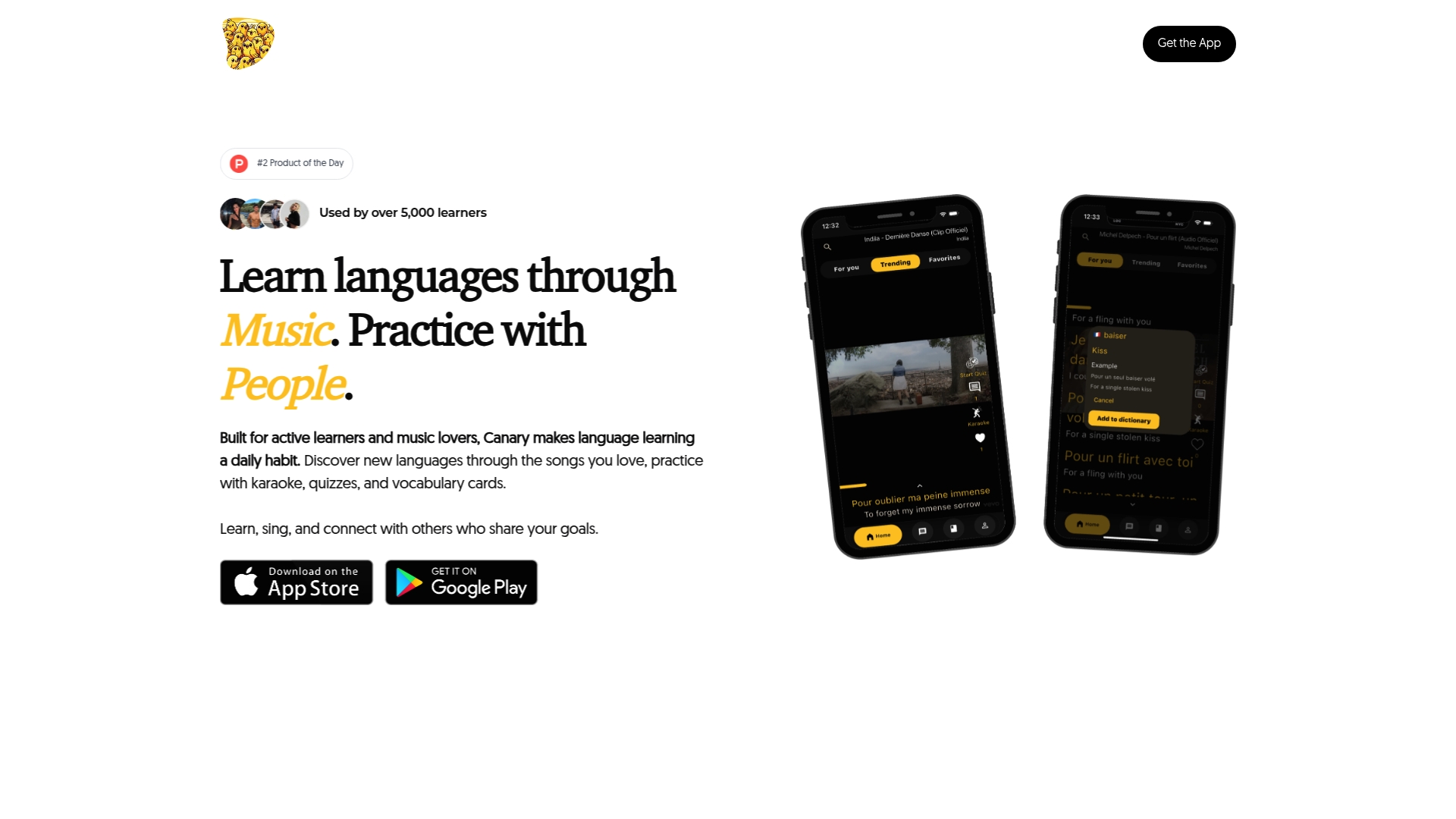
The app’s weekly song sessions give you a ready-made context for running gap-fills, shadowing rounds, and lyric substitution with real people, in real time. Karaoke mode handles the lyric sync. Vocabulary cards handle the follow-up retrieval. The community handles the social pressure that makes you show up again tomorrow. Sign up and run your first icebreaker session in under ten minutes.
Sources
- Music as pedagogy in ELT: mechanisms, micro-sequences, and measured gains — Frontiers
- KSJ article excerpt — Dubiner & Avirbach PDF
- ESL songs for kids and teens — Bridge TEFL
- Teaching English through music and lyrics — EFLCafe
- Sing and Share musical icebreakers game — TeachStarter