Memorizing word lists is one of those habits that feels productive but rarely sticks. You write the word, you read the definition, and two days later it’s gone. Songs work differently. They wrap new words in melody, emotion, and repetition, which is exactly how your brain prefers to store information. Authentic materials in songs capture nuances, slang, and pronunciation patterns that no flashcard can replicate. This guide walks you through the science, the comparisons, and the practical steps to make songs your most powerful vocabulary tool.
Table of Contents
- How songs enhance vocabulary acquisition
- Comparing songs with traditional vocabulary study
- What science says: age, retention, and melody
- Practical strategies for learning vocabulary with songs
- Expand your vocabulary with music-driven tools
- Frequently asked questions
Key Takeaways
| Point | Details |
|---|---|
| Songs boost vocabulary | Music-driven learning exposes you to authentic language, slang, and pronunciation. |
| Memory and motivation | Singing improves memory and makes vocabulary practice engaging and less stressful. |
| Nuanced science | Songs benefit older learners most, while spoken sentences work better for preschoolers. |
| Active strategies matter | Combining songs with tasks like quizzes and pronunciation practice accelerates progress. |
How songs enhance vocabulary acquisition
Songs are not just background noise. They are dense packages of real language, delivered with rhythm, emotion, and cultural context. When you hear a word repeated in a chorus three or four times, your brain starts to recognize it as familiar, and familiarity is the first step toward retention.
Here is what makes songs so effective for building vocabulary:
- Context over isolation: Words appear inside full sentences, so you understand meaning from usage, not just a dictionary entry.
- Pronunciation modeling: Singers articulate words clearly and consistently, giving you a natural model to imitate.
- Slang and colloquial speech: Songs reflect how people actually talk, not how textbooks say they should.
- Emotional memory: When a lyric moves you, your brain tags it as important and stores it more deeply.
- Repetition without boredom: Choruses repeat key phrases naturally, reinforcing vocabulary without feeling like a drill.
The research backs this up. Music training and singing improves verbal memory performance and adds measurable benefits on top of language learning alone. That means singing along is not just fun. It is genuinely making your memory stronger.
“BBC Learning English uses songs to widen vocabulary and grammar understanding, improve memory, and make learning fun.”
This approach works because enjoyment drives exposure. The more you enjoy a method, the more time you spend with it. More time with the language means more vocabulary absorbed. Explore songs for vocabulary growth and see how learning with lyrics can reshape your daily practice. The benefits of songs in language learning go well beyond what most learners expect.
Comparing songs with traditional vocabulary study
Traditional vocabulary study has its place. Flashcards, word lists, and spaced repetition apps are structured and measurable. But they have a serious weakness: they strip words out of context. You memorize a definition, not a living word.
Songs flip that model. You encounter a word in a sentence, inside a story, wrapped in emotion. That combination is far harder to forget. Songs provide an emotional buffer that reduces learning anxiety, which means you stay relaxed, open, and more receptive to new information.

| Feature | Traditional study | Song-based learning |
|---|---|---|
| Context | Low (isolated words) | High (full sentences, stories) |
| Emotional engagement | Low | High |
| Pronunciation modeling | Rare | Built-in |
| Slang and colloquial language | Limited | Abundant |
| Repetition | Forced | Natural |
| Anxiety level | Often high | Generally low |
| Motivation over time | Tends to drop | Tends to stay high |
Neither method is perfect on its own. Daily song practice builds fluency and vocabulary breadth, while structured study sharpens precision. The real power comes from combining both. Use songs to absorb language naturally, then use drills to lock in spelling and grammar rules. Explore music and language education to understand how these two approaches complement each other.
Pro Tip: Build a playlist of 10 to 15 songs in your target language. Listen once for enjoyment, then go back and study the lyrics. This two-pass method gives you both emotional engagement and analytical depth.
What science says: age, retention, and melody
Songs are not a one-size-fits-all solution. The research reveals some important nuances, especially when it comes to age and the type of vocabulary being learned.
For older learners and adults, songs consistently outperform rote methods for retention and motivation. Melody acts as a memory scaffold, giving your brain a structure to hang new words on. But for very young children, the picture is more complicated.
“In 47 to 50 month olds, spoken sentences led to better novel word learning than songs.”
This finding from Cambridge University is worth paying attention to. For preschool-age children learning brand-new words, the melody can actually compete with the word itself for cognitive attention. The child focuses on the tune and misses the meaning.
Here is a quick breakdown of how song-based learning performs across age groups:
| Age group | Song-based learning strength | Key consideration |
|---|---|---|
| Preschool (3 to 5) | Motivation and familiarity | Spoken sentences better for new words |
| School age (6 to 12) | Retention and engagement | Choose simple, clear lyrics |
| Teens and adults | Vocabulary breadth, pronunciation | Tempo and clarity matter most |
To choose the right song for your level, follow these steps:
- Identify your goal. Are you building vocabulary, improving pronunciation, or learning slang?
- Check the tempo. Slower songs give you more time to process each word.
- Evaluate lyric clarity. Avoid songs where words are heavily distorted or mumbled.
- Match the content to your level. Beginner learners need simpler vocabulary; advanced learners can handle complex metaphors.
- Use expert guidance on song selection to refine your choices based on learning goals.
Look at examples of music-based learning and explore methods for music-driven learning to find the approach that fits your style.
Practical strategies for learning vocabulary with songs
Knowing that songs work is one thing. Knowing how to use them strategically is what actually moves the needle. Here are the methods that deliver the best results.
Choose your songs wisely. Select songs by clarity, tempo, and age-appropriateness and combine them with active tasks like quizzes for the best outcomes. A beautiful song with mumbled lyrics will not help your vocabulary. A clear, moderately paced track with rich vocabulary will.
Here is a practical routine you can start today:
- Passive listening first: Play the song while doing something else. Let the sounds and rhythm become familiar.
- Active lyric study: Pull up the lyrics and read along. Highlight every word you do not know.
- Look up and record: Find definitions, write example sentences, and note pronunciation.
- Sing along: This is where retention really kicks in. Singing forces you to produce the sounds, not just recognize them.
- Take a lyrics quiz: Test yourself on meaning and usage. This active recall step is what separates casual listeners from real learners.
- Revisit the song: Come back to it a few days later. Notice how much more you understand.
Combining passive and active engagement is the key. Passive listening builds familiarity. Active tasks like quizzes and pronunciation drills build mastery. Explore explained song-based learning methods to find the structure that works for you, and check out weekly song learning for curated tracks designed around language goals.

Pro Tip: Group your songs by theme or vocabulary category. A playlist of songs about travel, for example, will cluster related words together and make them easier to recall as a set.
Expand your vocabulary with music-driven tools
You now have the science, the comparisons, and the strategies. The next step is putting them into practice with tools built specifically for music-loving language learners.
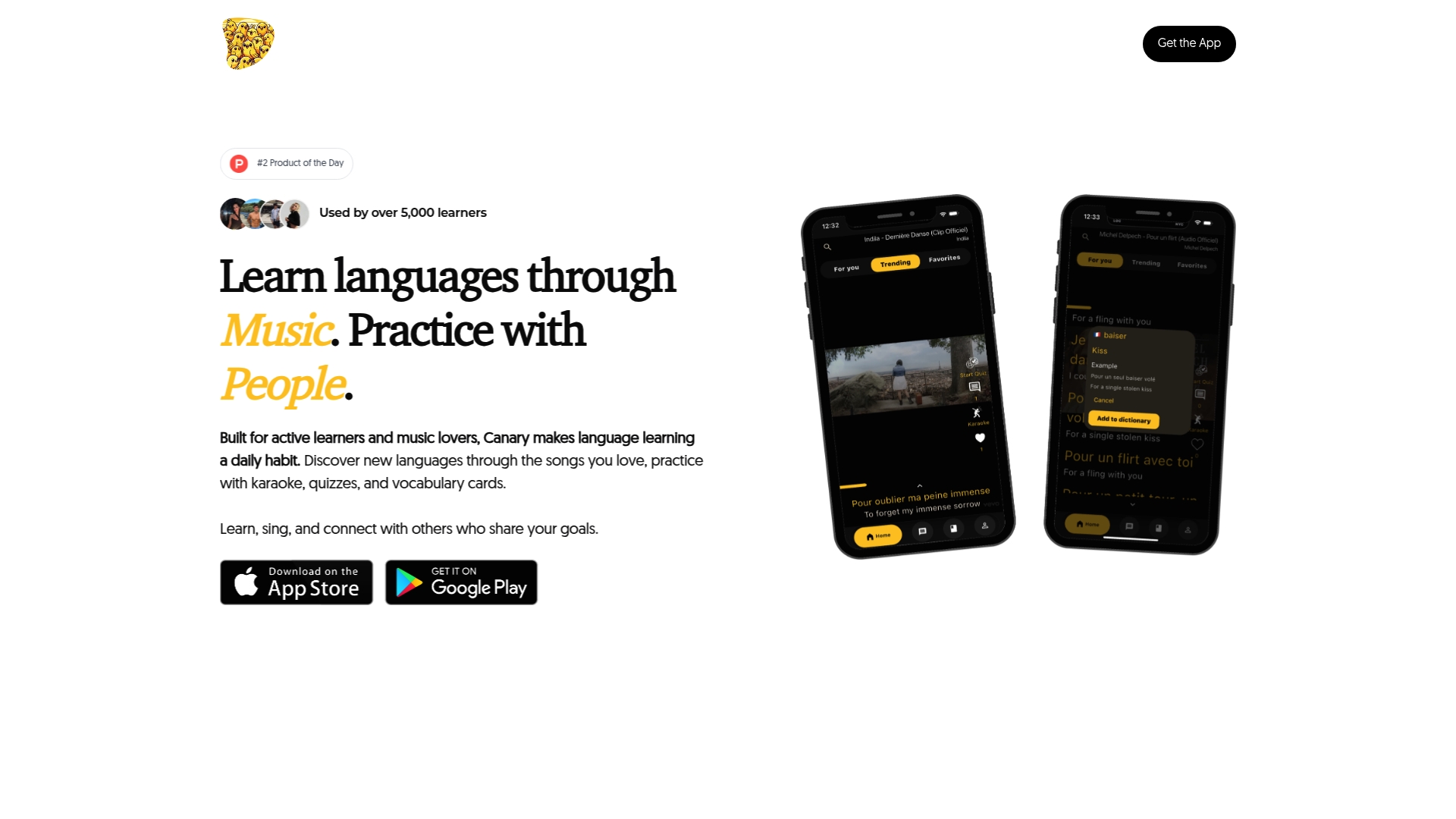
Canary is designed for exactly this. It combines song-based learning with karaoke, vocabulary cards, and interactive quizzes so you can learn languages with music in a way that actually sticks. Every feature is built around the idea that enjoyment and learning are not opposites. They work best together. Check out tips for music lovers to get personalized strategies, and use the song-based vocabulary guide to build a structured practice routine. Your playlist is waiting.
Frequently asked questions
Why are songs so effective for language learning?
Songs deliver authentic language and reduce anxiety, which creates the ideal conditions for vocabulary and pronunciation to stick. The combination of repetition, emotion, and real-world context makes new words far more memorable than isolated study.
Does singing help with vocabulary retention more than just listening?
Yes. Music training and singing improves verbal memory performance beyond what passive listening alone achieves. Producing the sounds yourself forces deeper cognitive processing.
Should children learn vocabulary through songs or spoken sentences?
For very young children, spoken sentences outperform songs for learning brand-new words, though songs still build motivation and familiarity. Older learners benefit more directly from song-based vocabulary practice.
What kinds of songs are best for learning vocabulary?
Choose songs with clear lyrics and moderate tempo that match your proficiency level. Age-appropriate content and rich but accessible vocabulary will give you the best outcomes.
How can I use songs for pronunciation practice?
Sing along and mimic the artist closely, paying attention to how they shape each sound. Songs provide authentic pronunciation models that reflect natural speech patterns far better than scripted audio exercises.