French verbs fall into three groups: regular -er verbs (first group), regular -ir verbs with an -iss- infix (second group), and everything else (third group, which is irregular). The core conjugation rule is the same across all three: drop the infinitive ending to get the stem, then add the person endings. Here’s what that looks like in one line per group:
- Parler (1st): je parle, tu parles, nous parlons
- Finir (2nd): je finis, tu finis, nous finissons
- Vendre (3rd, -re): je vends, tu vends, nous vendons
The first group covers a large majority of French verbs, which means mastering -er patterns alone gives you an enormous head start. The third group is where the most common verbs live, including être, avoir, aller, and faire — so you’ll need to memorize those separately. Start with -er, then learn the super-irregulars, and the rest falls into place.
Table of Contents
- How to conjugate any French verb in the present tense
- First-group (-er) verbs: the most productive pattern in French
- Second-group (-ir) verbs: how to spot the real ones
- Third-group (irregular) verbs: how to manage the chaos
- Practice strategies that actually work
- Key Takeaways
- Why the sequence matters more than the rules themselves
- Singwithcanary turns verb drills into something you’ll actually do daily
How to conjugate any French verb in the present tense
The process is the same whether you’re looking at a regular -er verb or an unfamiliar -re verb. Follow these four steps every time:
- Identify the infinitive ending. Look at the last two or three letters: -er, -ir, or -re.
- Drop the ending to find the stem. Parler → parl-. Finir → fin-. Vendre → vend-.
- Check the nous form for stem changes. Some verbs shift their stem in certain persons (especially 3rd-group verbs). The nous form is your anchor.
- Add the correct endings for each person.
Present-tense endings for each group:
| Person | -er (1st) | -ir/-iss- (2nd) | -re (3rd) |
|---|---|---|---|
| je | -e | -is | -s |
| tu | -es | -is | -s |
| il/elle | -e | -it | — |
| nous | -ons | -issons | -ons |
| vous | -ez | -issez | -ez |
| ils/elles | -ent | -issent | -ent |
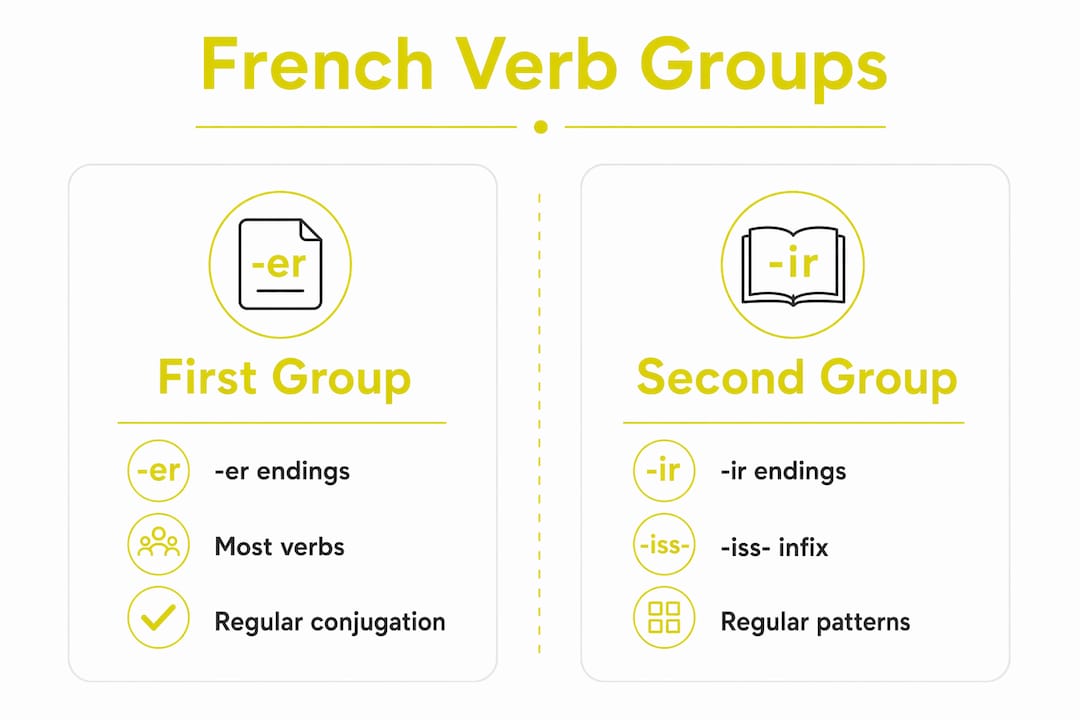
Worked example — parler (to speak): Drop -er → stem parl- → add 1st-group endings: je parle, tu parles, il parle, nous parlons, vous parlez, ils parlent.
Worked example — finir (to finish): Drop -ir → stem fin- → add 2nd-group endings: je finis, tu finis, il finit, nous finissons, vous finissez, ils finissent.
Worked example — vendre (to sell): Drop -re → stem vend- → add 3rd-group -re endings: je vends, tu vends, il vend, nous vendons, vous vendez, ils vendent.
First-group (-er) verbs: the most productive pattern in French
New verbs in modern French almost always join the first group. Words like googler, tweeter, and scroller all conjugate as regular -er verbs. That makes the first group an open, productive class — any new word you encounter ending in -er almost certainly follows the same pattern.

The first group contains a large majority of French verbs, so the return on time spent here is higher than anywhere else in French grammar.
Full conjugation table: three -er verbs
| Person | parler (speak) | manger (eat) | commencer (begin) |
|---|---|---|---|
| je | parle | mange | commence |
| tu | parles | manges | commences |
| il/elle | parle | mange | commence |
| nous | parlons | mangeons | commençons |
| vous | parlez | mangez | commencez |
| ils/elles | parlent | mangent | commencent |
Spelling-change patterns to watch
Three predictable spelling changes affect certain -er verbs in the nous form (and sometimes other forms) to preserve pronunciation:
- -ger verbs (manger, nager, voyager): insert an e before -ons → nous mangeons. Without it, the g would harden to /g/ instead of staying /ʒ/.
- -cer verbs (commencer, lancer, placer): swap c for ç before -ons → nous commençons. The cedilla keeps the /s/ sound.
- -eler / -eter verbs (appeler, jeter): double the consonant in forms where the ending is silent → j’appelle, il appelle (but nous appelons).
Common learner errors: Forgetting the cedilla in commençons is one of the most frequent written mistakes. Another is applying the doubling rule to every -eler verb — geler uses an accent grave instead (je gèle), not a doubled l. When in doubt, check the nous form first.
Pro Tip: Master -er verbs before moving on. Because they cover the vast majority of French vocabulary, getting these right gives you a working conjugation system from day one.
Second-group (-ir) verbs: how to spot the real ones
Not every verb ending in -ir belongs to the second group. The defining feature is the -iss- infix, which appears in the plural present forms and in the present participle. If you don’t see -iss-, the verb is third-group, full stop.
The recognition test: Form the present participle. If it ends in -issant, the verb is 2nd-group (finissant → finir is 2nd-group). If it ends in -ant without the -iss- (partant from partir), it belongs to the third group.
Full conjugation: finir (to finish)
| Person | finir |
|---|---|
| je | finis |
| tu | finis |
| il/elle | finit |
| nous | finissons |
| vous | finissez |
| ils/elles | finissent |
The second group contains a moderate number of verbs, including choisir (to choose), grandir (to grow), rougir (to blush), and réussir (to succeed). They all follow the finir pattern without exception.
Common -ir verbs that are NOT 2nd-group:
- partir (to leave) → present participle partant, not partissant
- sortir (to go out) → sortant
- dormir (to sleep) → dormant
- ouvrir (to open) → behaves like a 1st-group verb in the singular (j’ouvre, tu ouvres)
An -ir verb that doesn’t produce -iss- behavior belongs to the third group and needs to be learned as an irregular. Treating partir like finir is one of the most common conjugation mistakes learners make.
Third-group (irregular) verbs: how to manage the chaos
The third group is a catch-all for everything that doesn’t fit the first two templates: all -re verbs, -oir verbs, -ir verbs without -iss-, and the irregular -er verb aller. It’s a closed class, meaning no new verbs ever join it. That’s actually good news — the list is finite, and the most important ones are a short set you can prioritize.
The super-high-frequency irregulars to learn first
These ten verbs appear constantly in spoken and written French. Learn them before anything else in the third group:
être, avoir, aller, faire, dire, pouvoir, vouloir, venir, prendre, mettre
Être and avoir matter most because they’re the auxiliary verbs for passé composé and dozens of fixed expressions. Avoir is the default auxiliary (j’ai parlé); être is used for a closed set of motion and change-of-state verbs (je suis allé) and all reflexive verbs.
Core conjugations for the five most common irregulars
| Person | être | avoir | aller | faire | venir |
|---|---|---|---|---|---|
| je | suis | ai | vais | fais | viens |
| tu | es | as | vas | fais | viens |
| il/elle | est | a | va | fait | vient |
| nous | sommes | avons | allons | faisons | venons |
| vous | êtes | avez | allez | faites | venez |
| ils/elles | sont | ont | vont | font | viennent |
Note that aller is suppletive: its present-tense stems (v-, all-, vaill-) come from entirely different historical roots, which is why it can’t be conjugated by any regular rule despite ending in -er.
Verb families reduce the memorization load
Grouping irregular verbs into families is far more efficient than learning each one in isolation. Once you know prendre, you also know apprendre, comprendre, and surprendre — they all share the same stem pattern. Key families to learn:
- -prendre family: prendre, apprendre, comprendre, surprendre
- -mettre family: mettre, permettre, promettre, soumettre
- -venir/-tenir family: venir, devenir, revenir; tenir, obtenir, maintenir
- -duire family: conduire, produire, traduire, réduire
- -aindre/-eindre family: craindre, plaindre; peindre, éteindre
Pro Tip: Learn irregular stems with a short mnemonic or a song line. Singing “je vais, tu vas, il va, nous allons” to a simple melody locks the pattern faster than writing it out ten times.
Practice strategies that actually work
Knowing the rules is one thing. Retaining them under pressure — when you’re mid-conversation — is another. These routines close that gap.
Music-based repetition combines melody, rhythm, and retrieval practice simultaneously, which makes it one of the most efficient ways to lock in irregular stems. Singing a two-line chorus where you replace infinitives with conjugated forms (je chante, tu chantes, nous chantons) forces you to produce the correct ending in real time, not just recognize it. Singwithcanary’s song-based learning approach applies exactly this principle, using karaoke and lyric-based drills to reinforce verb forms in context.
Other evidence-backed habits:
- Spaced repetition for high-frequency verbs. Review être, avoir, aller, and faire daily for the first two weeks, then every few days.
- Mixed production and recognition. Don’t just read conjugation tables — write out the full paradigm from memory, then check.
- Use lyrics for contextual grammar practice. A song line like “je vais bien, tu vas bien” gives you aller in context, which sticks better than a table cell.
A 7-day micro-practice plan
- Day 1: Master -er endings with parler. Write the full paradigm from memory three times.
- Day 2: Add spelling-change -er verbs (manger, commencer). Sing a short chorus replacing the verb with each person.
- Day 3: Learn the -iss- test. Conjugate finir and choisir in full; test three -ir verbs to classify them.
- Day 4: Memorize être and avoir in full. Write them without looking, then use each in a sentence.
- Day 5: Tackle aller, faire, and venir. Sing or say each conjugation aloud.
- Day 6: Learn the -prendre and -mettre families. Notice how the pattern transfers.
- Day 7: Mixed drill: conjugate one verb from each group from memory, then check. Identify any gaps and repeat those forms.
Pro Tip: Keep each session to 10–15 minutes. Short, daily contact with conjugation patterns beats a two-hour weekend session every time.
Key Takeaways
The single most important move for any French learner is to master -er verbs first, then memorize the super-irregular auxiliaries, because those two steps cover the vast majority of real French usage.
| Point | Details |
|---|---|
| -er verbs dominate | Roughly 90% of French verbs are first-group; mastering them gives the highest return on study time. |
| Use the -iss- test | If an -ir verb doesn’t produce -issons / -issant, it belongs to the third group, not the second. |
| Auxiliaries come first | Être and avoir are the backbone of passé composé; learn them in week one. |
| Learn by families | Grouping irregulars (-prendre, -mettre, -venir) lets one learned pattern cover several verbs at once. |
| Singwithcanary for retention | Singwithcanary’s karaoke and lyric-based drills reinforce conjugated forms in context, making irregular stems stick faster than rote repetition. |
Why the sequence matters more than the rules themselves
Most learners spend too long trying to understand the third group before they’ve automated the first. The result is a kind of conjugation paralysis — you know the exceptions but hesitate on the basics. The three-group framework works precisely because it gives you a triage system: if the verb ends in -er and isn’t aller, apply the simple rule. If it ends in -ir, run the -iss- test. Everything else, check your list of high-frequency irregulars.
What often gets skipped is the music angle. Singing a conjugated line isn’t a gimmick — it’s retrieval practice with a melody attached, which research on memory consistently shows improves recall. The learners who internalize irregular stems fastest tend to be the ones who’ve heard those forms in songs or repeated them aloud, not just read them in a table. That’s the real argument for integrating music into your French practice from day one, not as a supplement but as a core drill.
Singwithcanary turns verb drills into something you’ll actually do daily
Conjugation tables are easy to understand and hard to remember. Singwithcanary flips that by embedding verb forms inside real French songs — so instead of staring at je vais, tu vas, il va on a flashcard, you’re singing it in a chorus and hearing it back immediately.
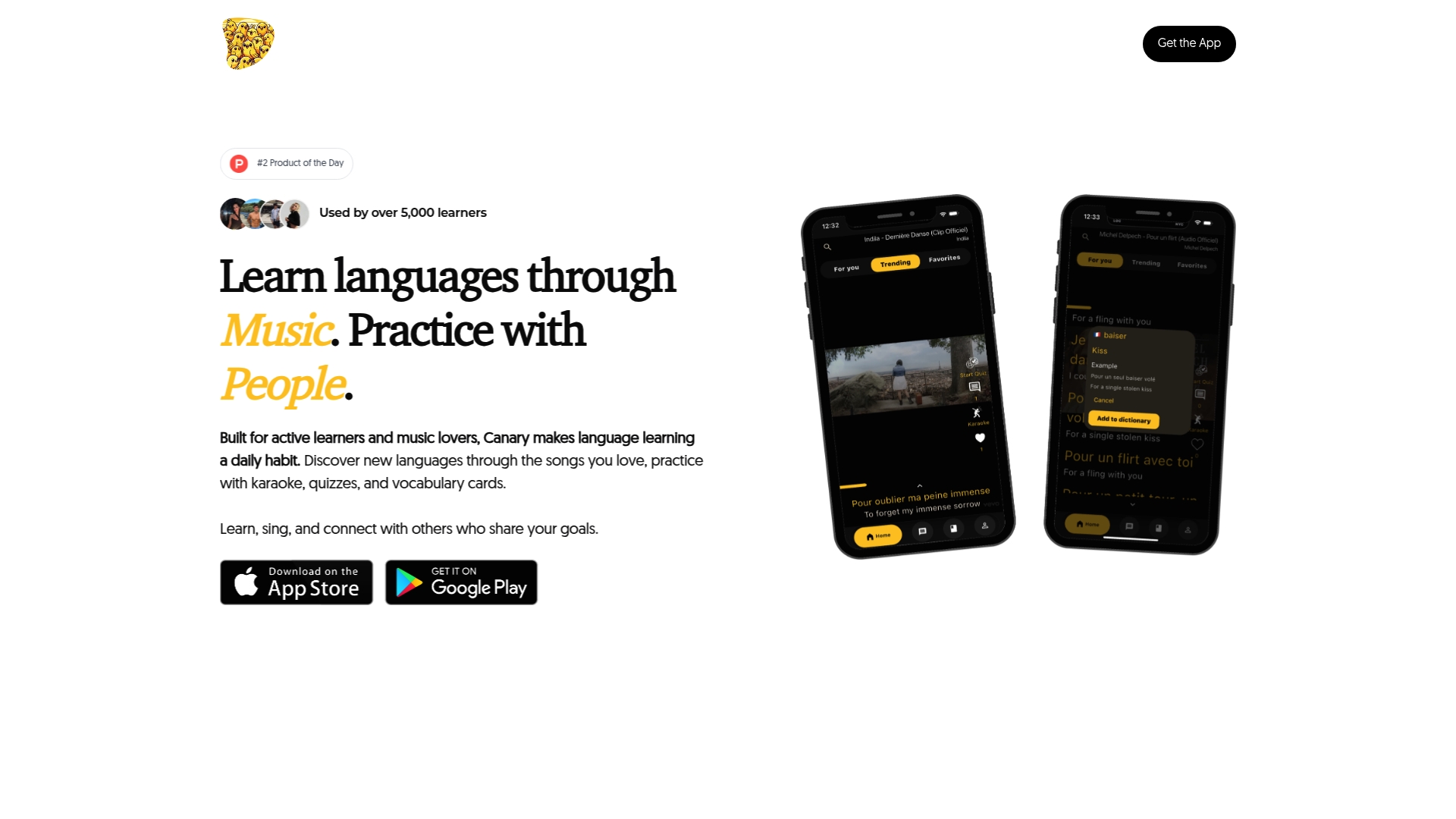
The platform’s karaoke mode puts conjugated verb forms in front of you in real lyrical context, which is exactly the kind of spaced, meaningful repetition that makes irregular stems stick. Vocabulary cards and quizzes let you drill je/tu/nous forms in isolation when you need focused practice, while the social features connect you with other learners for live conversation — the moment where conjugation has to work under pressure.
If you want to move from knowing the rules to actually using them, start your free trial at Singwithcanary and try the song-of-the-week drill as your first conjugation workout.
Useful sources and further reading
The following references were used throughout this guide and are worth bookmarking for deeper study, especially once you’re ready to move beyond the present tense into the imparfait and passé composé:
- French conjugation overview — Wikipedia: Comprehensive reference for all three groups, including historical notes on aller’s suppletive stems.
- The French Verb System: Overview — Elon.io: Clear breakdown of group definitions, productivity, and auxiliary usage.
- The Three Conjugation Groups: -er, -ir, -re — Elon.io: Detailed explanation of the -iss- diagnostic and group membership rules.
- How to conjugate regular French verbs — Dummies: Step-by-step conjugation guide with present-tense endings for all three groups.
- French verb group explanation — FrenchETC: Practical guide to classifying -ir verbs and avoiding the most common misclassification errors.
- French Conjugation reference — FrenchConjugation.com: Model conjugation pages for individual verbs across all tenses.
Once you’re confident with present-tense forms, use these same sources to look up the imparfait and passé composé paradigms for the verbs you’ve already learned. The stem work you’ve done carries over directly.