Flashcards, grammar drills, and vocabulary lists have one thing in common: they’re boring, and for most adults, they simply don’t stick. If you’ve spent months studying French and still freeze up when a native speaker talks fast, you’re not failing at languages. You’re using the wrong method. Combining music with social practice rewires how your brain stores and retrieves words, and daily 10-20 min of this approach brings measurable gains in vocabulary and pronunciation within 1 to 6 months. This guide gives you a week-by-week workflow that makes French feel less like homework and more like something you actually want to do.
Table of Contents
- Why use music and social interaction to learn French?
- What you need to start your French vocabulary workflow
- Step-by-step: The music-driven French vocabulary workflow
- Troubleshooting and making the workflow work for you
- What to expect: Your results after 1, 3, and 6 months
- Take your French vocabulary workflow further with Canary
- Frequently asked questions
Key Takeaways
| Point | Details |
|---|---|
| Music accelerates vocabulary | Learning French through music integrates rhythm and meaning for faster word retention. |
| Daily sessions yield results | Just 10–20 minutes a day leads to measurable improvement in conversation and pronunciation. |
| Social practice cements skills | Practicing phrases with others or in karaoke increases recall and real-world fluency. |
| Anyone can benefit | Both beginners and experienced learners gain from music-based vocab workflows, regardless of prior musical training. |
Why use music and social interaction to learn French?
Music is not just a fun add-on to language learning. It mirrors the way children absorb their first language: through rhythm, repetition, and emotional connection. When you hear a French phrase set to a melody, your brain encodes it differently than when you read it off a page. That melody becomes a retrieval cue, making the word easier to recall later in conversation.
Musicians and musically-trained nonmusicians showed improved word learning and verbal memory compared to those with no music exposure. But here’s the part that surprises most people: you don’t need to be a musician to benefit. Even casual listeners who engage actively with songs see accelerated vocabulary growth.
Social interaction adds another layer. Speaking French with real people, even imperfectly, forces your brain to retrieve words under pressure. That pressure is exactly what builds fluency. Reading about a word and using it in a live conversation are two completely different cognitive events.
Here’s what music and social practice give you that traditional methods don’t:
- Rhythm training: Songs teach you the natural flow of French speech, including liaisons and elisions that textbooks rarely explain well.
- Pronunciation modeling: Singers enunciate clearly and consistently, giving you a reliable model to imitate.
- Emotional memory: You remember lyrics tied to a song you love far longer than a word on a flashcard.
- Cultural fluency: French songs by artists like Zaz or Stromae carry slang, idioms, and cultural references that textbooks skip.
- Motivation: Singing is enjoyable. Enjoyment creates consistency. Consistency creates results.
“Music-based study improves vocabulary and pronunciation noticeably in 1 to 6 months with regular practice.” This is not a slow method. It’s a smarter one.
If you want to go deeper on the science, learn French with music and explore how French learning methods with songs compare to traditional approaches. Now that you know there’s a better way, let’s look at what you’ll need to get started.
What you need to start your French vocabulary workflow
The good news: you don’t need expensive software or a language tutor to begin. Most of what you need is already on your phone or available for free online. Active listening and karaoke tools enable all levels to engage in a structured vocabulary workflow, from complete beginners to intermediate learners.
Here’s a quick checklist of what to gather before you start:
- French songs with clear lyrics: Start with artists who sing slowly and clearly. Zaz, Carla Bruni, and early Stromae tracks are excellent for beginners.
- Lyric sheets or apps: Use a lyrics site or a dedicated app that highlights words as the song plays.
- Karaoke versions: YouTube has thousands of French karaoke tracks. These remove the vocal track so you can sing along and hear yourself.
- A vocabulary notebook or flashcard app: Anki is free and uses spaced repetition, which dramatically improves retention.
- A conversation partner or group: Apps like Tandem or HelloTalk connect you with native French speakers for free.
- Optional: French radio or podcast apps: Radio France and France Inter stream live and are free to access globally.
| Tool | Cost | Best for |
|---|---|---|
| YouTube karaoke tracks | Free | Pronunciation practice |
| Anki flashcard app | Free | Vocabulary retention |
| Tandem or HelloTalk | Free/paid | Conversation practice |
| Spotify or Apple Music | Free/paid | Song discovery |
| France Inter radio app | Free | Listening comprehension |
| Lyrics sites (Genius, AZLyrics) | Free | Reading along with songs |
The benefits of learning French with music go well beyond vocabulary. Research consistently shows that music also improves vocabulary retention in ways that passive reading simply cannot match.

Pro Tip: Before your first session, pick just one French song you genuinely enjoy. Don’t overthink the level. Loving the song matters more than it being “appropriate” for beginners. You’ll listen to it dozens of times, and that repetition is the whole point.
Once you’ve gathered these essentials, you’re ready to build your daily and weekly routine.
Step-by-step: The music-driven French vocabulary workflow
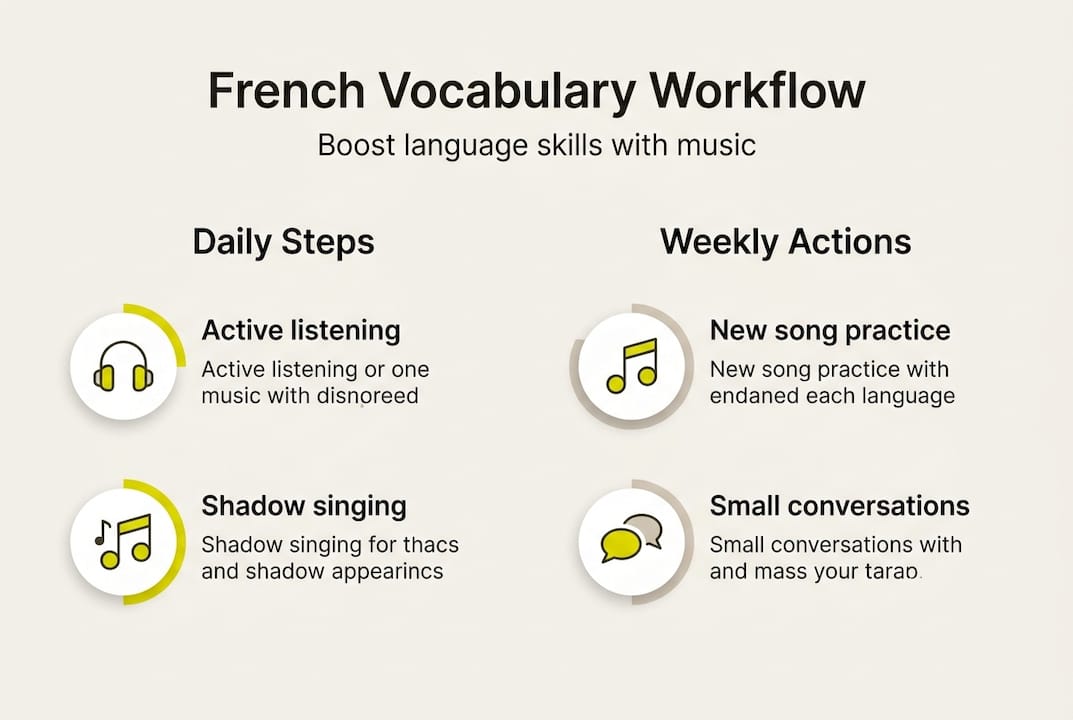
This workflow is built around a seven-day cycle that you repeat each week. Each day has a clear focus, so you never sit down wondering what to do. The total time commitment is 10 to 20 minutes per day, which is realistic even for busy schedules.
Here’s how the week breaks down:
- Monday: Active listening. Play your chosen French song two or three times without looking at lyrics. Focus on sounds, not meaning. What words can you pick out? Write them down.
- Tuesday: Vocabulary study. Read the full lyrics with a translation. Highlight 5 to 10 new words. Add them to your flashcard app with example sentences from the song.
- Wednesday: Pronunciation singing. Use a karaoke for French learning track and sing along. Don’t worry about perfection. Focus on matching the rhythm and melody before you focus on accuracy.
- Thursday: Conversation practice. Use three to five of your new words in a chat with your language partner. If you don’t have one yet, record yourself using the words in sentences and play it back.
- Friday: French radio or podcast. Listen to 10 minutes of spoken French. You won’t understand everything. That’s fine. Train your ear to the natural pace of the language.
- Saturday: Movie or TV flex. Watch a French film or show with French subtitles. Pause when you hear a word from your weekly list.
- Sunday: Review and reset. Go through your flashcards, pick a new song for next week, and note your wins from the week.
The weekly plan combines active listening, vocabulary study, pronunciation with karaoke, and conversation into a rhythm that builds on itself. Each day reinforces what you did the day before.
| Day | Activity | Time |
|---|---|---|
| Monday | Active listening | 10-15 min |
| Tuesday | Vocabulary study | 15-20 min |
| Wednesday | Karaoke singing | 10-15 min |
| Thursday | Conversation practice | 15-20 min |
| Friday | Radio or podcast | 10 min |
| Saturday | Movie or TV | 20 min |
| Sunday | Review and reset | 10 min |
Shadowing with music is superior for rhythm learning compared to isolated word repetition. Shadowing means mimicking the singer’s exact rhythm, stress, and melody before you even worry about whether your pronunciation is perfect. The role of music in learning is especially powerful here because songs give you a consistent, repeatable model to shadow.
Pro Tip: On Wednesday, record yourself singing and compare it to the original. You’ll hear your own accent clearly and notice exactly where to improve. Most learners find this uncomfortable at first, but it’s one of the fastest ways to fix pronunciation habits.
The structure makes it easy to stick with, but what if you get stuck or want to go further?
Troubleshooting and making the workflow work for you
Every learner hits a wall at some point. The song is too fast, life gets busy, or motivation dips. Here’s how to handle the most common obstacles without abandoning the workflow.
If the song is too fast or complex: Slow it down. Most music apps and YouTube allow you to reduce playback speed to 75% or 50% without distorting the pitch. Start there, then gradually increase speed as you get comfortable.
If you’re struggling to find time: Shrink the session. Even five minutes of active listening on your commute counts. The vocabulary retention strategies that work best are the ones you actually do consistently, not the ones that are theoretically perfect.
If motivation drops: Switch songs. Pick something from a genre you love, whether that’s French hip-hop, chanson, or pop. Motivation follows interest, not discipline.
If you can’t find a conversation partner: Join a language community online. Discord servers, Reddit groups, and language exchange apps all have active French communities. You can also post short voice recordings and ask for feedback.
For tracking progress: Review your flashcard app weekly. Count new words added and retention rates. Most apps show you this automatically. Seeing the numbers grow is genuinely motivating.
Here are the most common pitfalls and how to sidestep them:
- Choosing songs that are too difficult too soon
- Skipping the conversation day because it feels uncomfortable
- Adding too many words at once instead of focusing on 5 to 10 per song
- Treating Sunday review as optional
- Comparing your progress to others instead of your own baseline
Even short training provides benefits to nonmusicians, and behavioral gains are stronger with dedicated, consistent practice over time. You don’t need to be perfect. You need to show up.
Pro Tip: When traveling or during a busy week, replace the full workflow with one task: listen to your current French song once a day. That single habit keeps your ear tuned and your motivation intact until you can return to the full routine.
With solutions to these challenges, you’ll see steady progress. What results can you expect if you stick with it?
What to expect: Your results after 1, 3, and 6 months
One of the most common questions learners ask is: “How long before I actually notice a difference?” The honest answer is: sooner than you think, if you’re consistent. Daily 10-20 min music-based study brings measurable gains in vocabulary and pronunciation after just one month, with compounding improvements through six months.
Here’s what you can realistically expect at each milestone:
| Milestone | Vocabulary | Pronunciation | Conversation comfort |
|---|---|---|---|
| 1 month | 50-100 new words | Noticeably clearer vowel sounds | Can use learned phrases in context |
| 3 months | 200-400 new words | Improved rhythm and liaisons | Holds short conversations with support |
| 6 months | 500-800 new words | Near-natural flow in familiar topics | Comfortable in casual conversation |
These benchmarks assume 10 to 20 minutes of daily practice following the workflow above. More time accelerates results, but consistency matters far more than duration.
Statistic to know: Learners using music-based methods report noticeable pronunciation improvements within the first month of regular practice, with vocabulary gains compounding significantly by month three.
The key insight here is that music-based learning doesn’t just add words to your mental list. It builds a network of associations: sound, rhythm, emotion, and context all tied to the same word. That network makes retrieval faster and more reliable under the pressure of real conversation. Regular song practice is the single most reliable way to keep that network growing week after week.
Ready to try this workflow with supported tools and guided lessons? Explore curated resources designed for music-based language learning.
Take your French vocabulary workflow further with Canary
You now have a proven, week-by-week workflow for expanding your French vocabulary through music and social practice. The next step is putting it into action with tools built specifically for this approach.
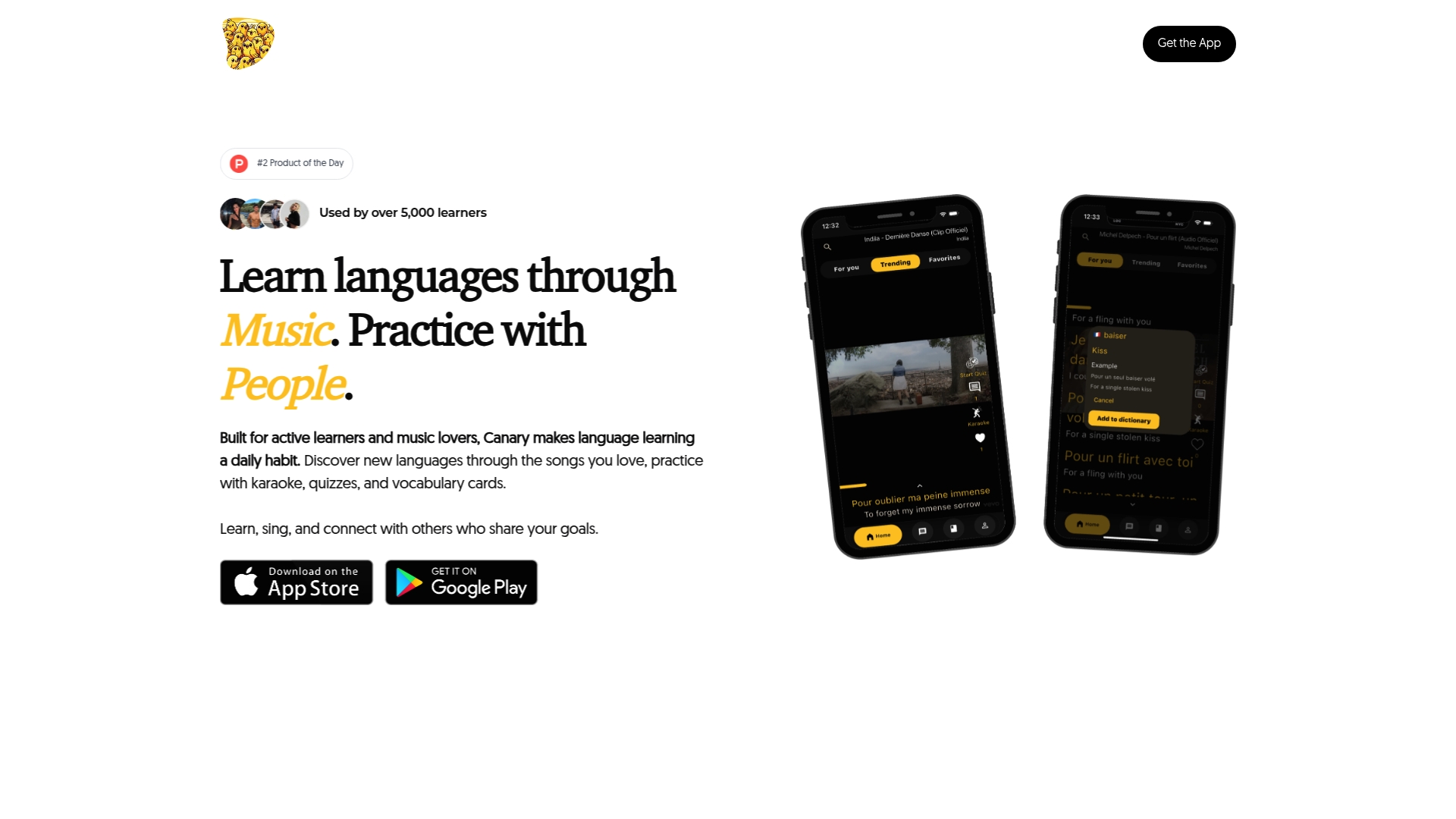
Canary is a language learning platform designed around exactly this method. It gives you a curated library of French songs at every level, interactive karaoke with real-time lyric highlighting, vocabulary cards pulled directly from song lyrics, and weekly challenges that keep your practice fresh. You also get access to a global community of learners who practice together, share song recommendations, and hold each other accountable. If you want tips for boosting vocabulary through music or want to explore the educational benefits of music in more depth, Canary’s resource library has you covered. The workflow you’ve just learned works on its own. With Canary, it works even better.
Frequently asked questions
How long should I practice with music each day?
Practicing 10-20 minutes daily yields noticeable improvements in vocabulary and pronunciation after 1 to 6 months. Consistency matters more than session length.
Can beginners use a music-driven workflow even if they aren’t musically trained?
Yes. Nonmusicians benefit from short music-based language training, and gains improve steadily with regular practice over time.
What if I can’t find a conversation partner?
You can use online communities or practice pronunciation with karaoke tools and recorded responses. Both approaches support language recall effectively.
Do I need premium subscriptions to use this workflow?
No. Free resources like lyrics sites, YouTube karaoke tracks, and Anki flashcards are enough to run the full workflow from day one.