A 4-week, 5–15 minute daily ear-training checklist is the fastest practical route to a cleaner German accent. You don’t need hours of study. You need the right sounds, drilled in the right order, every day. After several weeks, many English-speaking learners notice clearer vowels, more reliable consonant production, and a rhythm more natural to German.
Start today in under five minutes:
- Listen to 60 seconds of native German audio (a news clip, a song, a short podcast segment) and notice one sound you can’t reproduce yet.
- Shadow a single sentence from that audio for 30 seconds, matching pitch and rhythm as closely as you can.
- Record yourself saying one sentence, then play it back against the original.
That’s Day 1 done. The ear training for German learners habit you’re building here compounds fast. Within a few weeks, you may be shadowing longer texts, recognizing your own errors on playback, and producing challenging sounds with more ease.
Daily time commitment: 5–15 minutes. Success at week four: you can shadow a 30-second clip at near-normal speed, your vowel length is consistent, and a native speaker can follow you without effort.
Key Takeaways
A 4-week, 5–15 minute daily ear-training checklist targeting vowels, CH sounds, rhythm, and shadowing produces measurable German accent improvement when paired with weekly record-and-compare self-assessment.
| Point | Details |
|---|---|
| Daily micro-practice wins | 5–15 minutes daily builds muscle memory faster than long, infrequent sessions. |
| Follow the listen-practice-assess cycle | The Goethe-Institut’s three-step loop structures every session and prevents drilling errors undetected. |
| ARM closes the transfer gap | Annotate, Read, Monologue moves target sounds from controlled drills into spontaneous speech. |
| Self-assess weekly with recordings | Record a 60-second monologue every Sunday; compare accuracy, rhythm, and intelligibility to the previous week. |
| Singwithcanary supports daily habit | Song-based shadowing and community feedback on Singwithcanary complement the checklist and sustain motivation past week two. |
Table of Contents
- Why short daily ear-training sessions outperform long weekly ones
- The 4-week German accent ear training checklist
- Warm-ups that prevent tension and sharpen articulation
- The ARM routine and how to assess your own progress
- The 7 German sounds that give English speakers the most trouble
- Which tools and audio sources actually help?
- What to expect at 2, 4, and 8 weeks
- Singwithcanary makes the daily checklist easier to stick with
- Sources
Why short daily ear-training sessions outperform long weekly ones
The answer is motor learning. Accent work isn’t just cognitive — it’s physical. Your jaw, tongue, lips, and throat are learning new muscle positions, and muscles respond to frequent, short repetition far better than occasional marathon sessions.
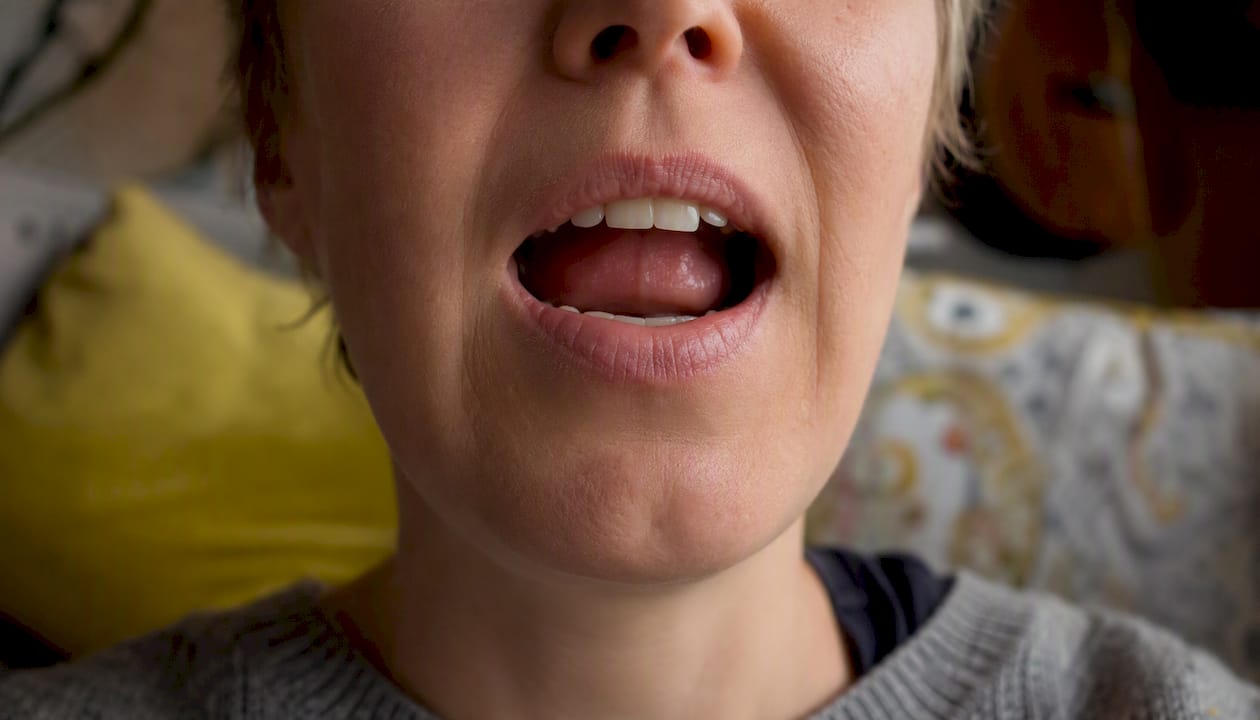
The Goethe-Institut’s pronunciation methodology formalizes this into a three-step cycle: listen → practice → assess. Each daily session follows that loop. You listen to a model, you practice the target sound actively, and you assess by recording and comparing. The cycle resets the next day with slightly harder material. That’s auditory recalibration in action: your ear learns to hear distinctions it previously ignored, and your mouth learns to produce them.
Think of it the way a musician approaches effective practice: short, focused repetitions with immediate feedback beat long, unfocused sessions. A pianist drilling a difficult passage for ten minutes daily will outperform one who practices the same passage for an hour on Saturdays. German pronunciation works the same way. Five focused minutes of minimal-pair drilling will do more for your CH sounds than forty-five distracted minutes of passive listening.
The deliberate practice principles behind this approach are well established: target a specific weakness, get immediate feedback, and repeat with slight variation. That’s exactly what this checklist is built around.
The 4-week German accent ear training checklist
This structure draws directly from the 30-day German accent reduction framework that breaks practice into weekly focus areas with daily micro-tasks. Each week targets a different sound system, so you’re never drilling the same thing for too long.
Week-by-week focus areas
| Week | Focus | Daily Goal |
|---|---|---|
| Week 1 | Vowels and umlauts (a/ä, o/ö, u/ü, long vs. short) | Hear and reproduce vowel length contrasts |
| Week 2 | CH sounds, R, and consonant clusters (sp, st, sch, pf) | Produce both CH variants reliably |
| Week 3 | Word stress, sentence rhythm, and intonation | Shadow full sentences with correct stress |
| Week 4 | Reductions, linking sounds, and full shadowing | Shadow 30-second clips at near-normal speed |
Daily 10-minute session structure
Follow this sequence every day. Adjust the time split based on your current weak spot.
- Warm-up (2 minutes): Jaw massage, tongue stretches, one lip trill. Details in the next section.
- Listen (2 minutes): Play your target audio once at normal speed, once at 75% speed. Focus on one specific sound.
- Drill (4 minutes): Run the week’s minimal-pair or shadowing drill (see below for exact scripts).
- Record and compare (2 minutes): Record one sentence, play it back against the native model, note one thing to fix tomorrow.
Sample drill scripts by week
Week 1 minimal pairs (vowels): Say each pair three times, pausing to listen between repetitions.
- Bahn / Bahn (long A) vs. Mann / Mann (short A)
- Höhle vs. Hölle
- Hüte vs. Hütte
Week 2 CH drill:
- ich (front CH, like a hiss behind your front teeth) vs. ach (back CH, like clearing your throat softly)
- Sentence shadow: “Ich möchte noch ein Stück Kuchen.”
Week 3 stress drill:
- Tap the stressed syllable on your desk as you say: “Ich KOMME aus DEUTSCHLAND.”
- Shadow a 15-second news clip, tapping stress beats.
Week 4 full shadowing:
- Choose a 30-second clip. Shadow at 80% speed for two rounds, then at full speed for one round.
When to repeat a day: If your playback recording sounds less clear than the previous day’s, repeat that day’s drill before moving on. Progress isn’t linear. A bad recording day is data, not failure.
Warm-ups that prevent tension and sharpen articulation
A 3–5 minute warm-up before drills isn’t optional padding. Tension in the jaw and throat is the single most common reason learners plateau. When muscles are tight, sounds come out clipped, over-articulated, or just wrong. Accent coaches recommend short daily warm-ups targeting jaw, tongue, and throat to reach the relaxed, open positions German sounds require.
Here’s the sequence:
- Jaw circular massage (30 seconds): Place your fingertips on your jaw joints and make small circles. Let the jaw drop open slightly. You’re releasing the masseter muscle, which tightens under stress and kills vowel openness.
- Tongue stretches (30 seconds): Push your tongue forward as far as it goes, hold three seconds, then pull it back and press it to the roof of your mouth. Repeat four times. This prepares the tongue tip for the German alveolar R and the front CH.
- Lip trills (20 seconds): Blow air through loosely closed lips so they vibrate. This relaxes the lip muscles needed for rounded vowels like Ö and Ü.
- Soft-palate lifts (20 seconds): Yawn silently, feeling the back of your mouth lift. This opens the resonance space that gives German its fuller, more forward sound compared to American English.
- Gentle larynx release (30 seconds): Hum on a comfortable pitch, then slide down to a lower note. Feel the larynx drop slightly. German resonance sits lower than American English, and this exercise helps your voice find that placement.
Pro Tip: Keep warm-ups gentle. The goal is relaxation, not a workout. If anything hurts or feels strained, back off immediately. Consistency over weeks matters far more than intensity on any single day.
The ARM routine and how to assess your own progress
ARM stands for Annotate, Read, Monologue. It’s a deliberate practice routine that moves target sounds from controlled reading into spontaneous speech, which is exactly where most learners stall. You can drill minimal pairs perfectly and still revert to your native accent the moment you’re speaking freely. ARM closes that gap.
How ARM works
- Annotate: Take a short paragraph (3–5 sentences) of German text. Mark every target sound from your current week’s focus. In week one, circle every umlaut. In week two, underline every CH. Use a different color or symbol for each sound type.
- Read aloud: Read the annotated paragraph slowly, pausing at each marked sound to produce it deliberately. Record this reading.
- Monologue: Put the text face-down. Describe the paragraph’s content in your own German words for 30–60 seconds. Don’t read. Don’t translate. Just speak. Record this too.
Compare the two recordings. The gap between your annotated reading and your free monologue tells you exactly how much transfer has happened. A small gap means the sound is becoming automatic. A large gap means you need more annotated reading before moving to monologue.
Weekly self-assessment checklist
Run this every Sunday (or at the end of your seventh session):
- Record a 60-second monologue on any topic in German.
- Play it back and score yourself on three dimensions: accuracy (are target sounds correct?), rhythm (does stress land on the right syllables?), and intelligibility (would a native speaker follow this without effort?).
- Compare to last week’s recording. Note one improvement and one thing to fix next week.
- Check off each week’s focus sounds: can you produce them reliably in free speech, not just in drills?
The record-and-compare method is what accent coaches consistently recommend for self-directed learners. Your ear improves faster than your mouth, which means you’ll start hearing your own errors before you can fix them. That’s progress, not a problem. Keep the recordings so you can hear the arc over four weeks.
The 7 German sounds that give English speakers the most trouble
German is relatively phonetic, which is good news. Mastering vowel length, umlauts, and the two CH variants produces quick clarity gains because German spelling maps reliably to pronunciation once you know the rules. These seven targets cover the vast majority of errors English speakers make.
-
Long vs. short vowels: German vowel length changes meaning (Bahn vs. Bann, Höhle vs. Hölle). English speakers tend to make all vowels medium-length. Drill: say the long version for two beats, the short version for one beat, alternating ten times.
-
Umlauts (Ä, Ö, Ü): These don’t exist in English. Ö is the sound in French feu; Ü is like saying “ee” with rounded lips. Drill: say “ee,” then slowly round your lips without moving your tongue. That’s Ü. Hold it for three seconds, release, repeat.
-
Front CH (ich-Laut): After front vowels (i, e, ä, ö, ü), CH is a soft hiss produced just behind your upper front teeth. It’s close to the H in “huge” in some American dialects. Drill: whisper “hee” and hold the H sound. That’s your front CH.
-
Back CH (ach-Laut): After back vowels (a, o, u), CH is a velar fricative, like a soft throat-clearing. Drill: say “loch” (the Scottish lake) and hold the final sound.
-
Uvular R: German R is produced in the back of the throat, not with the tongue tip like American English R. Drill: gargle water gently, then try to make that vibration without water. That’s the uvular R position.
-
W pronounced as V: German W is always a V sound. Wasser sounds like “Vasser.” Drill: read a sentence replacing every W with V until it feels natural.
-
Final devoicing: German B, D, G at the end of words become P, T, K. Hund ends with a T sound, not a D. Drill: say Hund, Kind, Weg and consciously unvoice the final consonant.
For the W→V substitution and other common non-native errors, the fix is always the same: isolate the sound, drill it in minimal pairs, then slot it into a full sentence before moving on.
Which tools and audio sources actually help?
Three categories of resources do real work in a German accent ear training checklist. Use them in combination rather than relying on any single one.
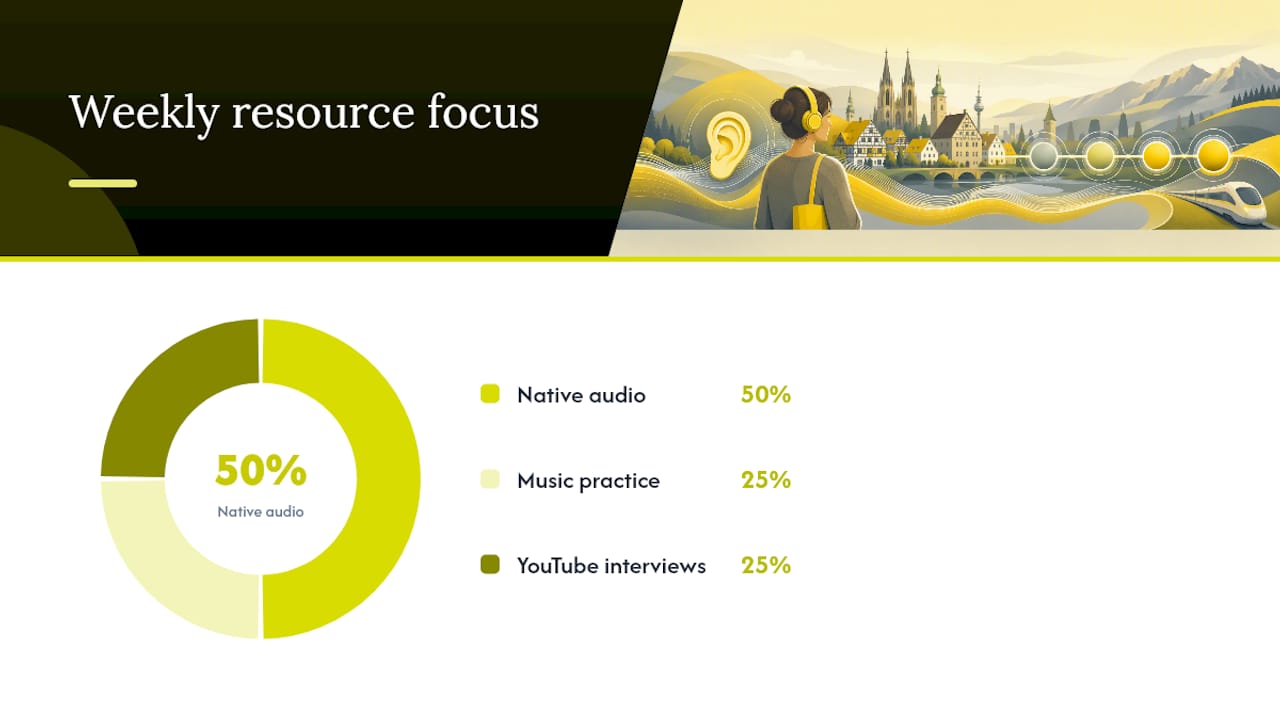
Native audio libraries (for listening and shadowing):
- Deutsche Welle’s Langsam gesprochene Nachrichten (slowly spoken news): ideal for weeks one and two when you need clear, deliberate pronunciation at a manageable pace.
- German pop songs with printed lyrics: songs force you to track rhythm and stress in a way that speech alone doesn’t. The melody locks the stress pattern into memory.
- Short YouTube interviews with German speakers: unscripted speech exposes you to reductions and linking sounds, which is the week-four focus.
AI pronunciation feedback tools: AI-based tools can grade individual sounds and give percentage-based scores, which is useful for identifying which phonemes need the most work. The YourDailyGerman pronunciation tool grades words and individual sounds and works well as a diagnostic. Use it to identify problem sounds at the start of each week, then drill those sounds manually. Don’t use AI feedback as the final judge of your progress — it misses prosody, rhythm, and naturalness. Human feedback from a native speaker or a community catches what the algorithm doesn’t.
Music-based practice with Singwithcanary: Singwithcanary turns song lyrics into ear training for German learners by combining karaoke-style shadowing with vocabulary cards and interactive quizzes. The song-based format is particularly effective for week-three rhythm and stress work because melody makes stress patterns audible in a way that spoken drills don’t. The platform also connects you with other learners for community feedback, which fills the gap that AI tools leave.
Loop a 10–15 second segment until you can shadow it cleanly before moving to the next. Short loops beat long passive listening every time.*
For a broader look at how musical ear training transfers to language learning, the same principles that help musicians develop pitch discrimination apply directly to phoneme discrimination in German.
What to expect at 2, 4, and 8 weeks
Progress in accent work is nonlinear but predictable. Here’s what a consistent 5–15 minute daily routine typically produces:
| Milestone | What you’ll notice | Suggested next step |
|---|---|---|
| Week 2 | Vowel length contrasts are audible; you catch your own long/short errors on playback | Add minimal-pair drills for umlauts |
| Week 4 | CH variants are reliable in drills; rhythm is more consistent; shadowing at 80% speed feels manageable | Start week-four reductions; add a 60-second free monologue daily |
| Week 8 | Free speech shows transfer; native speakers follow you without effort; you self-correct in real time | Add a conversation partner; increase shadowing speed to 100%; start a second 4-week cycle on a new focus |
If you reach week four and CH still feels inconsistent, repeat week two rather than pushing forward. The checklist is a guide, not a contract. The step-by-step listening progression from A1 to B1 confirms that loop listening and short-segment shadowing need time to consolidate before speed increases. Rushing the progression is the most common reason learners plateau at an intermediate level.
At week eight, consider adding a conversation partner or community feedback loop. The benefits of social language practice are well documented: real-time feedback from another speaker catches errors that self-assessment misses, and the social pressure of a real conversation accelerates transfer from drills to natural speech.
What the checklist gets right that most guides miss
Most German pronunciation guides give you a list of sounds to practice and leave you to figure out the order, the frequency, and what “good enough” looks like. This checklist is built differently, and the difference matters.
The Goethe-Institut’s listen-practice-assess cycle isn’t just a nice framework. It’s a feedback loop. Without the assess step, you can practice the wrong thing for weeks and never know it. The record-and-compare method forces that assessment to happen daily, not just at the end of a course.
The ARM routine addresses something even more specific: the gap between controlled practice and spontaneous speech. Most learners can produce a sound correctly when they’re focused on it. The problem is that focus disappears the moment they’re trying to communicate an idea. ARM’s monologue step is the only drill format that replicates that pressure in a safe, low-stakes way.
What I’d push back on in most 30-day challenge formats is the assumption that every learner needs the same four weeks. If your vowels are already solid, skip week one and spend two weeks on rhythm. The checklist is a default order, not a fixed sequence. Use the weekly self-assessment to decide when to move and when to repeat.
Missed a day? Don’t double up. Just continue from where you left off. Doubling up creates fatigue and breaks the habit loop. One missed day in a 30-day program is noise. Three missed days in a row is a pattern worth addressing, and the fix is always the same: shorten the session to five minutes, not zero.
Singwithcanary makes the daily checklist easier to stick with
The hardest part of a 30-day ear-training program isn’t the drills. It’s showing up on day 14 when the novelty has worn off. Singwithcanary is built for exactly that problem: it turns German pronunciation practice into something you actually want to do.
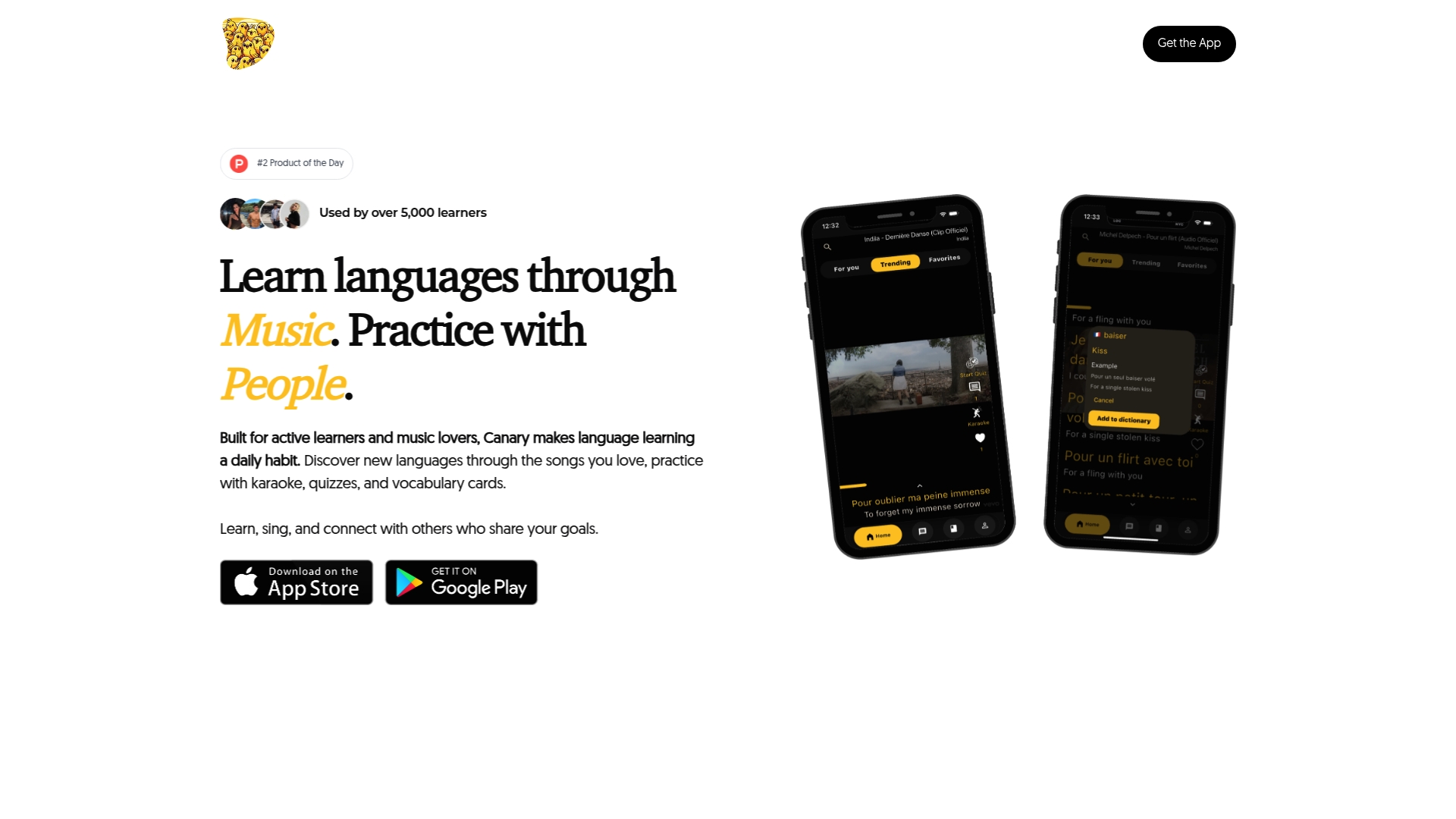
Each session on Singwithcanary pairs a German song with karaoke-style shadowing, vocabulary cards, and listening quizzes that map directly onto the checklist’s weekly focus areas. Week-three rhythm work? The melody does half the teaching. Week-two CH drills? The lyric display highlights the target sound in real time. The platform also connects you with a community of learners for feedback that no AI tool can replicate.
The free tier gives you enough to run the first two weeks of this checklist. The premium subscription unlocks the full song library and interactive features. Sign up at Singwithcanary and use the song of the week as your daily shadowing material starting on day one.
Sources
- Pronunciation training resources — Goethe‑Institut
- Exercises to improve accent and speech clarity — The Accent Coach
- ARM exercises for accent improvement — AccentAmazing
Recommended listening by week:
Pick audio that’s one level above comfortable. If you understand every word, the audio isn’t training your ear anymore.