TL;DR:
- Consistent use of five music-based German listening strategies can significantly improve comprehension and pronunciation within weeks. Engaging in daily fifteen-minute routines that combine focused listening, shadowing, and recall accelerates progress more effectively than irregular long sessions.
Five music-first German listening practice strategies will improve your comprehension and pronunciation within weeks if you use them consistently. A 15-minute daily routine that combines focused listening, shadowing, and recall produces noticeable gains faster than irregular, long sessions.
The five strategies at a glance:
- Karaoke and shadowing: Mimic rhythm, stress, and pronunciation line by line
- Lyric cloze: Fill missing words from a song to sharpen listening-for-form
- Micro-dictation and minimal pairs: Drill German-specific vowel contrasts and consonant clusters
- Level-graded listening: Match audio speed and complexity to your current level
- Active vs. passive balance: Alternate focused drills with background exposure daily
Table of Contents
- Why do these five music-based strategies actually work?
- Step-by-step song exercises you can start today
- How to sharpen your ear with dictation and minimal-pair drills
- Which German listening resources fit your level?
- Sample weekly and 4-week practice plans
- Quick fixes for the most common roadblocks
- Why music-based learning has a real cognitive edge
- Key Takeaways
- Why music-first practice suits motivated learners most
- Singwithcanary puts every drill in one place
- Useful resources to pair with your practice
Why do these five music-based strategies actually work?
Music does something textbooks cannot: it locks pronunciation into memory through melody and rhythm. When you shadow a German song, you are not just repeating words. You are training prosody, the rise and fall of speech that makes German sound natural rather than robotic.
Each strategy targets a specific skill:
- Shadowing trains prosody and pronunciation by forcing immediate production
- Lyric cloze builds vocabulary and listening-for-form simultaneously
- Micro-dictation sharpens phoneme discrimination, especially for umlauts
- Graded listening builds sustained comprehension at the right challenge level
- Active/passive balance creates daily exposure without burnout
Combining listening and speaking from week one builds rhythm and confidence faster than passive listening alone. The reason is simple: production trains perception. When you try to sing a line, your brain pays closer attention to how it sounds the next time you hear it.
Research note: Konversa Global’s structured 15-minute routine divides practice into ear warm-up, focused listening, transcript review, shadowing, and one-line recall — a habit-driven design with measurable short-term gains.
Step-by-step song exercises you can start today
Pick one German song you genuinely like. Tempo matters: choose something with clear diction and a repetitive chorus—not a fast-rap track. A mid-tempo pop song or a folk ballad works well for beginners.
Exercise 1: Karaoke line mimicry (5 minutes)
- Play one verse with the lyrics in front of you.
- Pause after each line and repeat it aloud, matching the melody and stress exactly.
- Do not worry about perfect pronunciation yet. Focus on rhythm.
- Replay the same line twice if you stumble.
- Move to the chorus and repeat the process.
Exercise 2: Shadowing without the transcript (3 minutes)
- Hide the lyrics.
- Play the chorus and repeat each phrase immediately after hearing it.
- Record yourself on your phone.
- Compare your recording to the original. Note where your vowels drift.
Exercise 3: Lyric cloze (5 minutes)
- Print or copy the lyrics and blank out every fifth word.
- Play the song and fill in the gaps as you listen.
- Check your answers against the full transcript.
- Any word you missed gets added to a vocabulary card.
Exercise 4: Translate and sing (5 minutes)
- Read the full lyrics in German and translate them mentally.
- Sing the song once while thinking about meaning, not just sound.
- This step anchors vocabulary to melody, which aids long-term retention.
Pro Tip: Combine all four exercises inside one 15–20 minute session by running them in order on the same song. Using the same song for a full week deepens familiarity faster than switching tracks daily. For pronunciation gains with music, repetition on a single track beats variety every time.
How to sharpen your ear with dictation and minimal-pair drills
German has sounds that simply do not exist in English: the umlaut vowels ü and ö, the front-rounded ü versus the back u, and the infamous schon versus schön contrast. These are not just spelling differences. They change meaning entirely.
Micro-drill templates (30–90 seconds each):
- Umlaut recognition: Play a short lyric clip and write down every word containing ü, ö, or ä. Check against the transcript.
- Consonant cluster drill: Isolate a line with clusters like str, pfl, or sch and repeat it five times at slow speed, then normal speed.
- Minimal-pair dictation: Listen to a line containing schon/schön or kann/kenn and write what you hear. Replay and correct.
Short dictation protocol:
- Listen to a 20–30 second clip twice for gist only. Do not write yet.
- Play it again sentence by sentence and transcribe what you hear.
- Compare your transcript to the original lyrics.
- Circle every error and replay just those sections using loop mode.
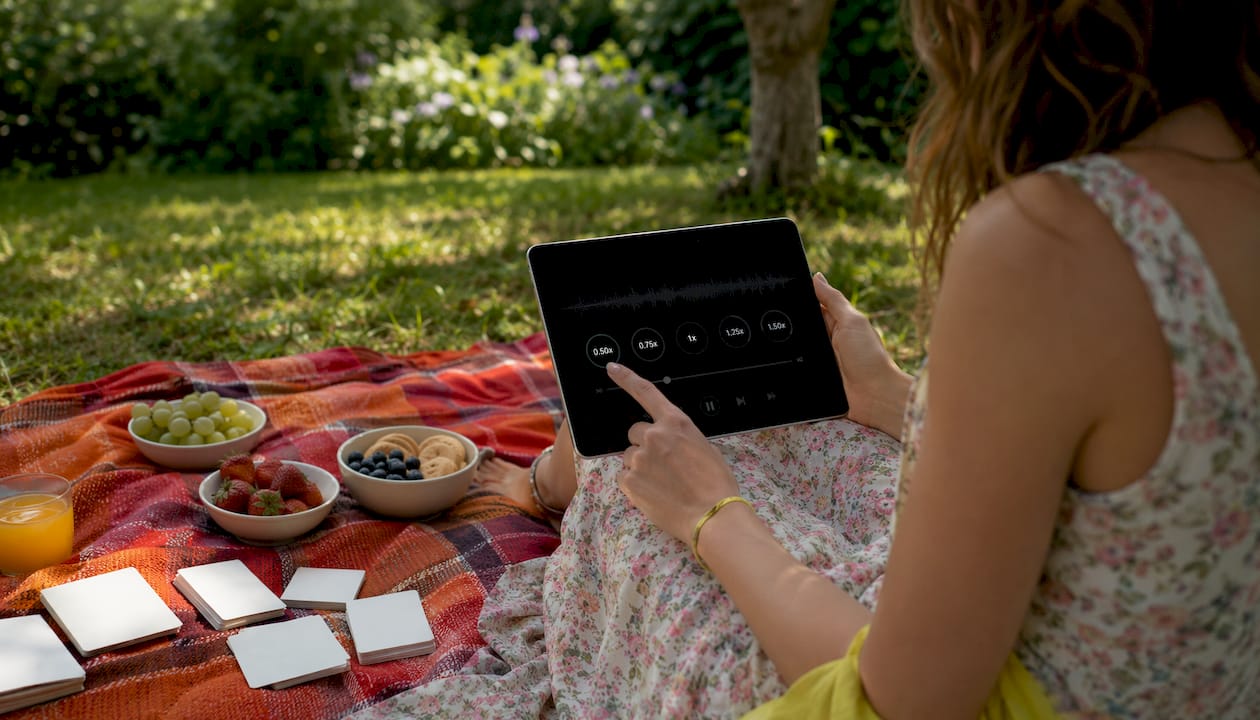
Slowed audio is your best friend for this. Most music apps and YouTube allow playback at 0.75x speed. Use it to isolate a problematic stretch, then bring it back to 1x once you can hear the contrast clearly. For a deeper look at ear training techniques, the connection between minimal-pair work and karaoke drills is worth exploring.
Which German listening resources fit your level?
Not all German audio is created equal. A native podcast at full speed will frustrate an A2 learner; slow news will bore a B2 learner. Matching audio speed and complexity to your level is one of the most practical things you can do to keep progress moving.
| Resource | Primary goal | How to adapt by level |
|---|---|---|
| German pop songs (Spotify playlists) | Prosody, vocabulary, pronunciation | A1–A2: slow ballads; B1+: normal tempo pop |
| Slow German podcast | Sustained comprehension, clear speech | A2–B1: listen once; B2: no transcript |
| Deutsche Welle Langsam gesprochene Nachrichten | News vocabulary, clear pronunciation | A2–B1: with transcript; B2: transcript after |
| Easy German (YouTube) | Connected speech, real-world German | B1: with subtitles; B2+: subtitles off |
| Goethe-Institut exercises | Structured comprehension across all levels | A1–C2: use their 260+ free exercises |
Playback tips that make a real difference:
- Use 0.75x speed on any resource when a section is unclear, then return to 1x
- Loop a single 10–15 second clip until you can transcribe it without pausing
- Download transcripts before listening, but cover them during the first pass
- Build a Spotify playlist of 5–10 German songs at your level and rotate one per week
Sample weekly and 4-week practice plans
Consistency beats intensity. A structured daily habit of 15 minutes outperforms a two-hour weekend session every time.
7-day starter plan (15–20 minutes per day)
- Monday: Ear warm-up (2 min) + karaoke line mimicry on your chosen song (8 min) + passive listening during commute (10 min background)
- Tuesday: Micro-dictation drill on one verse (10 min) + minimal-pair practice (5 min)
- Wednesday: Lyric cloze exercise (10 min) + Slow German episode, gist only (10 min)
- Thursday: Shadowing without transcript (10 min) + record and compare (5 min)
- Friday: Translate-and-sing (10 min) + Deutsche Welle slow news clip (10 min)
- Saturday: Full 20-minute session combining all four song exercises on the same track
- Sunday: Passive listening only. Play German music while cooking or exercising.
4-week progressive plan
| Week | Focus | Active time | Target outcome |
|---|---|---|---|
| 1 | Karaoke + shadowing on one song | 15 min/day | Recognize word boundaries in the chorus |
| 2 | Add lyric cloze + minimal-pair drills | 15–20 min/day | Transcribe the chorus accurately |
| 3 | Introduce graded podcast (Slow German or DW) | 20 min/day | Summarize a 2-minute clip in 2–3 sentences |
| 4 | Mix song drills + podcast + recorded readback | 20 min/day | Record a fluent one-minute readback of lyrics |
Realistic timelines: With daily practice, A1 learners typically notice clear listening gains within 2–3 months. B1/B2-level improvements with structured training tend to take 6–9 months. Progress is real before those milestones, though. Most learners notice faster word recognition and better vowel discrimination within the first two to three weeks.
Track two simple metrics:
- Dictation accuracy: what percentage of a 30-second clip can you transcribe correctly?
- Recorded fluency: how many seconds can you read back a lyric passage without stopping?
Quick fixes for the most common roadblocks
You can’t keep up with the native pace. Slow the playback to 0.75x and loop a single line until you can follow it. Then return to 1x. Never try to keep up with a full song at speed before you can handle one line.
The sung lyrics sound different from the spoken version. They often are. Singers compress syllables, drop endings, and shift stress for rhythm. Use the transcript to reconcile what you hear with what is written, then practice the spoken version separately.
Your singing sounds unnatural. Record yourself, then compare. Usually the problem is vowel length: German vowels are longer and more distinct than English ones. Practice the minimal pair in isolation before putting it back into the song.
Common micro-habits to avoid:
- Relying on subtitles for every listen. Cover them on the second pass.
- Trying to mimic a regional accent before you can produce standard High German clearly.
- Switching songs every session. Stick with one track for a full week.
- Translating every word mentally while listening. Train gist first, detail second.
Why music-based learning has a real cognitive edge
Music-based listening works because rhythm supports prosody, melody aids memory encoding, and active repetition strengthens the motor patterns behind pronunciation. These are not abstract claims. They reflect how the brain processes and stores language.
Shadowing and karaoke reinforce listening because production trains perception. When you try to produce a sound, your auditory system becomes more sensitive to that sound in future input. That feedback loop is what makes song-based drills more efficient than passive listening alone.
Singwithcanary is built around exactly this mechanism. The platform’s immersive German learning workflow combines karaoke, lyric-focused vocabulary cards, quizzes, and ear-training features in a single app, so the feedback loop runs automatically inside every session.
Key Takeaways
Music-first German listening practice works because it trains prosody, pronunciation, and vocabulary simultaneously through the same feedback loop that connects production to perception.
| Point | Details |
|---|---|
| Daily 15-minute habit | A structured 15-minute daily routine produces noticeable listening gains faster than irregular long sessions. |
| One song per week | Sticking with one track for a full week deepens familiarity and pronunciation accuracy faster than switching daily. |
| Two metrics to track | Measure dictation accuracy and recorded one-minute fluency to see concrete progress week over week. |
| Level-matched resources | Use slow ballads and Slow German at A1–A2; add Easy German and DW news at B1–B2 for the right challenge. |
| Singwithcanary | Singwithcanary’s karaoke, lyric cloze, ear-training, and quiz features put all five strategies inside one app. |
Why music-first practice suits motivated learners most
The conventional wisdom says to build listening skills by consuming as much German audio as possible. That advice is not wrong, but it is incomplete. Volume without structure produces slow gains and a lot of frustration.
What actually works for motivated learners is the combination of deliberate repetition and genuine enjoyment. Music delivers both. When you care about a song, you replay it voluntarily. That voluntary repetition is where the real learning happens, not in the forced third listen you push through out of obligation.
The social dimension matters too. Practicing pronunciation in isolation is useful, but practicing with other learners or native speakers accelerates feedback and builds confidence faster. A music-first platform that adds social interaction to song-based drills is not a gimmick. It is the closest thing to a real immersive environment most learners outside Germany will ever access.
Singwithcanary puts every drill in one place
If you have been running these exercises across five different apps and a browser tab of lyrics, there is a simpler path. Singwithcanary is built specifically for music-first language learners who want karaoke drills, lyric cloze, ear training, vocabulary cards, and social practice in one place, without stitching together a DIY toolkit.
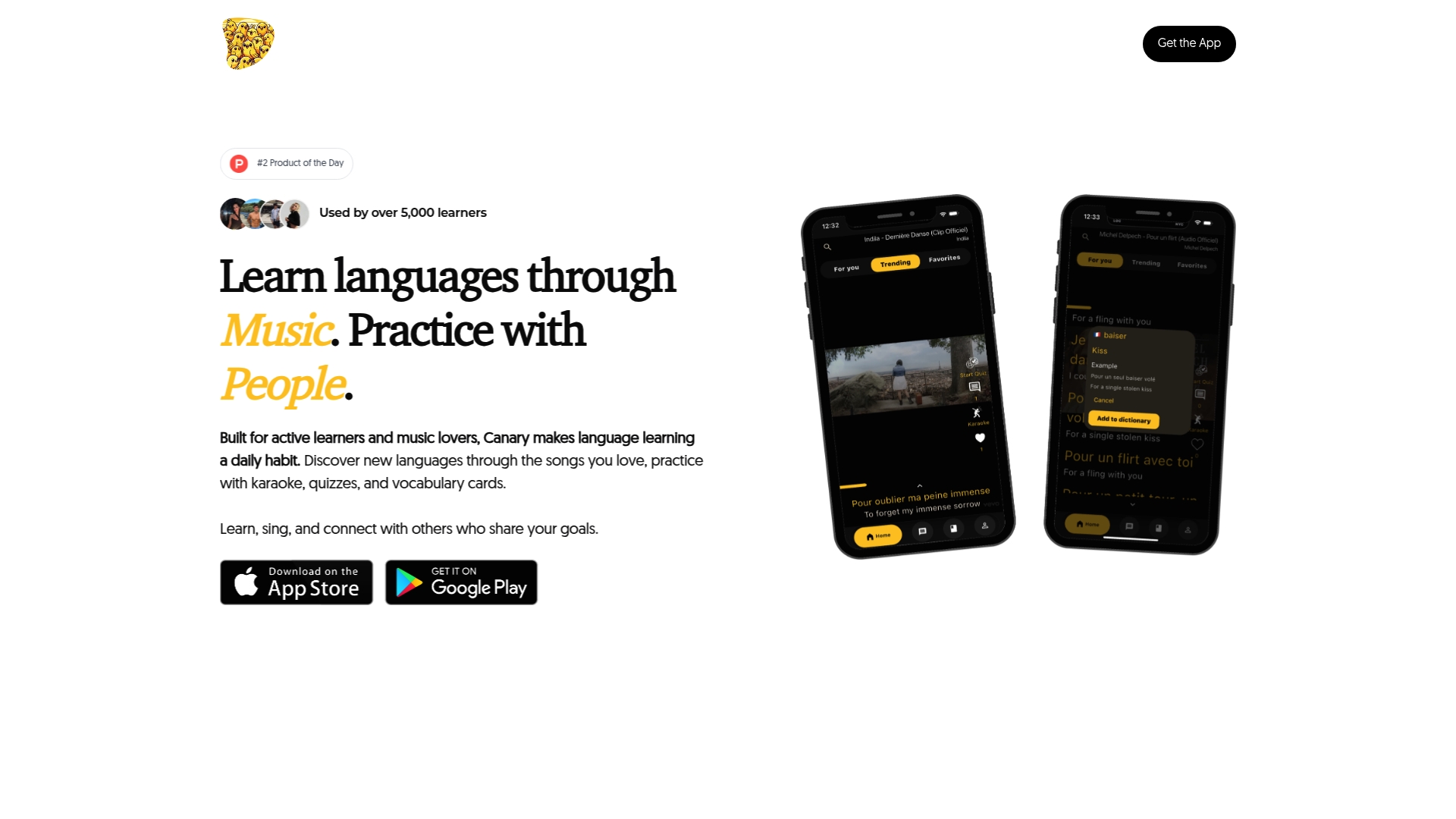
The app maps directly to the exercises in this article: karaoke mode for shadowing and line mimicry, lyric-gap quizzes for cloze practice, ear-training features for minimal-pair work, and a community of learners to practice with. Learners report real gains in accent quality and vocabulary retention, and the format makes the daily 15-minute habit easy to maintain because it feels like listening to music, not studying.
Getting started takes three steps: download the app, pick a German song from the library, and run the 15-minute routine from this article inside the platform. Or try the song of the week feature for a curated, ready-to-practice track with all exercises pre-loaded.
Useful resources to pair with your practice
- Deutsche Welle Langsam gesprochene Nachrichten: Slow-paced German news read at roughly 60% of normal speed. Use it at A2–B1 with the transcript; at B2, listen first and check the transcript after. Available free at dw.com.
- Slow German (podcast by Annik Rubens): Short episodes on everyday German topics, spoken slowly and clearly. A2–B1 learners can follow without a transcript after a few weeks of consistent listening.
- Easy German (YouTube): Street interviews with real Germans, subtitled in both German and English. At B1, watch with German subtitles only. At B2+, turn them off entirely.
- Spotify German-language playlists: Search “Deutschpop” or “Deutsche Hits” for curated playlists. Use the music-based learning methods guide to match playlist tempo to your level.
- Goethe-Institut free exercises: More than 260 exercises, films, and podcasts covering A1 through C2. Use the interactive comprehension exercises after a song session to reinforce what you practiced.