TL;DR:
- Online learning communities boost motivation and reduce isolation by fostering peer support and group interaction. Incorporating music enhances memory, pronunciation, and emotional engagement, accelerating language acquisition. Combining community with structured practice ensures comprehensive fluency and authentic cultural integration.
Most people picture language learning as a lonely grind: flashcards at midnight, grammar drills, and muted frustration. But online learning communities support motivation and reduce isolation by enabling peer support and group interaction, which turns out to be one of the most powerful forces behind real fluency. When you mix that social energy with music, something remarkable happens. This guide breaks down exactly how community and song work together to speed up learning, strengthen memory, and make the entire process genuinely enjoyable.
Table of Contents
- How community transforms language learning
- Why music amplifies community learning
- Community methods in action: What works and what to watch out for
- Choosing and using the right community space
- Integrating local communities and language norms
- The uncomfortable truth about community language learning: Why structure still matters
- Take your language journey further with music and community
- Frequently asked questions
Key Takeaways
| Point | Details |
|---|---|
| Community boosts motivation | Active engagement in a language community keeps you accountable, encouraged, and consistent in your studies. |
| Music enhances learning | Layering music with social interaction helps vocabulary, pronunciation, and memory retention. |
| Balance creativity with structure | Combine open-ended community methods with systematic study to avoid missing key skills. |
| Local norms matter | Engaging with target-language speakers—online and in person—accelerates norm adoption and confidence. |
How community transforms language learning
Now that we’ve set the myth straight, let’s dig deeper into how community-based language learning works.
Most learners quit alone. That’s not a personality flaw. It’s a design flaw in how we think about language study. When you’re grinding through a textbook in isolation, there’s no one to celebrate your wins, no one to push back when you make the same mistake twice, and no one to remind you why you started. Community fixes all of that.
Online language-learning communities boost motivation by creating a structure of social accountability. When someone else is counting on you to show up for a study session or a group singalong, you’re far less likely to bail. Motivation stops feeling like a personal responsibility and starts feeling like a shared one.
Here’s what a healthy language community looks like in practice:
- Peer accountability: Members check in on each other’s progress, share milestones, and nudge each other when someone goes quiet.
- Resource sharing: Recommendations for great songs, YouTube channels, podcast episodes, and reading materials flow freely.
- Real-time feedback: You can ask a native speaker whether your pronunciation sounds natural, and get an honest answer within minutes.
- Emotional support: Anxiety around speaking is real. A supportive community normalizes mistakes and celebrates the courage it takes to try.
| Solo learning | Community learning |
|---|---|
| Self-motivated only | Peer accountability |
| No immediate feedback | Real-time corrections |
| Fixed resources | Shared, curated materials |
| High dropout risk | Group momentum reduces quitting |
| Speaking anxiety builds | Supportive environment lowers anxiety |
“The sense of belonging that comes from a language community doesn’t just feel good. It directly impacts how long and how hard you’re willing to practice.”
The transformative power of community goes far beyond motivation. It changes the emotional texture of learning entirely. Speaking a new language feels vulnerable. Having people in your corner, who are going through the same experience, makes that vulnerability bearable, even exciting.
Pro Tip: Join a community where members are at mixed levels. Beginners gain inspiration from advanced learners, and advanced learners reinforce their own knowledge by helping beginners. Both sides win.
Why music amplifies community learning
Understanding why community matters, let’s see why adding music takes everything to the next level.
Language and music are processed in overlapping regions of the brain. That’s not a coincidence. Music is essentially a memory delivery system wrapped in emotion. When you learn vocabulary through a song, you’re attaching that word to a melody, a rhythm, a mood, and often a visual of the lyrics on screen. That’s four memory hooks instead of one.
Pedagogical guidance recommends learning from songs across multiple layers: sound, text, and visual context. This multilayered approach means that when you hear a word you learned in a song, your brain pulls it up faster because it has more pathways to follow. That’s why you still remember the lyrics to songs from ten years ago, even if you’ve forgotten what you had for breakfast.
Here’s how music turns passive exposure into active language use, especially in a community setting:
- Listen first, feel the rhythm. Before dissecting lyrics, let the song wash over you. Your ear is training itself to the natural flow of the language.
- Read along with lyrics. Connecting sound to written text builds reading and listening skills simultaneously.
- Sing it out loud. Pronunciation improves fastest when you’re mimicking melody, because you’re forced to match pitch, stress, and rhythm.
- Break down lyrics with your community. Group lyric analysis uncovers idioms, slang, and cultural references you’d never catch solo.
- Recreate or remix. Try rewriting a verse, performing it for the group, or comparing translations. This is where deep learning happens.
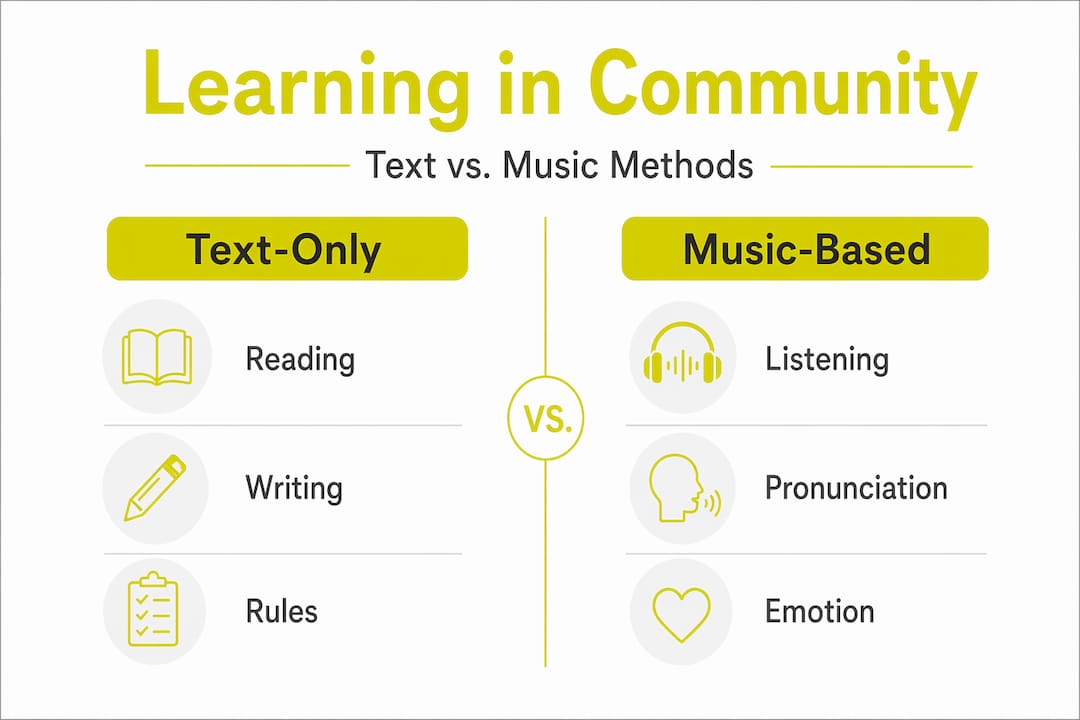
| Text-only community | Music-based community |
|---|---|
| Reading and writing focused | Multisensory engagement |
| Limited pronunciation support | Natural pronunciation modeling through song |
| Lower emotional engagement | High emotional resonance |
| Structured but dry | Structured and enjoyable |
| Harder to sustain daily habit | Music creates a natural daily ritual |
Music-based pronunciation communities offer something that traditional forums simply can’t: the experience of hearing the language at its most natural and expressive. Singers don’t read from a textbook. They elongate vowels, drop syllables, and blend words in ways that mirror real conversation. That’s the authentic input you need.
You can also boost skills with music through collective listening sessions where members vote on songs to study each week, discuss their favorite lines, and share what they learned. The social layer turns a solo listening habit into a shared cultural experience.
Pro Tip: Choose songs you actually love, not songs you think are “educational.” Emotional connection to the music dramatically increases how much vocabulary you absorb and retain.
Community methods in action: What works and what to watch out for
Once you see the appeal of music-based communities, it’s time to explore how these methods play out in the real world and where to be careful.
Group conversations are the cornerstone of community language learning. When you sit in a discussion with fellow learners, even virtually, you’re practicing the thing that matters most: real, spontaneous communication. You learn to tolerate ambiguity, recover from misunderstandings, and find your footing in a live conversation. These are skills that no flashcard can teach you.

Learner-generated content is another powerful tool. When a group of learners writes new lyrics to a familiar melody, or translates a song together and debates which version sounds more natural, they’re doing applied linguistics without knowing it. The process is creative, collaborative, and deeply memorable.
What works best in community settings:
- Peer-led discussions about song meanings, cultural context, and vocabulary
- Group karaoke challenges where members record themselves singing and share for feedback
- Lyric writing exercises that push learners to use new vocabulary in creative ways
- Accountability pairs who check in weekly on learning goals
- Virtual events like themed listening parties or “song of the week” discussions
But here’s the honest truth: community language learning methods emphasize group interaction and can reduce anxiety, but the lack of a fixed syllabus may cause gaps in coverage. If every session is driven by whatever the group feels like discussing, you might spend three weeks on travel vocabulary and never touch the present perfect tense.
The gap risk is real. Without a structured framework, learners in community settings can plateau. They get very comfortable in their conversational niche while avoiding the grammar or pronunciation issues they never had to face. The social environment that makes learning enjoyable can also make it too easy to stay comfortable.
Social interaction’s role in language acquisition is best understood as a catalyst, not a complete system. Think of community as the engine that keeps you running and structured resources as the map that makes sure you’re headed somewhere useful.
Pro Tip: At least once a month, audit your own skills honestly. Which areas are you avoiding in group conversations? That gap is probably where your next big breakthrough is hiding.
Choosing and using the right community space
Now that you know what works and what to look out for, let’s pick the best community space and make the most of it.
Not all communities are created equal. Some are buzzing with daily activity, regular events, and genuine mutual support. Others are ghost towns with a few pinned posts and no real interaction. Knowing what to look for saves you from investing your time and enthusiasm into a space that won’t give anything back.
Seek out spaces with peer-mediated interaction: discussions, group activities, and shared accountability structures. A healthy community has members who are actively helping each other, not just posting content and disappearing.
What to look for in a great language learning community:
- Active discussion threads with real back-and-forth conversation, not just announcements
- Regular events such as singalongs, listening parties, vocabulary challenges, or live sessions
- Clear community guidelines that keep the environment respectful and focused
- Mixed proficiency levels so you’re always challenged and always able to contribute
- Song-based activities that bring grammar and vocabulary to life through music
- Accountability structures like weekly check-ins, progress sharing, or partner pairing
Once you find your space, consistent participation matters more than perfect participation. Showing up regularly, even for short bursts, compounds over time. Think of it like practicing an instrument. Fifteen focused minutes every day beats three-hour weekend marathons.
Social music practice tips include organizing virtual “open mic” nights, starting a book club focused on song lyrics, or running a community translation challenge where members vote on the best version of a lyric in the target language.
Integrating local communities and language norms
After weighing your community options, it’s time to connect with the broader world and see how local norms come to life in language use.
One of the most underrated aspects of language learning is norm adoption: picking up the way native speakers actually talk, not just the way textbooks say they should talk. This is where local or target-language community integration becomes crucial.
Local target-language community integration helps propagate local vernacular norms among learners. In plain terms: when you regularly interact with people who use the language in authentic contexts, you naturally absorb slang, rhythm, register, and cultural meaning in ways that formal study cannot replicate.
Song lyrics are one of the richest sources of this authentic language. When a Spanish singer drops a regional idiom or a French rapper uses a slang term that no textbook would include, you’re getting a direct line into living language. Group discussion around those lyrics, especially with native speakers, turns that exposure into true understanding.
“The learners who progress fastest aren’t the ones who study the hardest in isolation. They’re the ones who build bridges to real communities where the language is alive.”
Practical ways to integrate authentic community:
- Virtual language exchanges with native speakers who share your taste in music
- Karaoke nights in a target-language community, in person or online
- Joining social media groups in your target language around shared interests
- Commenting and engaging on music platforms in the target language
Music-fueled language exchange accelerates this process by giving you an immediate shared interest with native speakers. You don’t need to manufacture small talk when you’re both obsessed with the same album.
The uncomfortable truth about community language learning: Why structure still matters
Having explored both the promise and potential pitfalls, let’s step back for a reality check no one else is telling you.
Here’s what most language learning content won’t say directly: community alone isn’t enough. That’s not a knock on social learning. It’s an acknowledgment that fluency requires breadth, not just depth in comfortable areas.
Community-native methods may leave gaps when not paired with systematic coverage. A learner can spend years in a vibrant music-based community and still struggle with formal writing, certain verb tenses, or pronunciation in unfamiliar contexts. Why? Because communities naturally gravitate toward what’s fun and easy. Challenging grammar doesn’t make for a great singalong topic.
The solution isn’t to abandon community. It’s to use community as your primary fuel while layering in structured resources to fill the cracks. A vocabulary quiz built around song lyrics. A tips to boost vocabulary practice that ties directly to what you’ve been singing. A pronunciation check from a tutor every few weeks to catch habits you’ve developed without realizing it.
Think of it this way: community gives you the want to keep going. Structure gives you a clear direction. You need both. The learners who reach genuine fluency aren’t choosing between social learning and systematic study. They’re doing both at once, using music as the thread that connects the two worlds.
The most honest advice we can offer? Don’t wait until you’re “ready” to join a community or until you’ve “finished” your grammar course. Jump in now, bring your love of music, accept the gaps, and build the structure around the edges. You’ll progress faster than you ever thought possible.
Take your language journey further with music and community
Ready to amplify your progress? Step into a thriving music-and-language community designed for your growth.
If this article has shown you anything, it’s that language learning is a social sport, and music is the universal language that brings everyone to the table. At Canary, we’ve built the exact kind of community this article describes, one where your love of music becomes your greatest learning advantage.
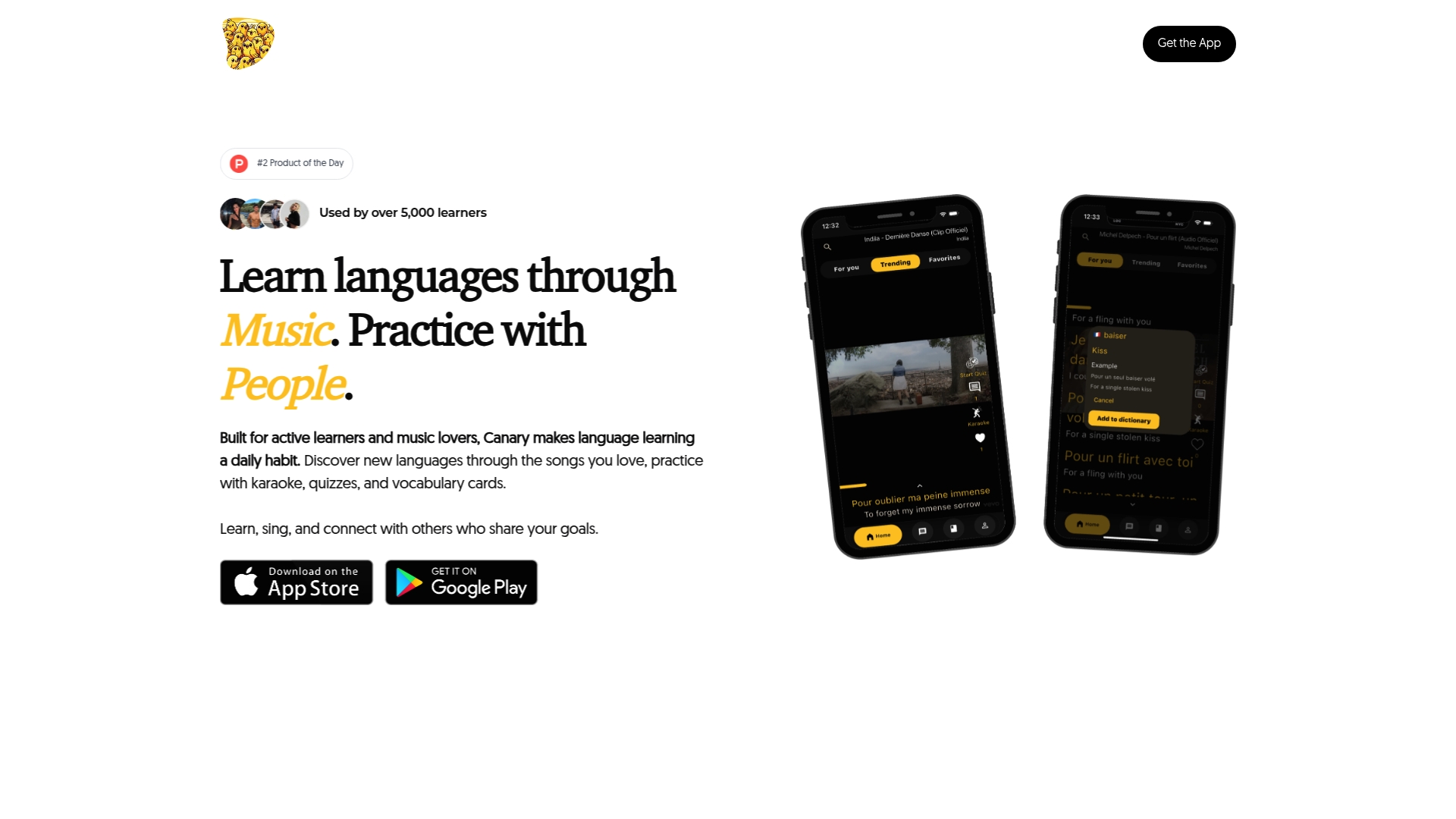
Learn languages with music through karaoke-style features, vocabulary cards, and pronunciation practice that are all anchored in real songs you actually want to hear. Join our Song of the Week community, where learners from around the world gather to dissect lyrics, practice pronunciation, and celebrate progress together. With interactive language communities that keep you accountable and motivated, Canary turns daily practice into something you genuinely look forward to. Your next language breakthrough might just start with your favorite song.
Frequently asked questions
How does joining a language community help overcome motivation slumps?
Language communities provide peer support, shared accountability, and group activities that keep you engaged even when solo study feels impossible. Well-designed communities reduce isolation and give motivation a social foundation that’s far more durable than willpower alone.
What’s the best way to combine music with community language practice?
Use songs as natural input by listening first, then bring your observations to a group discussion, singalong, or lyric analysis session. Pedagogical frameworks recommend combining sound, text, and social interaction with music for the deepest learning effect.
Can community methods replace classroom or app-based study?
Community methods are powerful for engagement and confidence, but they work best when combined with structured study. Combining methods is often most effective because community fills motivation gaps while structured resources fill knowledge gaps.
Does local community integration matter if I’m learning online?
Absolutely. Even online, connecting with native speakers and target-language communities exposes you to authentic vocabulary and cultural norms you won’t find in a textbook. Local community involvement supports real language norm adoption and accelerates cultural fluency alongside linguistic fluency.