TL;DR:
- Passive listening alone rarely improves pronunciation or vocabulary; deliberate ear training is essential for recognition of speech sounds. Effective methods like high-variability phonetic training involve practicing with multiple speakers, varied contexts, and immediate feedback to improve perceptual skills and long-term language gains. Using songs thoughtfully, with targeted tasks and regular short sessions, enhances motivation and complements structured ear training for sustainable language improvement.
You’ve probably spent hours playing your favorite foreign-language songs on repeat, hoping your accent would magically improve. It’s a tempting shortcut, and the fun of it makes it feel productive. But passive listening, even with music you love, rarely moves the needle on pronunciation or vocabulary. The missing link is ear training, which means actively developing your ability to hear and distinguish new speech sounds. In this article, you’ll learn exactly how ear training works, what the research says about song-based learning, and how to combine both for real, lasting language gains.
Table of Contents
- What is ear training and why does it matter for language learners?
- How evidence-based ear training methods work
- Does song-based learning really help with pronunciation and vocabulary?
- Pairing ear training with music: Best practices and common pitfalls
- Why ear training with music is not a magic bullet—and what actually works
- Ready to level up your language skills with music?
- Frequently asked questions
Key Takeaways
| Point | Details |
|---|---|
| Perception precedes production | You need to hear new language sounds accurately before you can speak or understand them well. |
| Active ear training works best | Using varied input, feedback, and short, focused practice leads to faster skill gains than passive listening. |
| Songs can motivate learning | Music boosts engagement, but the right song choice and structured tasks maximize pronunciation and vocabulary results. |
| Avoid background music pitfalls | Listening to music in the background can hurt comprehension, so use songs actively during training. |
What is ear training and why does it matter for language learners?
Ear training, in the context of language learning, means deliberately practicing your ability to recognize and distinguish the individual speech sounds, known as phonemes, that exist in your target language. It’s not about whether you enjoy music or have a good memory. It’s about retraining your brain to hear sound contrasts that your native language never required you to notice.
Think about a Japanese speaker learning English. The “r” and “l” sounds in English are genuinely difficult because Japanese uses a single consonant that sits somewhere between both. The problem isn’t lack of effort. The problem is perception. As researchers at learnenglishsounds.com explain, pronunciation is constrained by the ear’s ability to discriminate phonemic contrasts, meaning perception must improve before accurate production can happen. You can’t say a sound you can’t hear.
This is why so many adult learners hit a wall. They practice speaking, they take lessons, and they even live in the country where the language is spoken. But if they’re not doing targeted ear training, their brain keeps filtering new sounds through the lens of their first language.
Here’s what ear training actually involves for language learners:
- Identifying minimal pairs: Listening to word pairs that differ by just one sound, like “ship” and “sheep,” and training yourself to hear the difference
- Distinguishing tone and stress patterns: In languages like Mandarin or Thai, pitch changes meaning entirely
- Recognizing sounds in different voices and contexts: A word sounds different from a man, a woman, a child, and in fast speech
- Getting immediate feedback: Knowing whether your perception was correct after each attempt
“The ability to perceive a sound accurately is the foundation for producing it accurately. Without deliberate practice targeting problem sounds, learners often reach a plateau where no amount of speaking practice creates a breakthrough.”
Pro Tip: Start your ear training by identifying exactly which sounds in your target language don’t exist in your native language. Focus your first month there, not on sounds you already recognize easily.
There are so many language learning methods for music lovers that combine listening with structure, and understanding which sounds to target first makes all of them more effective.
How evidence-based ear training methods work
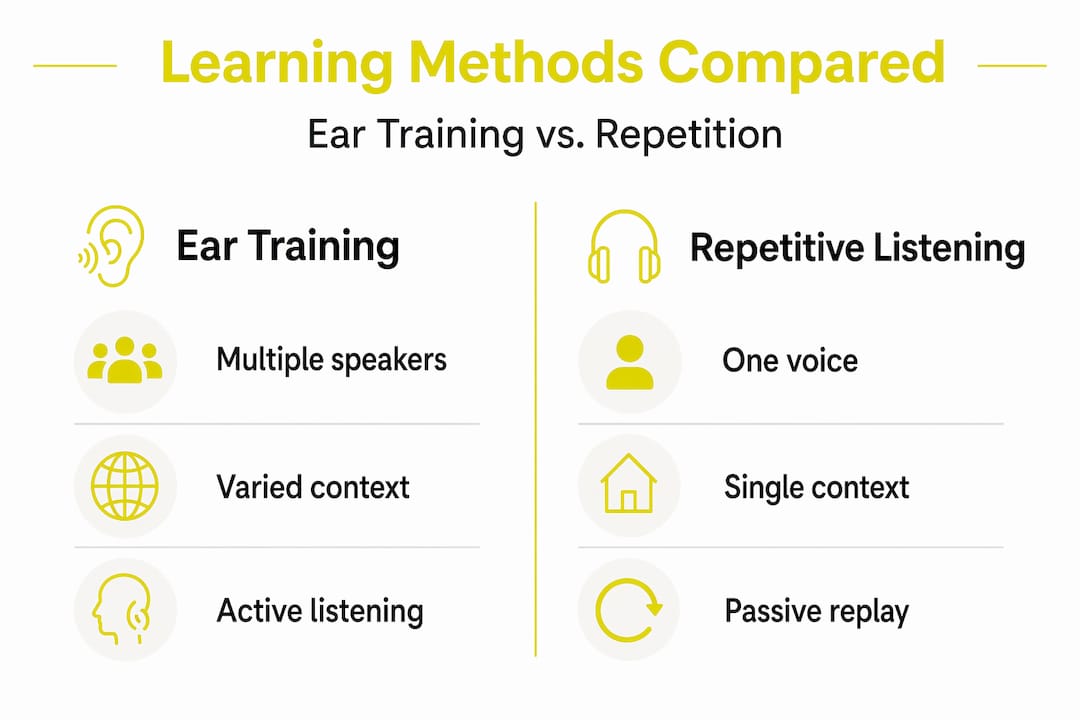
So what does effective ear training actually look like, according to research? The most powerful approach studied so far is called High-Variability Phonetic Training, or HVPT. The core idea is simple but counterintuitive: learning to hear sounds is faster when you hear them from many different speakers, in many different contexts, rather than from one voice repeating the same word.

HVPT produces medium-to-large effects on second language speech perception, with results that hold up over time. This is a big deal because many language learning interventions show short-term gains that fade within weeks. HVPT gains stick.
Here’s what the method involves in practical terms:
| HVPT element | What it means in practice |
|---|---|
| Multiple speakers | Hear the same sound from men, women, children, different accents |
| Varied contexts | Same sound in different words and sentence positions |
| Immediate feedback | Know right away if your perception was correct or not |
| Spaced repetition | Return to difficult contrasts across multiple sessions |
| Short, focused sessions | 10 to 20 minutes works better than 90-minute marathons |
Notice how different this is from replaying the same song 50 times. One voice, one melody, one context. That’s the opposite of high-variability training.
The role of feedback in language learning is especially important here. Without feedback, your brain doesn’t know whether it heard something correctly. With feedback, it can adjust and recalibrate. This is why passive listening hits a ceiling so fast.
Here’s a practical four-step ear training framework you can apply starting today:
- Identify your hard sounds: Use a pronunciation guide or ask a native speaker which pairs trip up learners from your language background
- Find multiple voices: Use recordings from at least three or four different speakers for the same target sounds
- Practice in short bursts: Set a timer for 12 to 15 minutes and focus entirely on one sound contrast per session
- Track your accuracy: Keep a simple log of how many you got right. Patterns in your errors tell you exactly where to focus next
Pairing this framework with song-based activities for fast language progress gives you the structure of HVPT with the engagement of music. That combination is more sustainable for most people than drills alone.
Does song-based learning really help with pronunciation and vocabulary?
Here’s the nuanced truth: music and songs can genuinely help with language learning, but not in the way most people assume. The benefits aren’t automatic. They depend heavily on how you use songs, what tasks you build around them, and who you are as a learner.
Research comparing spoken and sung input shows a more complex picture than the popular “songs make learning easy” narrative suggests. A Cambridge University study found that effects depend on task and learner, and some studies show spoken input is more effective for older learners in specific word-learning tasks. This doesn’t mean music is useless. It means music is a tool, not a guarantee.
Here’s a clear-eyed comparison of what songs do and don’t deliver for adult language learners:
| What songs help with | What songs don’t reliably help with |
|---|---|
| Listening engagement and motivation | Grammatical accuracy |
| Vocabulary through repetition and melody | Fast-speech comprehension in real conversations |
| Pronunciation rhythm and intonation | Distinguishing minimal pairs |
| Cultural and emotional connection to the language | Formal register and professional vocabulary |
| Making daily practice feel enjoyable | Replacing structured feedback |
Songs shine when they pull you into daily contact with the language. Motivation matters enormously for long-term learning. A learner who practices 15 minutes every day because they love the music will almost always outperform someone who does occasional two-hour study sessions out of obligation.
Here’s what the research and real-world experience confirm about effective song-based learning:
- Songs with clear pronunciation and moderate pace work better for beginners than fast or heavily stylized tracks
- Singing along out loud activates production in addition to perception, which reinforces learning more than passive listening
- Focusing deliberately on specific words or phrases within a song creates much deeper encoding than general enjoyment
- Using audio-based methods for language practice alongside songs adds variety and trains your ear for real conversational input
You’ll find excellent examples of learning with music that show how targeted tasks transform a song session from entertainment into genuine language practice. The benefits of song-based language learning are real, but they’re unlocked by what you do with the music, not just by listening to it.
Pairing ear training with music: Best practices and common pitfalls
Now that you understand both the power and the limits of music for language learning, here’s how to actually combine ear training with songs so you get the most out of every session.
The core principle is this: treat songs as a scaffold for targeted listening, not as background entertainment. Music playing softly while you do grammar exercises is not ear training. It might even make things worse. As a recent scoping review found, background music and lyrics can sometimes interfere with linguistic processing, especially during reading or comprehension tasks. The brain can only focus on so much at once.
“Music-mediated learning works best when the music is the object of attention, not an ambient backdrop. The moment lyrics become wallpaper, most of the phonetic benefit disappears.”
Here’s a step-by-step approach to building effective ear training sessions around music:
- Select songs with intention: Choose tracks where the singer’s pronunciation is clear. For beginners, ballads and acoustic music tend to be easier to follow than fast rap or heavily produced pop
- Pre-listen without lyrics: Play the song once and just notice sounds. Which words do you not recognize? Which sounds seem unfamiliar?
- Target one sound per session: Pick a phoneme that appeared in the song and listen specifically for it each time it occurs
- Sing or speak along in short sections: Pause after each phrase, imitate the pronunciation, then listen again to compare
- Mix up your songs and singers: Rotate through different genres, genders, and accents to replicate the variety principle from HVPT
- Use fill-in-the-lyrics tasks: Cover a section of the lyrics and try to write what you hear. Then check. This forces active listening
Pro Tip: After mimicking a singer’s pronunciation, record yourself and play it back. Most people are surprised how different their production sounds from what they thought they were saying. This gap is exactly what ear training closes over time.
Avoid these common mistakes that undercut your progress:
- Listening passively on repeat: Your brain habituates to familiar input and stops processing it closely
- Skipping feedback: If you never check whether you heard or said something correctly, you’re practicing without learning
- Sticking to one singer: This creates a narrow perception that doesn’t transfer well to real conversations with new speakers
- Using music as multitasking background: This is the #1 way to feel like you’re learning while actually making very little progress
Explore methods for song-based learning that build these principles into ready-made activities, and dig into the educational benefits of music in language learning to understand why this approach is worth the extra effort.
Why ear training with music is not a magic bullet—and what actually works
Let’s be direct about something: music is one of the most powerful motivational tools in language learning, but motivation alone doesn’t create fluency. We’ve seen learners who spent years listening to their favorite foreign-language artists, loving every minute of it, and still struggle to understand native speakers in real conversations. The experience is real, but the progress is slower than it could be.
The hard-won truth is that your favorite track will only take you so far. Listening to the same three albums by the same artist essentially gives you one voice repeated hundreds of times. It feels productive because you’re engaged. But engagement and learning are not the same thing.
What actually moves adult learners forward is the combination of deliberate perceptual practice with variety and feedback built in. HVPT principles applied to music means rotating songs constantly, across genres, genders, and regional accents. It means designing tasks around specific sounds rather than general enjoyment. It means checking yourself regularly instead of assuming progress is happening.
Here’s the most overlooked truth: short, focused sessions beat long passive ones every single time. Twenty minutes of active ear training with a song, where you’re listening for specific phonemes, mimicking, and checking your accuracy, produces more measurable change than three hours of background listening. This is not just our observation. The research on perceptual learning consistently supports this.
The sweet spot is combining the emotional engagement of music with the rigor of structured ear training. Use music-infused language learning as your daily anchor and your motivation source, but build deliberate practice into every session. That combination is what makes language learning feel sustainable and actually deliver results you can measure.
Ready to level up your language skills with music?
Most language apps give you drills or flashcards and call it a day. Canary takes a different approach by putting music at the center of every learning experience.
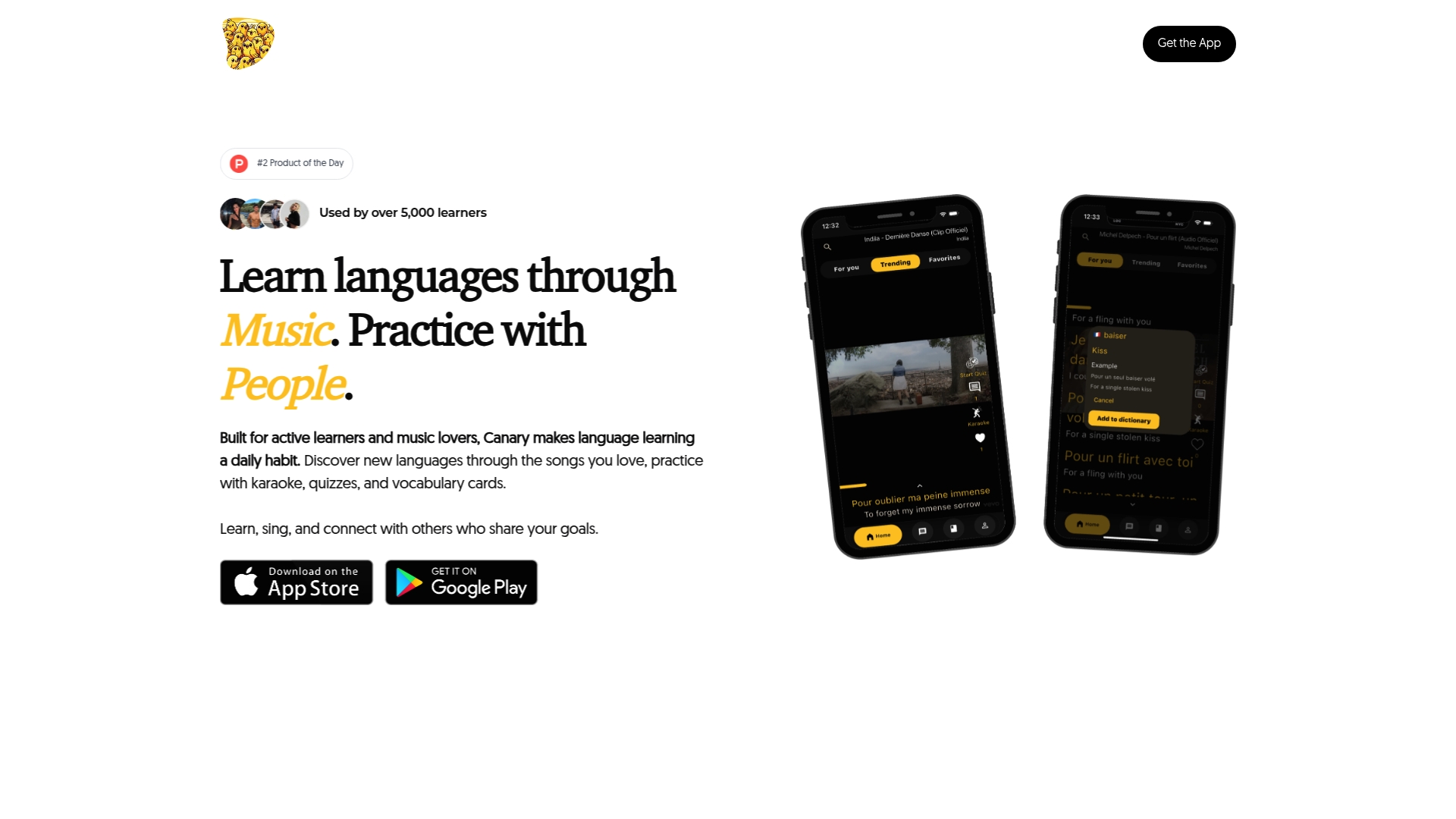
At Canary, you get structured ear training and pronunciation activities built directly around real songs, not abstract exercises. Try the song of the week practice, which gives you a guided breakdown of a new track every week, complete with listening tasks, vocabulary cards, and pronunciation practice. If you’re just starting out, the beginner language workflow walks you through exactly how to use songs and ear training together from day one. You’ll also connect with a global community of learners who use the same evidence-based, music-first approach to make practice a daily habit rather than a chore.
Frequently asked questions
Do I need to have a musical background to benefit from ear training in language learning?
No. Ear training for language learners is about sound perception, not rhythm or melody skills. As noted in perceptual practice guides, these benefits apply to all learners regardless of musical background.
How long should I practice ear training each day for language results?
Short, regular sessions of about 10 to 15 minutes daily are most effective. Research on ear training consistently shows that consistent daily sessions build new sound perception faster than longer, infrequent study blocks.
Is singing along really better than just listening to language songs?
Singing along activates production alongside perception, which creates stronger learning than passive listening. However, active engagement with sounds matters more than whether you sing or just listen closely.
Can background music hurt my focus during language study?
Yes, it can. Studies show that background music with lyrics may interfere with comprehension or reading tasks, so it’s best to use music intentionally and actively rather than as ambient sound.
What’s the best way to use songs for ear training if I’m a beginner?
Choose clear, moderately paced songs in your target language, listen for one or two specific sounds or words per session, and repeat with feedback by checking your answers or recording yourself to compare your pronunciation.