TL;DR:
- Music enhances adult pronunciation by engaging neural networks shared with speech, improving accuracy and retention. Incorporating structured active practice, recording, and deliberate song choice maximizes its benefits and reduces language anxiety. Overall, music serves as a motivating, effective supplement that accelerates pronunciation mastery through enjoyable, targeted repetition.
Pronunciation is often the last skill to click for adult language learners, not because of a lack of effort, but because traditional drills feel mechanical and disconnected from real communication. Here’s something worth knowing: empirical studies show that music and songs significantly improve phonological skills for adults through rhythm, pitch, and repetition. That means the songs you already love could be doing serious linguistic work for you. This guide breaks down why music is so effective, what the research actually proves, and how to build a music-centered pronunciation routine that sticks.
Table of Contents
- Why music makes pronunciation practice work
- What the research says: Evidence and outcomes
- How to train pronunciation with music: Practical techniques
- Limitations and the role of song choice
- Why music might be your missing link for lasting pronunciation improvement
- Ready to sing your way to better pronunciation?
- Frequently asked questions
Key Takeaways
| Point | Details |
|---|---|
| Music accelerates learning | Adding songs to your routine significantly boosts pronunciation and vocabulary growth. |
| Motivation and engagement rise | Music-based practice makes learning enjoyable and helps reduce language anxiety. |
| Song choice is crucial | Picking suitable songs maximizes pronunciation gains and keeps you progressing. |
| Supplement structured practice | For best results, use music alongside targeted drills or feedback for your accent goals. |
Why music makes pronunciation practice work
Music doesn’t just make practice more fun. It physically changes how your brain processes language sounds. When you sing, you recruit overlapping neural networks used for both music and speech, meaning your brain is doing double duty in the best possible way.
The educational benefits of music for language learning go deep. According to research from the IATEFL Pronunciation SIG, music and language share neural resources related to pitch and rhythm processing. This overlap creates a shortcut. When you train your ear through melody, you’re also sharpening the phonemic precision required for accurate pronunciation.
Here are the core mechanisms at work:
- Prosodic bootstrapping: Melody naturally maps onto the stress patterns and intonation of a language, helping you internalize rhythm before you even consciously study it
- Dual coding: You process the song both auditorily and linguistically, creating two memory pathways instead of one, so sounds stick harder and longer
- Metalinguistic awareness: Adult learners can analyze what they’re hearing and compare it to what they’re producing, a skill children lack and one that makes music-based practice especially powerful for grown-up learners
- Repetition without fatigue: Songs repeat phrases and sounds in a pleasurable loop, making it easy to hit the kind of repetition count needed for muscle memory without the boredom of drills
“Adults bring something unique to music-based language practice: the ability to consciously reflect on what they’re hearing and adjust their output. That self-awareness, paired with the emotional engagement of music, creates a powerful feedback loop that traditional pronunciation drills rarely achieve.”
The way music and vocabulary retention intersect is particularly useful here. Words learned in song context carry melodic anchors, making them far easier to recall during actual conversation.
What the research says: Evidence and outcomes
So what does the data actually show when adults use music for pronunciation training? The numbers are compelling and increasingly hard to ignore.
A study published in Moluch found that musical interventions, including rhythm exercises and singing, led to a 20% increase in pronunciation accuracy for adult EFL learners over just 12 weeks. That’s a meaningful gain from a method most learners treat as a bonus activity rather than a core practice.
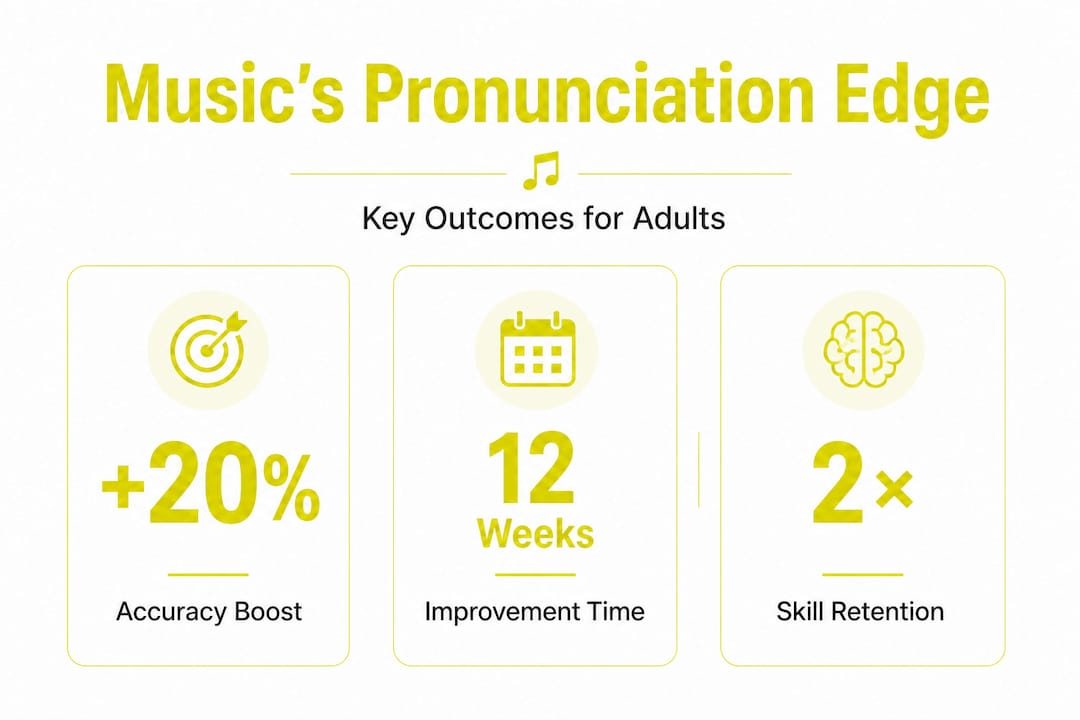
Research published in JPURM reinforces this, showing that music and songs measurably improve phonological skills through repeated exposure to rhythm, pitch, and melodic patterns. Phonological skills here refers to the ability to recognize and produce the individual sounds of a language accurately.
| Outcome | Music-based training | Traditional drills |
|---|---|---|
| Pronunciation accuracy | +20% over 12 weeks | Moderate improvement |
| Vocabulary retention | High (dual coding effect) | Moderate |
| Learner motivation | Consistently high | Often declines over time |
| Anxiety levels | Lower (affective filter reduced) | Higher for many learners |
| Long-term engagement | Strong daily habit formation | Irregular for many adults |
The affective filter concept, first developed in language acquisition research, refers to the emotional barrier that blocks language input when a learner feels anxious or self-conscious. Music lowers that filter dramatically. A study in PMC found that adult music enthusiasts show higher engagement and lower anxiety when using music-based methods, precisely because the enjoyment factor overrides the self-consciousness that plagues traditional classroom drills.
The bottom line: Music doesn’t just make you feel better about practicing. It actively improves the conditions your brain needs to absorb and retain pronunciation patterns at a measurable rate.
How to train pronunciation with music: Practical techniques
Armed with these research-backed benefits, here’s how to actually build music into your language routine in a way that produces results, not just entertainment.
The key is structure. Passive listening to foreign-language songs has some benefit, but it’s nothing compared to active, intentional practice. Here’s a proven stepwise approach:
- Choose the right song. Pick tracks with clear vocals, moderate tempo, and lyrics that match your current proficiency level. Avoid songs with heavy studio effects that obscure the singer’s actual pronunciation.
- Listen actively without the lyrics. On your first pass, just absorb the rhythm, stress patterns, and overall melody. Notice where the singer speeds up, pauses, or emphasizes certain syllables.
- Follow along with the lyrics. Read the text while you listen. Connect the written words to the sounds you hear. This activates the dual-coding process described earlier.
- Sing along out loud. Don’t worry about sounding perfect. Focus on matching the rhythm and vowel sounds as closely as possible. Sing the whole song, not just the parts you find easy.
- Record yourself singing. This is the step most people skip, and it’s the most important one. Recording gives you objective feedback that your own ear, distorted by self-perception, can’t provide.
- Compare your recording to the original. Listen side by side. Identify two or three specific sounds you want to improve. Don’t try to fix everything at once.
- Repeat with focused attention. Go back to those specific sections. Slow them down if needed. Repeat until the target sounds feel more natural in your mouth.
As highlighted by Fearless Presentations, combining music-based practice with recording and self-feedback produces the strongest results. The feedback loop is what transforms enjoyable singing into measurable accent improvement.
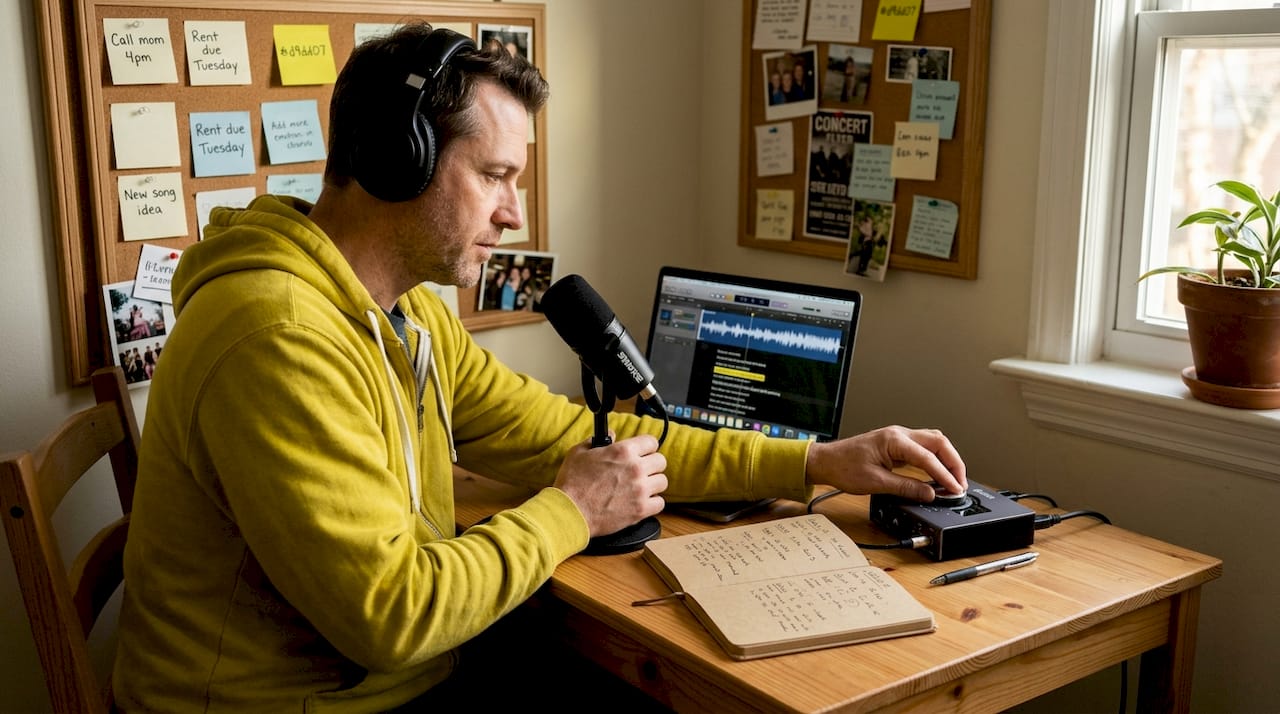
For structured guidance on pronunciation with lyrics, a step-by-step framework can help you stay consistent and focused rather than drifting into casual listening.
Pro Tip: Mix genres strategically. Pop music is great for contemporary rhythm and casual speech patterns. Folk or acoustic tracks are ideal for clear diction. Jazz helps with syncopated rhythms that mimic natural spoken English. Switching between genres challenges your ear in different ways and prevents the plateau effect that happens when you only practice one style.
When it comes to practice with music for mastery, consistency beats intensity. Twenty minutes of focused song practice daily outperforms a two-hour session once a week. Your brain consolidates sound patterns during sleep, so daily input creates compounding gains over time.
Limitations and the role of song choice
No approach is perfect, and music-based pronunciation training has real constraints worth understanding before you rely on it completely.
Research published in Acuity points out that music-based learning is not universally superior to traditional methods in quasi-experimental settings. In some studies, structured pronunciation training matched or even outperformed song-based approaches for specific skills like isolated phoneme production. The researchers also note that song choice is critical and that inappropriately chosen songs can actually reinforce bad habits rather than correct them.
The benefits of song-based language learning are real but only materialize when the songs themselves are well-matched to the learner’s level and goals. And according to PMC, while the evidence for gains is strong, results are mixed when it comes to outright superiority over structured methods. The smart approach is to use music as a powerful supplement rather than a total replacement.
Here’s a comparison to guide your choices:
| Song type | Best for | Potential issues |
|---|---|---|
| Slow ballads | Vowel sounds, clarity | May lack natural speech rhythm |
| Upbeat pop | Conversational pace, linking sounds | Can obscure individual phonemes |
| Rap and hip-hop | Rhythm, stress patterns | Often too fast for early learners |
| Folk and acoustic | Clear diction, simple vocabulary | May feel less engaging for some learners |
| Jazz standards | Pitch variation, intonation | Complex melodies can distract from text |
Watch out for these common pitfalls when using music for pronunciation training:
- Choosing songs based purely on personal taste without considering vocal clarity
- Practicing only the chorus and skipping verses with more complex phonetic content
- Singing along without ever recording and reviewing your own output
- Sticking to one genre, which limits the range of sounds and rhythms you practice
- Using songs with heavy regional accents before you’ve established a solid phonemic baseline
Pro Tip: For early-stage learners, avoid tracks with rapid-fire lyrics, dense slang, or heavy regional accents. Opt instead for songs where you can hear each word clearly at normal playback speed. Artists known for precise diction, like many Broadway performers or classic pop vocalists, make excellent starting points.
Music-based language activities work best when paired with targeted feedback, whether from a teacher, a language partner, or a recording you analyze yourself.
Why music might be your missing link for lasting pronunciation improvement
Here’s an angle most pronunciation guides won’t give you: the real reason adults struggle with pronunciation isn’t lack of knowledge. It’s lack of meaningful repetition in a low-stakes environment. Adults are intensely self-conscious about sounding foolish. That self-consciousness creates tension, and tension degrades motor output. Your mouth literally performs worse when you’re nervous about how you sound.
Music bypasses that entirely. When you’re singing, the emotional frame shifts. You’re not “failing at pronunciation,” you’re singing a song. The role of music in learning is partly about giving adults permission to practice imperfectly in a context where imperfection feels normal and even enjoyable.
Adults also have something children don’t: a sophisticated awareness of how language works. When you notice the way a singer stretches a vowel across two beats, you can analyze it, label it, and consciously replicate it. That’s metalinguistic awareness doing its job. Children absorb sounds intuitively over years. Adults can accelerate that process by combining intuitive absorption through music with conscious analysis.
But here’s where most music-based learners leave progress on the table: they skip the feedback step. Singing without reviewing your own recordings is like going to the gym without tracking your lifts. You might improve slowly, but you’ll hit a ceiling fast and not understand why. The combination of enjoyable repetition and honest self-assessment is what separates learners who plateau from those who keep improving.
Song selection is the other underrated variable. Most learners pick songs they love, full stop. That’s a fine starting point, but if every song you choose features the same phoneme set and the same tempo, you’re not challenging the full range of sounds your target language uses. Deliberate variety in your song library is a form of structured practice in disguise.
The learners who get the most out of music-based pronunciation work treat it with the same intentionality they’d bring to any skill-building practice. They choose strategically, record consistently, analyze honestly, and vary their input. Music makes all of that feel less like work. That’s its superpower.
Ready to sing your way to better pronunciation?
If this article has convinced you that music deserves a central place in your pronunciation routine, the good news is that you don’t have to figure it out alone. Canary is built exactly for learners like you, combining song-based practice with interactive tools that make the process structured, social, and genuinely fun.
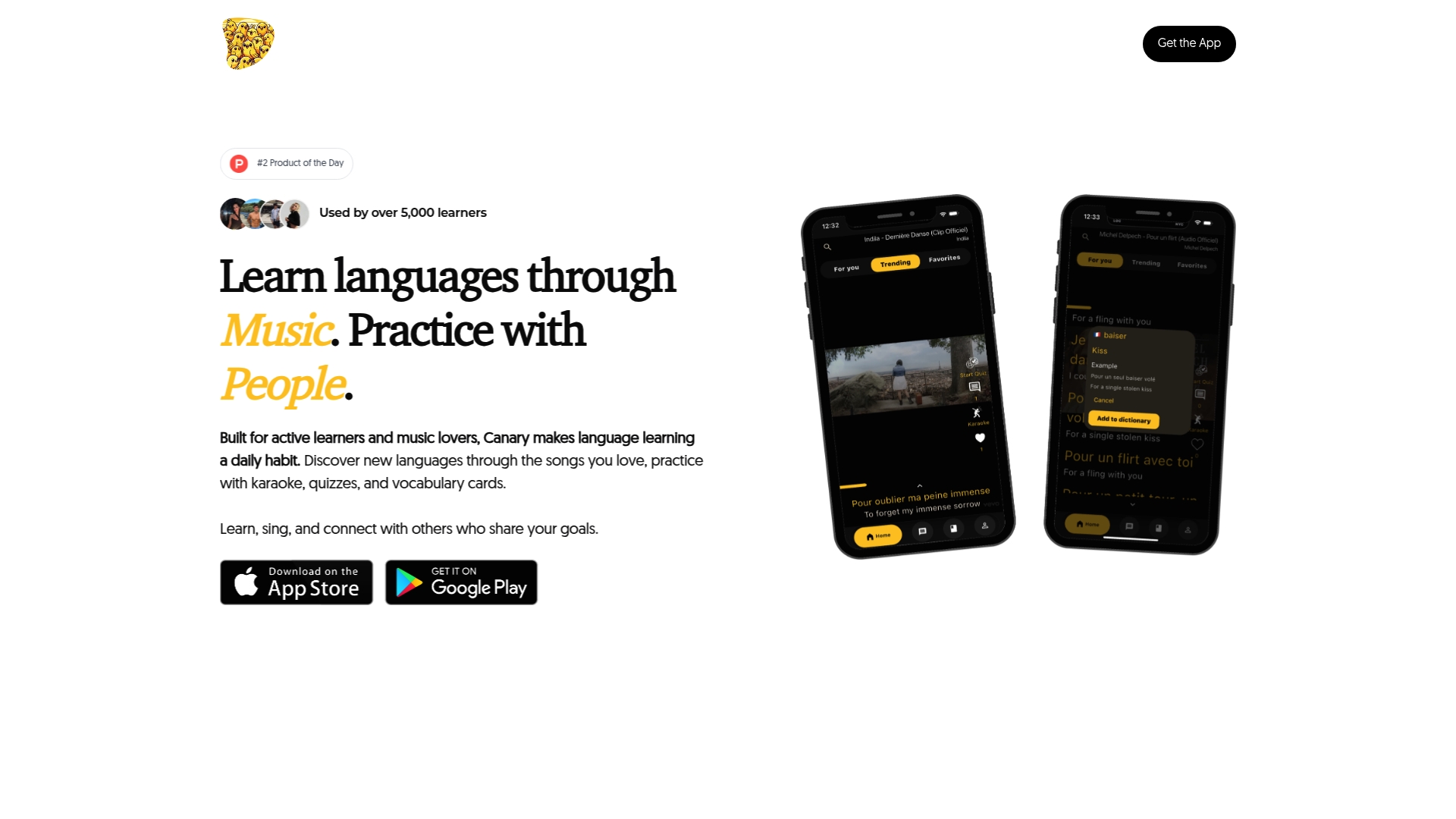
At Canary, you can practice with real song lyrics using karaoke features, vocabulary cards, and pronunciation quizzes that give you the feedback your practice needs to actually move the needle. The song of the week feature keeps your practice fresh with curated tracks chosen for their learning value, not just chart performance. And if you want to go deeper, interactive singing practice connects you with other learners around the world so you can practice pronunciation in a real, social context. Join the community and start turning your favorite songs into your most effective language tool.
Frequently asked questions
Does singing really improve adult pronunciation more than traditional drills?
Music-based training boosts pronunciation accuracy by around 20% over 12 weeks, though research suggests it performs best as a supplement to structured practice rather than a standalone replacement for targeted drills.
What type of songs work best for pronunciation training?
Songs with clear vocals, moderate tempo, and vocabulary matched to your level are most effective. Research confirms that song choice matters significantly, and inappropriate choices can limit or even undermine your progress.
Is music-based pronunciation practice suitable for all ages?
Music is highly motivating for adult learners, but studies indicate that direct speech training may outperform music-based methods for very young children, particularly in early word-learning stages.
Can using music reduce language learning anxiety?
Yes. Music lowers the affective filter, which is the emotional barrier that blocks language input when learners feel anxious, resulting in higher engagement and a more relaxed, productive practice environment for adults.