TL;DR:
- Focusing on clear understanding should be your primary goal in language learning, not sounding completely native.
- Music leverages rhythm and melody to enhance pronunciation, listening comprehension, and long-term vocabulary retention effectively.
- Using songs trains both your ear and mouth, reduces anxiety, and builds confidence, making pronunciation practice engaging and practical.
Many learners spend years obsessing over sounding “native” while missing a far more practical goal: being clearly understood. Pronunciation plays a fundamental role in second language acquisition by enhancing listening comprehension, communicative competence, and intelligibility. The good news? Music offers a uniquely powerful shortcut to stronger pronunciation, one that doesn’t require endless grammar drills or embarrassing role-play exercises. If you love songs and you’re learning a language, you’re already holding the most effective pronunciation tool available.
Table of Contents
- Why pronunciation matters in language acquisition
- How music and rhythm boost pronunciation skills
- Segmentals vs. suprasegmentals: What to focus on
- Science-backed strategies for rapid progress
- Why most learners miss the real power of pronunciation practice
- Take your pronunciation further with music-based learning
- Frequently asked questions
Key Takeaways
| Point | Details |
|---|---|
| Focus on intelligibility | You do not need a perfect accent—being understood should be your main pronunciation goal. |
| Music enhances speech skills | Practicing with songs accelerates mastery of rhythm, stress, and intonation vital for real-world communication. |
| Balance sound and flow | Train both individual sounds and overall speech melody for the best results. |
| Diverse practice matters | Use a variety of song voices and explicit pronunciation exercises to improve quickly. |
Why pronunciation matters in language acquisition
There’s a persistent myth in language learning that pronunciation is just about accent. Strip that idea away completely. Pronunciation is about whether people understand you, whether you understand them, and whether the conversation actually goes anywhere useful.
The research is clear. Pronunciation plays a fundamental role in second language acquisition, touching every layer of communication from listening comprehension to real-world intelligibility. When your pronunciation is off, you don’t just sound foreign. You create friction. Listeners work harder to decode what you’re saying, and misunderstandings pile up faster than you’d expect.
Here’s something that might surprise you: the connection between sound and vocabulary is deeper than most learners realize. Phonological memory is crucial for vocabulary retention, pronunciation accuracy, and overall acquisition. In plain terms, when you can hear and reproduce the sounds of a word correctly, you remember that word much more reliably. This is exactly why learners who focus on pronunciation early tend to build vocabularies faster than those who skip the phonetic work entirely.
Pronunciation also feeds directly into your ability to understand fast, natural speech. One of the most common pronunciation and listening challenges learners face is that native speakers blur words together, drop syllables, and shift sounds in ways that textbooks never prepare you for. When your ear is trained to recognize those sounds accurately, connected speech stops sounding like one long, incomprehensible blur.
Consider what music and adult pronunciation learning research consistently shows: songs naturally expose you to connected speech patterns in a memorable, repeatable format. Each time you sing along, you’re training both your ear and your mouth at the same time.
Key reasons why pronunciation sits at the core of language learning:
- Intelligibility: Clear pronunciation gets you understood, which is the entire point of communication
- Listening comprehension: Knowing how sounds work helps you decode what others say
- Vocabulary retention: Phonological memory links sounds directly to meaning, making words stick
- Confidence: Accurate pronunciation reduces anxiety in real conversations
- Cultural connection: Getting sounds right helps you engage with music, film, and native speakers authentically
The song-based language learning benefits extend across all of these areas simultaneously, which is why music isn’t just a fun supplement to your studies. It’s a legitimate training tool with real phonetic payoff.
“The learner who trains their ear trains their mouth. Pronunciation is not a finish line — it’s the road itself.”
Now that we see why pronunciation is central, let’s explore how music amplifies its learning power.
How music and rhythm boost pronunciation skills
Songs do something that textbooks and flashcard apps simply cannot: they package sounds inside rhythm, melody, and emotion, which are exactly the conditions under which your brain locks information into long-term memory.
Embodied music training (combining rhythm and melody with physical movement) measurably enhances speech imitation and pronunciation skills in second language learners. When you tap along to a beat while singing, you’re not just enjoying music. You’re encoding the stress patterns and rhythm of the language into your body, making them easier to reproduce automatically in real speech.

This is bigger than it sounds. Stress and intonation are features of language that most learners barely practice, yet native speakers use them constantly to signal meaning, emotion, and emphasis. A sentence like “I didn’t say he stole the money” changes its meaning entirely depending on which word receives the most stress. Songs train you to hear and feel these patterns without any conscious effort because the melody carries you there.
| Pronunciation feature | How music trains it | Why it matters |
|---|---|---|
| Word stress | Melody highlights stressed syllables | Prevents misunderstandings in fast speech |
| Sentence rhythm | Beat enforces natural pacing | Sounds more fluent and natural |
| Intonation | Melody mimics rising/falling patterns | Conveys meaning and emotion accurately |
| Connected speech | Songs model blending and elision | Improves listening comprehension |
| Individual sounds | Repetition isolates and reinforces phonemes | Builds segmental accuracy |
Physical engagement amplifies every one of these effects. Try practicing pronunciation with music by tapping your foot on stressed syllables while you sing. You’ll immediately feel which beats the language leans into, and that physical sensation becomes a reference point your body remembers.
One of the most underrated benefits is what linguists call suprasegmental training, which covers the melody and rhythm of speech rather than individual sounds. Most learners drill individual vowels and consonants (segmentals) but ignore intonation and rhythm. Songs naturally flip this balance, giving you massive suprasegmental exposure without any extra work.
There’s also a compelling case for how music speeds up language learning through sheer repetition. A song you love, you’ll listen to 30, 50, 100 times without getting bored. That’s 100 exposures to the pronunciation patterns embedded in those lyrics, far more than any workbook exercise could ever provide.
Pro Tip: Download a karaoke version of a song you already love in your target language. Sing it without the original vocals so you’re forced to carry the melody yourself. You’ll immediately discover which sounds and rhythms your mouth struggles with, and those are exactly the spots to focus your practice.
For Spanish learners, checking out Spanish audio pronunciation files alongside your song practice creates a powerful combination of structured phonetic input and musical reinforcement.
With music’s unique advantages established, it’s crucial to know how to target both the core sounds and the flow of speech.
Segmentals vs. suprasegmentals: What to focus on
Before you can deliberately improve your pronunciation through music, you need to understand what you’re actually targeting. Pronunciation breaks down into two categories, and knowing the difference changes how you practice.
Segmentals are the individual sounds: vowels, consonants, and the specific way they’re produced. Getting the “r” sound right in Spanish, or mastering the French nasal vowels, or distinguishing the short “i” from the long “ee” in English — these are segmental challenges.
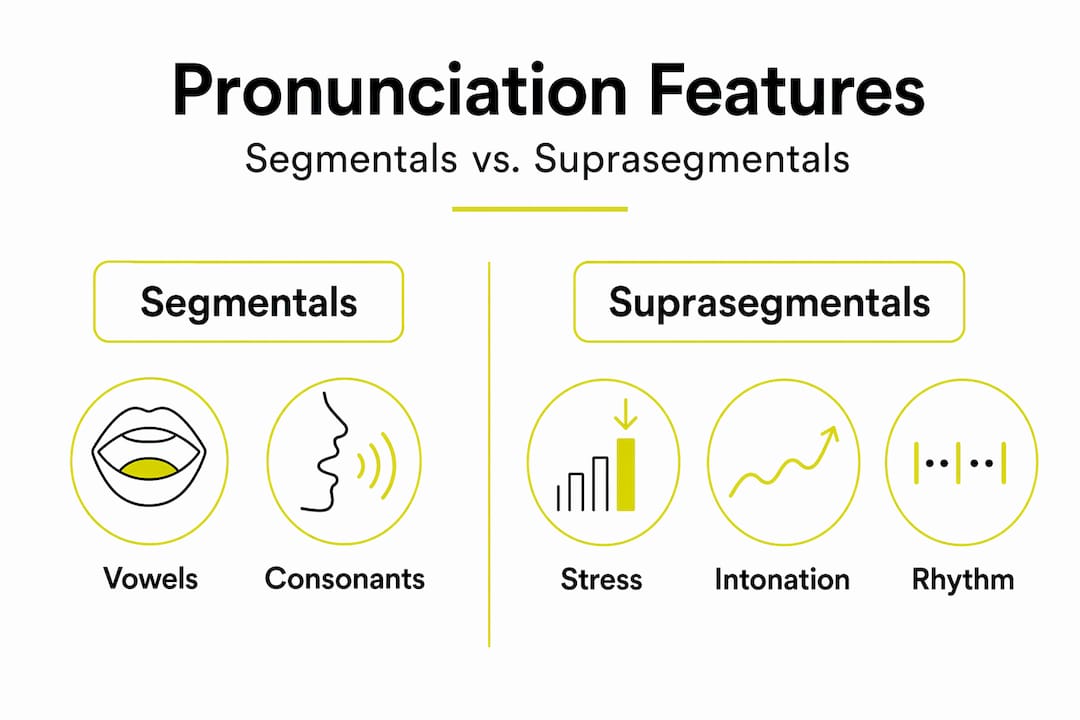
Suprasegmentals are the bigger patterns layered over those sounds: stress, intonation, rhythm, and pacing. These are the features that make speech sound musical, emphatic, or emotionally expressive. They span multiple syllables and words rather than sitting in one isolated sound.
| Feature | Type | Music practice method | Real-world impact |
|---|---|---|---|
| Vowel sounds | Segmental | Slow down and isolate held notes | Reduces accent-related confusion |
| Consonant clusters | Segmental | Break lyrics into small chunks | Improves clarity in fast speech |
| Word stress | Suprasegmental | Follow melody, tap stressed beats | Signals meaning and emphasis |
| Sentence intonation | Suprasegmental | Mimic the rise and fall of the melody | Conveys emotion and intent |
| Speech rhythm | Suprasegmental | Clap or move to song’s tempo | Creates natural-sounding flow |
Research shows that pronunciation teaching is most effective when it targets specific segmental or suprasegmental features with focused monitoring, with meta-analyses showing medium-to-large effect sizes. In other words, the learners who improve fastest are those who identify exactly what they’re training and actively listen back to check their output.
Here’s a simple process for using a song to work on both layers:
- Listen first without singing. Let the melody and rhythm wash over you. Notice where the singer places stress and how the tune rises and falls.
- Read the lyrics. Identify any sounds you’re unsure about and look up the correct pronunciation before singing.
- Sing slowly. Reduce the playback speed and exaggerate your mouth movements, especially on difficult sounds.
- Record yourself. Compare your recording to the original. This step is uncomfortable but enormously productive.
- Target one problem at a time. Pick either a tricky segmental sound or a rhythm pattern and repeat that specific line until it feels automatic.
Mastering pronunciation with lyrics using this structured approach transforms passive listening into active phonetic training.
Pro Tip: Use the “mumble singing” trick. Hum the melody without words first, focusing purely on the rhythm and intonation contour. Then add words. This separates the suprasegmental work from the segmental work, making each layer easier to focus on.
Now that you know what to train, let’s put it all together and apply music techniques for real-life speaking confidence.
Science-backed strategies for rapid progress
Knowing that music helps is one thing. Knowing exactly how to structure your practice is what actually produces results. These strategies come directly from the research on phonetic training and music-based language acquisition.
-
Use explicit phonetic activities. Explicit phonetic instruction significantly improves pronunciation accuracy and auditory discrimination in second language learners. Don’t just passively sing along. Before you start, identify two or three specific sounds in the song and consciously focus on producing them correctly every single time you sing.
-
Shadow the artist. Shadowing means speaking or singing simultaneously with the recording, matching the pace, rhythm, and intonation as closely as possible. This is one of the fastest known methods for internalizing pronunciation patterns because it forces real-time imitation rather than delayed recall.
-
Use call-and-response repetition. Pause the song after each line and immediately repeat it from memory. Don’t wait. This rapid repetition forces your mouth and ear to work together under mild time pressure, which dramatically accelerates retention.
-
Practice with multiple voices and accents. Intelligibility-focused methods recommend high-variability input from multiple singers to help learners generalize pronunciation skills beyond a single model. In practical terms: don’t just imitate your favorite artist. Find two or three different singers in your target language and practice with all of them. Your ear will build a more flexible and robust understanding of the sound system.
-
Choose songs with clear enunciation. Select tracks where the vocalist pronounces words cleanly and at moderate speed. Ballads and acoustic tracks tend to work better than heavily produced pop or rapid-fire hip-hop for early pronunciation work.
-
Record and compare. This is non-negotiable. Record yourself singing a section, play back your recording alongside the original, and listen for the gaps. Pronunciation teaching research consistently shows that monitored production of specific features drives the largest improvements.
“The singers who improve fastest are the ones who listen back. Progress lives in the gap between what you think you sound like and what you actually sound like.”
Look through real examples of learning with music and you’ll notice a pattern: the most successful music-based learners treat songs like workout sessions with specific targets, not just entertainment. For a broader view of how these methods fit into your overall routine, exploring music-based language learning methods can help you build a complete system.
Pro Tip: Create a personal “pronunciation playlist” of five to eight songs that cover different tempos, vocal styles, and sound challenges. Rotate through them weekly. This ensures you’re getting varied input while building deep familiarity with each song’s phonetic patterns.
Why most learners miss the real power of pronunciation practice
Here’s an uncomfortable truth most language courses will never tell you: the obsession with sounding native is actively holding many learners back. It creates anxiety, perfectionism, and avoidance of real speaking practice, which is the exact opposite of what actually builds communication skill.
Research is direct about this. Intelligibility is prioritized over accent reduction. A strong accent does not necessarily mean low intelligibility. Two things that most learners conflate are actually separate: you can have a noticeable accent and still be completely clear and effortless to understand. And that’s the actual goal.
Music learners are particularly well-positioned to get this right, because the musical experience teaches a different kind of listening. When you engage with a song in another language, you stop asking “do I sound like a native?” and start asking “does this feel right? Does the melody land the way it should?” That’s a healthier relationship with pronunciation.
The benefits of learning languages with music go beyond the phonetic. Music practice builds the emotional confidence to actually use the language, to sing along in public, to hum a tune and let the words fall naturally out of your mouth. That’s not a small thing. Confidence in production is one of the biggest predictors of communicative success.
Redefine what progress looks like for you. Progress is not the day you stop having an accent. Progress is the day a native speaker understands you without effort. Progress is the day you catch a fast lyric without rewinding. Progress is the day you smile because a joke in the song finally lands. Music gets you there, and it does it in a way that keeps you coming back every single day.
Take your pronunciation further with music-based learning
You now have a clear picture of why pronunciation matters, how music accelerates it, and which specific strategies produce the fastest results. The next step is putting those strategies into practice with tools built exactly for this kind of learning.
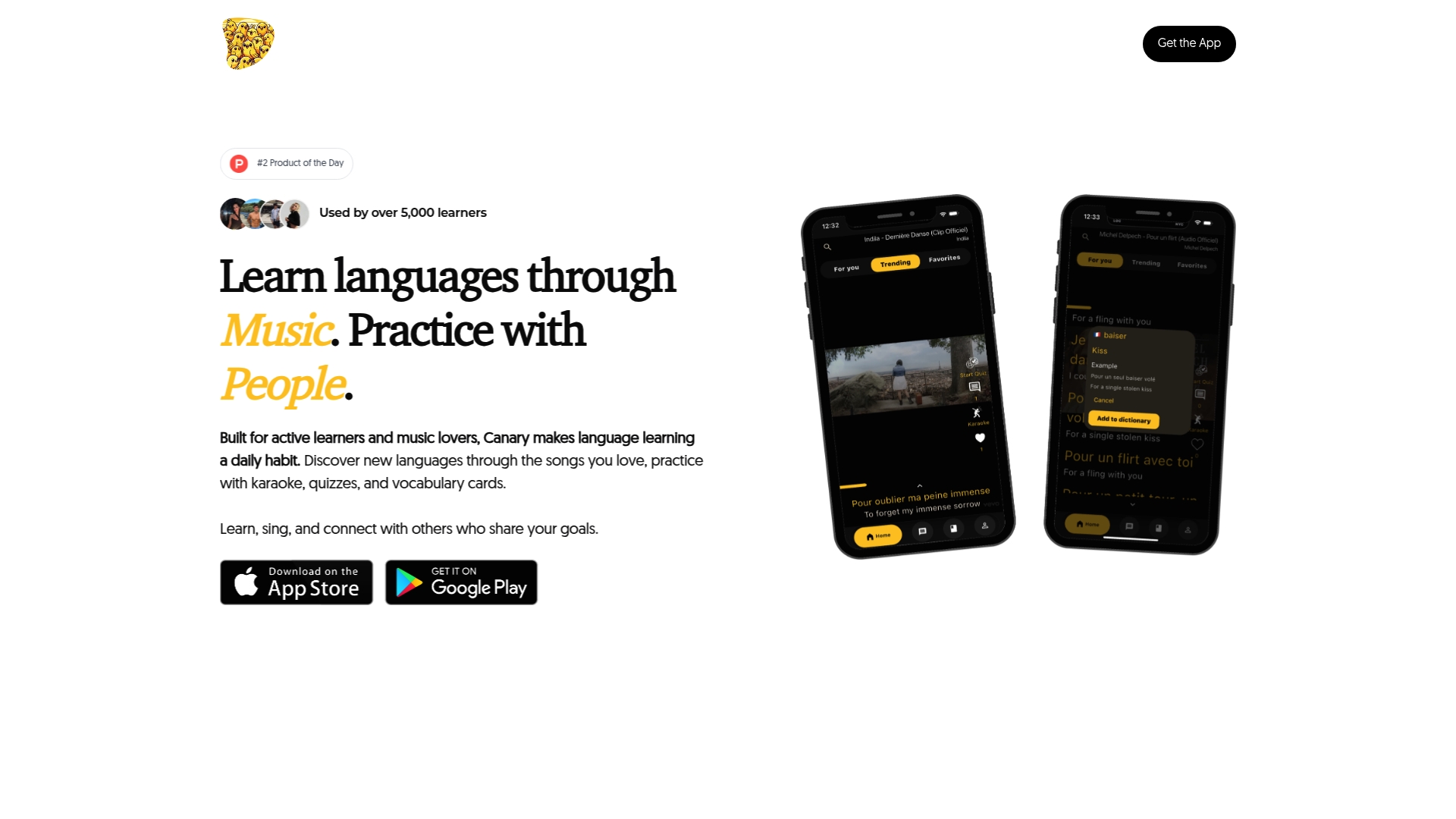
Canary is a learn languages with music platform designed for learners who want real pronunciation gains through real songs. With interactive karaoke, vocabulary cards, and quizzes built directly into the song experience, every session doubles as both pronunciation training and vocabulary building. Explore what music-infused learning for language skills looks like in practice, and see how quickly your ear and your mouth catch up when the training is actually enjoyable. Better yet, get started immediately with weekly song-based practice and build the daily habit that makes fluency feel inevitable.
Frequently asked questions
Is it more important to reduce my accent or to be easily understood?
Being easily understood is more important than removing your accent. Research confirms that intelligibility is prioritized over accent reduction, meaning a noticeable accent and clear communication can absolutely coexist.
Does singing really improve language pronunciation skills?
Yes, and the evidence is solid. Embodied music training that combines rhythm, melody, and body movement measurably enhances speech imitation and pronunciation accuracy in second language learners.
What’s the difference between segmental and suprasegmental pronunciation features?
Segmentals are individual vowel and consonant sounds; suprasegmentals are patterns that span multiple sounds, including stress, intonation, and rhythm. Both matter, and targeted pronunciation teaching of each produces measurable improvements.
How do I choose the best songs for pronunciation practice?
Prioritize songs with clear vocals, moderate tempo, and accurate enunciation, and vary your sources. Practicing with multiple singers for generalization helps your ear adapt to the full range of sounds in the language, not just one voice.