TL;DR:
- Social interaction is fundamental to acquiring language, as it forms the core mechanism for building mental functions. Engaging in meaningful conversations, especially paired with music, accelerates vocabulary retention, pronunciation, motivation, and cultural understanding. Virtual exchanges and structured musical activities further enhance sociolinguistic skills, making social, music-driven practice essential for effective language mastery.
Most people assume that language mastery is a solo sport: flashcards, grammar drills, and hours of listening practice. But social interaction sits at the core of how humans actually acquire language, and the research backing this up is hard to ignore. The good news is that you don’t need to move abroad or enroll in an expensive immersion program to tap into this power. When you pair social interaction with music, you get a learning environment that’s engaging, memorable, and surprisingly effective. This article breaks down the evidence and hands you concrete strategies you can use right now.
Table of Contents
- Why social interaction matters in language learning
- How classroom interaction shapes language development
- Virtual and cross-cultural interaction: Expanding your language world
- Singing, music, and social learning: A powerful language recipe
- Putting it into practice: Social strategies for language mastery
- What most learners miss: The hidden value of musical interaction
- Bring social, music-driven learning to life with Canary
- Frequently asked questions
Key Takeaways
| Point | Details |
|---|---|
| Interaction drives learning | Collaborative dialogue and feedback boost vocabulary and language mastery more than passive input. |
| Music makes practice memorable | Song-based interaction creates rich, fun environments that accelerate speaking and comprehension skills. |
| Virtual exchanges work | Online chats with native speakers improve real-world communication and sociolinguistic fluency. |
| Quality of interaction matters | Engaging in meaningful, structured tasks is more effective than generic group work. |
| Anyone can benefit | You don’t need musical talent—just a willingness to interact and learn through songs and conversation. |
Why social interaction matters in language learning
Language learning theory has evolved a lot since the days of rote memorization. One of the most influential frameworks comes from the psychologist Lev Vygotsky, who argued that all higher mental functions, including language, appear first between people and only later become internalized by the individual. In other words, talking with others isn’t a nice bonus—it’s literally how your brain builds language.
“Language development occurs first on the social plane, then on the psychological plane. Interaction is not supplementary to learning; it is the mechanism of learning.” — Vygotsky’s socio-cultural principle
This insight has massive practical implications. When you engage in collaborative dialogue, negotiate meaning with a partner, or receive corrective feedback mid-conversation, you’re triggering the exact cognitive process that locks new language into long-term memory. Vygotsky’s socio-cultural theory places social interaction at the center of all higher mental and language functions, making conversation practice far more than a supplement to textbook study.
Recent empirical work backs this up in measurable ways. Studies show that interaction predicts vocabulary growth more reliably than passive input alone in many learning contexts. Simply hearing or reading words is not enough—you need to use them in real exchanges where meaning actually matters to someone else.
Evidence-based benefits of social interaction in language learning:
- Faster vocabulary retention because words are used in meaningful contexts
- Improved pronunciation through immediate, natural feedback from partners
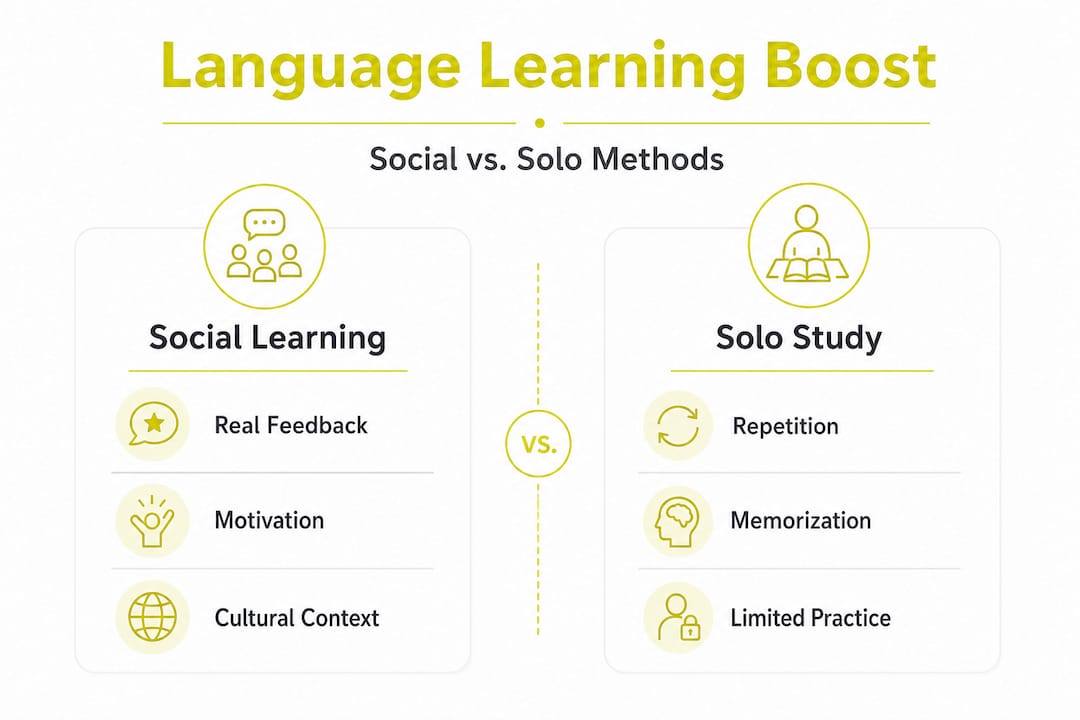
- Greater motivation and accountability when learning with others
- Exposure to authentic expressions, idioms, and cultural nuance
- Practice with turn-taking and conversational repair, skills that textbooks rarely address
- Reduced anxiety over time when interaction becomes a regular habit
Knowing about music’s role in language learning adds another dimension to this picture: music creates ready-made social contexts where interaction feels low-stakes and joyful.
Pro Tip: Don’t rely solely on apps or self-study. Even one weekly virtual conversation with a native or advanced speaker will accelerate your progress more than doubling your daily solo study time.
How classroom interaction shapes language development
Understanding that interaction matters is one thing. Knowing what kind of interaction actually produces results is another. Not every group activity is equally effective. The design of the task shapes the quality of the language exchange, and the quality of the exchange determines how much you learn.
Task-based language teaching (TBLT) is an approach that structures learning around meaningful communication goals rather than grammar exercises. Research shows that TBLT creates distinct patterns of teacher-student discourse that push learners to produce real, meaningful language rather than rehearsed responses.
| Feature | Task-based interaction | Non-task-based exchange |
|---|---|---|
| Communication goal | Authentic, real-world outcome | Drill or repetition |
| Learner role | Active co-constructor of meaning | Passive responder |
| Feedback type | Negotiated, natural correction | Explicit error correction |
| Language quality | Varied, creative, contextualized | Formulaic and scripted |
| Motivation level | Higher due to genuine purpose | Lower without clear payoff |
| Learning outcome | Broader vocabulary and fluency gains | Limited to target structure |
The difference is significant. Learners in task-based settings consistently show measurable increases in the range and accuracy of language they produce. The key is that the task has to feel real. Open-ended questions, collaborative problem-solving, and activities with shared outcomes all trigger richer language production than fill-in-the-blank exercises. You can read more about the benefits of song-based language practice to see how music tasks fit neatly into this framework.
Steps to foster effective interaction in any learning group:
- Choose tasks with a clear, shared goal—analyzing a song’s lyrics together, for example.
- Build in opportunities for genuine question-and-answer exchanges, not just reading aloud.
- Assign rotating roles so everyone gets to lead and respond.
- Include a brief feedback phase where participants reflect on language they encountered.
- Keep the group small (three to six people) so everyone gets enough talking time.
Real language learning success with music tends to happen in exactly these kinds of structured but relaxed group settings, where the song gives everyone a shared text to respond to and discuss.
Virtual and cross-cultural interaction: Expanding your language world
You don’t have to be physically in the same room as a native speaker to get the benefits of authentic interaction. Virtual exchanges have matured rapidly, and the research now confirms that digital conversation practice can deliver real sociolinguistic gains.

A compelling study found that virtual exchanges improved sociolinguistic skills, including the correct use of pronouns and register in Spanish learners. Participants who engaged in structured online exchanges with native speakers significantly outperformed control groups on measures of real-world language appropriateness.
| Group | Sociolinguistic competence gain | Pronoun accuracy improvement | Overall communication confidence |
|---|---|---|---|
| Virtual exchange participants | Significant improvement | +34% accuracy | Reported higher confidence |
| Control group (no exchange) | Minimal improvement | +6% accuracy | No significant change |
The takeaway is clear: meaningful exchanges with diverse speakers produce gains that self-study simply cannot replicate. The critical word is “meaningful.” Generic chat sessions or random language exchange apps where conversations stay shallow won’t move the needle much. What works is structured interaction around shared content.
Simple platforms and approaches for effective online interaction:
- Join language-specific music communities on social platforms where members share and discuss songs
- Use video call tools to set up regular lyric-analysis sessions with a partner in your target language
- Participate in collaborative playlist creation with speakers of your target language and discuss your choices
- Attend virtual karaoke or song challenge events hosted by language learning communities
- Look for conversation exchange programs that pair you with a partner based on shared musical interests
Pro Tip: Structure your online interactions around a specific song each week. Discussing what a lyric means, debating its cultural context, and practicing pronunciation together creates exactly the kind of meaningful exchange that drives real progress. Explore methods for virtual and music-based practice to find the approach that fits your schedule.
Singing, music, and social learning: A powerful language recipe
Music and social interaction are not just compatible. They are natural partners for language development. A musically rich environment lowers the social stakes of making mistakes, provides repetitive exposure to target language structures in emotionally engaging contexts, and gives groups a shared activity that motivates consistent practice.
“Pro-social parents who sing more to their infants and young children contribute directly to greater language acquisition outcomes.” — National Endowment for the Arts research blog, 2025
This finding, highlighted by the NEA’s research on singing and language gains, shows that the connection between musical engagement and language development is not anecdotal. It is measurable and consistent across age groups. If singing to infants produces language gains, imagine what intentional musical social practice does for motivated adult learners.
Evidence shows that group singing and music-based activities foster vocabulary acquisition, sharpen pronunciation, and even support gesture development—the physical, embodied side of language that purely text-based study ignores. Exploring the benefits of music for language learning reveals just how wide the impact is across different aspects of language ability.
How to create or join music-driven language practice groups:
- Start a weekly “song of the week” group where members study lyrics in the target language and discuss meaning before a shared listening session
- Organize virtual sing-alongs where participants take turns performing verses and get pronunciation feedback from the group
- Use call-and-response games with song lines: one person sings a line, another answers with a variation or the next line
- Set up lyric-decoding challenges where partners listen to a new track and try to transcribe unfamiliar vocabulary before comparing notes
- Share voice recordings of yourself singing a short passage and invite feedback from group members on pronunciation and expression
Building daily song practice for fluency into your routine does not require huge time commitments. Even fifteen minutes of engaged, social song-based practice beats an hour of passive listening.
Pro Tip: Don’t let concerns about singing talent hold you back. Research consistently shows that participation and social context—not musical skill—drive language gains. The learning happens in the interaction, not in the performance.
Putting it into practice: Social strategies for language mastery
Theory is valuable. But you also need a clear action plan. Here are five concrete steps you can start this week to build a social, music-driven language practice routine that delivers results.
Good language learning through interaction is designed to encourage the co-construction of meaning, real dialogue, and genuine feedback—not just passive exposure to input.
-
Join a conversation group with a music theme. Search for language exchange communities or social platforms centered on a musical genre you enjoy in your target language. The shared passion makes conversation easier and more natural from the first meeting.
-
Set up weekly song exchanges with a partner. Each week, you each choose one song in the other’s target language. You share it, discuss it, and identify three to five new vocabulary items together. This creates accountability and consistent new input.
-
Record and share song challenges. Record yourself singing or speaking along with a short passage from a song. Share it with your group or partner and ask for feedback on specific elements—word stress, connected speech, or intonation patterns.
-
Pair with a partner for lyric-based learning sessions. Choose a song and divide the lyrics between you. Each person becomes the “expert” on their section and teaches the vocabulary and meaning to the other. Teaching forces deeper processing than just studying.
-
Build feedback loops into every sing-along. After any group singing or listening activity, spend five minutes reviewing language that came up. What was new? What was confusing? What would you say differently? This reflection step is what separates casual fun from actual progress.
Pro Tip: For best results, combine social meetings with structured musical tasks that include a clear feedback moment. The combination of interaction, music, and reflection hits all three of the mechanisms that accelerate language acquisition. Read more about music and language benefits to understand why this triple combination works so well.
What most learners miss: The hidden value of musical interaction
Here’s the honest truth that most language learning advice skips over: perfectionism kills progress. The single biggest barrier most learners face is not a lack of grammar knowledge or vocabulary. It’s the fear of making mistakes in front of other people.
Music changes this in a way that almost nothing else can. When you’re singing together, everyone sounds a little uncertain at first. Everyone mispronounces things. Everyone stumbles on fast passages. That shared vulnerability creates a group permission slip to get things wrong, try again, and laugh about it. This social safety net is not a soft benefit—it’s what allows the brain to stay in an open, receptive state instead of shutting down from embarrassment.
Most solo apps, regardless of how well-designed they are, cannot replicate this. They can give you input, track your streaks, and quiz your vocabulary. But they cannot give you the motivating warmth of a group celebrating your first successful attempt at a tricky verse. They cannot give you the natural corrective feedback of a native speaker gently modeling the right pronunciation mid-conversation. These are irreplaceable human experiences, and they are what real music learning success stories are built on.
The learners who make the fastest progress are not the ones with the best apps. They’re the ones who show up consistently to social, interactive practice and embrace the messy, joyful process of learning with others.
Bring social, music-driven learning to life with Canary
Ready to put these research-backed strategies into action? Canary is built exactly for this—a platform where language learning happens through music and community, not isolation and drills.
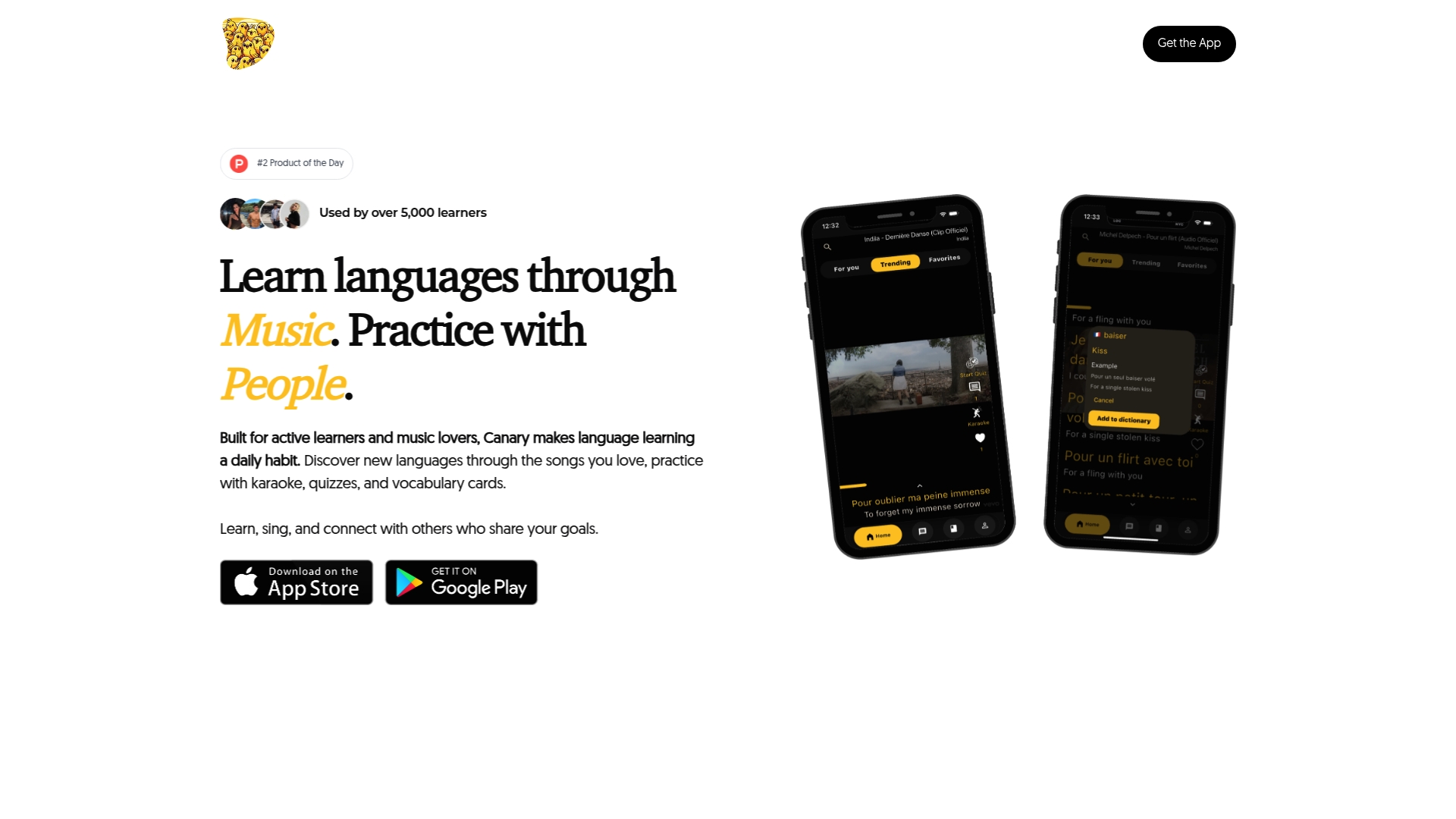
Canary’s Song of the Week challenges give you a structured, social way to practice every week—complete with vocabulary cards, karaoke features, and a community of learners ready to practice with you. Whether you’re working on pronunciation, expanding your vocabulary, or just trying to build a habit you’ll actually stick to, Canary connects you with international learners through the universal language of music. Explore social music practice ideas and discover the full range of music-driven learning benefits waiting for you inside the platform. Your next language breakthrough might just start with a song.
Frequently asked questions
Why is social interaction more effective than self-study for language development?
Social interaction provides real-time feedback, genuine motivation, and meaningful context that solo repetition cannot replicate. Learning occurs interpersonally first before it becomes internalized, according to Vygotsky’s well-supported socio-cultural framework.
How does music enhance the effectiveness of social language practice?
Music creates emotionally engaging, memorable contexts that naturally encourage communication and lower the barrier to participation. Research from the NEA shows that singing predicts language development across different age groups and environments.
Can virtual language exchanges really boost fluency and sociolinguistic skills?
Yes—structured virtual exchanges with native speakers produce measurable results. Studies confirm that virtual exchanges improved sociolinguistic competence significantly compared to learners who had no such interaction.
What is a simple way to add more social interaction to my language practice?
Join a virtual or local group that uses music or collaborative tasks as its focus. Even one weekly session built around a shared song gives you consistent, enjoyable interaction.
Do I need to be a good singer to benefit from song-based language learning?
Not at all. Participation and the social context of group singing matter far more than vocal ability when it comes to language outcomes.