TL;DR:
- Building daily language habits with music relies on short, focused sessions that fit busy schedules and foster consistency. By combining lyric-based shadowing, recording, vocabulary journaling, and micro-dialogues, learners can improve pronunciation, retention, and fluency gradually. Overcoming obstacles like boredom and pronunciation plateaus requires variety, personalization, and measuring progress through recordings and milestone achievements.
Knowing how to build daily language habits sounds simple until your schedule fills up, your motivation fades, and your practice turns into a once-a-week scramble. Most learners plateau not because they lack talent but because they never find a method that actually fits their life. Music changes that equation entirely. Song-based microlearning gives you a built-in hook for engagement, a natural training ground for pronunciation, and vocabulary that sticks because it comes wrapped in melody and emotion. This guide shows you exactly how to set that system up and keep it running.
Table of Contents
- What you need to start building daily language habits
- Step-by-step guide to building daily language practice habits with music
- Common challenges and how to overcome them in daily practice
- Measuring progress and staying motivated with song-based language practice
- Why music-infused microlearning revolutionizes daily language habits
- Explore Canary’s music-driven language learning to power your daily habits
- Frequently asked questions
Key Takeaways
| Point | Details |
|---|---|
| Microlearning convenience | Short, daily sessions of 10-20 minutes fit easily into busy lifestyles and build fluency steadily. |
| Shadowing benefits | Repeating speech simultaneously improves natural pronunciation, rhythm, and listening comprehension. |
| Music aids retention | Learning with songs strengthens vocabulary and prosody through emotional and mnemonic engagement. |
| Consistent feedback | Recording and reviewing your speech accelerates improvement and keeps you motivated. |
| Overcoming obstacles | Using diverse songs and personalized practice prevents boredom and builds lasting habits. |
What you need to start building daily language habits
Before you can make practice automatic, you need the right materials and the right mindset. Neither has to be complicated.
The core toolkit is short:
- A phone or computer that can play music and record your voice
- Access to song lyrics with side-by-side translations in your target language
- A dedicated notebook or app to log new vocabulary and phrases
- Headphones for focused listening sessions
The recording element is non-negotiable. Hearing yourself back is the fastest way to catch pronunciation errors you cannot detect while speaking. Most learners skip this step because it feels awkward. That discomfort is exactly why it works.
On the mindset side, the most important shift is accepting that short beats long. Microlearning with 10-20 minute focused sessions fits busy schedules and builds fluency more effectively than the occasional two-hour marathon. A daily language practice workflow built around 15 focused minutes will outperform irregular hour-long sessions every single week.
| Session length | Frequency | Outcome |
|---|---|---|
| 10-20 minutes | Daily | Strong habit formation, steady vocabulary growth |
| 30-60 minutes | 2-3x per week | Moderate progress, harder to sustain long-term |
| 60+ minutes | Once a week | Slow retention, frequent backsliding |
The data is clear: consistency wins over volume. Pair that principle with a daily language practice workflow with music and you give yourself a structure that holds even on your worst days.
Once you have your tools ready, use a language learning habits checklist to confirm you are set up correctly before diving into daily sessions.
Now that you know what you need, let’s explore a step-by-step method to build your habits.
Step-by-step guide to building daily language practice habits with music
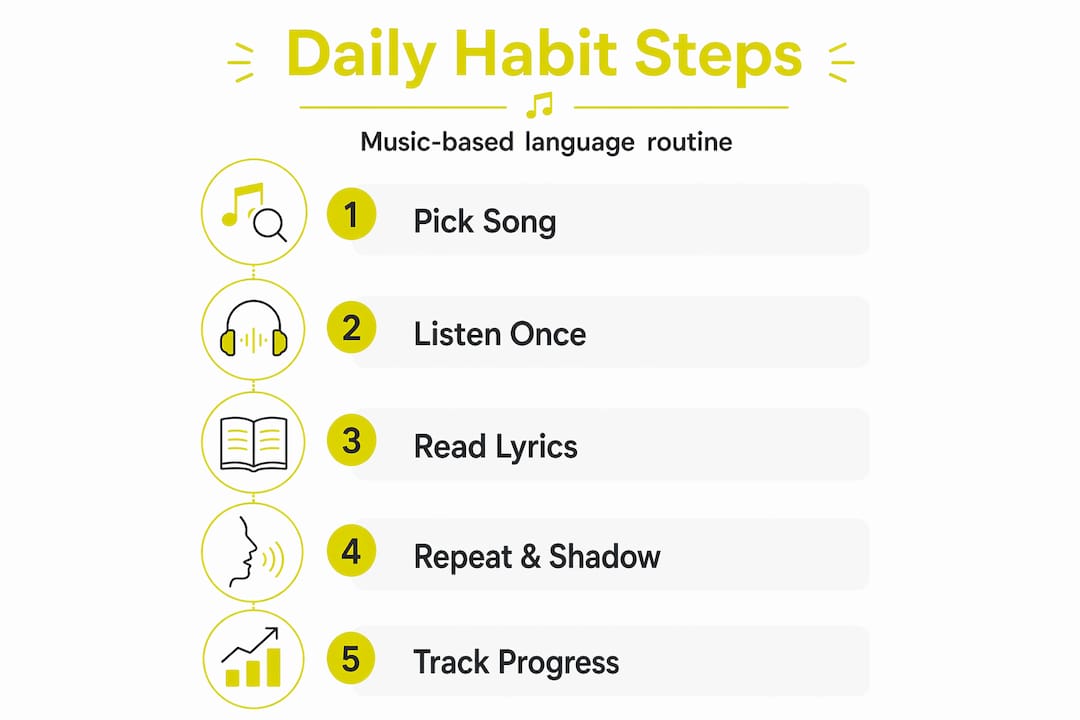
This is where daily language practice tips move from theory into action. Follow these steps in order and repeat them daily at the same time.
-
Pick a song that matches your current level. Not too easy, not so dense that you lose the meaning. Pop songs, folk tracks, and film soundtracks in your target language work well. Your emotional connection to the genre matters more than people admit. If you dread pressing play, the habit dies fast.
-
Read the lyrics with translation before listening. Spend 3-5 minutes identifying 3-5 new words or phrases. Write them down with a brief note on meaning and context. This primes your brain to notice those words when you hear them sung.
-
Shadow the song out loud. Shadowing means listening and repeating simultaneously, matching the singer’s rhythm, pitch, and pacing. Shadowing trains your phonological loop for automatic processing, which is what makes rhythm and prosody feel natural instead of forced. It is one of the most underused techniques in language learning.
-
Record yourself singing or speaking a verse. Keep it short: 30 seconds to one minute. Play it back immediately and listen for specific issues, not general impressions. Did you rush a syllable? Flatten a vowel? Blur two words together? One issue per session is enough.
-
Build a micro-dialogue from the song’s theme. If the song is about a breakup, write three lines of conversation someone might have in that situation. Speak them aloud. This bridges song vocabulary into real-world speech, which is the gap most music-only learners miss.
-
Log the session in your habit tracker. Even a simple checkmark on a calendar works. Visual streaks are powerful motivators, and seeing your consistency laid out in front of you makes skipping feel like a real cost.
Pro Tip: Rotate your songs every 5-7 days. Repeating the same track deepens mastery of specific phrases, but switching keeps your ear adapting to new sounds, accents, and vocabulary patterns. Both matter for well-rounded fluency.
Short, consistent speaking practice mirrors real communication situations and builds fluency faster than occasional long sessions ever will. That is not an opinion. It is how language retention actually works.
| Technique | Skill trained | Time needed |
|---|---|---|
| Shadowing with lyrics | Pronunciation, rhythm, prosody | 5-7 minutes |
| Vocabulary journaling | Word retention, contextual use | 3-5 minutes |
| Micro-dialogue practice | Speaking fluency, real-world phrasing | 3-5 minutes |
| Self-recording and review | Accuracy, self-correction | 2-4 minutes |
Review the daily language practice benefits if you want a deeper breakdown of why this structure works neurologically. For genre-specific strategies, check out these song-based practice tips and interactive language practice tips to expand your approach.
With the preparation complete, you now have a concrete process to build your language habits with music.
Common challenges and how to overcome them in daily practice
Understanding these common hurdles helps ensure your habit-building journey stays on track.
The real obstacles are not what most learners expect.
“The biggest barrier to daily practice is not laziness. It is a practice method that feels like work rather than something worth returning to.”
Here are the most common problems and what actually fixes them:
-
No time. The fix is not finding more hours. It is accepting that 10 focused minutes count. Set a non-negotiable daily window, even during a commute or lunch break. Three songs on the way to work is legitimate practice.
-
Pronunciation feels stuck. Shadowing fixes this over time, but only with consistent feedback. Record every session and compare recordings from week one to week three. Progress shows up in the recordings before you feel it in the moment.
-
Boredom from repetition. Rotate genres actively. A week of bossa nova, a week of K-pop, a week of Spanish rap. Each genre brings new vocabulary, slang, and phonetic patterns. Boredom is not a motivation problem. It is a variety problem.
-
Sounding scripted or unnatural. This is a real risk when practice leans too heavily on memorized phrases. Over-reliance on scripted replies can make speech sound less authentic. Personalize your micro-dialogues. Add your own opinions and reactions instead of repeating lyrics verbatim.
-
Motivation dips after two weeks. This is the standard plateau. Counter it by tracking one measurable improvement per week, whether that is a new phrase you used naturally in conversation or a pronunciation shift your recording confirms.
Pro Tip: Take a screenshot or voice memo of your practice on day one and compare it to day 30. The difference is almost always bigger than you expect, and that comparison alone resets motivation faster than any pep talk.
A well-designed fun language practice workflow accounts for all of these challenges upfront, so you are not improvising solutions when your energy is low.
Measuring progress and staying motivated with song-based language practice
With ways to measure your journey, you can maintain momentum toward fluency.

Progress in language learning is often invisible in the short term, which is exactly why learners quit. Building a simple feedback loop makes improvement concrete and visible.
The 3-step feedback loop:
- Record a 30-60 second segment of yourself singing or speaking in your target language.
- Identify one or two specific targets: a vowel sound, a rhythm pattern, a vocabulary word used naturally.
- Re-record the same segment after focused work and compare the two versions side by side.
Recording yourself, noting issues, and re-recording to compare is one of the highest-return actions you can take for rapid progress. It turns vague feelings of improvement into actual evidence.
Track these specific signals weekly:
- Fewer filler words (“um,” “uh,” or their equivalents in your target language)
- Smoother transitions between words without unnatural pauses
- Vocabulary from songs appearing naturally in your own sentences
- Improved rhythm that matches native speaker patterns rather than your first language’s cadence
Milestone ideas worth celebrating:
- Mastering the full lyrics to one song without looking
- Pronouncing a previously difficult sound consistently and correctly
- Using a song phrase in a real conversation with a native speaker
Set one micro-goal per session. Not “get better at Spanish” but “nail the rolled R in this specific verse.” Small targets create a language learning habits checklist mentality where every session has a clear win condition.
Statistic to keep in mind: Research on habit formation consistently shows that tracking behavior increases the likelihood of continuing it by a significant margin. Seeing your streak broken is uncomfortable enough to motivate showing up the next day.
Why music-infused microlearning revolutionizes daily language habits
Here is the honest observation that most language learning advice skips: traditional study methods are built around comprehension and grammar, almost never around how language actually sounds and feels in motion. That is a significant structural gap.
Native fluency is not just knowing the right word. It is producing the right word at the right speed with the right stress pattern. Music trains all three simultaneously, which is why shadowing forces rapid phonological processing that no grammar drill can replicate. You cannot shadow a conjugation table. You can shadow a Shakira chorus.
The microlearning piece solves a different problem. Most people do not fail at language learning because they lack commitment. They fail because they design habits that require more time, energy, and willpower than their daily life consistently supports. Ten minutes daily is not a compromise. It is actually the right dosage for habit formation during the critical early weeks when the behavior is still fragile.
What makes music uniquely powerful here is the emotional and mnemonic layering. When you associate vocabulary with a song you love, you are encoding it in multiple memory systems at once: semantic, episodic, and procedural. That triple encoding is why you can still remember lyrics to a song you have not heard in ten years. Dry drills do not come close to that level of retention.
The underutilization of this approach in mainstream language education is baffling, especially when learners report that songs were the thing that finally made a word or phrase stick. For anyone serious about creating language learning habits that last, music is not a supplementary tool. It is the foundation. Explore a full music language learning habits guide to see how this plays out in structured practice.
Explore Canary’s music-driven language learning to power your daily habits
If you have read this far, you already know what effective daily language practice looks like. The missing piece is a platform designed to deliver it without friction.
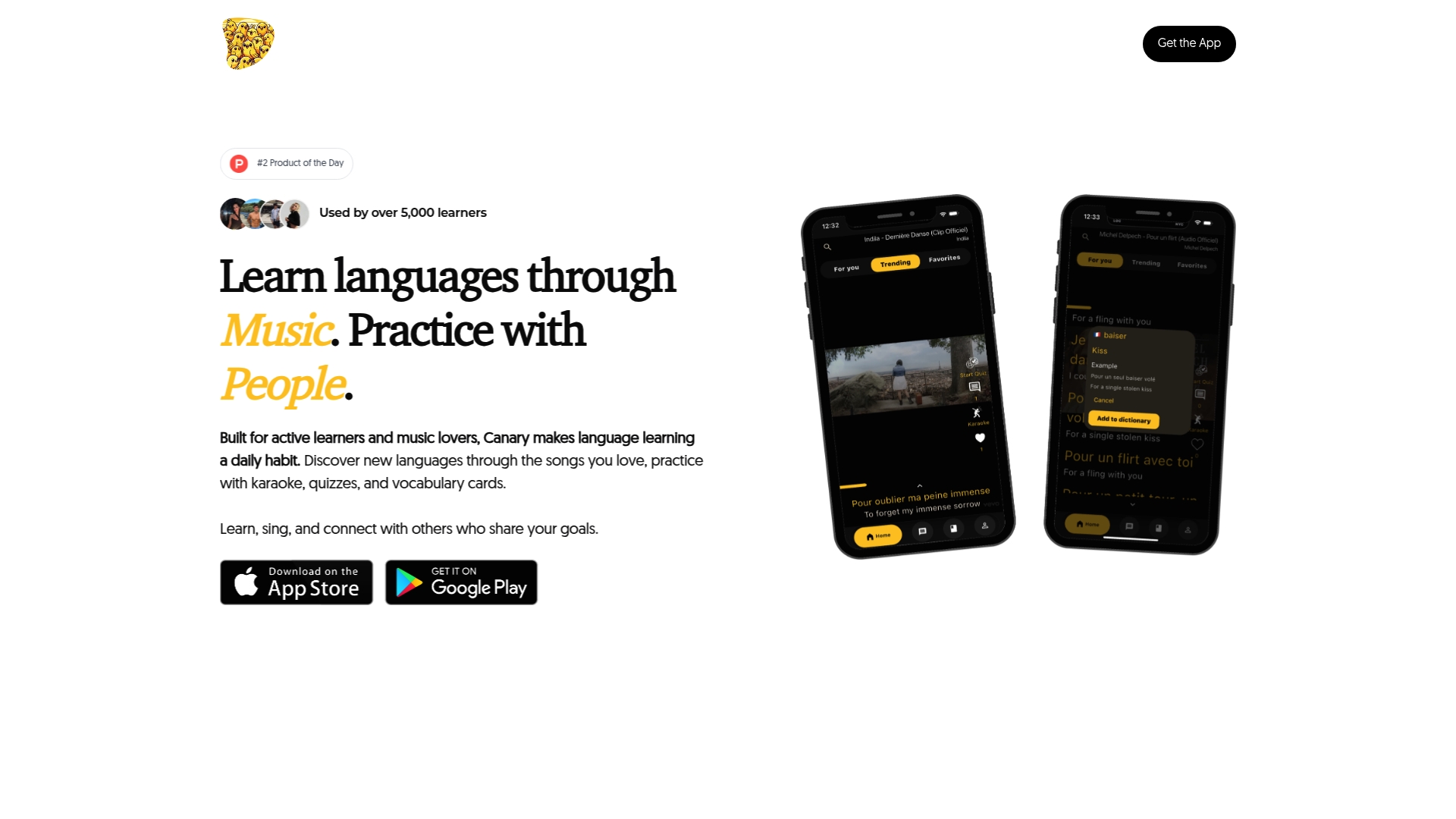
Canary is built specifically for active learners and music enthusiasts who want to practice pronunciation, expand vocabulary, and build real fluency through songs. The platform combines karaoke-style interaction, vocabulary cards pulled directly from song lyrics, and a global community of learners who practice together. You get the structure this article describes, built directly into the experience. Start with a daily language practice workflow with music and pair it with song-based practice tips tailored to your target language. Motivation stays high when practice feels like something you want to do rather than something you scheduled.
Frequently asked questions
What is the ideal daily time for language practice to build habits effectively?
10-20 minutes a day is enough to build confidence and fluency when sessions are focused on one skill at a time rather than trying to cover everything at once.
How does shadowing improve language pronunciation and fluency?
Shadowing trains the brain’s phonological loop for automatic processing of rhythm and prosody, meaning your mouth learns to produce natural sounds before your conscious mind catches up.
Can music really help with vocabulary learning in a new language?
Yes. Music encodes vocabulary in emotional and melodic memory, and singing lyrics creates stronger word retention than flashcards or written drills because meaning and sound are learned together in context.
What are common obstacles in building daily language habits and how can I overcome them?
The most common obstacles are time pressure, boredom, and pronunciation plateaus. Microlearning fits busy schedules while rotating songs, personalizing your practice, and using feedback loops address the rest.