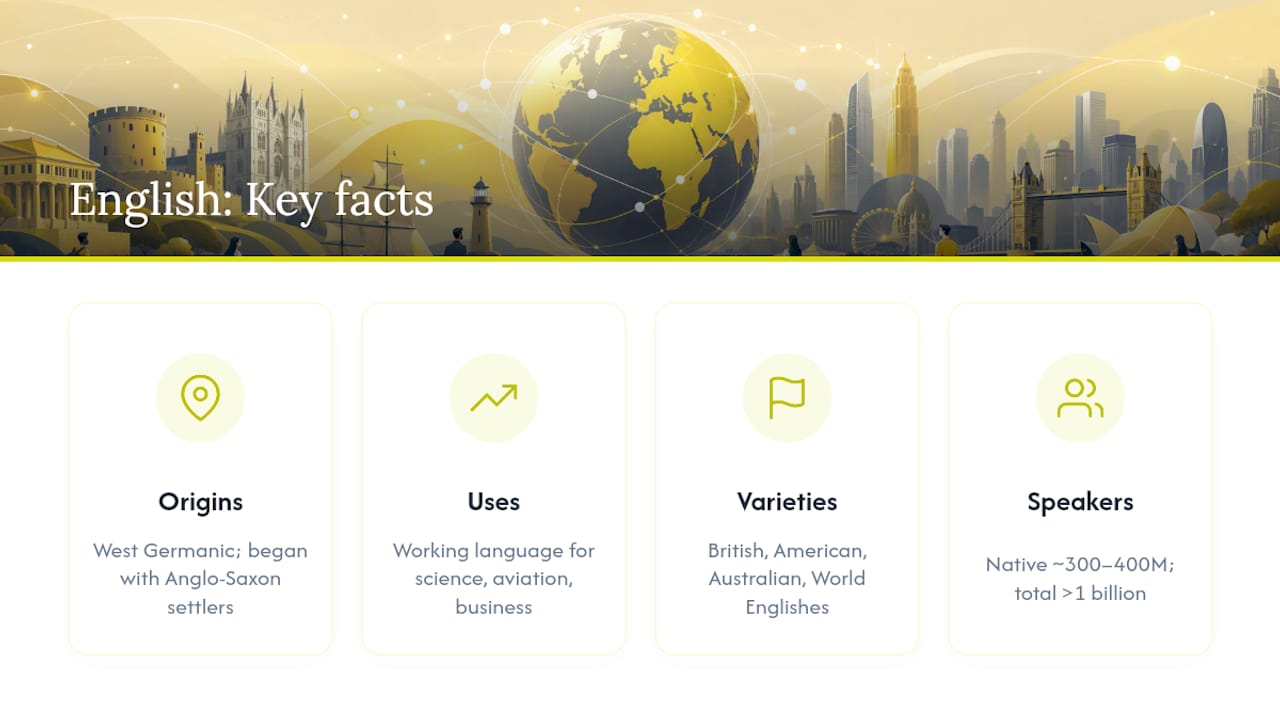
English is a West Germanic, Indo-European language born in the Anglo-Saxon kingdoms of early medieval Britain, pronounced /ɪŋglɪʃ/. It now functions as the world’s working language for science, business, and travel.
The numbers back that up. English has roughly 300 to 400 million native speakers, a range that puts it among the largest native-speaker languages on Earth. Once you count second-language and foreign-language speakers, the total climbs past a billion worldwide.
- Native speakers: approximately 300 to 400 million
- Total speakers (native plus non-native): a very large number, more than a billion
- Official or primary language status: dozens of countries and major international bodies
- Global function: the de facto lingua franca of science, aviation, and international business
Key Takeaways
English’s global reach comes from historical spread and institutional adoption, not from any inherent structural advantage over other languages.
| Point | Details |
|---|---|
| West Germanic roots | English belongs to the Indo-European family’s West Germanic branch, sharing ancestry with German and Dutch. |
| Layered history | Old English, Norse contact, the Norman Conquest, and the printing press each reshaped vocabulary and grammar. |
| Hybrid vocabulary | Roughly half of English words trace to French and Latin, while everyday words remain mostly Germanic. |
| Irregular spelling has causes | The Great Vowel Shift plus multiple source languages froze spellings that no longer match pronunciation. |
| Fluency needs rhythm and idiom | Register and idiomatic knowledge matter as much as grammar for sounding natural in conversation. |
| Music-based practice | Singwithcanary pairs song lyrics, karaoke drills, and vocabulary cards to train pronunciation and rhythm through daily musical practice. |
Table of Contents
- What Is the “idioma inglés” and Where Does It Rank Globally?
- How Did English Evolve From Old English to Today?
- What Makes English Grammar and Sound System Distinct?
- What Are the Main Varieties of English Around the World?
- Why Is English Considered the Global Lingua Franca?
- Why Does English Spelling Look So Irregular?
- Does Fluency Require More Than Grammar and Vocabulary?
- Can Music Really Speed Up How You Learn English?
- How Does English Compare to Other Languages Learners Study?
- The Bigger Problem With How Most People Study English
- Learn English Faster With Music-Based Practice
- Frequently Asked Questions
- Sources
What Is the “idioma inglés” and Where Does It Rank Globally?
“Idioma inglés” is simply Spanish for “the English language,” and understanding that phrase is the first step toward understanding why so many Spanish speakers study it. English belongs to the West Germanic branch of the Indo-European family, sharing ancestry with German and Dutch rather than with Romance languages like Spanish or French.
That family tree matters for learners: Spanish speakers often expect English grammar to behave like a Romance language, but its bones are Germanic, even though roughly half its vocabulary traces back to French and Latin after centuries of borrowing.
| Category | Detail |
|---|---|
| Language family | Indo-European → Germanic → West Germanic → Anglic |
| Writing system | Latin alphabet |
| Native speakers | Roughly 300 to 400 million |
| Total speakers (native + non-native) | Over a very large number, exceeding a billion, based on aggregated counts |
| Official status | Official or co-official in dozens of countries and in bodies like the United Nations |
A few things stand out in that table. English has no single “owner” nation the way Spanish is anchored to Spain and Latin America. It spread through colonization, trade, and later through American media and technology, which is why its official status list includes countries with almost no historical Anglo-Saxon settlement at all, from Nigeria to Singapore.
How Did English Evolve From Old English to Today?
English didn’t arrive as one language. It’s the product of at least four invasions, one printing revolution, and a few centuries of empire, and each stage left fingerprints still visible in the language you’re learning today.
- Old English (roughly 450 to 1150 AD). Germanic tribes, the Angles, Saxons, and Jutes, crossed the North Sea into Britain after Roman withdrawal and brought their dialects with them. This is the English of Beowulf, the epic poem whose opening line, “Hwæt! We Gardena in geardagum,” is nearly unreadable to modern eyes. Old English had grammatical gender, complex noun cases, and a vocabulary that was almost entirely Germanic.
- Viking contact (roughly 800 to 1050 AD). Norse raiders and settlers didn’t just pillage. They intermarried, traded, and left behind words English still uses daily: sky, knife, egg, they, are. Norse contact also simplified English grammar, since speakers of related but distinct Germanic dialects tend to drop the fussy endings that trip up mutual understanding.
- Middle English (1150 to 1500 AD). The Norman Conquest of 1066 put French-speaking rulers on the English throne for generations, and Latin remained the language of the church and scholarship. Government, law, and cuisine words came from French, so English ended up with pairs like cow (Germanic, the living animal) and beef (French, the food on your plate). Geoffrey Chaucer wrote The Canterbury Tales in this stage, and while it takes practice, modern readers can actually follow it, unlike Beowulf.
- Early Modern English (1500 to 1700 AD). The Great Vowel Shift quietly reorganized how English speakers pronounced long vowels, but spelling had already started to freeze thanks to the printing press William Caxton introduced to England in 1476. That mismatch between shifting sound and fixed spelling is the root of a lot of modern English’s orthographic headaches. William Shakespeare wrote during this period, and his work shows a language stabilizing into something close to what you read today, even as he coined or popularized hundreds of new words.
- Modern English (1700 AD to today). The British Empire, and later American economic and cultural power, carried English to every continent. Colonial contact, industrialization, and eventually the internet added waves of new vocabulary and new regional varieties, from Indian English to Nigerian Pidgin-influenced speech.
The word “English” itself comes from Englisc, the Old English term for the language of the Angles, one of the three main Germanic tribes that settled Britain. The tribe’s name outlived its politics.
- Germanic migrations gave English its skeleton: core grammar and everyday words.
- Norse contact stripped away grammatical complexity and added common vocabulary.
- The Norman Conquest layered French and Latin vocabulary onto that Germanic base.
- The printing press locked in spellings just before pronunciation kept shifting.
- Colonial and economic expansion turned a regional language into a global one.
For a deeper look at how these historical layers still shape the English language you hear in songs and conversation today, the connections between medieval sound changes and modern pronunciation quirks run deeper than most learners realize.
What Makes English Grammar and Sound System Distinct?
English, pronounced /ɪŋglɪʃ/, keeps its West Germanic bones but wears a mostly Romance vocabulary on top, and that mismatch is exactly what trips up Spanish-speaking learners the most.
Start with sound. English has a notably large vowel inventory, somewhere between 12 and 20 distinct vowel sounds depending on the dialect you’re counting, compared to Spanish’s five. Consonant clusters pile up in ways Spanish rarely allows: think of the three consonants stacked in “strengths” or the initial cluster in “splash.” English is also stress-timed, meaning syllables get compressed or stretched to keep a steady beat between stressed syllables, while Spanish is syllable-timed, giving each syllable roughly equal weight. That rhythmic difference is often why Spanish speakers sound slightly stilted in English even when their grammar is flawless, and why native English speakers sometimes sound like they’re mumbling through unstressed words.

Grammar leans simpler in some ways and stranger in others. Word order sticks fairly rigidly to subject-verb-object, unlike Spanish, which tolerates more flexibility. English relies heavily on auxiliary verbs and modals (“do,” “have,” “will,” “might”) to build tenses and questions, a system Spanish handles through verb conjugation instead. Then there are strong verbs that change internally (sing, sang, sung) sitting alongside weak verbs that just add -ed (walk, walked), a split inherited straight from Old English. Phrasal verbs, look up, give in, run into, multiply the vocabulary you need for basic fluency, since each combination can mean something unrelated to its parts.
The vocabulary itself is a patchwork:
- Old Norse: sky, knife, window, they
- Norman French: government, castle, beef, justice
- Latin and Greek (often via scholarship and science): biology, democracy, photosynthesis
- Modern global borrowings: tsunami (Japanese), safari (Swahili via Arabic), sofa (Arabic)
That hybrid vocabulary is a double-edged sword for learners. On one hand, Spanish speakers get a huge head start: thousands of English words derived from Latin or French look and mean almost exactly what their Spanish cognates do (information/información, nation/nación, possible/posible). On the other hand, the everyday, high-frequency words tend to be the Germanic ones with no obvious cognate at all, which is why intermediate learners often feel stuck despite recognizing plenty of “big” vocabulary.
What Are the Main Varieties of English Around the World?
There’s no single “correct” English, just a set of major varieties shaped by geography and history, and knowing the differences helps you understand why a British sitcom and an American sitcom sometimes need separate subtitles.
- British English: the reference variety for most of Europe and much of Africa and Asia, with distinct vocabulary (lift, flat, biscuit) and non-rhotic pronunciation in most regions, meaning the “r” sound often drops at the end of syllables.
- American English: dominant in media, technology, and business globally, rhotic in pronunciation, and the variety most streaming services and tech interfaces default to.
- Australian and New Zealand English: distinct vowel shifts and a vocabulary shaped by Indigenous languages and isolation from other English-speaking regions.
- World Englishes: varieties like Indian English, Nigerian English, Singaporean English, and Caribbean English, each shaped by local languages, colonial history, and now hundreds of millions of speakers in their own right.
Native-majority regions, the United States, the United Kingdom, Ireland, Australia, Canada, and New Zealand, differ sharply from regions where English functions as an official or widely used second language, like India, Nigeria, or the Philippines, where it coexists with dozens of local languages.
Mutual intelligibility holds up reasonably well across these varieties. Vocabulary and pronunciation differences (trunk vs. boot, soccer vs. football) cause more confusion than grammar does, and most educated speakers across regions can adjust within a few sentences of conversation.
Why Is English Considered the Global Lingua Franca?
English earned its lingua franca status through history and economics, not linguistic superiority, and it now sits at the center of the domains that run the modern world. Academic sources describe English as the de facto global language precisely because of that institutional weight rather than any inherent advantage over other languages.
- Science and academia: the majority of peer-reviewed research worldwide gets published in English, regardless of the authors’ native language.
- Aviation: the International Civil Aviation Organization mandates English as the standard for pilot-controller communication on international flights.
- Maritime navigation: international shipping relies on standardized English phrases to prevent communication failures at sea.
- International business and diplomacy: English serves as a working language at the United Nations and dominates cross-border commerce and negotiation.
- The internet: a disproportionate share of online content, from documentation to major platforms, defaults to English.
Non-native speakers now vastly outnumber native ones, and that shift changes what “global English” even means. The language spoken between a German engineer and a Japanese client on a video call often isn’t British or American English at all. It’s a simplified, functional dialect built for clarity across accents, and it’s arguably the most-used form of English on the planet today, even though it appears in no textbook.
Why Does English Spelling Look So Irregular?
English spelling looks chaotic because it froze in place while pronunciation kept moving, and three historical forces collided to create the mess learners deal with today. The Great Vowel Shift, a centuries-long change in how long vowels were pronounced, happened right around the time printing standardized written forms, so words like “knight” and “through” kept spellings that reflect sounds no longer spoken.
Add in the fact that English vocabulary comes from Old English, Norse, French, Latin, and Greek, each with its own spelling conventions, and you get inconsistent letter combinations for the same sound: the “sh” sound alone can appear as sh, ti (nation), ci (special), or ch (machine). Silent letters, the k in “knife,” the gh in “though,” are fossils of pronunciations that existed centuries ago but vanished from speech while the spelling stayed put.
Pro Tip: Instead of memorizing spelling rules with dozens of exceptions, focus on the 100 to 200 most common irregular words first. They cover a disproportionate share of everyday reading and writing, and pattern recognition takes care of the rest over time.
Does Fluency Require More Than Grammar and Vocabulary?
Real fluency depends on register and idiom as much as grammar accuracy, and this is the piece most textbooks shortchange. Register refers to how formal or casual your language is: “Could you possibly help me?” versus “Can you help?” versus “Gimme a hand?” all say the same thing at wildly different formality levels, and using the wrong one in the wrong setting makes you sound off even with perfect grammar.
Idioms compound the challenge. “Break a leg” has nothing to do with injury, and “under the weather” has nothing to do with meteorology. EF’s fluency guidance specifically recommends learning dialect-appropriate idioms, since British and American English don’t always share the same expressions: Americans “table a discussion” to postpone it; the British use the same phrase to mean starting it immediately.
- Register examples: formal (“I would appreciate your assistance”) vs. informal (“Help me out?”)
- Idiom examples: “hit the books” (study hard), “spill the beans” (reveal a secret)
- Dialect note: American and British idioms sometimes overlap in words but diverge completely in meaning
Pro Tip: Build cultural literacy the way native speakers absorb it: through song lyrics, films, and podcasts, not just grammar drills. Cultural literacy is a core component of practical fluency, often mattering more than another semester of isolated grammar exercises.
Can Music Really Speed Up How You Learn English?
Song lyrics repeat vocabulary in emotionally memorable contexts, which is exactly the kind of repetition that helps words stick in long-term memory. Rhythm and melody also mirror the stress-timed pattern of English speech, so singing along trains your ear for natural sentence rhythm in a way flashcards never will.
A few techniques make the biggest difference:
- Shadowing with songs: singing along in real time trains pronunciation and rhythm simultaneously.
- Lyric gap-fills: listening for missing words sharpens listening comprehension under real, fast-paced speech conditions.
- Karaoke-style pronunciation drills: repeating lines aloud builds muscle memory for sounds that don’t exist in Spanish.
- Vocabulary cards tied to specific songs: anchoring new words to a melody you already know improves recall.
Chunk-based learning, memorizing whole phrases instead of isolated words, speeds up natural speech production, and song lyrics are essentially pre-packaged chunks with built-in rhythm and emotional context. Learners who pair music with structured vocabulary review tend to report faster gains in accent and word retention than those relying on textbook repetition alone, since the melody does part of the memorization work for free.
How Does English Compare to Other Languages Learners Study?
Choosing English isn’t a decision made in isolation. Plenty of learners weigh it against other major world languages depending on career goals or personal interest, and the case for learning any second language usually comes down to similar factors: economic opportunity, cultural access, and cognitive benefits from bilingualism.
What sets English apart is reach without requiring you to choose a single region. Learning Mandarin opens doors mainly tied to China and its diaspora; learning English opens doors in scientific publishing, Silicon Valley, London finance, Australian universities, and call centers in Manila, all at once. That breadth is why English tends to be the second language people add first, even when their real interest lies elsewhere.
The Bigger Problem With How Most People Study English
Most English courses drill grammar tables and vocabulary lists as if fluency were a math problem to solve. It isn’t. Fluency is closer to muscle memory: the ability to retrieve the right phrase, in the right rhythm, without translating in your head first.
That’s where conventional advice falls short. Grammar accuracy gets tested obsessively because it’s easy to grade, while rhythm, stress, and cultural register, the things that actually make you sound fluent instead of just correct, get treated as advanced extras for later. But native speakers don’t process English as a grammar chart. They process it as chunks, rhythms, and idioms absorbed through thousands of hours of exposure, mostly through media, conversation, and yes, music.
If you’re studying English right now, the priority should flip: get your ear trained on rhythm and common phrases before you obsess over the subjunctive. Grammar mistakes are forgivable and easy to correct later. A stilted rhythm and a stiff, memorized-textbook register are much harder to unlearn once they set in. Start with the sound of the language, not its rules.
Learn English Faster With Music-Based Practice
Singwithcanary turns the chunk-based, rhythm-first approach this article just made the case for into an actual daily habit instead of a good intention. Where grammar apps ask you to grind through drills, Singwithcanary uses song lyrics, karaoke-style pronunciation practice, and vocabulary cards tied to music you already enjoy, so your ear absorbs English rhythm while you’re having fun instead of forcing it through repetition alone.

The platform’s social features let you practice speaking with people around the world, which matters because reading about idioms and registers only gets you so far; you need real exchanges to make them stick. Vocabulary cards built around song lyrics also reinforce the chunk-based learning that speeds up natural speech, letting you learn phrases in context rather than as isolated words on a flashcard.
If the history and structure covered in this article made you curious about how English actually sounds when it’s sung, spoken, and shared casually rather than studied academically, sign up for Singwithcanary and start your first song-based lesson today.
Frequently Asked Questions
What is the English language, in simple terms? English is a West Germanic language, part of the Indo-European family, that began with Anglo-Saxon settlers in Britain and later spread worldwide through trade, colonization, and cultural influence. It now functions as the leading language of international business, science, and travel.
Why is English considered so important today? English serves as the working language for science, aviation, maritime navigation, and global business, which means fluency opens doors to international education, remote work, and cross-border communication that few other single languages can match.
What are the main types of English spoken around the world? The major varieties include British English, American English, Australian English, and a group often called World Englishes, covering varieties like Indian English, Nigerian English, and Caribbean English. Each carries distinct pronunciation and vocabulary shaped by local history.
How many people speak English worldwide? Estimates put native speakers at roughly 300 to 400 million, while total speakers, including second-language and foreign-language users, exceed a billion when combined.
Why is English spelling so hard to predict from pronunciation? Spelling froze around the time the printing press standardized written forms, but pronunciation kept shifting afterward, especially during the Great Vowel Shift. Combined with borrowed words from French, Latin, and Norse, each with its own spelling habits, the result is a writing system with far more exceptions than rules.
Sources
- English language
- Idioma inglés - Wikipedia, la enciclopedia libre
- English often considered de-facto global language (UCL Culture Online)