TL;DR:
- Italian pronunciation is straightforward due to consistent phonetic rules and clear vowel sounds that are easy to learn. Focusing on rhythm, intonation, and practice with native audio helps learners sound more natural and improve comprehension. Daily routines incorporating repetition, shadowing, recording, and music-based practice accelerate mastery of Italian sounds and speech patterns.
Italian pronunciation is defined by consistent phonetic rules, pure vowel sounds, and a musical rhythm that English speakers can learn with targeted daily practice. Unlike English, Italian almost always sounds exactly as it is spelled. That predictability is your biggest advantage. This guide to improving Italian pronunciation breaks down the key sounds, rhythm patterns, and daily habits that move you from hesitant to confident in real conversation. Master the fundamentals of vowels, consonant clusters, and natural phrasing, and your Italian will sound clear and natural far sooner than you expect.
What are the key Italian sounds to master for clear pronunciation?
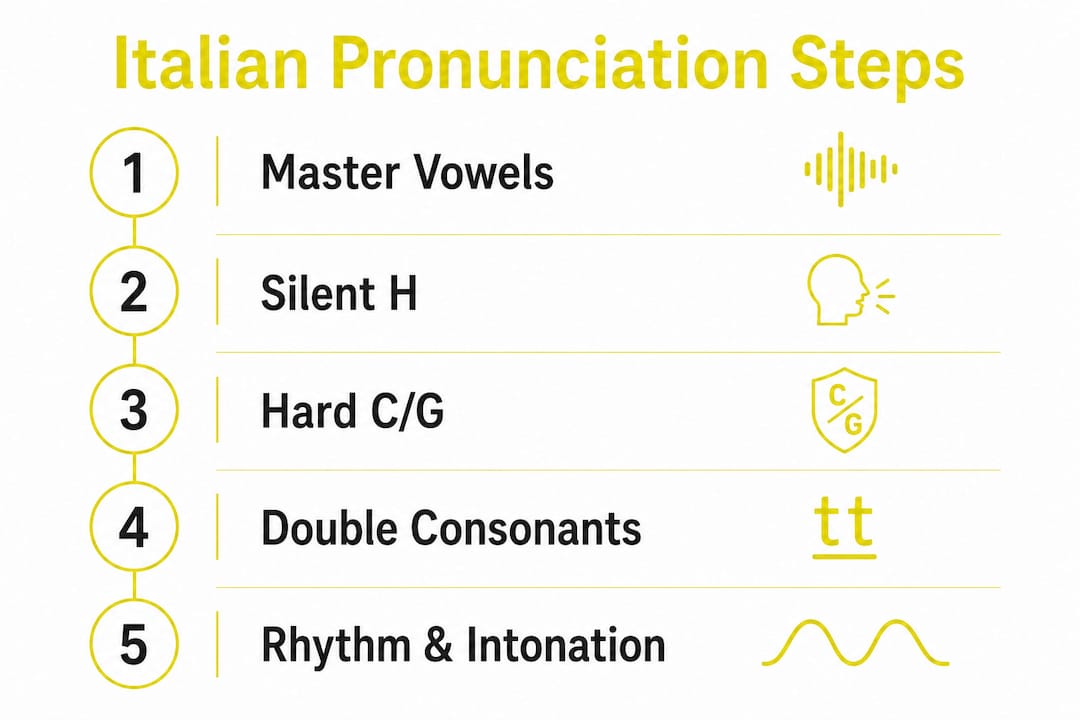
Italian phonetics practice starts with vowels. Italian has 5 vowel letters producing 7 distinct pure vowel sounds. Each vowel is always pronounced fully and clearly, with no reduction or blurring the way English vowels shift depending on stress. The “a” in “casa” sounds the same every single time. That consistency makes Italian vowels far easier to master than English ones once you commit to keeping them clean.
Consonant clusters are where most English speakers stumble. The three groups worth drilling first are:
- GN: Pronounced like the “ny” in “canyon.” The word “gnocchi” sounds like “nyoki,” not “noki.”
- GL: Produces a soft sound similar to “lli” in “million.” “Figlio” (son) is pronounced “feelyo.”
- SC: Changes depending on the vowel that follows. Before “e” or “i,” it sounds like “sh” (as in “scena,” meaning scene). Before “a,” “o,” or “u,” it sounds like “sk” (as in “scala,” meaning staircase).
The letter “H” is always silent in Italian. “Ho” (I have) is pronounced “o.” That trips up English speakers who instinctively add a breath at the start.
The rules for “C” and “G” follow the same vowel-based logic. A hard “C” (like “k”) appears before “a,” “o,” and “u.” A soft “C” (like “ch” in “cheese”) appears before “e” and “i.” The same pattern applies to “G”: hard before “a,” “o,” “u” (as in “gatto,” meaning cat), and soft before “e” and “i” (as in “gelato”). Learning this rule once unlocks hundreds of words immediately.

Double consonants are one of the most meaningful features of Italian. They change the meaning of words entirely. “Pala” means shovel. “Palla” means ball. The difference is a slightly longer hold on the consonant. Skipping this distinction does not just sound foreign. It creates genuine confusion for native speakers.
How does Italian rhythm and intonation influence pronunciation?
Italian is a syllable-timed language, meaning every syllable receives roughly equal time and weight. English is stress-timed, so English speakers naturally compress unstressed syllables. That habit is the single biggest obstacle to sounding natural in Italian. Dropping it takes conscious effort, but the payoff is immediate.
Intonation in Italian carries emotion more than stress does. A native speaker does not punch one word in a sentence to show emphasis the way English speakers do. Instead, the melody of the whole phrase rises and falls to signal questions, excitement, or certainty. Copying that melodic shape, even imperfectly, makes you sound far more natural than getting every phoneme right but speaking in a flat, English-style monotone.
“Focusing on intonation and natural rhythm often improves perceived fluency more than perfecting every single phoneme. Learners who sound musical get understood faster, even when individual sounds are imperfect.”
Pausing slightly before double consonants adds the necessary weight that separates them from single consonants. Think of it as a tiny breath-hold before the sound, not a full stop. Practice with minimal pairs like “pala” and “palla” until the pause becomes automatic.
Pro Tip: Record yourself saying a short Italian sentence, then play it back next to a native speaker saying the same phrase. Listen for where your rhythm flattens out. That gap is your most productive practice target.
Rhythm also acts as a buffer for small errors. When your syllable timing is even and your intonation follows the natural arc of Italian, native speakers fill in the gaps. A well-timed phrase with one mispronounced vowel lands better than a perfectly pronounced word delivered with English stress patterns.
What is an effective daily practice routine to improve Italian pronunciation?
A structured daily routine produces faster results than occasional long study sessions. A 15-minute routine divided into four focused blocks covers every key skill without burning out your attention.
- Repeat short phrases (3 minutes). Choose 3 to 5 sentences from a dialogue or song lyric. Say each one aloud five times, focusing on vowel clarity and even syllable timing. Do not rush.
- Shadow a native speaker (5 minutes). Play a short audio clip of a native Italian speaker and speak along in real time, matching their rhythm and melody as closely as possible. Shadowing trains your ear and your mouth simultaneously.
- Free-speak from a script (5 minutes). Take a simple topic, such as describing your morning routine, and speak aloud in Italian without stopping to check your notes. Fluency under mild pressure builds faster than careful, error-free recitation.
- Record and review (2 minutes). Record one sentence or short paragraph. Play it back and compare it to a native model. Note one specific thing to fix the next day.
| Block | Duration | Focus |
|---|---|---|
| Phrase repetition | 3 minutes | Vowel clarity, syllable timing |
| Shadowing | 5 minutes | Rhythm, intonation, melody |
| Free-speaking | 5 minutes | Fluency, natural flow |
| Self-recording | 2 minutes | Error identification, self-correction |
Self-recording and comparing to native speech is one of the most effective self-correction techniques available. Most learners avoid it because hearing your own voice is uncomfortable. That discomfort is the point. It forces you to hear what you actually sound like rather than what you think you sound like.
Daily practice of 5 to 10 minutes on specific sounds like GN, GL, and SC produces measurable improvement for English speakers. Short, focused sessions beat a two-hour weekend marathon every time. Consistency is the mechanism, not duration.
Pro Tip: Pick one Italian song you enjoy and use it as your daily shadowing material for a full week. Songs lock rhythm and intonation into muscle memory faster than spoken dialogue because the melody gives you a fixed target to match.
How can learners overcome common pronunciation challenges native to English speakers?
The rolled Italian “R” intimidates most English speakers. A light tap similar to the American English “tt” in “butter” is enough for intelligibility. A full trill is the goal eventually, but forcing it creates tension that disrupts your rhythm. Start with the tap, get comfortable, and the trill develops naturally over time.
Vowel reduction is the deepest English habit to break. In English, unstressed vowels collapse into a neutral “uh” sound. Italian has no equivalent. Every vowel in every syllable stays fully formed. The word “università” has five distinct vowel sounds, and each one counts. Practicing Italian with pure vowel sounds means slowing down enough to give each syllable its full shape.
Common challenges and targeted fixes:
- Flat intonation: Record a question in Italian, then compare it to a native speaker. Italian questions often rise earlier in the sentence than English ones do.
- Rushing through consonant clusters: Slow your speech by 20% when practicing GN, GL, and SC words. Speed comes back naturally once the sound is correct.
- Ignoring double consonants: Drill minimal pairs daily. “Nono” (ninth) versus “nonno” (grandfather) is a classic example that native speakers notice immediately.
- English sentence stress patterns: Learning fixed phrase chunks rather than building sentences word by word removes the temptation to apply English stress logic. Phrases like “come stai?” or “non lo so” are absorbed as single units with their own natural rhythm.
Pro Tip: When you catch yourself reducing a vowel, stop the sentence and restart it at half speed. Rebuilding the habit at a slower pace is faster than trying to correct it at full speed.
Slowing down does not make you sound robotic if your intonation stays musical. Native speakers appreciate clarity. They would rather hear a slow, clear sentence than a fast, garbled one. Speed is a byproduct of correct habit, not a goal in itself.
Learning idiomatic phrases and common conversational fillers also improves rhythm. Phrases like “allora,” “cioè,” and “dai” are not just vocabulary. They are rhythm markers that native speakers use to pace their speech. Using them correctly signals fluency even when your grammar is still developing.
Key Takeaways
Consistent daily practice of Italian phonetics, rhythm, and idiomatic phrases produces clearer, more natural speech faster than any single technique alone.
| Point | Details |
|---|---|
| Master vowels first | Keep all 7 Italian vowel sounds pure and fully articulated; never reduce them the way English does. |
| Learn the C, G, and SC rules | These consonant rules follow a predictable vowel-based pattern and unlock correct pronunciation across hundreds of words. |
| Practice double consonants daily | A slight pause before double consonants changes word meaning and marks native-level clarity. |
| Use a 15-minute daily routine | Split practice into phrase repetition, shadowing, free-speaking, and self-recording for balanced improvement. |
| Prioritize rhythm over perfection | Even syllable timing and natural intonation make you sound fluent faster than perfecting every individual sound. |
Why rhythm matters more than accent perfection
Accent perfection is a trap. I have watched learners spend months drilling a single sound while their overall rhythm stays flat and their conversations stall. Native Italian speakers care far more about whether you sound musical and clear than whether your “r” is a perfect trill.
The most useful shift I have seen in learners is when they stop thinking about individual sounds and start thinking about phrases as single units. Italian has a natural music to it. When you absorb that music through shadowing and song, your pronunciation improves across the board because your mouth and ear are working together instead of fighting each other.
Mistakes are not setbacks. They are data. Every time a native speaker looks confused, you have learned exactly which sound or rhythm pattern to fix next. That feedback is worth more than any textbook exercise. The learners who improve fastest are the ones who speak the most, make the most mistakes, and treat each one as a specific, solvable problem.
The goal is not to sound like you were born in Rome. The goal is to be understood clearly and to connect genuinely. Clarity and emotion conveyed through pronunciation matter more to native speakers than flawless accent imitation. Focus on that, and the accent takes care of itself over time.
— Ben
How Singwithcanary helps you practice Italian pronunciation daily
Real songs are one of the fastest ways to internalize Italian rhythm and intonation. Music locks syllable timing into memory in a way that textbook drills simply cannot match.
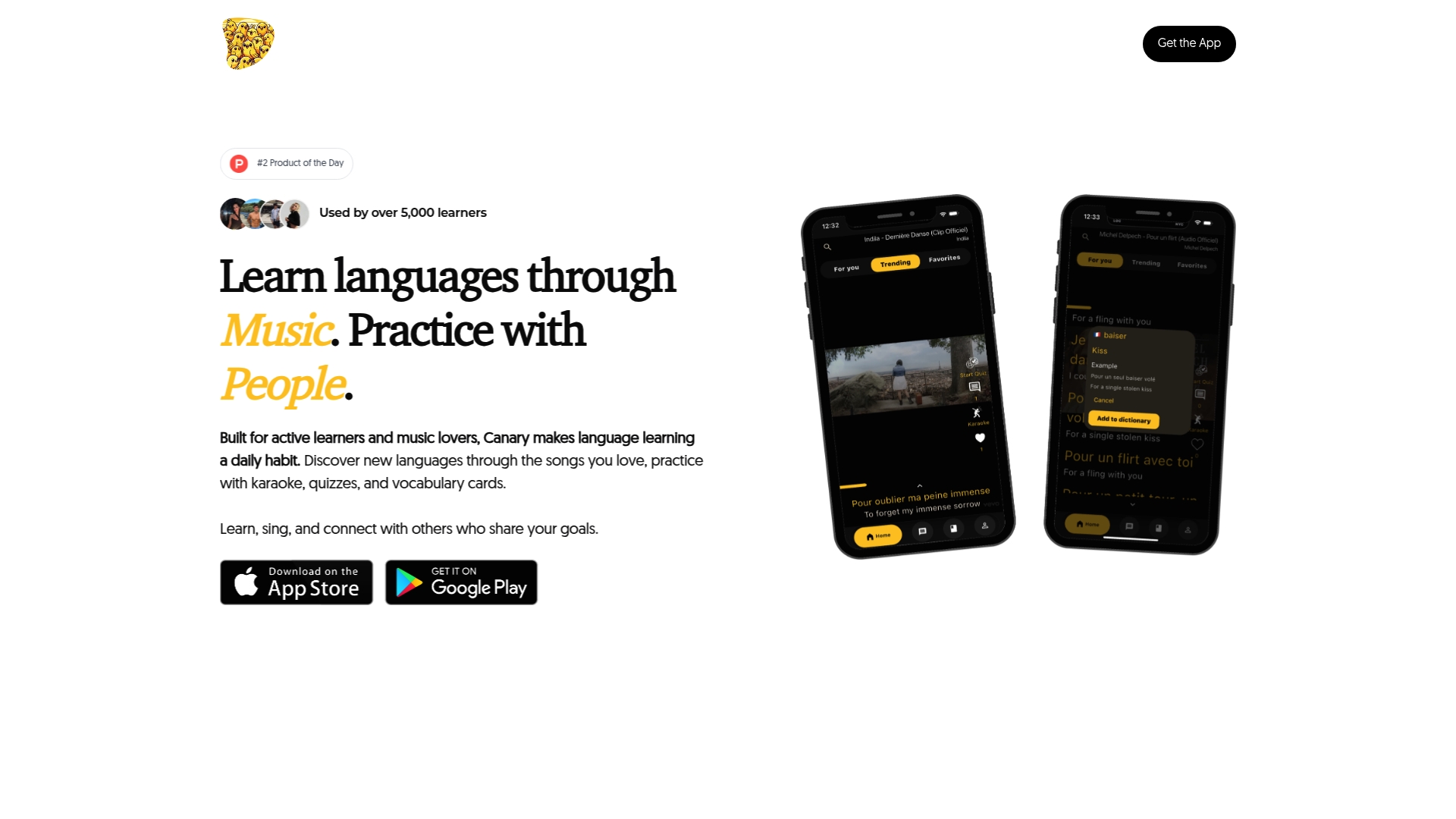
Singwithcanary is built around exactly that idea. The platform combines Italian songs with music and interactive features including karaoke, vocabulary cards, and pronunciation quizzes so you practice the sounds and rhythm of real Italian in context. You also connect with other learners and native speakers, which means your pronunciation gets tested in actual conversation, not just solo drills. If you want a daily habit that feels less like studying and more like listening to music you enjoy, explore the best apps for Italian learners and see where Singwithcanary fits into your routine.
FAQ
What are the hardest Italian sounds for English speakers?
The consonant clusters GN, GL, and SC are consistently the most difficult for English speakers, along with double consonants and the rolled “R.” Daily focused practice of 5 to 10 minutes on these specific sounds produces clear improvement.
How long does it take to improve Italian pronunciation noticeably?
Most learners notice a clear improvement in rhythm and vowel clarity within a few weeks of consistent daily practice. A structured 15-minute daily routine covering shadowing, repetition, and self-recording accelerates that timeline significantly.
Do I need a perfect Italian accent to be understood?
No. Clarity and natural rhythm matter more to native speakers than a flawless accent. Even a light foreign accent is well understood when vowels are pure and syllable timing is even.
What is the best way to practice Italian pronunciation at home?
Shadow native speakers using audio or video content, record your own speech and compare it to native models, and drill minimal pairs for double consonants. Music-based pronunciation practice is especially effective for training rhythm and intonation in a natural context.
Why do double consonants matter so much in Italian?
Double consonants change word meaning entirely. “Nono” means ninth, while “nonno” means grandfather. A slight pause before the double consonant is the key marker that native speakers use to distinguish them.