TL;DR:
- Interactive learning features involve active participation through decision-making, collaboration, and immediate feedback. They effectively engage learners on cognitive, social, and emotional levels, leading to significant learning gains. Technology enhances these features when paired with sound pedagogy, supporting personalization and multichannel content delivery.
Interactive learning features are defined as participatory technologies and pedagogical methods that actively engage learners through decision-making, collaboration, and immediate feedback. Unlike passive instruction, these features require learners to respond, reflect, and apply knowledge in real time. Research confirms that cognitive, social, and emotional engagement are all necessary for interactivity to produce lasting learning outcomes. Focusing on only one dimension, such as mechanical clicking through slides, produces superficial results. Educators and trainers who understand what are interactive learning features at this deeper level design experiences that build real capability, not just familiarity.
What are the most effective types of interactive learning features?
The most effective interactive features share one quality: they require learners to make decisions that reveal their thinking. Adaptive quizzes, collaborative problem-solving tasks, simulation-based scenarios, and reflective microblogging all fall into this category. Each one forces the learner to produce a response, not just receive information.
Research shows that these four feature types produce effect sizes ranging from 0.50 to 0.82 on student achievement across diverse subjects. An effect size above 0.50 is considered educationally significant. That means these are not marginal improvements. They represent a meaningful difference in what learners actually retain and can apply.
Here are the most widely used types of interactive features, organized by their primary engagement function:
- Adaptive quizzes: Questions that adjust difficulty based on learner responses, keeping challenge at the right level to maintain focus and reduce frustration.
- Simulation-based tasks: Virtual labs, case studies, and branching scenarios that place learners in realistic situations requiring judgment.
- Collaborative problem-solving: Structured group tasks where learners must negotiate, debate, and build shared understanding. This mirrors real-world professional communication.
- Reflective microblogging: Short written reflections posted after a lesson or activity. These prompt metacognition, the act of thinking about one’s own thinking.
- Role-playing exercises: Learners take on specific perspectives or characters to practice applying concepts in context. Language learning and ethics training both use this format effectively.
- Vocabulary and concept cards: Spaced repetition tools that surface items at the moment a learner is most likely to forget them.
Pro Tip: When selecting features for your course, choose one from each engagement category: cognitive, social, and emotional. A quiz addresses cognition, a group task addresses social learning, and a storytelling element addresses emotion. Mixing all three in a single unit produces deeper retention than stacking three quizzes.
Singwithcanary applies several of these feature types directly to language learning. Its karaoke format, vocabulary cards, and quiz tools each target a different engagement layer, making the platform a practical example of interactive language learning in action.

How do interactive features engage learners on multiple levels?
Effective interactivity works because it addresses three distinct dimensions of engagement: cognitive, social, and emotional. Treating these as separate levers, rather than a single dial labeled “engagement,” is what separates well-designed learning from busy work.

Cognitive engagement means mental effort directed at understanding. Inquiry-based learning is the most effective instructional strategy for long-term retention and transfer compared to other methods. Inquiry works because it forces learners to generate questions, test hypotheses, and reconcile new information with what they already know. Problem-solving tasks and case analyses serve the same function.
Social engagement builds understanding through interaction with others. Peer feedback, group projects, and discussion boards all activate social learning. Interactive learning fosters critical thinking by placing learners in collaborative, real-world scenarios that require communication and negotiation. These skills do not develop through solo study.
Emotional engagement is the dimension most often neglected in formal education. Curiosity, a sense of achievement, and even mild surprise all strengthen memory encoding. Gamification elements like progress bars, badges, and narrative arcs tap into this dimension. Storytelling in particular creates emotional investment in the outcome of a lesson.
| Engagement type | Core mechanism | Example feature |
|---|---|---|
| Cognitive | Mental effort and problem-solving | Adaptive quizzes, inquiry tasks |
| Social | Peer interaction and shared meaning-making | Collaborative projects, peer review |
| Emotional | Curiosity, joy, and sense of progress | Gamification, storytelling, music |
Pro Tip: Audit your current course for engagement balance. If every activity is individual and text-based, you are likely hitting only cognitive engagement. Add one peer feedback task and one emotionally resonant element, such as a real-world story or a creative challenge, to cover all three dimensions.
Balancing all three engagement types across a course produces more inclusive learning that supports diverse learner needs. No single feature type serves every learner equally well.
What role does technology play in advancing interactive learning?
Technology does not create interactivity. It creates the conditions for interactivity when paired with sound pedagogy. The distinction matters because many digital tools are marketed as interactive when they are simply digital versions of passive content.
The clearest evidence for technology’s potential comes from a 2026 study of 60 US high school students. Those using an AI-powered interactive platform with dynamic visual and audio content reported more positive learning experiences and achieved better outcomes than peers using static digital textbooks. The platform’s interactivity, not its novelty, drove the difference.
Multichannel content presentation is one of the most reliable ways technology adds genuine value. Presenting the same concept through text, audio, video, and a visual mind map gives learners multiple entry points. Learners who struggle with dense text may grasp the same idea immediately through an annotated diagram or a short audio explanation.
Feedback quality is the other critical variable. Timely, constructive feedback improves self-efficacy and learner independence more than simply providing correct answers. A platform that tells a learner “you got it wrong, the answer is B” teaches compliance. A platform that explains why the learner’s reasoning led to the wrong conclusion builds understanding.
Key technology features that genuinely advance interactivity include:
- Branching scenarios: Learners make choices that lead to different outcomes, making consequences of decisions visible and memorable.
- Real-time analytics: Instructors see where learners struggle, allowing mid-course corrections rather than post-course regret.
- Spaced repetition algorithms: Content resurfaces at intervals calibrated to the learner’s forgetting curve.
- Social features: Comment threads, live polls, and co-creation tools that bring the social engagement dimension into digital environments.
Singwithcanary’s use of interactive music methods demonstrates how audio-based interactivity can serve as a primary learning channel, not just a supplement. Song lyrics provide context, rhythm aids memory, and karaoke-style practice creates immediate pronunciation feedback.
How can educators implement interactive learning features effectively?
Effective implementation starts with pedagogy, not platform selection. Many highly effective interactive features require no technology at all. The Harvard Bok Center identifies think-pair-share and minute papers as two of the most reliably effective classroom activities. Both are free, require no setup, and work in any subject.
Think-pair-share gives learners 60 seconds to form an opinion, two minutes to discuss it with a partner, and then asks pairs to report back to the group. This simple structure activates all three engagement dimensions. Minute papers ask learners to write the most important thing they learned and the question they still have. Instructors read these before the next session and address gaps directly.
For educators moving into digital or blended formats, a structured implementation approach works best:
- Map your learning objectives first. Identify what learners must be able to do, not just know, by the end of the unit. This determines which feature types are appropriate.
- Select one new interactive feature per unit. Trying to add five new tools at once creates cognitive overload for both educators and learners.
- Use authoring templates. Authoring templates and analytics dashboards help educators design, monitor, and sustain interactive experiences without burning out. Most learning management systems include basic templates for quizzes, discussion boards, and peer review.
- Build in a feedback loop. After each interactive activity, collect learner responses about what worked and what confused them. Use this data to refine the next iteration.
- Blend digital and analog methods. A digital simulation followed by a face-to-face debrief produces deeper reflection than either format alone.
Pro Tip: Start with the minute paper technique in your next session before investing in any new platform. If learners consistently report the same confusion in their minute papers, that signals a gap in your instructional design, not a need for more technology.
Innovative online teaching methods consistently show that the most effective digital courses combine structured interactivity with human connection. Technology handles repetition and personalization. Educators handle nuance, motivation, and the moments when a learner needs a real conversation.
Interactive learning success depends on integrating cognitive, metacognitive, and affective learner modeling rather than randomly adding features. Random addition produces noise. Intentional design produces growth.
Key Takeaways
Interactive learning features work because they address cognitive, social, and emotional engagement simultaneously, producing measurable gains in retention, critical thinking, and learner motivation.
| Point | Details |
|---|---|
| Define interactivity precisely | Interactivity requires learner decisions and immediate feedback, not just digital activity. |
| Use all three engagement types | Combine cognitive tasks, social collaboration, and emotional elements in every unit. |
| Technology supports, not replaces, pedagogy | AI platforms improve outcomes only when paired with sound instructional design. |
| Start with no-tech methods | Think-pair-share and minute papers are free, proven, and work in any setting. |
| Feedback quality drives independence | Constructive, explanatory feedback builds self-efficacy far more than correct answers alone. |
Why activity and interactivity are not the same thing
The most common mistake I see educators make is confusing busyness with engagement. A learner clicking through 40 slides with embedded pop-up questions is active. That learner is not necessarily learning. Real interactivity, as I have come to understand it after years of working with course designers and trainers, is a conversational feedback loop. The learner makes a decision, the system or instructor responds in a way that reveals something about the learner’s thinking, and the learner adjusts.
What that means in practice is that the quality of the feedback matters more than the quantity of the interactions. I have seen courses with 200 quiz questions that produced almost no learning transfer, and I have seen a single well-designed branching scenario change how a learner approached their entire professional practice. The difference was always the feedback. The branching scenario showed learners the consequences of their choices in a way that felt real. The quiz just told them they were wrong.
The other pitfall worth naming is misaligned engagement. A course that is heavy on gamification but light on cognitive challenge produces emotionally engaged learners who cannot apply what they practiced. The role of quizzes in language education is a good example of this tension. Quizzes feel interactive and produce immediate feedback, but they only build retention when the questions require genuine reasoning, not pattern recognition.
My honest recommendation: before adding any new feature to your course, ask whether it requires the learner to make a meaningful decision and whether the feedback they receive will help them understand their own reasoning. If the answer to either question is no, the feature is decoration, not instruction.
— Ben
How Singwithcanary brings interactive learning to language practice
Singwithcanary applies the principles covered in this article directly to language acquisition. The platform combines karaoke-style pronunciation practice, vocabulary cards, and social interaction with international learners into a single experience that addresses cognitive, social, and emotional engagement at once.
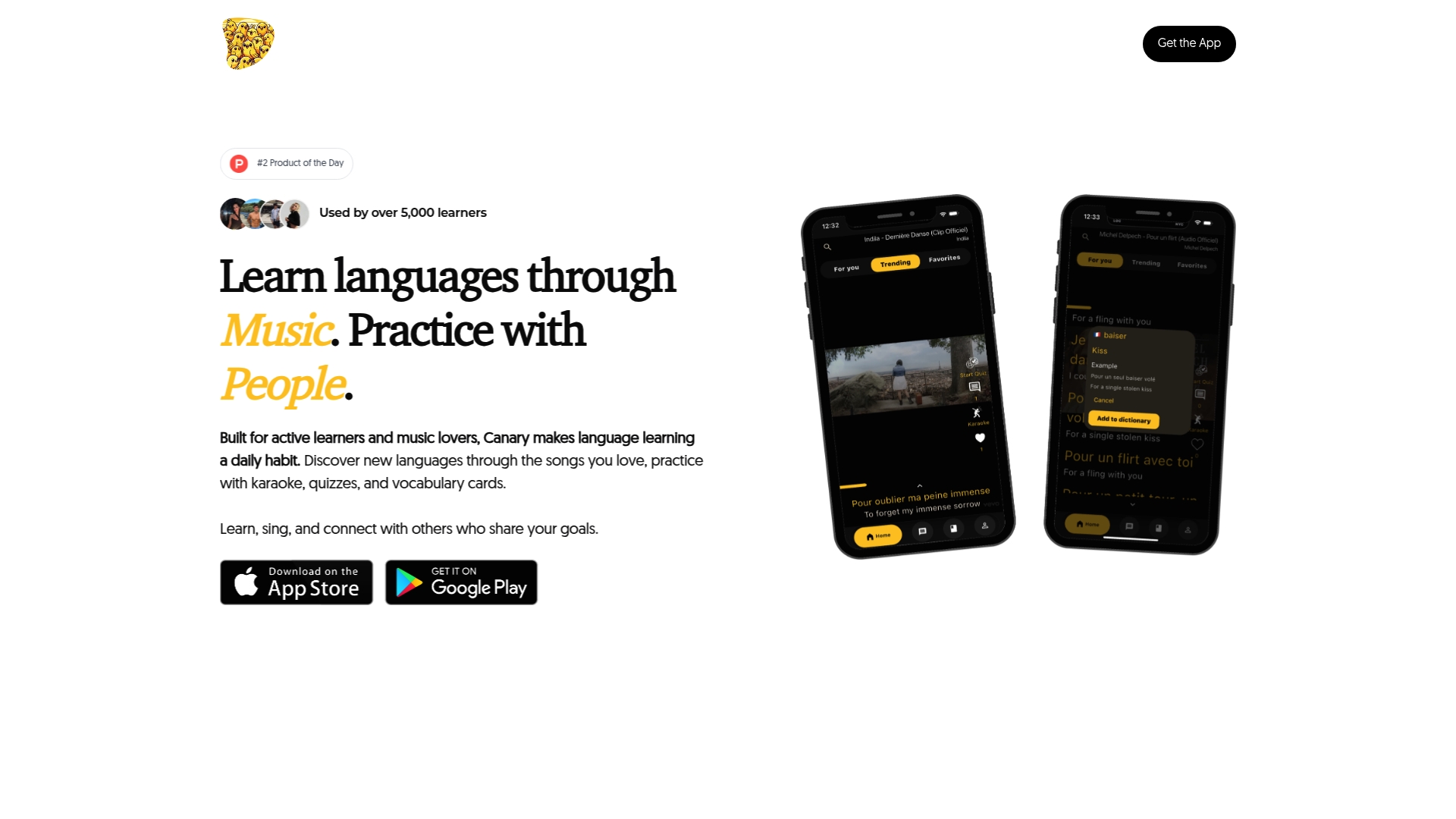
Music provides the emotional hook. Lyrics provide the vocabulary context. Karaoke practice provides immediate pronunciation feedback. And the community of international learners provides the social dimension that most language apps skip entirely. If you are an educator looking for a concrete example of interactive language learning that your learners can use independently, Singwithcanary is worth exploring. Sign up and see how music-driven interactivity changes the way your learners practice every day.
FAQ
What are interactive learning features?
Interactive learning features are technologies and pedagogical methods that require learners to actively participate through decision-making, collaboration, and real-time feedback. They address cognitive, social, and emotional engagement to produce deeper retention than passive instruction.
What are the best examples of interactive learning?
Adaptive quizzes, collaborative problem-solving, simulation-based tasks, think-pair-share, and reflective microblogging are among the most effective examples. Research shows these methods produce effect sizes of 0.50 to 0.82 on student achievement.
How does feedback improve interactive learning outcomes?
Timely, constructive feedback improves self-efficacy and learner independence more than simply providing correct answers. Feedback that explains the reasoning behind an error builds understanding, while feedback that only marks answers right or wrong builds compliance.
Do interactive learning features require expensive technology?
No. Many of the most effective interactive methods, including think-pair-share and minute papers, require no technology at all. Technology adds value when it enables personalization, real-time analytics, or multichannel content delivery that would be impractical in a manual format.
How can music function as an interactive learning feature?
Music engages emotional memory, provides vocabulary in context, and enables pronunciation practice through singing. Platforms like Singwithcanary use music-based interactivity to combine all three engagement dimensions in a format learners return to voluntarily every day.