TL;DR:
- Using music-infused techniques enhances vocabulary learning through emotional engagement and retrieval practice. Combining karaoke, gap-fill, shadowing, duet role-play, and spaced repetition accelerates pronunciation and recall in daily sessions. These methods benefit from feedback, interleaving tasks, and short practice durations to improve long-term language mastery.
Use these five interactive, music-infused techniques to learn and pronounce new vocabulary faster today: karaoke with targeted word lists, lyric gap-fill with pretesting, shadowing with slowed audio, duet role-play with corrective scaffolding, and micro-gamified spaced repetition (SRS) games. Together, they combine the emotional pull of music with the retrieval practice and corrective feedback that research consistently links to stronger recall and better pronunciation.
The five techniques at a glance:
- Karaoke + targeted word lists — sing along while tracking several pre-selected words
- Lyric gap-fill with pretesting — guess missing words before seeing the answer
- Shadowing with slowed audio — mimic a native singer at 75% speed, then full speed
- Duet/role-play with corrective scaffolding — practice with a partner who gives gentle recasts
- Micro-gamified SRS — short spaced-repetition card bursts tied to your song’s vocabulary
Done daily in 15–20 minute sessions, this combination accelerates recall, sharpens pronunciation, and keeps motivation high enough to actually show up tomorrow.
Table of Contents
- Why does interactive feedback make vocabulary stick faster?
- What do the best music-based activities actually look like?
- How should you give and receive corrective feedback?
- How do you turn daily music practice into a habit that lasts?
- What do three ready-to-run practice sessions look like?
- How do you measure vocabulary and pronunciation progress?
- What mistakes slow down music-based vocabulary learning?
- Key Takeaways
- Why music works for adult learners — and what most guides miss
- Singwithcanary puts these techniques in one place
- Useful sources
Why does interactive feedback make vocabulary stick faster?
The core claim from second-language acquisition research is straightforward: interaction plus corrective feedback accelerates acquisition more than passive exposure alone. Gianfranco Conti, whose work at Language Gym synthesizes decades of classroom research, identifies negotiation of meaning — recasts, clarification requests, and timely prompts — as among the highest-leverage techniques a learner can use.
Pretesting amplifies this further. A National University of Singapore study found that guessing a word before seeing the correct answer produced stronger cued recall and recognition in adult learners than study-only designs. The act of attempting an answer primes neural pathways, so the correction lands harder. That is exactly what lyric gap-fill exploits.
On the technology side, a systematic review published in the ACM Digital Library identifies mobile apps, VR, and AI-driven personalization as the key growth areas for interactive language learning. Adaptive systems that schedule reviews at the moment you are about to forget a word, and that tailor pronunciation feedback to your specific errors, compress the time it takes to move a word from recognition to active use.
What do the best music-based activities actually look like?
Karaoke with targeted word lists
Objective: Build recognition and pronunciation of 8–12 words in a single song. Setup: Pick a song one level below your current ceiling — you should understand most of the lyrics without help. Extract several words you do not know. Write them on a card or in a notes app before you sing. How-to:
- Listen once without singing. Note where your target words appear.
- Sing through the song twice, pausing at each target word to say it clearly.
- After singing, cover the lyrics and try to recall each word from memory.
Time: 10 minutes. Vocabulary focus: concrete nouns and high-frequency verbs work best for beginners; idioms and phrasal verbs for intermediate learners.
Pro Tip: Choose songs with a slower tempo for your first pass. Ballads and acoustic tracks give you more processing time between phrases than up-tempo pop.

Lyric gap-fill with pretesting
Remove 8 target words from a printed or digital lyric sheet. Before playing the song, guess each blank. Then play the track and check. This sequence — guess, hear, confirm — is the exact workflow the NUS pretesting research supports for stronger word encoding. Time: 8 minutes.
Shadowing with slowed audio
Play the song at 75% speed using any audio player with a pitch-lock feature. Repeat each line immediately after the singer, matching rhythm and intonation. Increase to full speed after two passes. Shadowing forces productive output, not just passive listening, which is where pronunciation gains actually happen. Time: 5–10 minutes.
Duet/role-play with corrective scaffolding
Sing or speak a verse with a partner. When you mispronounce or misuse a target word, your partner recasts it naturally in their next line rather than stopping to correct you. This keeps the flow and lowers anxiety. Group language practice built around songs gives you the social accountability that solo study lacks. Time: 10–15 minutes.
Sing-and-translate
After singing a verse, pause and translate it aloud into your native language, then back into the target language. This forces you to process meaning, not just phonetics. Time: 5 minutes per verse.
How should you give and receive corrective feedback?
Low-anxiety correction is the difference between a learner who improves and one who freezes. The goal is to make the correct form audible without turning practice into a grammar lesson.
Do:
- Use recasts: repeat the learner’s sentence with the error corrected, naturally, as part of conversation
- Ask clarification questions (“Did you mean empezar or comenzar?”) to prompt self-repair
- Give immediate audio-model feedback — play the native pronunciation right after the learner’s attempt
- Record yourself singing a verse, then compare it to the original at half speed
Don’t:
- Stop mid-song to explain grammar rules
- Correct every error in one pass — pick one or two target sounds per session
- Use competitive leaderboard pressure during pronunciation practice
Pro Tip: When giving peer feedback, frame it as an echo, not a correction: “I heard you say X — the singer actually goes with Y here.” That phrasing keeps the song as the authority, not you.
Peer correction script example:
Partner A sings: “She don’t know my name.” Partner B (naturally, in next line): “She doesn’t know, and I can’t explain it…” Partner A hears the recast and self-corrects on the next pass.
How do you turn daily music practice into a habit that lasts?
Gamification elements — streaks, badges, micro-goals, and leaderboards — increase daily engagement when used carefully. The catch: competitive leaderboards can backfire for anxious learners, triggering avoidance instead of motivation. Cooperative or private challenge modes work better for most adults.
Practical gamification setups:
- Solo streak + weekly score: Track how many days in a row you complete a 15-minute session. Aim for a weekly streak before adding a new song.
- Cooperative duet challenge: You and a partner each learn the same song independently, then compare pronunciation recordings at the end of the week.
- Community song-of-the-week: Join a group working on the same track. Share a 30-second clip of your best verse. No ranking — just participation credit.
- Micro-goal cards: Write one specific goal per session (“I will use melancholy in a sentence by Friday”). Cross it off when done.
Setting SMART goals for each session keeps micro-goals concrete enough to actually close. Vague targets (“get better at French”) produce far less follow-through than specific ones (“recall all eight words from La Vie en Rose without the lyric sheet”).
What do three ready-to-run practice sessions look like?
Short, frequent sessions outperform long, infrequent ones for long-term retention. Here are three templates you can start today.
10-minute session (exposure + quick recall)
- Listen to your chosen song once, following the lyrics (2 min)
- Lyric gap-fill pretest on some target words
- Sing through the song, pausing at each target word (3 min)
- SRS card review for today’s 5 words (2 min)
20-minute session (active recall + pronunciation)
- Lyric gap-fill pretest on several words
- Shadowing at 75% speed, two passes (5 min)
- Shadowing at full speed (3 min)
- Record yourself singing one verse (2 min)
- SRS card review, recall mode (4 min)
- Compare your recording to the original (2 min)
30-minute session (full productive practice)
- Lyric gap-fill pretest on multiple words
- Shadowing, two speeds (8 min)
- Duet or role-play with a partner (7 min)
- Sing-and-translate one verse (5 min)
- SRS card review + pronunciation recording (5 min)
Pro Tip: Do your SRS review at the end of a session, not the start. You want the song’s context fresh in your memory when the cards appear — that connection between melody and meaning is what makes the word retrievable later.
Interleaving receptive and productive tasks within a session — listening first, then speaking, then writing — forces retrieval from multiple angles and produces faster, more durable recall than blocked practice.
How do you measure vocabulary and pronunciation progress?
Measure both accuracy and fluency. Accuracy tells you whether a word is stored correctly; fluency tells you whether you can retrieve it fast enough to use it in conversation.
Evaluation metrics checklist:
- Cued recall rate: Cover the target-language column on your word list. How many can you produce from the English prompt? Track weekly.
- Active use count: How many target words did you use spontaneously in conversation or writing this week? Aim to increase by two per week.
- Pronunciation accuracy: Compare your recorded verse to the original. Note specific phonemes or stress patterns that still differ.
Tool types that support measurement:
| Tool type | What it measures | How it helps |
|---|---|---|
| SRS/vocab card apps | Recall accuracy over time | Schedules reviews at optimal intervals |
| Pronunciation AI | Phoneme and pitch accuracy | Gives instant scored feedback on recordings |
| Karaoke/social recording platforms | Fluency and intonation | Lets you compare your take to a native model |
| Audio-slowing tools | Phoneme clarity | Reveals sounds you miss at full speed |
| Lyric editors | Comprehension and gap-fill | Supports pretesting workflows |
Interactive platform features that combine quiz-based recall with pronunciation scoring give you both metrics in one session, which is more efficient than tracking them separately.
What mistakes slow down music-based vocabulary learning?
The three most common pitfalls: choosing songs that are too fast or too dense, relying only on recognition tasks (listening without producing), and letting competitive features create stress.
Common pitfalls and quick fixes:
- Song too difficult: You understand less than 50% of the lyrics without help. Fix: drop one difficulty level or choose a slower-tempo track.
- Over-reliance on recognition: You can recognize words when you hear them but cannot recall them unprompted. Fix: switch from gap-fill listening to gap-fill writing or speaking.
- Leaderboard anxiety: Competitive rankings make you avoid practicing. Fix: turn off leaderboards and use private streaks or cooperative challenges instead.
- No variety in exercise type: Doing only karaoke every session. Fix: alternate receptive tasks (listening, gap-fill) with productive ones (shadowing, recording, SRS recall).
- Skipping the SRS review: Singing the song but never testing recall. Fix: add a 2-minute card burst at the end of every session.
Progress-stall check: If your cued recall rate has not improved after two weeks, you are likely reviewing too infrequently or your song vocabulary is too far above your level. Downgrade the song or shorten the word list to 5 words per session.
Key Takeaways
Music-based interactive vocabulary practice works because it combines pretesting, corrective feedback, and spaced retrieval — the three mechanisms research most consistently links to durable word learning.
| Point | Details |
|---|---|
| Pretest before you study | Guessing a word before seeing the answer produces stronger recall than study-only methods. |
| Interleave receptive and productive tasks | Alternate listening and singing tasks with speaking and writing to force retrieval from multiple angles. |
| Keep sessions short and daily | Sessions of 15–20 minutes daily outperform longer, infrequent practice for long-term retention. |
| Use low-anxiety feedback | Recasts and clarification requests improve uptake without raising the stress that shuts down learning. |
| Singwithcanary fits this workflow | The platform combines karaoke, lyric gap-fill, pronunciation recording, and social duet practice in one music-first app. |
Why music works for adult learners — and what most guides miss
Most vocabulary guides treat music as a motivational garnish: something to make the “real” study more palatable. That framing gets it backwards. Melody and rhythm are memory architecture. When a word is encoded alongside a melodic contour, it gets stored with more retrieval cues than a word learned from a flashcard alone. That is why you can still recall the lyrics to a song you have not heard in a decade but forget a vocabulary list you studied last Tuesday.
For adults specifically, the emotional and cultural hooks in music do something that drills cannot: they create a reason to care about the word. Melancholy means more after you have sung it in a Billie Eilish track than after you have read its dictionary definition. That emotional encoding is not a soft benefit — it is a measurable advantage in recall.
What most guides also miss is the pronunciation angle. Shadowing a native singer at reduced speed gives you phoneme-level feedback that most conversation practice does not. You hear exactly where your vowel diverges from the model, and you can repeat the phrase ten times in two minutes without it feeling like a drill. Singwithcanary’s music-infused approach builds this into the core experience rather than treating it as an add-on.
Singwithcanary puts these techniques in one place
If you have been running these activities across five different apps and a printed lyric sheet, there is a cleaner way. Singwithcanary is built specifically for the music-first workflow this guide describes: karaoke with targeted vocabulary overlays, lyric gap-fill with instant feedback, pronunciation recording you can compare to the original, and social duet practice with real learners and native speakers.
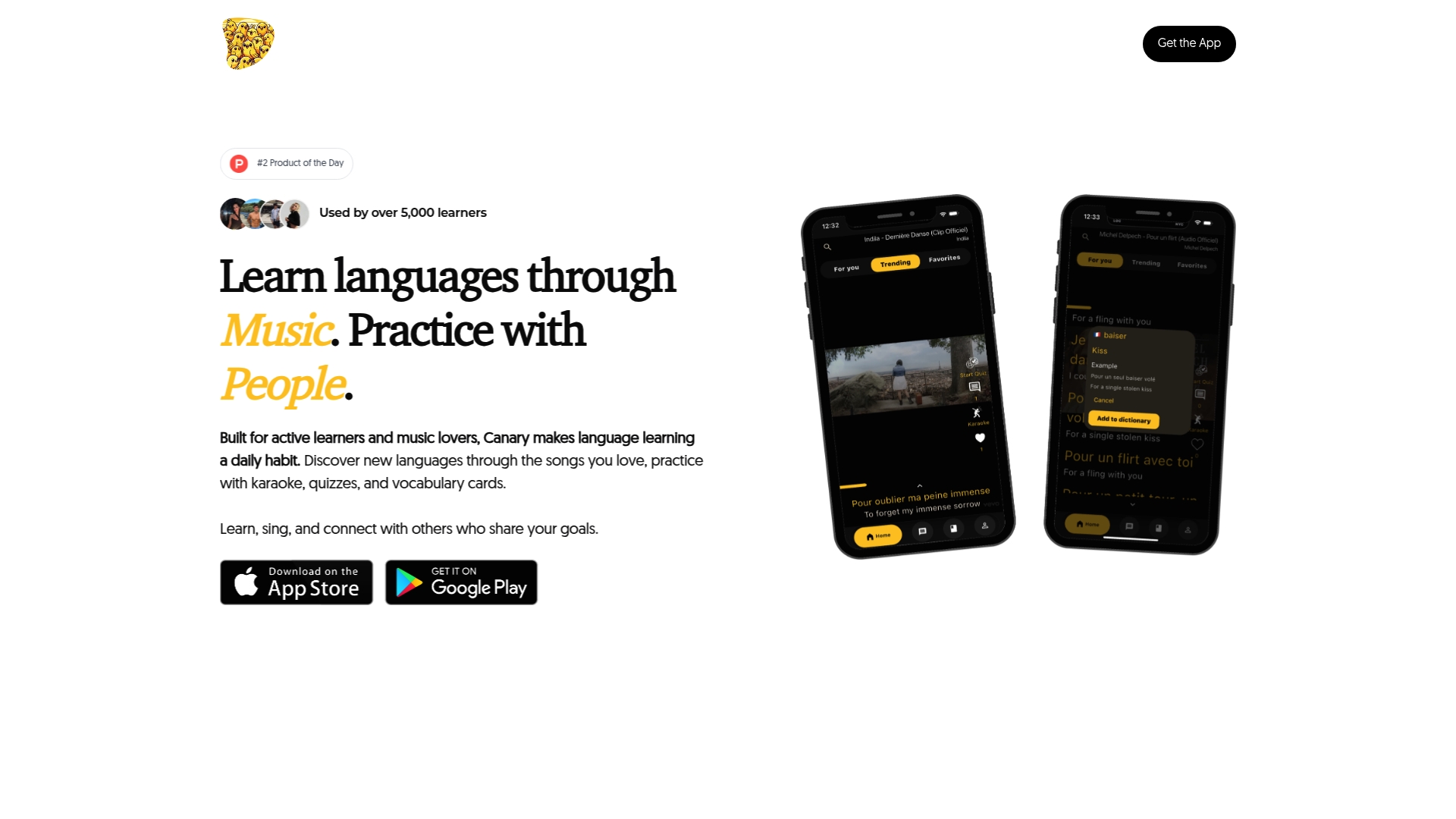
The SRS-style vocabulary review is tied directly to the songs you are already singing, so the words you test are the words you just heard in context. The social layer means you can run a cooperative duet challenge or share a verse recording with the community without switching platforms. Every feature maps to a technique covered in this guide.
Start your first music session on Singwithcanary today, or check out the song of the week for a ready-made track with vocabulary and pronunciation exercises already built in.
Useful sources
- Study confirms guessing before learning improves memory in language learning — NUS
- The Top 10 Research-Backed Instructional Techniques for the language classroom — Gianfranco Conti
- Technological Transformation in Language Learning: A Systematic Review of Interactive Learning Tools — ACM
- How to Use Mobile Games for Vocabulary Learning That Sticks — Lexiloot
- How to Learn Vocabulary Through Interactive Quizzes and Games — 5MinuteEnglish
- 10 Ways to Use Technology to Build Vocabulary — Reading Rockets
- Vocabulary booster tips that actually build lasting skills — Singwithcanary
- Understanding the Role of Educational Apps in Learning — Optio Station