TL;DR:
- Effective immersion combines meaningful exposure with active output through music and social practice.
- Music accelerates vocabulary, pronunciation, and retention by engaging multiple senses and emotional memory.
- Interactive, social activities are essential to develop real conversational fluency beyond passive listening.
Most people assume that surrounding yourself with a language is all it takes to become fluent. Put on a foreign film, travel abroad, or download a popular app, and fluency will follow. But passive input alone is not enough for real production skills. The learners who actually break through combine meaningful exposure with active output, and the most effective tools for that combination are music and structured social practice. This article shows you exactly how to make that work.
Table of Contents
- What is language immersion and how does it actually work?
- The science: Why music powers vocabulary and pronunciation
- Interaction: The missing link in effective immersion
- Practical framework: How to design your own immersive, music-driven routine
- Why most immersion advice falls short—and what actually works
- Ready to put language immersion into action?
- Frequently asked questions
Key Takeaways
| Point | Details |
|---|---|
| Immersion requires action | Real gains happen when you combine active output with meaningful input, not just passive listening. |
| Music boosts retention | Learning with songs leads to deeper vocabulary and pronunciation gains than traditional study alone. |
| Social practice is key | Interacting with others through singing and conversation solidifies language skills and confidence. |
| Hybrid routines work best | A mix of pre-teaching vocabulary and immersive, music-driven practice delivers the strongest results. |
What is language immersion and how does it actually work?
Language immersion is often misunderstood as simply being surrounded by a language. In reality, it goes much deeper than that. Immersion language learning involves surrounding learners with the target language in naturalistic contexts to facilitate subconscious acquisition through comprehensible input, active production, error tolerance, and maximal exposure. The “naturalistic” piece is critical. Your brain learns best when language is attached to real meaning, real emotion, and real use.
Stephen Krashen’s comprehensible input theory explains a lot of this. The idea is that you acquire language most effectively when you understand the message just slightly beyond your current level, not so easy it’s boring, not so hard you’re lost. This is why a well-chosen song, with a melody carrying meaning and emotion, can teach vocabulary more powerfully than a worksheet ever will. The music gives you context clues, rhythm cues, and emotional anchors all at once.
The role of music in language learning fits naturally into immersion because it satisfies multiple requirements at once. Consider the four key ingredients that make immersion work:
- Comprehensible input: songs deliver meaning in chunks your brain can absorb
- Active production: singing out loud forces you to produce the language, not just receive it
- Error tolerance: music creates a low-stakes environment where mistakes feel natural
- Constant repetition: choruses and hooks repeat key phrases dozens of times in a single session
One common misconception is that immersion only works if you move to a country where the target language is spoken. That simply is not true. Simulated immersion environments, when built thoughtfully around music, conversation, and genuine engagement, can replicate the core brain processes behind natural language acquisition. What matters is the quality of your exposure and the depth of your engagement, not the geography.
“The most powerful immersion isn’t measured in miles traveled. It’s measured in how much of your attention, emotion, and effort you put into every single encounter with the language.”
The science: Why music powers vocabulary and pronunciation
Understanding immersion’s foundations sets the stage. Now let’s look at exactly how music accelerates vocabulary and pronunciation to a new level.
The data here is striking. Research on the effects of songs on EFL learners shows significant gains in lexical density, accuracy, and fluency, with vocabulary retention running 20 to 30 percent higher in music-based groups compared to speech-only groups. In one measured cohort, the music group averaged a gain of 33 new vocabulary items retained versus just 15 in the control group.
| Method | Avg. vocabulary gain | Fluency improvement | Accuracy improvement |
|---|---|---|---|
| Song-based immersion | +33 words | Significant | Significant |
| Speech only | +15 words | Moderate | Moderate |
| Traditional study | +10 words | Minimal | Minimal |

Why does music work so much better? It comes down to three overlapping forces: multi-sensory engagement, emotional encoding, and structured repetition. When you hear a song, your auditory cortex, motor system, and memory centers all fire at the same time. That combination burns new words and sounds into long-term memory far more efficiently than reading a list. Understanding the educational benefits of music in learning helps you stop thinking of songs as entertainment and start treating them as precision learning tools.
Statistic callout: Learners using song-based language techniques retain vocabulary at rates up to 33% higher than those using speech-based practice alone.
Pronunciation is another area where music absolutely shines. When you sing, you naturally exaggerate vowel sounds, stress syllables correctly, and match your mouth movements to a rhythm that mirrors natural speech patterns. Research confirms that music for pronunciation mastery produces measurable gains that outpace traditional drills, partly because musical training also lowers the affective filter and engages multi-sensory auditory, motor, and visual processes simultaneously.
The affective filter is simply the psychological wall that anxiety builds between you and language learning. When that wall is high, you freeze up, avoid speaking, and stop retaining new input. Music tears that wall down. You’re too busy enjoying the melody to feel self-conscious about your accent.
Pro Tip: Before starting a new song, preview five to ten key vocabulary words and their meanings. This “pre-teach” step primes your brain so that when the words appear in context during the song, recognition locks them into memory faster. This hybrid model consistently outperforms diving into a song cold.
Interaction: The missing link in effective immersion
Music gives you the foundation. Now let’s uncover why interaction makes your new skills actually usable.
Here’s a truth that most language learning advice glosses over: input without output creates passive understanding, not active fluency. You can recognize a word every time you hear it and still be completely unable to use it naturally in conversation. Immersion without interaction hits a ceiling quickly because passive exposure alone is insufficient for real production skills.
This is where social practice becomes non-negotiable. Interactive immersion activities, things like group singing, call-and-response exercises, conversational games, and collaborative lyric analysis, bridge the gap between knowing a word and actually deploying it under pressure. According to research on social interaction in immersive learning, conversation partners and group singing specifically enhance pragmatic use, meaning your ability to use language appropriately in real social situations.

Here’s a comparison that makes this concrete:
| Approach | What you gain | What you miss |
|---|---|---|
| Passive immersion only | Vocabulary recognition, ear training | Speaking confidence, production speed |
| Interactive immersion | All of the above plus fluency, accuracy, real-world readiness | Nothing significant |
The numbered steps below show how you can build interaction into a music-driven routine:
- Listen actively. Play a song and focus on catching specific words you pre-studied.
- Sing along. Do this even if your pronunciation feels rough. Production is the goal.
- Discuss the lyrics. With a partner or in a group, talk about what the song means. This forces you to use new vocabulary in a different context.
- Replay and refine. Go back to the sections where you stumbled and repeat them until they feel natural.
For adult learners specifically, the path to fluency runs through vocabulary first. You need a working base before immersion can really take hold. Music lovers’ language tips consistently point to building that base through song-contextual vocabulary, where you learn words as they appear in real, emotionally charged musical settings rather than in isolated drills.
Pro Tip: Find a language exchange partner who shares your music taste. Choose a song you both love, study it together, then discuss the lyrics in your target language. You get vocabulary, pronunciation, cultural context, and conversation practice all in one session.
Practical framework: How to design your own immersive, music-driven routine
Seeing the science and social advantages, here’s a hands-on framework for your next steps.
Before anything else, assess where you stand. Research recommends that adults aim for a vocabulary base of 2,000 to 3,000 words before diving into full immersion, because this foundation lets you decode enough of what you hear to make the input truly comprehensible. Below that threshold, too much is incomprehensible and immersion loses its edge.
Once you know your baseline, build a daily routine around this structure:
- Morning (10 minutes): Preview five to eight vocabulary words from a chosen song. Read the lyrics, look up unfamiliar terms, and note their pronunciation.
- Midday (15 minutes): Play the song two or three times. Sing along on the second and third passes, even if quietly. Focus on the words you previewed.
- Evening (10 to 15 minutes): Join a group session, a language exchange, or a community practice where you discuss the song or use its vocabulary in free conversation.
Choosing the right music matters more than most learners realize. The best songs for language learning share a few qualities:
- Clear, natural lyrics without heavy slang or dialect distortion
- Daily-life themes like relationships, emotions, routines, and places
- Good rhythm that mirrors natural speech cadence in the target language
- Moderate tempo that lets you follow along without losing your place
Tracking your progress is also essential for long-term motivation. Set simple benchmarks every two weeks. How many new words can you use in a real conversation without thinking? Can you sing a verse without checking the lyrics? Has your listening comprehension improved on the first pass of a new song? These markers keep you honest and keep the process rewarding.
Exploring the full range of methods for music lovers shows you that there is no single right approach. Karaoke nights, lyric analysis sessions, vocabulary card drills built from song lines, and collaborative listening groups all serve different learning preferences. Mix and match based on what keeps you coming back every day.
Finally, build error tolerance into your routine from day one. Progress in language learning is not linear. You will mispronounce words you have heard dozens of times. That is not failure. That is exactly how the brain calibrates new motor patterns for speech. Celebrate the mistakes, because they mean you are producing output, not just consuming input.
Why most immersion advice falls short—and what actually works
Here is something worth saying plainly: most popular immersion advice is stuck in the past. It tells you to watch foreign films, move abroad, or use an app for twenty minutes a day. That advice is not wrong exactly, but it is radically incomplete for the modern learner.
The problem is that traditional immersion advice treats the learner as a passive receiver. Watch enough, listen enough, and fluency will appear. It will not. Real fluency is built through the interaction of input and joyful, social output. That second half is almost always missing from conventional guidance.
What we have seen consistently, both in research and in real learner experiences, is that the learners who make the fastest, most lasting progress are the ones who combine meaningful music-driven input with regular, low-pressure social output. They are not grinding through grammar drills or white-knuckling flashcard decks at midnight. They are singing songs they love, talking about those songs with other people, making mistakes out loud, and coming back the next day because the process is genuinely enjoyable.
This matters especially when novelty fades. Every learner hits a wall around weeks three to six, when the initial excitement of starting something new wears off. Motivation that depends on novelty collapses at that wall. Motivation that is built on genuine enjoyment, on music you actually love and people you actually want to talk to, keeps going. That is not a soft, feel-good point. It is the practical key to long-lasting fluency.
Apps alone will never give you this. An app can deliver input. It can quiz you, track your streaks, and gamify your progress. But without interactive practice for fluency rooted in real social exchange and genuine musical engagement, even the best app leaves you at comprehension without production. That gap is where most learners get stuck, and it’s exactly the gap that music-driven social practice closes.
Ready to put language immersion into action?
You now understand the science, the social dynamics, and the practical framework behind effective language immersion. The next step is putting it into motion with tools that are built specifically for this approach.
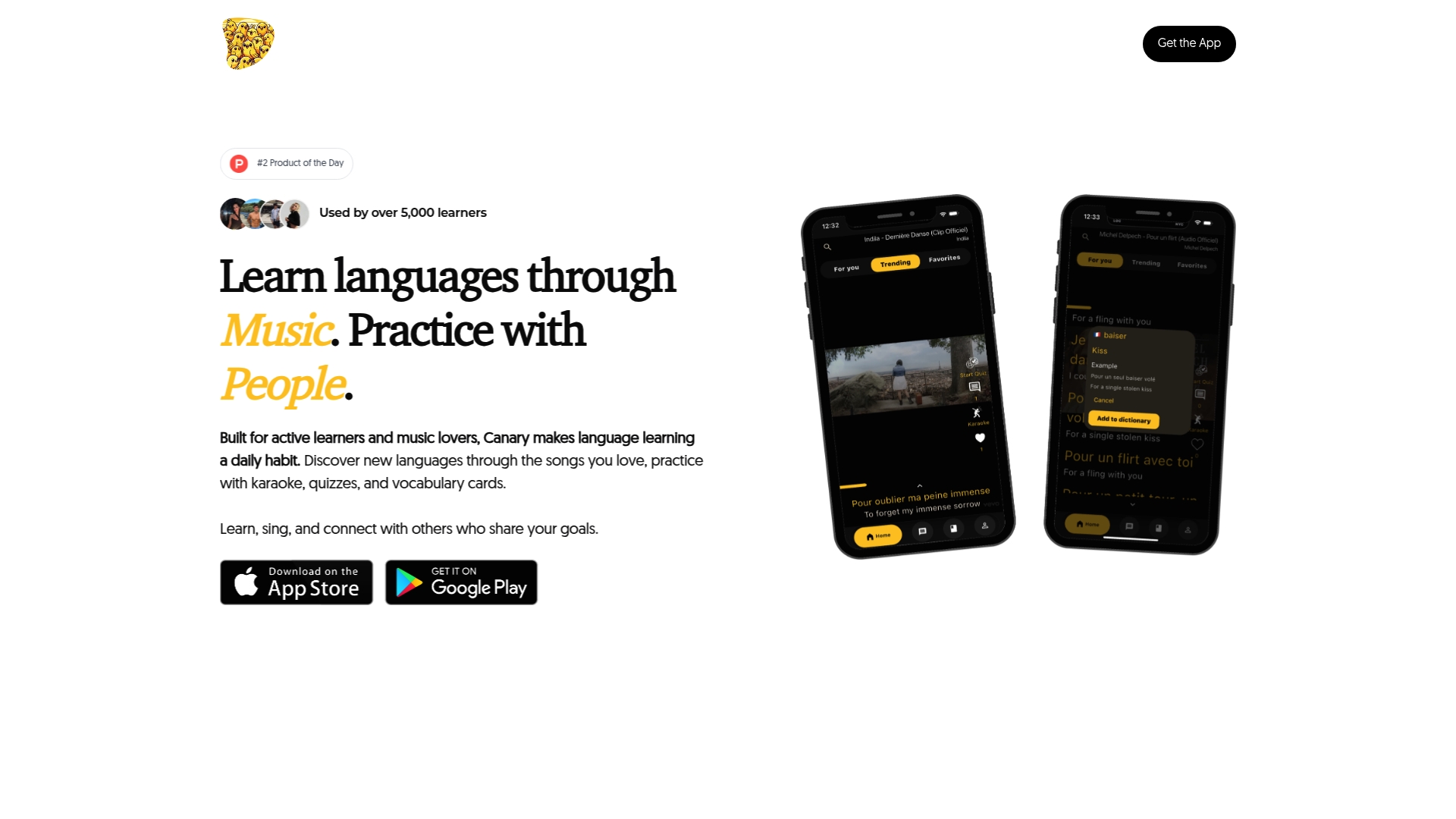
Canary brings all of these research-backed principles into one platform. It combines weekly song immersion routines with interactive features like karaoke, vocabulary cards, and quizzes that make daily practice feel like something you look forward to rather than something you push through. You practice with real learners from around the world, which means you get the social interaction that passive tools simply cannot replicate. If you are serious about moving from understanding to actually speaking with confidence, practicing with songs daily on Canary is where that journey accelerates.
Frequently asked questions
How many words do I need before immersion makes sense?
Adults benefit most from immersion after building a vocabulary base of roughly 2,000 to 3,000 words, because that foundation makes enough of the input comprehensible to drive real acquisition. Below that level, too much is noise rather than meaningful input.
Does singing really improve my accent and vocabulary?
Yes. Research on EFL learners using songs shows statistically significant improvements in pronunciation accuracy, fluency, and vocabulary retention that outperform speech-only practice. Singing forces your mouth and ear to work together in ways that passive listening never achieves.
What are some common mistakes with language immersion?
The biggest mistake is treating immersion as purely passive, relying on listening apps or background audio without ever producing output. Real fluency requires input, interaction, and output working together, and apps that skip the social and production side consistently fall short.
How can I lower my anxiety when using immersion methods?
Start with music. Music lowers the affective filter and engages multi-sensory learning pathways, which naturally reduces the fear of making mistakes. Choosing low-pressure group singing or lyric discussion activities before jumping into open conversation makes the transition feel far less intimidating.