Frustrated by endless flashcards that never stick? Research shows that learning languages with songs improves vocabulary retention by up to 40% compared to traditional memorization. Songs engage your brain’s auditory, motor, and emotional centers simultaneously, creating powerful neural connections that make pronunciation natural and words unforgettable. This article reveals how music transforms language learning from a chore into an engaging cultural experience.
Table of Contents
- The Power of Music in Language Learning
- Neurological Basis for Language Learning with Songs
- How Songs Improve Pronunciation and Vocabulary
- The Emotional and Social Advantages of Learning with Songs
- Common Misconceptions About Learning Languages with Songs
- Practical Applications and Best Practices
- Discover Effective Language Learning with Canary
- Frequently Asked Questions
Key Takeaways
| Point | Details |
|---|---|
| Enhanced Vocabulary | Songs boost vocabulary retention by up to 40% through melodic repetition and contextual learning. |
| Improved Pronunciation | Music activates auditory, motor, and memory centers simultaneously, strengthening pronunciation accuracy. |
| Social Engagement | Karaoke and interactive features increase practice frequency by 25%, building speaking confidence. |
| Active Learning | Singing along and analyzing lyrics outperform passive listening for measurable language gains. |
| Cultural Context | Lyrics provide authentic idioms and cultural insights that textbooks miss. |
The Power of Music in Language Learning
Music creates a unique learning environment that traditional methods cannot replicate. When you listen to a song, melody combines with rhythm and lyrics to form memorable patterns that stick in your mind long after the music stops. This combination activates multiple brain regions at once, creating stronger memory cues than simple text repetition.
The emotional connection you feel while listening to music triggers dopamine release, which strengthens memory formation. A catchy chorus replays in your head naturally, giving you free vocabulary practice throughout the day without conscious effort. This automatic repetition happens because music engages your brain’s reward system, making language acquisition feel effortless.
Social elements amplify music’s learning benefits. Sharing songs with friends, singing karaoke with native speakers, or discussing lyrics in online communities transforms solitary study into interactive practice. These social interactions provide immediate feedback and create accountability that keeps you motivated.
Key benefits of music based language learning:
- Engages auditory processing for better sound recognition
- Activates motor regions that control speech production
- Triggers emotional responses that strengthen memory encoding
- Provides natural repetition without boredom
- Offers cultural context through authentic native content
Neurological Basis for Language Learning with Songs
Your brain processes music differently than spoken language, creating unique advantages for learners. Music activates multiple brain regions simultaneously—including auditory, motor, and memory centers—enhancing language learning by creating stronger neural connections for pronunciation and vocabulary retention. When you sing along to a song, you engage these areas in coordinated activity that reinforces new language patterns.
The hippocampus, responsible for forming new memories, shows increased activity during musical learning. Repetitive melodies create neural pathways that become stronger with each replay, much like how a frequently traveled path becomes easier to walk. This process happens naturally as you enjoy music, requiring less willpower than forcing yourself through flashcard drills.
Melodic intonation therapy demonstrates this principle in clinical settings. Patients who struggle with speech after brain injuries often regain abilities faster when practicing with songs rather than speaking exercises alone. The musical structure provides scaffolding that supports language production, making pronunciation more accessible.
Studies reveal that pairing vocabulary with music improves retention rates by 25 to 30% compared to standard memorization techniques, as melody provides additional memory anchors beyond semantic meaning alone.
| Brain Region | Language Function | Music Enhancement |
|---|---|---|
| Auditory Cortex | Sound processing | Distinguishes subtle pronunciation differences |
| Broca’s Area | Speech production | Coordinates singing movements that mirror speech |
| Hippocampus | Memory formation | Encodes vocabulary through melodic associations |
| Amygdala | Emotional processing | Strengthens memories through emotional engagement |
The educational benefits of music extend beyond memory enhancement. Rhythm helps learners internalize stress patterns and intonation curves that define natural speech. Your brain naturally mimics these patterns when you sing, training your mouth to form sounds correctly without conscious analysis.

How Songs Improve Pronunciation and Vocabulary
Singing forces your mouth into positions that match native pronunciation. Unlike reading aloud, where you might skip difficult sounds, melody requires you to hold notes and sustain vowels correctly. This extended practice builds muscle memory in your tongue, lips, and jaw, making proper pronunciation automatic over time.

Vocabulary learned through songs sticks because context comes built in. Instead of memorizing isolated word lists, you acquire terms within complete phrases that show natural usage. The benefits of learning languages with songs include understanding how words combine in real conversations, not just their dictionary definitions.
Research comparing different learning methods shows clear advantages for musical approaches:
| Method | Vocabulary Retention | Pronunciation Accuracy | Engagement Level |
|---|---|---|---|
| Flashcards | 60% after 2 weeks | Limited improvement | Low to moderate |
| Textbook exercises | 65% after 2 weeks | Moderate improvement | Low |
| Song based learning | 84% after 2 weeks | Significant improvement | High |
| Active singing practice | 90% after 2 weeks | Major improvement | Very high |
Catchy melodies create involuntary rehearsal that extends your practice time without extra effort. You might find yourself humming a tune hours after your study session, unconsciously reviewing vocabulary and pronunciation. This effortless repetition multiplies your learning time far beyond scheduled study blocks.
Effective vocabulary acquisition through songs requires these elements:
- Choose songs with clear, repeated choruses that reinforce key phrases
- Focus on tracks with moderate tempo that allows pronunciation practice
- Look up lyrics to connect sounds with written forms
- Break down complex lines into smaller, manageable chunks
- Record yourself singing to identify pronunciation areas needing work
Pro Tip: Start with children’s songs or simple pop tracks in your target language. These typically feature clear pronunciation, repetitive structures, and everyday vocabulary that builds a strong foundation for more complex material later.
The examples of learning with music for language success demonstrate that even beginners can achieve measurable progress within weeks. One study tracked learners using language learning methods for music lovers and found they practiced 40% more frequently than those using traditional apps, simply because the process felt enjoyable rather than obligatory.
The Emotional and Social Advantages of Learning with Songs
Emotions act as memory enhancers, and music naturally triggers strong feelings. When a song makes you happy, sad, or nostalgic, your brain releases neurochemicals that flag the experience as important, strengthening associated language memories. This emotional tagging means you remember lyrics and phrases connected to meaningful songs far longer than sterile textbook examples.
Social interaction features around songs, such as karaoke and quizzes, enhance language learning by providing immediate feedback and peer motivation—leading to improved speaking confidence. Practicing with others transforms language from an abstract skill into a tool for real connection. You stop worrying about perfection and start focusing on communication, which accelerates fluency development.
Karaoke provides a low pressure environment for pronunciation practice. The music masks minor errors while guiding your rhythm and intonation, giving you confidence to vocalize sounds you might avoid in regular conversation. Regular karaoke sessions build speaking stamina and reduce the anxiety that often blocks language production.
Key social and emotional benefits include:
- Peer feedback helps identify and correct persistent pronunciation errors
- Group singing creates accountability that maintains consistent practice
- Shared musical experiences build community connections with native speakers
- Performance elements reduce fear of speaking mistakes
- Cultural appreciation through music creates intrinsic motivation to continue learning
The role of music in language learning extends to psychological well-being. Learners who incorporate music report lower stress levels and greater enjoyment compared to those using conventional methods alone. This positive emotional state creates better conditions for memory formation and skills acquisition.
Pro Tip: Join online communities where members share favorite songs in your target language. Discussing lyrics, recommending tracks, and explaining cultural references provides authentic language practice while building friendships that motivate continued learning.
Common Misconceptions About Learning Languages with Songs
Many learners hold outdated beliefs about music based language learning that limit their progress. Understanding the reality behind these myths helps you use songs more effectively.
- Songs only help beginners learn basic vocabulary
Reality: Advanced learners gain tremendous value from analyzing lyrics. Songs contain idioms, slang, and cultural references that textbooks skip. Intermediate and advanced students use music to understand regional accents, generational language differences, and subtle emotional nuances that make speech sound natural rather than mechanical.
- Passive listening while doing other tasks provides sufficient practice
Reality: Background music offers minimal learning benefits. Active engagement through singing along, analyzing lyrics, or discussing meanings with others produces measurable skill improvements. Your brain needs focused attention to form the neural connections that support language acquisition. Passive exposure might help with accent familiarity, but it cannot replace deliberate practice.
- Songs are entertainment, not serious educational tools
Reality: Lyrics teach practical language usage and cultural context that traditional materials often lack. Songs show how native speakers actually communicate, including contractions, informal grammar, and emotional expression. This authentic input prepares you for real conversations better than scripted dialogues designed for classrooms.
Understanding the actual role of music in language learning helps you avoid wasting time on ineffective approaches. Focus on active methods that engage your full attention and require you to produce language, not just consume it passively.
Practical Applications and Best Practices
Effective song based learning requires strategy beyond simply listening. Start by selecting material appropriate for your current level. Beginners benefit from children’s songs or pop music with clear, repetitive lyrics. Intermediate learners can tackle more complex tracks with varied vocabulary, while advanced students should explore genres showcasing regional dialects or poetic language.
Active participation makes all the difference. Sing along rather than just listening, even if you feel self conscious. Your pronunciation improves through physical practice, and the act of producing sounds reinforces memory far better than passive recognition. Record yourself periodically to track progress and identify persistent errors.
Analyze lyrics systematically to maximize learning:
- Read translations alongside original text to understand meaning
- Identify unfamiliar vocabulary and create flashcards for review
- Notice grammar patterns and how they differ from textbook rules
- Research cultural references to deepen your understanding
- Compare different recordings to hear pronunciation variations
The best practices for music language learning emphasize consistent, focused sessions over marathon cramming. Fifteen to thirty minutes of active practice daily produces better results than occasional longer sessions. Your brain needs regular exposure to consolidate new patterns into long term memory.
Leverage technology and social features to enhance your practice. Many platforms offer synchronized lyrics, vocabulary tools, and communities where you can discuss songs with other learners. Interactive features like quizzes and karaoke provide immediate feedback that helps you correct mistakes before they become habits.
Pro Tip: Create themed playlists for different learning goals. Use upbeat songs for pronunciation practice, slower ballads for lyric analysis, and genre variety for cultural exploration. Rotating through different styles maintains interest while targeting specific skills.
Avoid choosing songs too difficult for your level, as frustration undermines motivation. If you cannot understand at least 60% of lyrics after reading them, the track may be too advanced. Build confidence with accessible material before tackling complex poetry or rapid hip hop verses.
Integrating music in language learning with other methods creates a balanced approach. Use songs for pronunciation and vocabulary, supplement with grammar exercises, and practice conversation with native speakers. This combination develops all language skills while keeping the process engaging.
Discover Effective Language Learning with Canary
Ready to transform your language learning with music? Canary combines everything discussed in this article into one innovative platform designed for active learners. Interactive karaoke sessions let you practice pronunciation with real time feedback, while vocabulary cards reinforce words you encounter in song lyrics. Quizzes test your comprehension and help identify areas needing more attention.
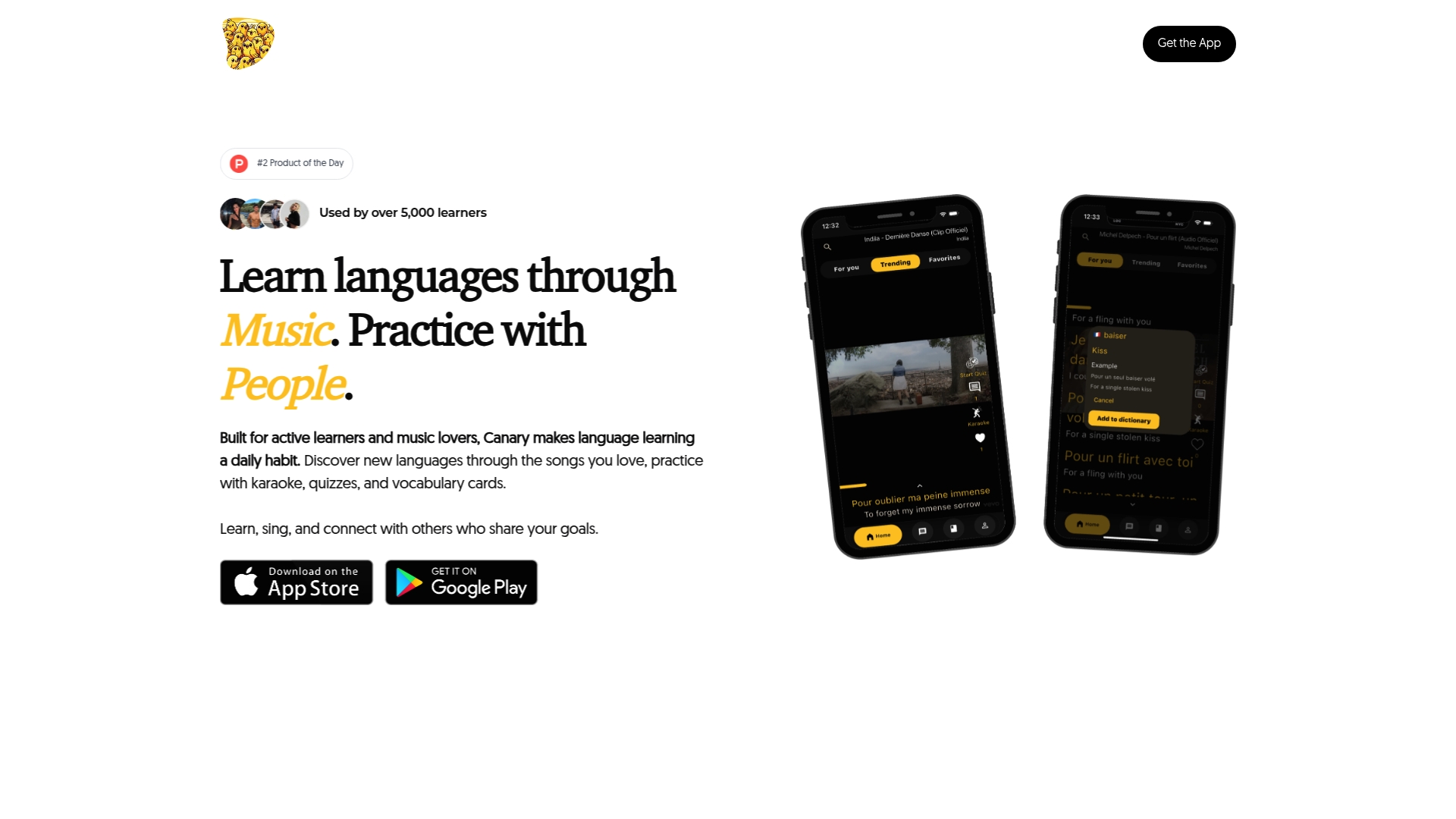
The platform’s social features connect you with international learners and native speakers, creating opportunities for authentic conversation practice. Join daily challenges, share your favorite tracks, and get motivation from a community that understands your goals. When you learn languages with music on Canary, you combine proven neurological benefits with cultural immersion and peer support.
Experience how song based learning accelerates your progress. Sign up to start learning with songs today and access curated content tailored to your proficiency level. Explore Song of the Week to discover tracks that match your interests while building language skills naturally through music you love.
Frequently Asked Questions
What types of songs are best for language learners?
Beginners should choose songs with clear, repetitive lyrics and moderate tempo, such as pop music or children’s songs. These tracks provide multiple exposures to key vocabulary and allow time to practice pronunciation. As you advance, explore different genres to encounter varied vocabulary and regional accents.
Can advanced learners benefit from learning languages with songs?
Absolutely. Advanced learners gain insights into idioms, slang, and cultural nuances that formal education often misses. Analyzing complex lyrics helps you understand how native speakers play with language, use metaphors, and express subtle emotions. Songs also expose you to regional dialects and generational language differences.
How often should I practice language learning with songs?
Daily sessions of 15 to 30 minutes with active engagement produce optimal results. Consistency matters more than duration, as regular practice helps your brain consolidate new patterns into long term memory. Even short sessions maintain momentum and prevent forgetting between study periods.
Is passive listening to songs effective for language learning?
Passive listening provides minimal benefits compared to active engagement. While background music might improve accent familiarity slightly, you need focused attention and vocal practice to develop speaking skills. Sing along, analyze lyrics, and interact with content to achieve measurable improvements.
How can I integrate cultural learning through songs?
Study lyrics for references to customs, history, and social issues in the target culture. Research the artists’ backgrounds to understand their perspectives and influences. Join online communities to discuss song meanings with native speakers, who can explain context you might miss. This cultural exploration deepens your language understanding and makes learning personally meaningful.