TL;DR:
- Using song lyrics as a primary learning material creates emotional and contextual associations that enhance vocabulary retention. This method improves pronunciation, comprehension, and cultural understanding by engaging multiple neural pathways through melody, rhythm, and storytelling. Incorporating lyric-based strategies into daily routines offers a sustainable, motivating alternative to traditional memorization techniques, fostering long-term language fluency.
Memorizing word lists works, until it doesn’t. You hit a wall around week three, the flashcards blur together, and the new words that seemed so solid yesterday vanish the moment you actually need them. There’s a better path, and it’s been hiding in your headphones all along. Song lyrics act as a living memory system, binding new vocabulary to melody, emotion, and rhythm in ways that pure repetition simply cannot replicate. This guide breaks down exactly what lyric-based vocabulary is, why it outperforms traditional methods in key areas, and how you can start using it today.
Table of Contents
- What is lyric-based vocabulary?
- How does learning from lyrics improve vocabulary and pronunciation?
- How lyric-based vocabulary compares to traditional study methods
- How to use lyric-based vocabulary in your daily routine
- A fresh perspective: why lyric-based vocabulary works when other methods fail
- Accelerate your learning with lyric-based tools
- Frequently asked questions
Key Takeaways
| Point | Details |
|---|---|
| Lyric-based vocabulary defined | Learning vocabulary through song lyrics provides context, emotion, and memorable repetition. |
| Improves retention and pronunciation | Active engagement with lyrics can lead to better vocabulary retention and clearer pronunciation. |
| Works alongside traditional methods | Combining lyric-based and classic study techniques offers maximum language growth. |
| Practical daily routines | Integrating lyric-based learning into everyday life is simple, fun, and effective. |
What is lyric-based vocabulary?
With the problem of uninspiring vocabulary study in mind, let’s dig into what lyric-based vocabulary really means.
Lyric-based vocabulary is exactly what it sounds like: using song lyrics as your primary material for discovering, studying, and retaining new words and phrases. Instead of pulling words from a frequency list or a textbook chapter, you extract them from real music. The song becomes your lesson, and every repeated listen is a study session you actually want to do.
Think of lyrics as a “living textbook.” Unlike a dictionary entry, a lyric gives you a word inside a sentence, inside a melody, inside an emotional story. The word longing isn’t just a definition anymore. It’s the ache you hear in a slow verse. That context is incredibly powerful for memory because your brain stores information in networks. When a word is connected to a sound, a feeling, and a story, you have four retrieval routes instead of one.
The benefits of song-based language learning span multiple cognitive dimensions. Here’s what makes this approach genuinely different from other methods:
- Engaging context: Words appear in real, natural sentences rather than isolated definitions.
- Repetition through listening: A single song can expose you to the same vocabulary dozens of times in one sitting.
- Emotional connection: Music triggers dopamine and emotional memory, which helps words stick long after one listen.
- Built-in pronunciation practice: You hear native-speed speech and mimic real stress patterns, not textbook phonetics.
- Cultural immersion: Lyrics carry slang, idioms, and cultural references that grammar books tend to skip entirely.
“Lyric-based approaches often aim to combine vocabulary growth with pronunciation/phonological practice via repeated listening and active production (e.g., shadowing or singing along).” — BBC Learning English
You can see examples of learning with music for language success across many languages and proficiency levels. From beginner English learners working through pop songs to advanced Spanish students breaking down rap verses, the method scales naturally to whatever level you’re at.
How does learning from lyrics improve vocabulary and pronunciation?
Now that you know what lyric-based vocabulary is, see how this approach actively transforms your language learning.
The workflow is simple, but each step builds on the last. You start by listening for the general idea, the emotional mood, the topic. Then you listen again with the lyrics in front of you. Next, you sing or shadow along, mimicking the singer’s rhythm and stress. Finally, you zoom in on the tricky words or phrases and practice them deliberately. This process turns passive listening into active language acquisition.
Some empirical studies of song-based instruction report improvements in vocabulary and pronunciation outcomes, though effects can vary depending on measure timing and study design. What the research consistently supports is that both immediate recognition and delayed recall improve when learners engage actively with lyrics rather than just listening passively.
Here’s a summary of what the evidence shows across different outcomes:
| Learning outcome | Immediate effect | Delayed effect |
|---|---|---|
| Vocabulary recognition | Strong improvement | Moderate retention |
| Pronunciation accuracy | Moderate improvement | Strong with repeated practice |
| Stress and rhythm | Immediate benefit from shadowing | Very strong long-term retention |
| Contextual word use | Gradual improvement | Strong with active singing |
Ready to know how to master pronunciation with lyrics? Here’s a step-by-step approach you can use with any song in any language:
- Choose a song you enjoy at roughly your current language level. Comfort with the topic helps you focus on language, not confusion.
- Listen once without lyrics to absorb the mood, tempo, and general meaning.
- Read the lyrics while listening. Mark any word you don’t know or can’t quite catch.
- Look up your marked words in context. Don’t just read the definition. Notice how the word fits the line.
- Shadow the song by speaking or singing along slightly behind the original. This forces you to match the native speaker’s sounds.
- Record yourself singing or speaking the tricky lines and compare your pronunciation.
- Revisit the song every few days to reinforce vocabulary and notice how much more you understand each time.
When you expand vocabulary with songs, you’re not just memorizing words. You’re building intuitive patterns for how those words actually behave in speech.
Pro Tip: Choose songs that are paced at your level. Ballads and acoustic tracks are great for beginners because the words are clearer and slower. Once you’re comfortable, move into upbeat pop or rap for a real pronunciation workout. Understanding how music boosts pronunciation can help you pick the right genre for your current goals.

How lyric-based vocabulary compares to traditional study methods
After understanding the process, it’s helpful to compare how lyric-based vocabulary stacks up with standard techniques.
Traditional methods like flashcard drilling, grammar exercises, and rote repetition have their place. They’re efficient for building a quick base and for systematically covering foundational structures. But they tend to struggle in three key areas: engagement, long-term retention, and pronunciation development. Lyric-based learning directly addresses all three.
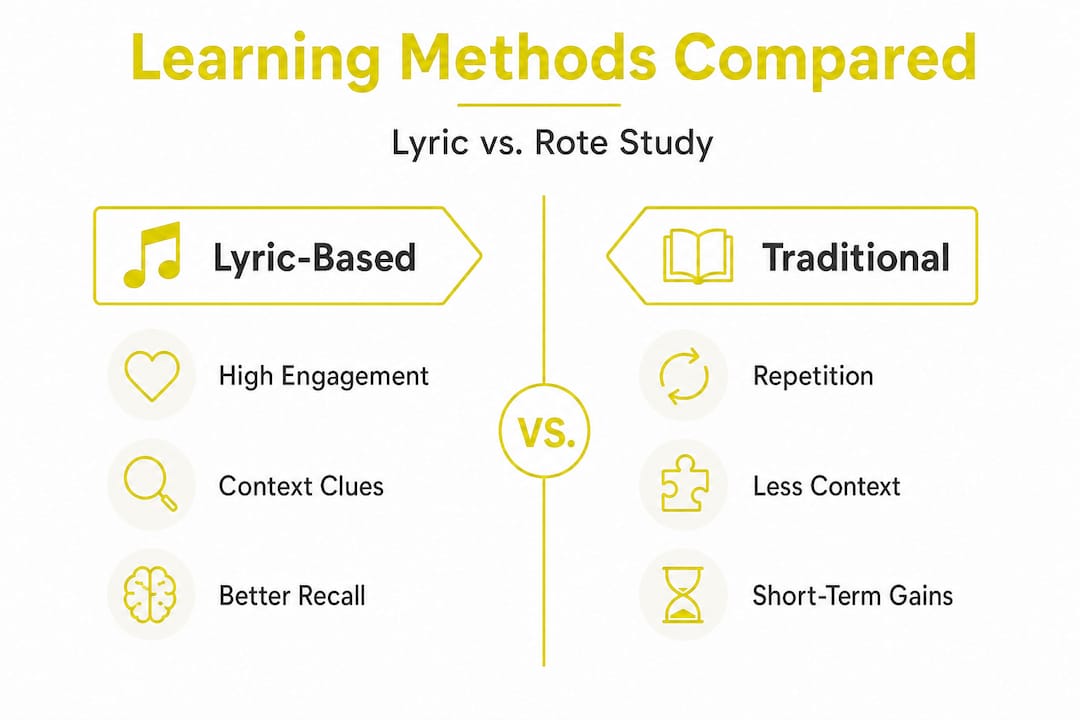
Here’s how the two approaches compare across the dimensions that matter most to language learners:
| Factor | Lyric-based learning | Rote memorization |
|---|---|---|
| Engagement level | High, driven by music and emotion | Low to moderate, depends on discipline |
| Vocabulary retention | Strong, linked to melody and emotion | Moderate, fades without review |
| Pronunciation practice | Built-in, natural, constant | Minimal, often an afterthought |
| Cultural context | Rich, idiomatic, authentic | Limited, textbook-focused |
| Grammar structure | Implicit, absorbed naturally | Explicit, rule-based |
| Accessibility | Anytime, anywhere with music | Requires study materials and focus |
That said, each approach shines in specific situations:
Lyric-based learning works best when:
- You want to improve pronunciation and listening comprehension.
- You’re an intermediate or advanced learner looking to build natural fluency.
- You find traditional study boring or unsustainable over time.
- You want to absorb cultural nuances, slang, and idiomatic expressions.
Rote memorization works best when:
- You’re a total beginner who needs foundational vocabulary fast.
- You’re preparing for a structured exam with specific word lists.
- You need to learn technical or domain-specific terms that don’t appear in songs.
Understanding how music makes new words stick helps explain why the emotional weight of a song does what a flashcard can’t. The research on memory shows that emotionally charged experiences create stronger neural connections, and music is one of the most efficient emotional triggers humans experience. A word you learned during a flashcard drill is stored in isolation. A word you learned from a song you love is stored in a web of associations: melody, mood, moment, and meaning.
The science behind song-based language learning also points to the role of rhythm and stress patterns in pronunciation retention. When you learn a word through lyrics, you automatically absorb its natural stress, the syllable that gets emphasis in real speech. Repeated listening and active production help anchor those sounds and stress patterns so they become second nature rather than something you have to consciously think about.
Pro Tip: Don’t treat this as an either/or choice. Use lyrics for pronunciation, natural vocabulary, and engagement. Use flashcards or spaced repetition apps for hard-to-remember technical terms or irregular verb forms. The combination is more powerful than either method alone.
How to use lyric-based vocabulary in your daily routine
With the comparison clear, here’s how you can start turning your music time into solid vocabulary gains.
The key to making lyric-based learning work is consistency, not intensity. You don’t need hour-long study sessions. You need short, regular contact with the language through music. Even 15 to 20 minutes of active lyric study each day will produce noticeable results over a few weeks.
Here’s a daily routine you can actually stick to:
- Morning: Choose your song for the day. Pick something from your target playlist. One song per day is enough.
- First listen: No lyrics. Just listen and enjoy. Let the language wash over you.
- Second listen: Follow the lyrics. Highlight or underline words you don’t know. Write them in your lyric journal.
- Look up the words. Write a short note for each word: the meaning, a synonym, and the line from the song where it appears.
- Shadow the song. Play it again and speak along, closely mimicking the singer’s sounds, rhythm, and pacing.
- Sing the whole thing. Yes, sing. Even badly. Especially badly. You’ll remember it.
- Evening: Quick review. Flip through your lyric journal entries from the day and week.
The lyric journal deserves special attention. It’s not a vocabulary list. It’s a collection of words in context, which is the critical difference. Write the full line from the song next to each new word. Practice using lyrics as anchors for sounds and stress patterns by reading those lines aloud when you review them.
Building a rotating playlist also helps you manage review naturally. Add new songs weekly, but keep older ones in the rotation. When you hear a song you studied two months ago, notice how differently you hear it now. Words that were invisible then will pop out clearly. That moment of recognition is one of the best motivators in language learning.
Learn more about daily language practice with songs to see how even casual listeners can build a structured, effective practice from their regular music habits.
Pro Tip: Every month, go back to the first song you studied. Compare what you understand now versus then. The visible progress is a powerful motivator that keeps you coming back to the practice.
A fresh perspective: why lyric-based vocabulary works when other methods fail
With practical routines in place, let’s examine what makes this approach uniquely powerful for language lovers.
Here’s what nobody tells you about grammar drills and flashcard apps: they work brilliantly for about six weeks, and then most people quietly stop. The dropout rate in traditional language study is staggering, and the main culprit isn’t laziness. It’s that the brain stops finding the input novel or meaningful. Once the challenge of remembering a word list fades, the motivation to review it fades too.
Music doesn’t have that problem. You don’t stop listening to a song because you’ve memorized it. You listen more. You discover new layers. The emotional reward of music keeps you returning long after the initial novelty is gone, and every return is another exposure to the language you’re learning. That’s a fundamentally different relationship with your study material.
There’s also something profound about the way music ties language to real communication. When a singer sings about heartbreak or joy or frustration, the vocabulary isn’t abstract. It’s alive and purposeful. Words like overwhelmed, restless, or resilient carry an entirely different weight when you first hear them in a song that moves you versus when you read them in a definition. That emotional encoding is what produces spontaneous recall, the kind where the right word surfaces naturally in conversation without effort.
We think about 7 benefits of learning languages with songs often here at Canary, and the one that surprises most learners is how fast their listening comprehension improves. When you’ve trained your ear to catch lyrics at native speed, normal conversation feels slower and clearer. Songs are actually harder to understand than most speech because they use non-standard rhythm and fast tempos. That makes them excellent training material for real-world listening.
The honest advice is this: don’t abandon your grammar book or your verb conjugation charts. But make music the center of your daily practice, not an occasional treat. The learners who make the fastest, most durable progress are the ones who find genuine emotional resonance in their target language, and music is the most direct route to that.
Accelerate your learning with lyric-based tools
Ready to take action with music? Explore tools that make the most of lyric-based learning.
If you’ve tried studying lyrics on your own and found it a bit scattered or hard to stay consistent, you’re not alone. That’s exactly why Canary was built. Canary turns lyric-based learning into a structured, interactive experience so you get the benefits of music without the guesswork.
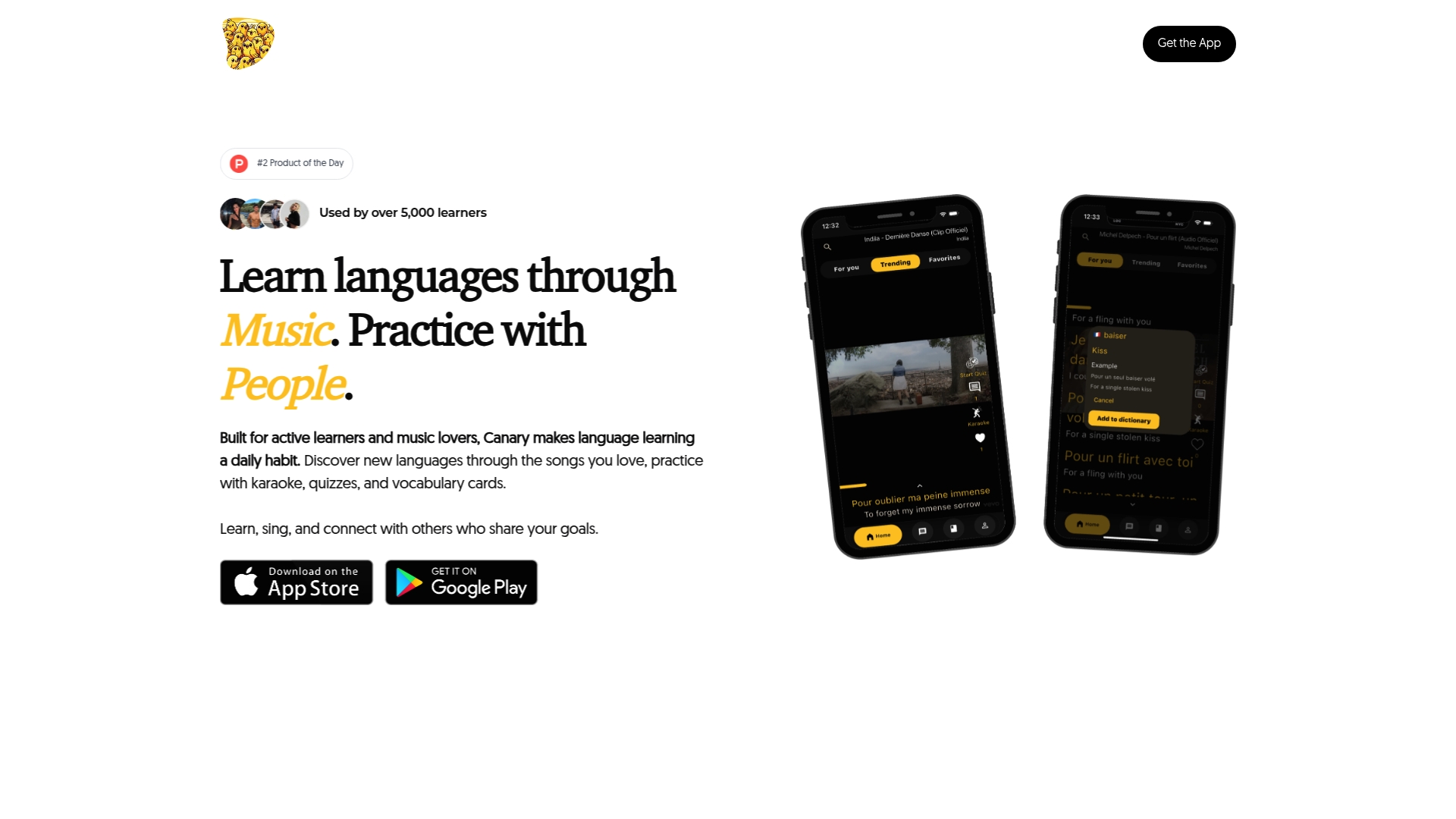
With Canary, you can follow a build vocabulary with music workflow that tracks your progress, highlights vocabulary in real lyrics, and gives you pronunciation feedback as you sing along. The platform combines karaoke-style interaction with vocabulary cards, quizzes, and a social community of learners practicing the same songs from around the world. Every week, a new featured track drops through the Song of the Week program, giving you a shared starting point to practice, compare notes, and celebrate wins with other learners. It’s language learning that finally feels worth showing up for every day.
Frequently asked questions
Can I learn grammar through lyrics, or just vocabulary?
You can learn both. Songs reinforce sentence structure and common language patterns through natural, repeated exposure, not just isolated new words.
Does lyric-based vocabulary work for all languages?
Yes, this method adapts to most languages as long as you have access to music and accurate lyrics in your target language.
How long does it take to see results?
Most learners notice improvement within a few weeks of consistent practice, and research shows a statistically significant increase can appear even in delayed post-speaking tests.
What’s the best way to choose songs for vocabulary learning?
Pick songs you genuinely enjoy with clear, level-appropriate lyrics so your focus stays on language rather than struggling with pace or clarity.