What are the best LyricFluent.com alternatives?
The strongest LyricFluent.com alternatives right now are LyricsTraining, Lirica, and Singwithcanary. Each takes a different angle on music-based language learning, so the right pick depends on whether you want fill-in-the-blank drills, structured vocabulary lessons, or a social karaoke experience with real speakers.
| Platform | Learning modes | Translations | Song library | Pronunciation | Gamification |
|---|---|---|---|---|---|
| LyricFluent | Lyric quizzes, listening | Word-level, full lyrics | Curated pop catalog | Contextual audio | Points, levels |
| LyricsTraining | Fill-in-the-blank, dictation | Partial word hints | Large, user-sourced | Listening-based | Leaderboards, levels |
| Lirica | Vocabulary drills, grammar | Full translations, explanations | Curated, genre-varied | Phonetic guides | Badges, streaks |
| Singwithcanary | Karaoke, quizzes, vocab cards | Full lyrics, word-level | Growing, curated | Native speaker audio | Social challenges |
No single platform wins across every category. LyricFluent leverages popular songs to build vocabulary and listening skills in a way that feels fresh compared to purely gamified apps. The alternatives listed here each carve out a distinct niche, which is exactly why comparing them matters before you commit.
Table of Contents
- How do learning modes differ across these music apps?
- Which platforms offer the best translations and pronunciation support?
- How big are the song libraries, and does it matter?
- What gamification and progress tracking do these apps offer?
- How do design, platform availability, and pricing compare?
- Do music-based language apps actually work?
- Which LyricFluent alternative fits your learning style?
- How do full lyric translations work across these platforms?
- Key Takeaways
- Singwithcanary brings music and real conversation together
How do learning modes differ across these music apps?
The exercise format is where these platforms diverge most sharply. LyricsTraining built its reputation on one mechanic: you listen to a song and type missing words as they play. It sounds simple, but at higher difficulty levels you are essentially transcribing the entire track in real time, which is genuinely hard and genuinely effective for ear training.
- LyricFluent pairs lyric quizzes with contextual vocabulary explanations, letting you tap words mid-song to see definitions without leaving the track.
- LyricsTraining offers four difficulty tiers from beginner (a few blanks) to expert (full dictation), plus a writing mode where you type complete lines.
- Lirica adds grammar-focused exercises alongside vocabulary drills, making it the most structured of the group for learners who want some scaffolding.
- Singwithcanary layers karaoke, vocabulary cards, and quizzes into a single session, then connects you with other learners to practice what you just heard.
Music-based apps work best for intermediate learners. Rapid colloquial speech in songs can overwhelm beginners who have not yet built a base vocabulary, so pairing any of these platforms with a foundational grammar resource first pays off.
Pro Tip: Try the expert dictation mode on LyricsTraining with a song you already know in your target language. Familiar melody plus unfamiliar spelling is one of the fastest ways to lock in new words.

Which platforms offer the best translations and pronunciation support?
Translation quality and pronunciation tools vary more than you might expect across these four platforms.
- LyricFluent shows word-level definitions on tap and displays full translated lyrics alongside the original, so you always have context for what you are hearing.
- LyricsTraining focuses on the listening mechanic rather than translation depth; you get word hints but not full lyric translations, which limits comprehension support for lower-intermediate learners.
- Lirica goes furthest on explanation quality, breaking down idioms, slang, and grammar structures within the lyrics rather than just swapping words for definitions.
- Singwithcanary provides full lyric translations and word-level breakdowns, backed by native speaker audio so you hear the correct pronunciation before you attempt it yourself.
Pronunciation support is the area where most lyric-based apps still have room to grow. Lirica uses phonetic guides, and Singwithcanary uses recorded native speaker audio, but none of these platforms currently offer real-time speech recognition feedback the way a dedicated speaking coach would. For accent work, ear training through music remains the primary mechanism, and it does work, just more gradually than active speaking practice.
How big are the song libraries, and does it matter?
Library size matters less than library curation. A platform with 50,000 songs you cannot filter by language level is less useful than one with 500 songs tagged by difficulty, genre, and target vocabulary.
- LyricsTraining has the largest catalog of the group, drawing on a user-sourced database that spans dozens of languages and hundreds of genres. The tradeoff is inconsistent quality control on some tracks.
- LyricFluent keeps a tighter, curated catalog focused on popular contemporary music, prioritizing songs where the vocabulary and speech speed are actually teachable.
- Lirica curates by genre and learning objective, so you can filter for songs that reinforce specific grammar points rather than just browsing by artist.
- Singwithcanary is building its catalog with a focus on cultural variety and language coverage, adding tracks regularly across the languages it supports.
For learners who want to explore lyrics across many languages with trending charts, Lyrks is worth bookmarking as a discovery tool. It pulls from Billboard Hot 100 and regional charts, covers lyrics in many languages, and links to full artist bios, though it is a lyrics database rather than a learning app.
What gamification and progress tracking do these apps offer?
Gamification is the feature most learners notice first and rely on least after the first month. Points and badges get you through the door; actual progress tracking keeps you coming back.
- LyricsTraining runs public leaderboards where you compete against other learners on the same song. That competitive edge works well for people who respond to social pressure.
- LyricFluent tracks points and levels tied to songs completed, giving you a sense of progression without heavy social comparison.
- Lirica uses streaks and badges, similar to what you find in most language apps, plus a progress dashboard that shows vocabulary growth over time.
- Singwithcanary combines individual progress tracking with social challenges, letting you practice with other learners and measure improvement against your own baseline rather than a global leaderboard.
The social dimension on Singwithcanary is genuinely different from the others. Competing on a leaderboard tells you where you rank; practicing with another person tells you whether you can actually communicate. Those are not the same thing.
How do design, platform availability, and pricing compare?
All four platforms run on web browsers, and three of the four have dedicated mobile apps.
- LyricsTraining is available on iOS, Android, and web, with a free tier that covers most core features and a premium subscription for ad-free use and additional game modes.
- LyricFluent offers iOS and Android apps alongside its web version. Pricing details are not publicly listed in full, but a free trial is available before committing to a paid plan.
- Lirica runs on iOS and Android with a subscription model. Offline access to downloaded lessons is available on paid tiers, which matters if you practice during a commute without reliable data.
- Singwithcanary is accessible via web and mobile, with a community-driven design built around daily practice sessions and social interaction. Pricing details are available directly on the platform.
Interface clarity differs noticeably between these apps. LyricsTraining keeps things minimal, almost spartan, which suits learners who want zero friction between opening the app and starting a song. Lirica and Singwithcanary invest more in guided onboarding and visual design, which helps if you are new to music-based learning and want some direction on where to start.
Do music-based language apps actually work?
The honest answer is: yes, as part of a broader study plan, and less reliably as your only tool. Music-based apps boost ear training and engagement but complement rather than substitute traditional study. That is not a criticism; it is just an accurate description of what they do well.
Lyric quizzes improve vocabulary retention by embedding words in memorable, emotional contexts rather than isolated flashcard drills. Songs repeat phrases naturally, which reinforces memory without the mechanical feel of spaced repetition software. The limitation is grammar: none of these platforms teach you why a sentence is structured the way it is, only that it sounds a certain way when sung.
Combining music immersion with social practice addresses that gap better than using either alone. Hearing a phrase in a song and then using it in conversation with another learner creates two separate memory pathways for the same vocabulary, which is why platforms that blend both tend to produce faster results than pure listening apps.
Which LyricFluent alternative fits your learning style?
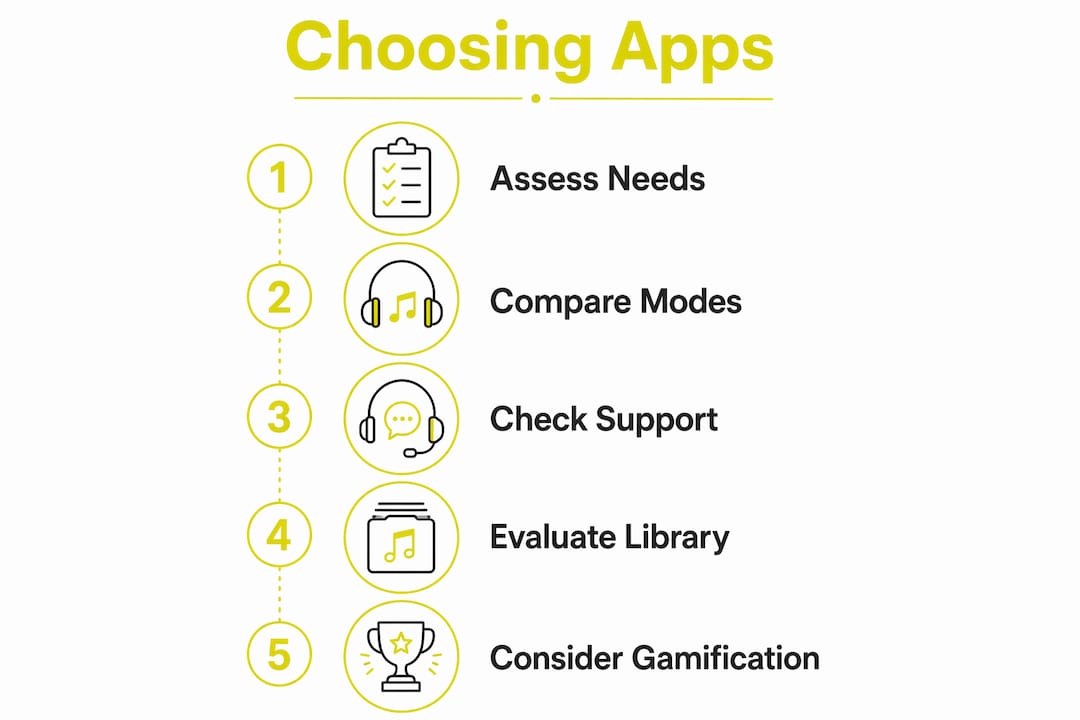
The right choice comes down to three questions: How structured do you need your learning to be? How important is social interaction? And how much do you care about library size versus lesson quality?
- Choose LyricsTraining if you want a free, competitive, high-volume listening workout with a massive song catalog and no setup required.
- Choose Lirica if you want music-based learning with actual grammar explanations and a more guided curriculum, especially for Spanish.
- Choose LyricFluent if you want curated contemporary music with clean word-level translations and a straightforward quiz format.
- Choose Singwithcanary if you want to blend music and language study with real social practice, karaoke, vocabulary cards, and a community of learners to practice with daily.
Beginners should treat any of these as a supplement, not a starting point. Music apps work best after foundational study because colloquial song lyrics assume vocabulary and grammar knowledge you need to build first. Once you have that base, music-based learning accelerates progress in ways that textbooks rarely match.
How do full lyric translations work across these platforms?
Full lyric translations are the feature that separates a learning tool from a lyrics lookup site. A raw translation tells you what words mean; a good learning translation tells you why the phrasing works, what the idiom implies, and how a native speaker would actually use that phrase in conversation.
LyricFluent and Singwithcanary both display full translated lyrics alongside the original, letting you read both versions simultaneously. Lirica goes a step further by annotating specific lines with cultural and grammatical context, which is particularly useful for songs that use regional slang or poetic compression. LyricsTraining, by contrast, keeps translation minimal by design, since the core mechanic is about listening and typing rather than reading comprehension.
Word-level translation, where you tap a single word to see its definition and hear it pronounced, is available on LyricFluent and Singwithcanary. That granularity matters when you encounter a word you almost know but cannot quite place in context. Hearing it isolated, then hearing it back in the lyric, is a faster path to retention than looking it up separately in a dictionary app.
Key Takeaways
Music-based language apps are most effective when used alongside structured study, not instead of it, and the best platform depends entirely on whether you prioritize library size, grammar support, social practice, or gamified listening drills.
| Point | Details |
|---|---|
| No single best platform | The right choice depends on learner level, preferred style, and whether social practice matters to you. |
| Music apps complement, not replace, grammar study | They excel at ear training and vocabulary retention but do not teach grammar sequencing. |
| Library size vs. curation | A large catalog matters less than well-tagged, level-appropriate songs you can actually learn from. |
| Intermediate learners benefit most | Beginners need foundational vocabulary before colloquial song lyrics become accessible and useful. |
| Singwithcanary adds social practice | It combines karaoke, quizzes, and vocabulary cards with real learner interaction, covering ground the others do not. |
Singwithcanary brings music and real conversation together
Most music-based language apps stop at the song. You listen, you fill in blanks, you move on. Singwithcanary takes a different route: after you work through a song with karaoke, vocabulary cards, and quizzes, you practice what you learned with actual people from around the world. That combination of music immersion and live social interaction is what separates it from platforms that treat listening as the finish line rather than the starting point.
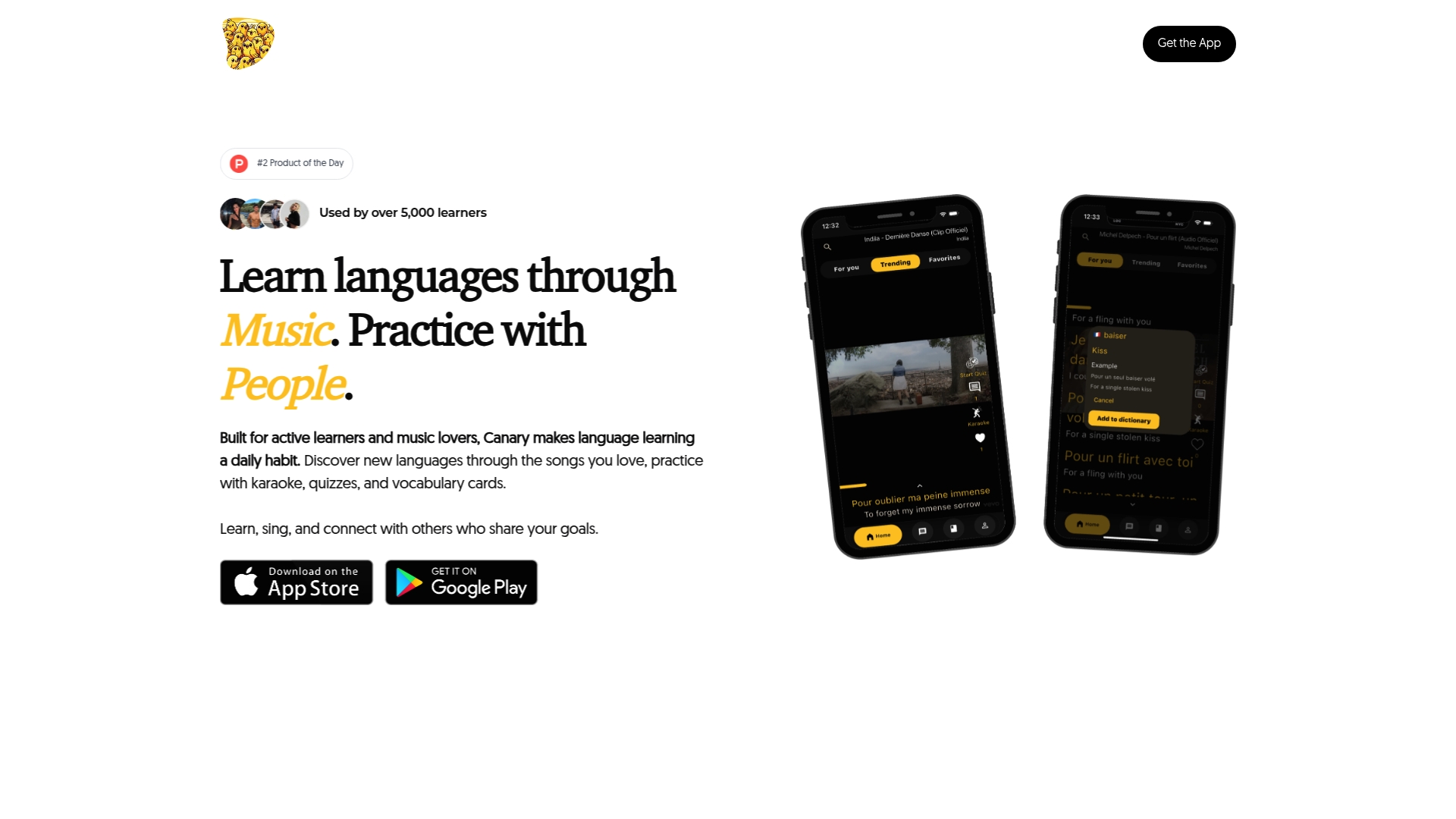
Singwithcanary is built for learners who want their daily practice to feel like something they chose to do, not something they have to check off. The platform covers pronunciation through native speaker audio, builds vocabulary through lyric-based exercises, and keeps you accountable through a community of learners working toward the same goal. If you have been cycling through apps that lose your attention after two weeks, the social layer here is what changes the equation.
Start learning with music on Singwithcanary and see how far a song can take you.