TL;DR:
- Music enhances pronunciation, fluency, and prosody through rhythm, repetition, and emotional engagement.
- Choosing clear, slow songs with accessible lyrics supports effective pronunciation practice.
- Combining lyric singing with real conversations accelerates language mastery and natural speech development.
You’ve memorized hundreds of vocabulary words, you can read full sentences, and yet the moment you open your mouth, you still sound… off. That disconnect is one of the most frustrating places a language learner can land. The good news is that song lyrics offer a surprisingly powerful fix. Music gives you rhythm, repetition, and real emotional connection, which are exactly the ingredients your brain needs to lock in accurate pronunciation. This guide walks you through a structured, evidence-backed method to use your favorite songs as a daily pronunciation workout, turning something you already love into a skill-building engine.
Table of Contents
- Why music and lyrics supercharge your pronunciation
- What you need: Song and lyric selection essentials
- Step-by-step: Practicing pronunciation with lyrics
- Troubleshooting: Common challenges and how to fix them
- A smarter way: Why lyric practice works (and when it doesn’t)
- Take your pronunciation further with interactive lyric practice
- Frequently asked questions
Key Takeaways
| Point | Details |
|---|---|
| Song lyrics enhance speaking | Practicing with lyrics helps you master stress, rhythm, and accent naturally through music. |
| Step-by-step practice works | Structured stages from selecting a song to self-recording deliver real, measurable results. |
| Choose the right materials | Picking clear, lyric-centered songs and effective tools accelerates your progress. |
| Combine with regular speech | Lyric-based learning is most powerful when paired with direct, everyday speaking practice. |
Why music and lyrics supercharge your pronunciation
Let’s start with the science, because it’s genuinely convincing. Your brain processes music in multiple regions at once, connecting sound, emotion, movement, and memory. That multi-region activation is exactly why a melody you heard once ten years ago can still pop into your head word for word. When you apply that same process to a new language, you’re not just memorizing sounds. You’re anchoring them.
Singing improves pronunciation accuracy and fluency, as proven in learner studies that tracked EFL (English as a Foreign Language) students over a semester. Students who practiced with songs consistently outperformed their peers on pronunciation tests. That’s not a small finding. That’s a direct argument for putting on a playlist during your next study session.
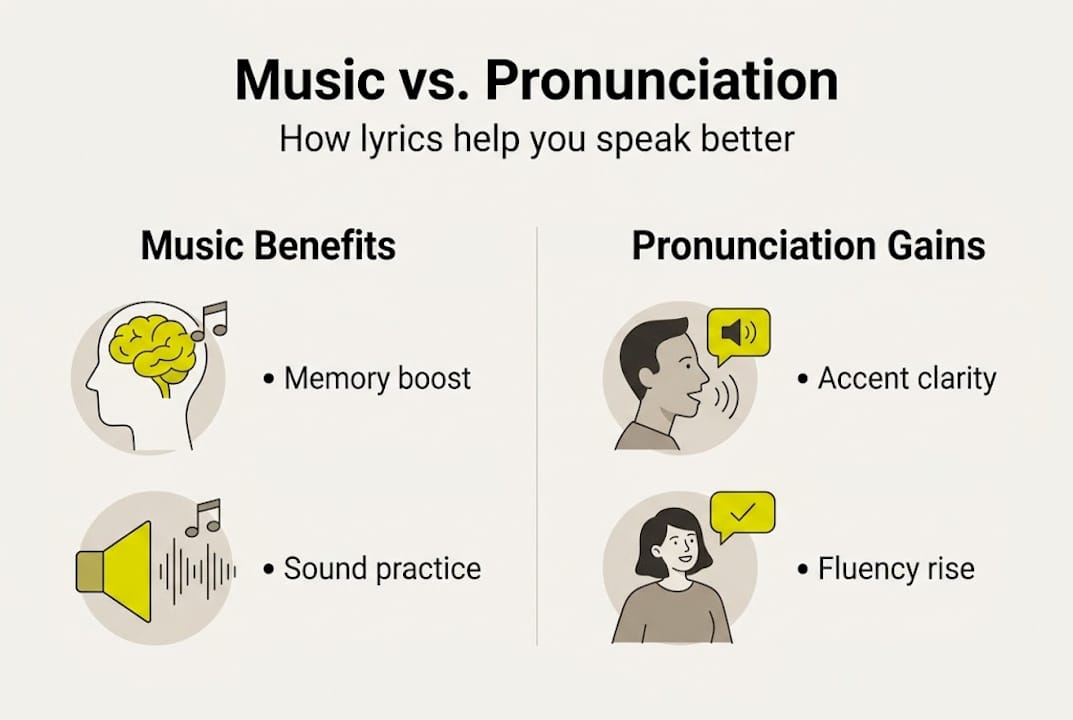
The benefits of song-based learning go beyond memory tricks. Songs naturally demonstrate how native speakers reduce sounds, blend words together, and stress syllables in real speech. When Adele sings “someone like you,” that phrase doesn’t sound the way it looks on paper. You hear the linking, the glides, the soft consonants. That’s authentic spoken language, delivered at a learnable pace.
Why lyrics beat traditional drills:
- Songs use natural connected speech, not isolated words
- Repetition through chorus structures builds muscle memory fast
- Emotional engagement deepens long-term retention
- Melodies carry stress patterns that mirror real conversation
- Music-based approaches show measurable gains in EFL learning contexts
| Practice method | Retention rate | Engagement | Real-world speech transfer |
|---|---|---|---|
| Vocabulary drills | Low to medium | Low | Low |
| Grammar exercises | Medium | Low | Medium |
| Song lyric practice | High | High | High |
| Conversation with natives | High | High | Very high |
One of the underrated benefits is what linguists call prosody, which means the rhythm, stress, and intonation patterns of a language. Songs teach prosody better than almost any classroom exercise. The language gains from songs include not just cleaner vowel sounds but also improved sentence-level flow. Learners who practice with music consistently report that their speech starts to feel more natural, not just sound more accurate.
What you need: Song and lyric selection essentials
The wrong song can actually slow you down. A track buried in heavy production, fast rap verses, or thick regional slang will leave you more confused than confident. Picking the right material is half the battle.
Choosing clear, slow songs like ballads helps you focus on tricky sounds without fighting the beat. Artists like Adele, Ed Sheeran, and John Legend are consistent favorites among language teachers because their enunciation is clean and their tempo is forgiving. You can actually hear every word.

For tools, you’ll want three things: a lyric source you trust, a way to slow playback without distorting pitch, and a recording app. Sites like Genius or AZLyrics are reliable for lyrics. Apps like YouTube or Spotify let you adjust speed. Voice Memos on your phone is enough to capture your attempts and play them back.
The methods for music lovers that actually stick are the ones that feel sustainable. If you hate the song, you won’t practice. Pick something you genuinely enjoy, even if it’s not the “pedagogically optimal” choice.
Ideal song checklist for pronunciation practice:
- Clear, uncluttered vocals in the foreground
- Moderate tempo (not a fast-paced hip-hop track)
- Standard accent or the accent you’re targeting
- Lyrics available online from a reliable source
- Emotionally engaging enough that you’ll replay it willingly
- Vocabulary that’s mostly accessible with a few stretch words
Pro Tip: Start with a song you already know well in your native language if a translation exists. Familiarity with the melody lets you focus entirely on the target language sounds instead of splitting attention between the tune and the words.
| Song type | Pronunciation focus | Difficulty for learners |
|---|---|---|
| Pop ballad | Vowels, linking | Easy to medium |
| R&B slow jam | Connected speech | Medium |
| Country ballad | Consonant clarity | Easy |
| Fast pop/rap | Reduction, slang | Hard |
Using real music learning examples from real learners confirms what many language teachers already know: the song itself is a scaffold. The right one holds you up while you find your footing.
Step-by-step: Practicing pronunciation with lyrics
Now comes the part where you actually do the work. The good news is that it’s enjoyable work. Here’s a proven sequence that takes you from first listen to confident, accurate singing.
Your pronunciation practice sequence:
- Read the lyrics cold. Before you hit play, scan the lyrics and highlight unfamiliar words. Look up their pronunciation using a phonetic dictionary or audio tool.
- Listen without singing. Play the song once and just absorb. Pay attention to where the singer stresses syllables and where sounds blur together.
- Mark up your lyrics. Underline linked sounds, circle reduced words (like “gonna” for “going to”), and note any sounds that feel unnatural to you.
- Echo one line at a time. Pause after each line and repeat it out loud. Match the melody, the rhythm, and the stress pattern as closely as you can.
- Slow the tempo. Drop playback to 75% speed using your app and sing along. This gives your mouth time to form sounds correctly before speeding back up.
- Record yourself. Sing an entire verse without stopping, then listen back. Compare your version to the original.
The structured steps of choosing a song, noting vocabulary, listening, following along, slowing the tempo, and self-recording are the backbone of this method, and they’re designed to build on each other.
“The goal isn’t to sound like a pop star. It’s to feel what accurate pronunciation feels like in your mouth, so that feeling becomes familiar.”
Pro Tip: Keep a running list of sounds that trip you up across multiple songs. If the “th” sound in English consistently gives you trouble, that’s your signal to drill it separately using a dedicated exercise, then return to the song to hear it in natural context.
For more ideas, pronunciation with music mastery gives you deeper frameworks for specific sounds. If you’re learning French specifically, French pronunciation with music breaks down the unique challenges of nasal vowels and liaisons in a song-based context. You can also explore mastering lyric-based learning for a broader approach to making lyrics your primary study material.
Troubleshooting: Common challenges and how to fix them
Even with the right song and a solid process, you’ll hit walls. Here’s how to push through the most common ones.
Problem: The lyrics move too fast to follow Slow the playback to 60% or 75% speed. If the song is still overwhelming at that pace, swap it for something slower. There’s no shame in starting with an easier track. Speed builds naturally.
Problem: You can’t hear your own mistakes This is the most common frustration, and it’s completely normal. Your ear adjusts to your own accent. Recording yourself and comparing with the original line by line forces you to hear the gap objectively. Alternatively, share your recording with a native speaker or use a pronunciation feedback app.
Problem: Progress feels invisible Instead of comparing yourself to native fluency, track micro-improvements. Did the linking between two specific words get smoother? Did you nail that vowel that used to come out wrong? Celebrate that.
“Progress in pronunciation often feels invisible until one day someone asks where you’re from, genuinely unsure.”
Problem: You understand the lyrics but can’t reproduce the sounds This is a production gap, and it’s different from a comprehension gap. Direct speech practice alongside singing boosts overall improvement. Don’t only sing. Read lyrics aloud in a spoken voice too, as if you’re performing a monolog. This bridges the gap between musical performance and natural speech.
The music and language benefits extend well beyond pronunciation alone. As you troubleshoot your singing, you’ll also notice vocabulary and listening comprehension improving on the side, which makes the effort feel even more worthwhile.
Quick fix checklist when you’re stuck:
- Slow the tempo and isolate one line
- Record, listen, and compare side by side
- Look up the phonetic transcription of problem words
- Switch to a clearer, slower song temporarily
- Add spoken reading of lyrics to your session
A smarter way: Why lyric practice works (and when it doesn’t)
Here’s the honest truth that most language learning content skips: lyric practice is extraordinary for building accent accuracy and prosody, but it won’t make you a conversational speaker on its own. Songs are scripted. They repeat. They follow a melody that guides your stress patterns for you. Real conversation doesn’t give you those guardrails.
We’ve seen learners who spent months singing along to their favorite albums and arrived at real conversations sounding noticeably better. Their vowels were cleaner, their rhythm was more natural, and they moved through sentences with less hesitation. That’s real progress, and it came directly from full benefits of music for language practice.
But those same learners sometimes froze when the conversation moved fast or went off-script. Songs break pronunciation plateaus brilliantly. They don’t replace the messiness of live interaction. The learners who got the best results combined their lyric practice with at least two or three real conversations per week, whether with a language partner, a tutor, or a community of fellow learners.
Think of lyrics as your training wheels and your gym. Use them daily to build strength and form. Then take those muscles into the real world and let the rough edges of actual conversation sharpen what music started.
Take your pronunciation further with interactive lyric practice
Learning pronunciation through song lyrics is most effective when you have the right tools supporting you at every step.
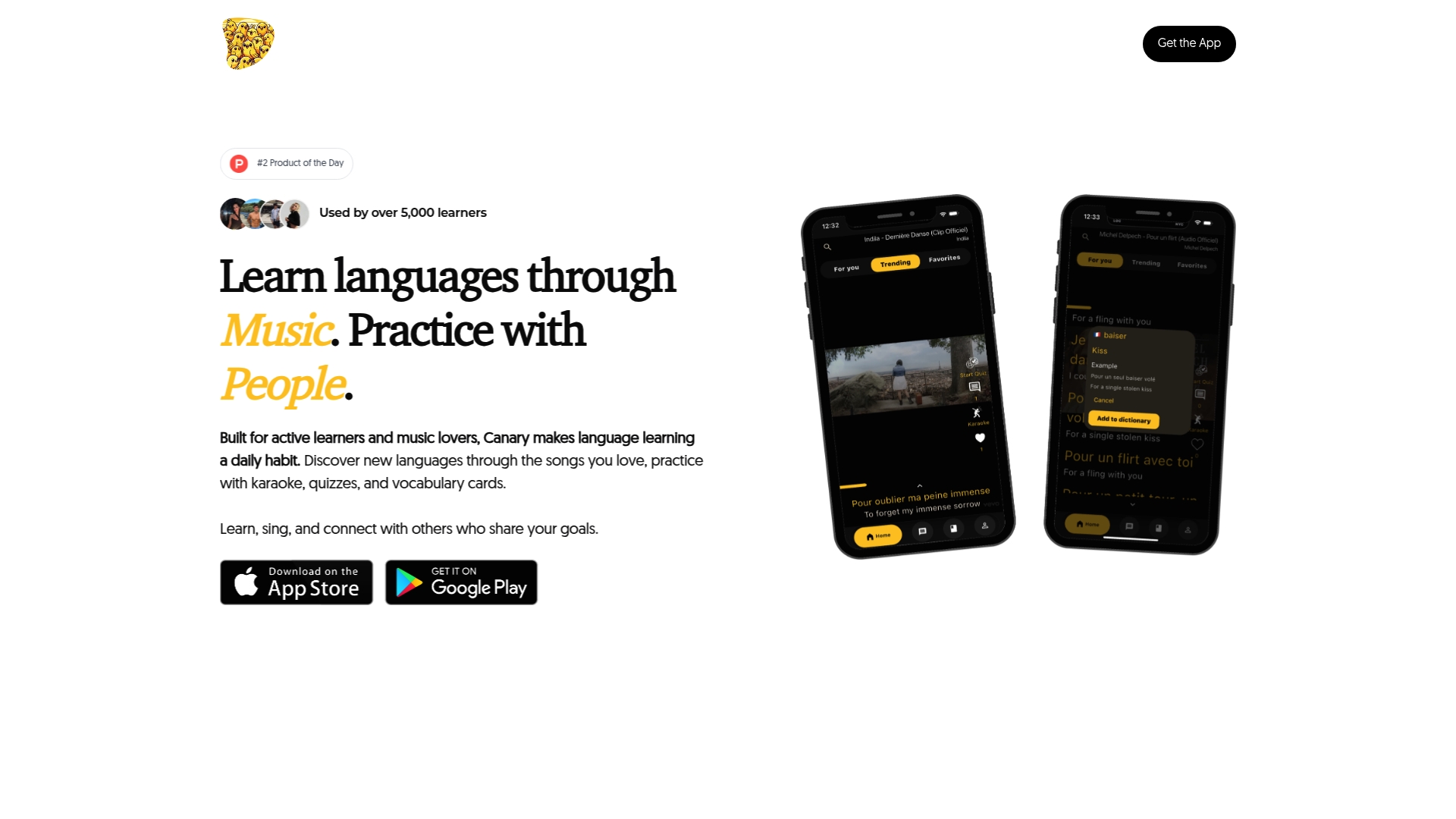
Canary was built exactly for this. The platform combines interactive pronunciation tools with real song lyrics, karaoke-style practice, vocabulary cards, and quizzes that make every session feel less like studying and more like playing. You can connect with other music-loving learners around the world, get feedback on your pronunciation, and track your progress song by song. Whether you’re working on English, Spanish, or another language, learn with music on Canary and explore music-based Spanish tools to find the approach that fits your goals.
Frequently asked questions
What types of songs are best for practicing pronunciation?
Clear, slow songs like ballads support pronunciation practice best, as they let you focus fully on accurate sounds without rushing to keep up with the beat.
Does singing along with lyrics really improve my accent?
Yes. Empirical studies show that learners who practiced with songs achieved measurably better pronunciation and fluency compared to those who relied on traditional methods alone.
How do I know if my pronunciation is improving?
Record yourself and compare with the original track line by line. Self-recording and comparison is a proven feedback method for spotting clearer stress, better sound linking, and increased confidence over time.
Should I focus only on lyrics, or also practice conversation?
Combine both for best results. Integrate lyrics with direct speech practice to strengthen your overall pronunciation, since real conversation adds the unpredictable flow that songs can’t replicate on their own.