Fixing your German pronunciation comes down to one habit: drilling a small set of high-impact minimal pairs, the kind of sound swaps that actually change meaning, using a listen, produce, test cycle instead of random vocabulary review. Do that regularly each day and your ear catches distinctions it used to blur past, while your mouth stops defaulting to English vowel shapes. The Goethe-Institut’s listening and pronunciation guidance backs this three-stage structure, and the International Phonetic Alphabet (IPA) gives you a precise way to see, not just hear, what your mouth needs to do differently.
Here is the starter plan:
- Pick 5 to 8 high-impact pairs (words like bitten / bieten or schön / schon) and listen to native audio for each before you say a single word aloud.
- Run a daily 10-minute production drill, repeating each pair multiple times while exaggerating the contrast, then dialing it back toward natural speech.
- Record yourself weekly and compare against the original audio, checking specifically for vowel length, lip rounding, and voicing at the end of words.
A tool built around music, like Singwithcanary, can make the listening and shadowing stages less tedious since you are training your ear against a melody instead of a flat word list. But the mechanics below work whether you use an app, a podcast, or a patient native speaker friend.
Key Takeaways
Fast, measurable improvement in German pronunciation comes from drilling a small set of high-impact minimal pairs through a listen, produce, test cycle rather than broad, unfocused review.
| Point | Details |
|---|---|
| Start with 5 to 8 pairs | Prioritize high-frequency contrasts like bitten/bieten and schön/schon before tackling rarer sound swaps. |
| Follow the three-stage method | Listen passively first, then produce actively, then test with new words weekly to confirm progress. |
| Watch vowel length and lip rounding | These two features cause more real confusion in German than almost any consonant mistake. |
| Record and compare weekly | Track progress against your own past recordings, not a perfect automated pronunciation score. |
| Use music for retention | Singing target contrasts in real German songs through Singwithcanary reinforces sounds through repetition you won’t have to force. |
Table of Contents
- What Minimal Pairs in German Are and Why They Matter
- High-Impact Minimal Pairs to Practice First
- Vowel Contrasts: Length, Umlauts, and Tenseness
- Consonant Contrasts That Confuse Learners
- The Listen, Produce, Test Training Method
- Common Mistakes and How to Fix Them Fast
- Ready-to-Use Practice Sets Grouped by Contrast
- Quick IPA Reference for Drilling
- Turning Song Lyrics Into Pronunciation Drills
- Why Most Learners Quit Pronunciation Practice Too Early
- Practice Pronunciation Through Songs You Already Love
- Sources
What Minimal Pairs in German Are and Why They Matter
A minimal pair is two words that differ by exactly one sound and mean something completely different because of it. Bitten (to ask) and bieten (to offer) differ only in vowel length. Say the vowel a beat too short or too long, and you have swapped verbs mid-sentence without realizing it. That is the entire value of minimal pairs: they isolate the one sound your ear is not yet catching, so you are not trying to fix your whole accent at once.
Standard pronunciation courses tend to introduce sounds individually, article by article, without ever forcing you to distinguish two similar ones side by side. Minimal-pair drills close that gap. StudySmarter’s breakdown of German minimal pairs frames them as a core tool for exactly this kind of fine-grained discrimination, and recommends active techniques like shadowing and recording rather than passive review. Reading about a sound difference does very little. Hearing it, producing it, then hearing your own attempt back against the original is what rewires the pattern.
This matters more in German than in a lot of languages learners come from, because German leans heavily on vowel length and quality to distinguish otherwise identical-looking words. English tolerates a lot of vowel sloppiness; German does not always forgive it.
High-Impact Minimal Pairs to Practice First
Not every minimal pair deserves equal practice time. Some sound swaps rarely cause real confusion in conversation, while others more often derail comprehension because the two words show up in similar contexts and the wrong one changes the sentence’s meaning entirely. Following an 80/20 approach, focusing on the most impactful contrasts, gets you fluent ears faster than grinding through every possible German sound pair in alphabetical order. This prioritization approach is well documented in Preply’s guide to German minimal pairs, which highlights vowel-length and umlaut contrasts as the biggest early wins for learners.
| Pair | Contrast | IPA Note | Priority |
|---|---|---|---|
| bitten / bieten | short i vs long ie | [ˈbɪtn̩] vs [ˈbiːtn̩] | High |
| schön / schon | umlaut ö vs plain o | [ʃøːn] vs [ʃɔn] | High |
| Schiff / schief | short i vs long ie | [ʃɪf] vs [ʃiːf] | High |
| Bahn / Pan | voiced vs voiceless stop | [baːn] vs [pan] | Medium |
| reisen / reißen | z (ts sound) vs ß (s sound) | [ˈʁaɪzn̩] vs [ˈʁaɪsn̩] | Medium |
Bitten / bieten tops this list because the short/long i distinction shows up constantly across verb conjugations, and mixing them up changes “ask” into “offer” in a way that genuinely confuses listeners. Schön / schon matters because both words are extremely frequent, “beautiful” versus “already”, and the umlaut is the only thing separating them. If your lips are not rounding for that ö, a German speaker hears “schon” when you meant “schön,” and the sentence stops making sense.
Bahn / Pan ranks lower priority only because voiced-voiceless confusion at the start of a word rarely creates real ambiguity in context. Nobody thinks you are talking about a frying pan when you mean the train. Still, training this contrast pays off once you reach word-final positions, which we will get to in the consonant section.
Vowel Contrasts: Length, Umlauts, and Tenseness
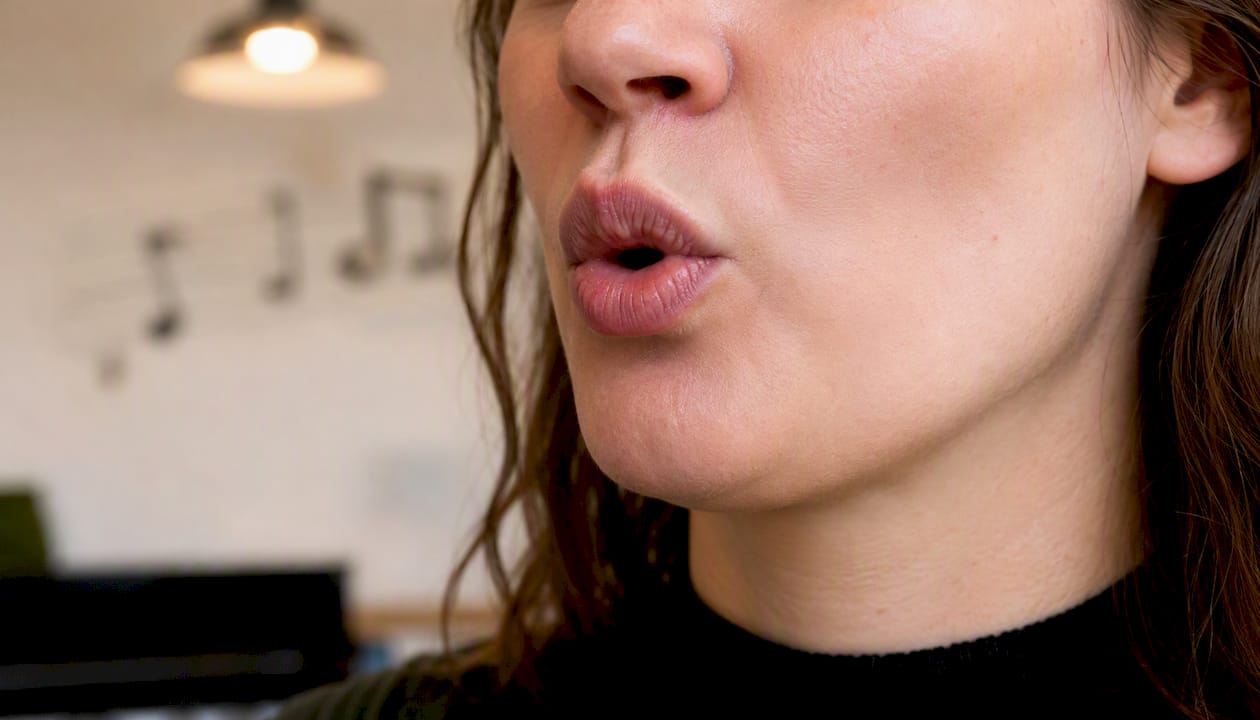
German vowels work on three overlapping axes, and confusing any one of them costs you clarity. The first is length: many vowel pairs are identical in quality but differ purely in duration, like the i in bitten versus the ie in bieten. The second is umlaut quality: ö, ü, and ä are not decorative dots, they represent genuinely different vowel sounds produced with rounded lips or a fronted tongue position. The third is tenseness, related to but distinct from length, where a “tense” vowel is produced with more muscular precision and a “lax” vowel is more relaxed and centralized.
Here is a compact reference for the vowel sounds behind the most common contrasts:
| Vowel | IPA | Example word | Notes |
|---|---|---|---|
| Long i | [iː] | bieten | Tense, held noticeably longer |
| Short i | [ɪ] | bitten | Lax, shorter and more centralized |
| Long o | [oː] | Ofen | Rounded, tense |
| Short o | [ɔ] | offen | More open, lax |
| ö (umlaut) | [øː] / [œ] | schön / können | Rounded lips, fronted tongue |
| ü (umlaut) | [yː] / [ʏ] | müde / müssen | Rounded lips, tongue forward like ee |
| u | [uː] | Fuß | Fully back and rounded |
The distinction between [uː] and [ʊ] (as in Mus versus muss) trips up a lot of learners because both are back rounded vowels with only subtle differences in tongue height and duration, a pairing described in detail in the phonetic literature on the close back rounded vowel. Your ear needs training specifically for that subtlety since English does not force the same precision.
Practice these vowel groups with short sentence drills rather than isolated words, since real confusion happens in context, not flashcards:
- Say “Er bittet um Hilfe” then “Er bietet Hilfe an” back to back, exaggerating the vowel length difference each time.
- Record yourself saying “Das ist schön” and “Das ist schon fertig,” then play both back and check whether the ö actually sounds different from the o.
- Practice ü words in pairs: “müde” (tired) against “Mut” (courage), rounding your lips fully for the ü and completely dropping the rounding for the u-adjacent sound.
Shadowing works particularly well here: play a native audio clip, pause after each sentence, and repeat it immediately while trying to match the vowel length you just heard, not the length that feels natural from English habits.
Consonant Contrasts That Confuse Learners
Vowels get most of the attention in German pronunciation guides, but consonant contrasts cause just as much real-world confusion, especially the voiced-voiceless distinction and the ich-Laut versus ach-Laut split that has no real English equivalent.
Voiced consonants like b, d, and g involve vocal cord vibration you can feel by placing a hand on your throat. Voiceless counterparts, p, t, and k, use the same mouth position without that vibration. English speakers usually manage this fine at the start of words but lose the distinction at the end of German words, where final devoicing kicks in and Rad (wheel) can sound dangerously close to Rat (advice) if you are not careful with the vowel preceding it.
The ich-Laut [ç] and ach-Laut [x] pair is the contrast that trips up nearly everyone learning German as a second language, because English simply does not use either sound. Both come from the same letter combination, “ch,” but the pronunciation depends entirely on what vowel comes before it. After front vowels like i and e, you get the softer palatal [ç] in words like ich and Milch. After back vowels like a, o, and u, you get the harsher velar [x] in words like ach and Buch. This rule is laid out clearly in ielanguages’ German pronunciation guide, which is worth bookmarking for spelling-to-sound patterns beyond just this one contrast.
| Contrast | IPA | Example pair | What to feel |
|---|---|---|---|
| Voiced vs voiceless stop | [b] vs [p] | Bahn / Pan | Throat vibration on the voiced sound |
| Voiced vs voiceless stop | [d] vs [t] | dann / Tann | Same vibration check |
| ich-Laut vs ach-Laut | [ç] vs [x] | ich / ach | Tongue position: front and high vs back and low |
| Fortis vs lenis fricative | [s] vs [z] | reißen / reisen | Buzzing vibration for the z-sound |
| Affricate | [pf] | Pfeffer | Full stop then release into fricative |
Pro Tip: Regional accents change the ach-Laut noticeably, and some southern German and Austrian speakers soften it closer to [ç] even after back vowels. Don’t panic if native audio from different regions sounds inconsistent. Aim for the standard [x]/[ç] split when practicing, since that gives you the clearest baseline, but don’t assume every native speaker you meet will match it exactly.
The Listen, Produce, Test Training Method
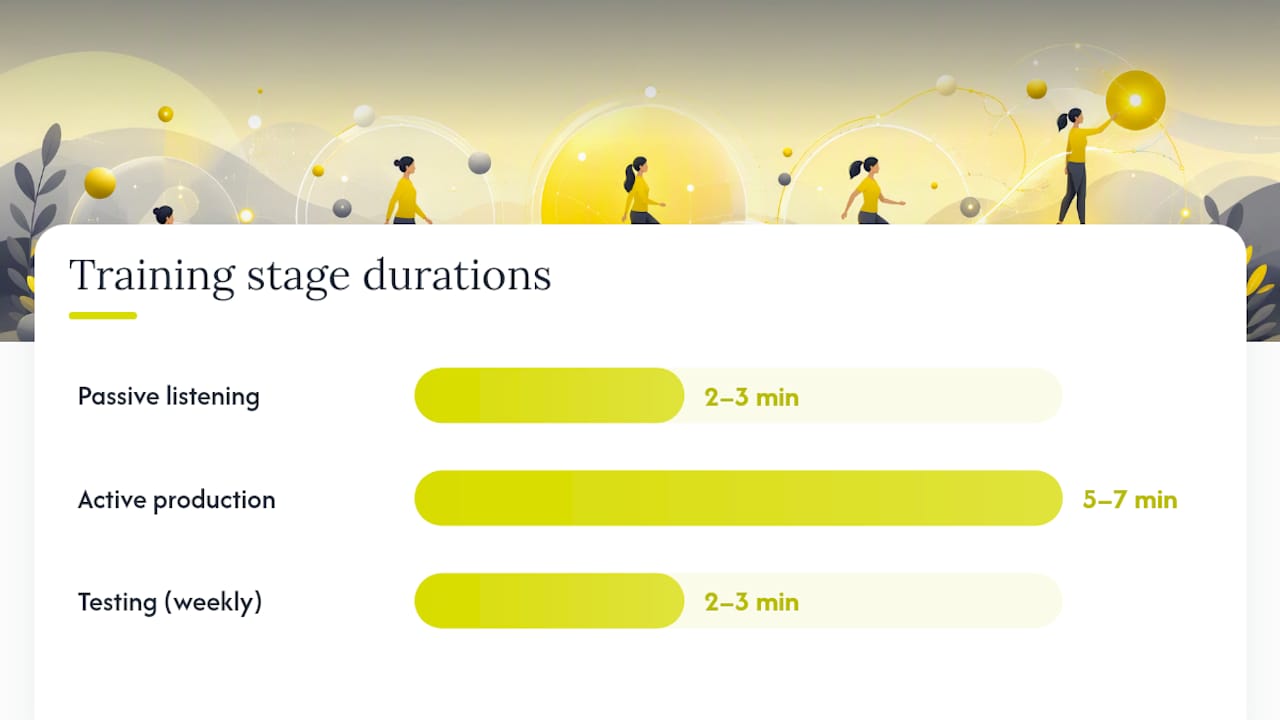
Random repetition wastes time. The method that actually moves the needle is a three-stage cycle: passive listening to recognize a contrast, active production to train your mouth, and testing with new material to confirm the skill transferred. This structure mirrors the Goethe-Institut’s own listening and pronunciation exercise framework, which specifically warns against skipping the listening phase, since production without a clear internal model of the target sound just reinforces your existing habits instead of correcting them.
Here is how to run each stage:
- Passive listening (2 to 3 minutes). Play 8 to 10 examples of your target contrast back to back without repeating anything aloud. Just listen and try to identify which word you heard each time, checking your guesses against a transcript.
- Active production (5 to 7 minutes). Say each word in the pair aloud, exaggerating the contrast at first, then gradually relaxing toward a natural speaking pace. Alternate between the two words in the pair rapidly, forcing your mouth to switch shapes quickly.
- Testing (2 to 3 minutes, done weekly rather than daily). Introduce new words that share the same contrast but were not part of your practice set, then record yourself saying them and compare against native audio.
A few exercise formats make each stage more concrete:
- Minimal-pair substitution drills: take a full sentence and swap in each word from your pair, saying both versions back to back to feel the contrast in context rather than isolation.
- Contrastive sentence practice: write two short sentences that only differ because of your target minimal pair, then read them aloud with deliberate emphasis on the differing sound.
- Record-and-compare: use your phone’s voice memo app, record yourself, then listen immediately afterward with the native audio for direct comparison.
For your weekly progress check, listen for three specific things: whether your vowel lengths are audibly different when they need to be, whether voiced consonants actually vibrate compared to your voiceless ones, and whether a native speaker (or a patient app) can correctly guess which word in the pair you meant. Chasing a perfect score from an automated pronunciation grader is less useful than this kind of targeted, human-focused check, since automated scorers sometimes reward exaggerated, unnatural clarity over the way people actually speak.
Common Mistakes and How to Fix Them Fast
The most frustrating part of minimal-pair practice is nailing a sound in isolation, then watching it vanish the moment you speak in a full sentence. This happens because isolated drilling trains muscle memory for a word by itself, not for that word surrounded by the momentum of connected speech. Sentence-length drills, not word lists, are what actually fix this, since they force your mouth to maintain the contrast under real conversational speed.
Lip rounding is another frequent casualty. Learners nail ü and ö perfectly when concentrating hard on a single word, then let their lips go slack the instant they are focused on getting through a whole sentence. The fix is a simple lip-check: say the sentence slowly first, physically holding the rounded lip shape a half-second longer than feels necessary, then speed up while trying to preserve that shape.
Final-position voicing is the third recurring trap. German devoices consonants at the end of words, so Rad and Rat sound nearly identical at the very end, but the preceding vowel length and quality still carry the distinction. Learners who ignore this end up flattening both words into the same sound, losing the contrast the language actually relies on.
A quick correction cycle that works for all three: exaggerate the target feature deliberately for three repetitions, then gradually reduce the exaggeration over the next three, aiming to land on something that sounds natural but still clearly distinct. This exaggeration-reduction pattern retrains the muscle memory without leaving you stuck sounding robotic.
Pro Tip: When you play back your own recording, don’t ask “does this sound right?” Ask “could someone who doesn’t know what I meant to say correctly guess which word this is?” That question exposes weak contrasts your ear glosses over when you already know the intended answer.
Ready-to-Use Practice Sets Grouped by Contrast
Here is a working set of pairs organized by contrast type, so you can pick a category and drill it without hunting for examples. Turn each row into a flashcard with the German words on one side and the IPA plus English gloss on the other, or record yourself reading down each column for an audio drill you can replay anytime.
Pull one row’s German A/B columns each day and drill them the way described in the methodology section. A tool that pairs this kind of drilling with song lyrics, so the contrast shows up in a melody you already have stuck in your head, tends to make the repetition stick without feeling like homework. Singwithcanary’s approach to ear training for German learners leans on exactly this kind of repeated exposure through music rather than flat word lists.
Quick IPA Reference for Drilling
Keep this nearby while you practice so you are not switching tabs mid-drill to look up a symbol.
| Symbol | Sound type | Example | Quick note |
|---|---|---|---|
| [iː] | Long, tense vowel | bieten | Hold noticeably longer than English “ee” |
| [ɪ] | Short, lax vowel | bitten | Shorter, more relaxed than [iː] |
| [øː] | Rounded front vowel | schön | Round lips, tongue forward |
| [ʏ] | Rounded front vowel, lax | müssen | Same lip rounding, shorter and looser |
| [x] | Voiceless velar fricative | ach | Back of tongue, throat friction |
| [ç] | Voiceless palatal fricative | ich | Front of tongue, softer hiss |
| [ʁ] | Uvular fricative or approximant | Rad | Varies by region, back-of-throat |
| [ts] | Affricate | Zahl | Written “z,” pronounced like English “ts” |
The colon-like triangle mark [ː] after a vowel always signals length, so any time you see it, hold that sound roughly twice as long as its unmarked counterpart. Stress marks, when shown, sit before the stressed syllable as a small vertical tick. When in doubt about a symbol you don’t recognize, Wiktionary’s German pronunciation appendix has the fullest mapping available for free, covering sounds this list doesn’t have room for.
Listening to real audio alongside the IPA matters more than memorizing the symbols themselves. The IPA tells you what your mouth should be doing; native audio tells you what it should sound like when a real person does it at conversational speed.
Turning Song Lyrics Into Pronunciation Drills
Music gives you something a textbook cannot: a phrase you will replay in your head involuntarily for the rest of the day, contrast and all. That repetition is free practice you don’t have to schedule. A 10 to 15 minute song-based session maps onto the three-stage method almost perfectly.
Start by picking a line containing your target pair, say a lyric with schön in it, and listen to it three or four times before singing along. That is your passive listening stage, except a melody makes the contrast easier to remember than a flat recording of an isolated word. Next, shadow the line, singing along in real time while matching the vowel length and lip rounding you just heard. That is active production, and the rhythm of the song actually forces better vowel timing than free speech does, since you have to fit the syllable into the beat. Finally, record yourself singing the line solo and compare it against the original, checking specifically for the target contrast.
Singwithcanary’s karaoke-based practice is built around this exact loop: karaoke for the shadowing stage, quizzes for the testing stage, and vocabulary cards to reinforce the words you are drilling. A few practical pointers for building this into a routine:
- Choose songs with clear, unhurried vocals for your first few weeks, since fast or heavily stylized singing masks vowel length.
- Repeat the same song for three or four days before switching, so you’re reinforcing the same contrasts rather than starting fresh each session.
- Schedule song practice at a consistent time, right after breakfast or during a commute, since habit consistency matters more than session length for pronunciation gains.
Structured vocal pedagogy backs this up too. Active listening techniques used in singing instruction, like the ones described in active listening techniques in vocal pedagogy, rely on the same listen-then-imitate loop that works for language sound contrasts, just applied to musical phrasing instead of vocabulary.
Why Most Learners Quit Pronunciation Practice Too Early
Learners tend to expect pronunciation gains to happen the way vocabulary does, memorize it once, keep it forever. It doesn’t work that way. Pronunciation is a motor skill, closer to learning a golf swing than memorizing a word list, and motor skills regress without regular reinforcement even after they start feeling natural.
What I’ve noticed in learner progress patterns is a predictable dip around week two. The initial exaggeration-based drills feel productive and obviously different, but then the improvement seems to plateau right as the sounds start feeling less novel. That plateau is not a sign the method stopped working. It is the point where gains shift from obvious to subtle, and the only way to see them is by recording yourself and comparing against your week-one recording, not your gut feeling about how you sound today.
A realistic target: with focused, daily 10-minute drills on a handful of high-priority pairs like bitten/bieten and schön/schon, most learners can reliably distinguish and produce those specific contrasts within three to four weeks, confirmed by a native speaker or a careful self-test rather than an app’s percentage score. That is not fluency. It is one solid brick in a wall that takes longer to build, but it is a measurable, honest win, and those compound faster than people expect once you have two or three contrasts locked in and stop having to think about them consciously.
Practice Pronunciation Through Songs You Already Love
Every method in this article, listen, produce, test, works better when the material sticks in your memory without effort, and that is where song lyrics have an advantage over flashcards or textbook dialogues. Singwithcanary builds its German lessons around real songs, using karaoke-style playback so you shadow native pronunciation in context, quizzes that test the contrasts you just practiced, and vocabulary cards that reinforce meaning alongside sound.
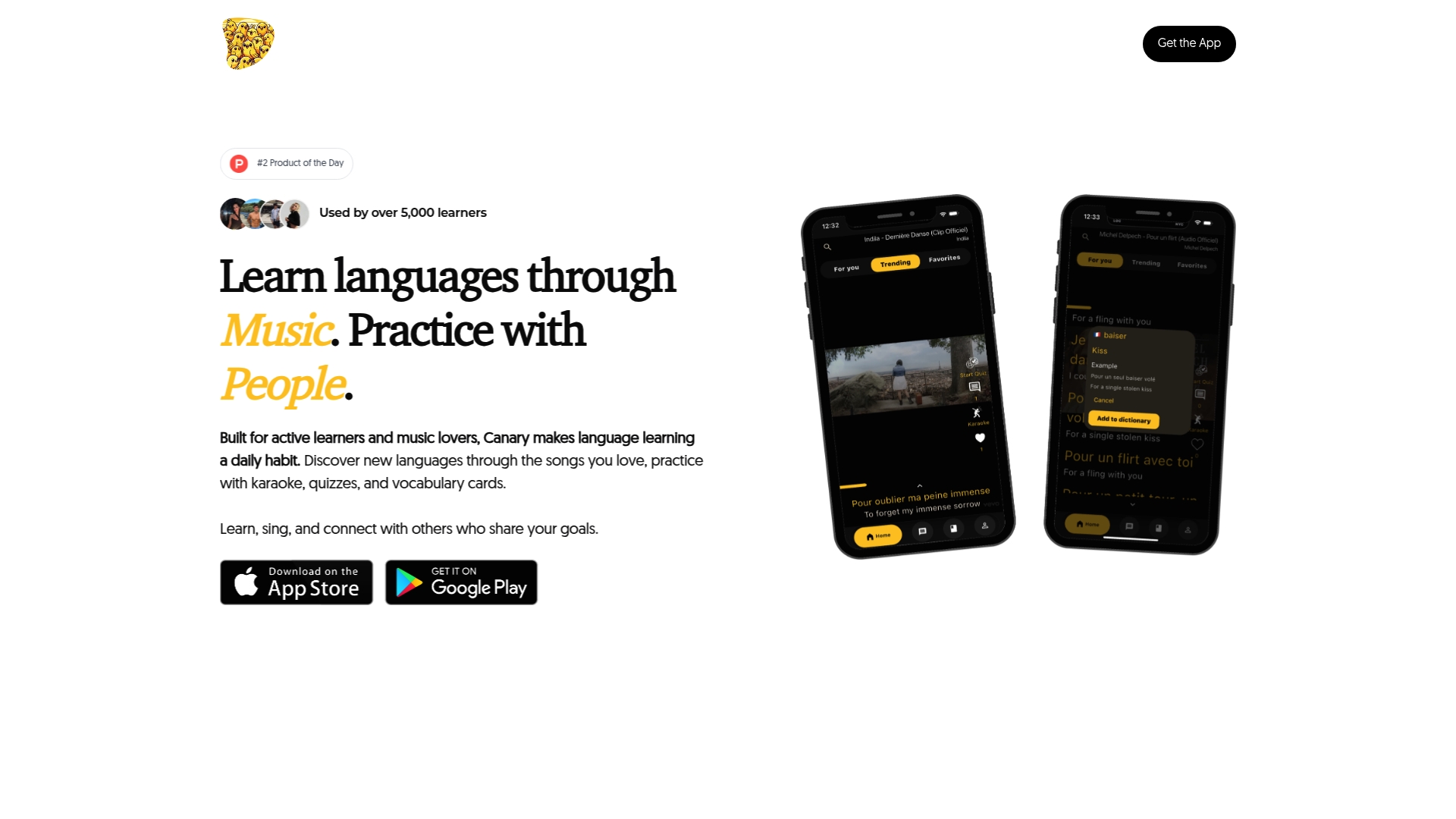
If you have been drilling schön versus schon from a word list and want to hear that same contrast inside an actual German song, the Song of the Week practice page is a low-friction place to start, a fresh track each week to keep your listening stage from getting stale. From there, signing up for Canary gets you the full karaoke and quiz loop instead of assembling your own drills from scratch. Pick a song, listen once through, then sing along and see how your German ear holds up against a melody instead of a flat recording.
Sources
- Goethe-Institut listening & pronunciation exercises
- German minimal pairs: Pronunciation, examples, and practice
- Appendix: German pronunciation — Wiktionary
- German minimal pairs: StudySmarter
- Ielanguages