TL;DR:
- Singing vocabulary enhances recall more effectively than reading or speaking, especially over time. Using familiar tunes and simple melodies leverages music’s natural memory aids, such as chunking and dual retrieval paths. The platform Singwithcanary applies these findings through song-based lessons and social practice to improve language learning.
How music and language memory hacks improve what you retain
Singing new vocabulary beats reading it. That’s not a motivational claim. A 2018 randomized controlled trial found that children who heard words sung to them recalled 20% more words immediately, with a 17% advantage still holding after a 15-minute delay. Adults learning Hungarian phrases through singing outperformed both speaking and rhythmic speaking groups on four out of five recall tests.
The core mechanism is straightforward. Music gives your brain two retrieval paths instead of one: the meaning of the word, and the melody it rides on. That redundancy is what makes song-based memory hacks so much stickier than flashcard repetition.
Key findings at a glance:
- Singing has been found to produce statistically significant advantages in verbatim recall over spoken repetition in controlled experiments.
- Musical mnemonics improve serial word order recall, not just overall count
- Combined music and language training produces additive verbal memory gains over time
- Simple, familiar tunes outperform complex melodies as mnemonic vehicles
What the science actually says about music and memory
Three studies form the backbone of what we know here, and they’re worth knowing specifically.
| Study | Design | Key Result |
|---|---|---|
| Ludke et al. (2014) | 60 adults, 3 learning conditions, Hungarian phrases | Singing outperformed speaking on 4/5 recall tests (p < .05) |
| Frontera et al. (2018) | Randomized trial, children aged 9–11, RAVLT | 20% more words recalled; 17% advantage after delay |
| Frontiers in Psychology (2025) | Longitudinal, 65 adults, one year of training | Music + language training produced the largest verbal memory gains |
The 2014 study, published in Memory & Cognition, was the first to show experimentally that singing aids foreign language phrase learning in adults under controlled conditions. Rate of presentation was matched across groups, ruling out the obvious confound that sung material is just slower.

The 2025 longitudinal research added something the earlier studies couldn’t: a time dimension. Participants who combined music and language training for a full year showed greater verbal memory improvements than those who did either alone. The gains compound.
What these studies share is specificity. The benefit is strongest for verbatim recall tasks, meaning the exact words in the exact order. That’s exactly what language learning demands.
Why your brain responds so strongly to melody
Three processes explain the effect, and they work together.
Neural entrainment is what happens when your brainwaves synchronize with an external rhythmic source. Music does this reliably. The rhythm organizes incoming information into predictable time slots, which makes encoding more efficient.
The reward cycle is the dopamine piece. Songwriter and educator George Hammond Hagan, who developed music-based study tools for students, puts it plainly:
Deep encoding is the result. Information stored alongside melody gets filed in a different memory system than plain spoken words. That’s why you can recall song lyrics from a decade ago but forget a phone number from this morning.
Pro Tip: Melodic pitch and rhythmic structure also improve serial recall, meaning the order of words. For language learners, word order is grammar. That’s a free grammar lesson baked into every song you memorize.
The musical structure organizes auditory information into chunks, reducing the cognitive load of holding multiple items in working memory at once. Miller’s classic “chunking” research from 1956 applies directly here: music gives your brain a natural grouping system.
Practical techniques for using music to learn a language
The research points to a few specific methods that work, and a few that waste your time.
- Use familiar tunes, not original compositions. “Twinkle, Twinkle, Little Star” or “Row, Row, Row Your Boat” work better than anything you write from scratch. The familiar melody gives your brain an existing hook; you’re just hanging new vocabulary on it.
- Make it silly. The more absurd the lyric, the more memorable. Don’t aim for grammatical perfection in your song. Aim for stickiness.
- Try rap-style delivery for dense material. A spoken-word rhythm allows more words per minute than a melodic ballad, making it practical for longer vocabulary lists or grammar rules.
- Re-listen without the lyrics. Once you’ve learned a section, hide the text and listen again. If you can only follow along while reading, you’re practicing reading, not listening. The goal is for your ear to track the words independently.
- Mine for chunks, not single words. Phrases like “I can’t help it” or “I’m looking forward to” are more useful than isolated vocabulary. Building Spanish vocabulary fast, for example, relies heavily on learning high-frequency phrase patterns rather than word-by-word memorization.
Pro Tip: Musical mnemonics reduce cognitive load by chunking complex concepts into lyrics. When you transform a grammar rule into a short verse, you’re restructuring the information, not just decorating it. That restructuring is what drives long-term retention.
A common pitfall: overcomplicating the melody. Learners who try to write original, musically interesting songs spend more time on composition than on the language. The sillier and simpler, the better.
How Singwithcanary puts these principles into practice
Singwithcanary is built around the exact mechanisms the research describes. The platform combines song-based language learning with karaoke, vocabulary cards, quizzes, and social practice with speakers from around the world.
What sets Singwithcanary apart from standard language apps is the cultural layer. Songs are not stripped-down teaching material. They carry accent, rhythm, idiom, and emotional context that textbooks can’t replicate. Learners practicing pronunciation through karaoke get real feedback on stress and intonation, not just vocabulary matching.
The platform’s features map directly to what the research recommends:
- Karaoke mode for active pronunciation and shadowing practice
- Vocabulary cards tied to song lyrics for contextual retention
- Quizzes that test recall in the same format the studies found most effective: verbatim production
- Social practice with international speakers to transfer musical learning into real conversation
Singwithcanary also surfaces the science behind why musicians learn languages faster, giving learners the reasoning behind the method, not just the method itself.
How rhythm and melody work together for vocabulary retention
Rhythm and melody aren’t interchangeable. They do different jobs.
Rhythm handles timing and sequence. When you hear a word at a predictable beat, your brain anticipates it, which strengthens the memory trace. That’s why music boosts vocabulary retention most reliably for ordered lists: days of the week, verb conjugations, numbered sequences.
Melody handles identity. A specific pitch pattern attached to a word makes that word distinct from every other word in your memory. It’s the difference between a face in a crowd and a face you’d recognize anywhere.
Together, they create what researchers call an “earworm effect.” Repeated listening to a catchy musical mnemonic leads to involuntary recall, where learners find themselves humming the material outside of study time. That passive rehearsal extends retention without any additional effort.
Real-world examples of music memory hacks in action
George Hammond Hagan’s work with Studytracks offers one of the clearest real-world demonstrations. After setting his son’s physics notes to a rap-style backing track, his son retained concepts that had previously eluded him and was able to answer classroom questions he couldn’t before. That single experiment became a platform used by students, teachers, and parents.
The Periodic Table is another well-documented case. Songs have helped learners memorize all 100-plus elements, a task that defeats most rote memorization attempts. The melody provides a scaffold for the sequence; the rhythm keeps the order intact.
Language classrooms have used the same approach for decades. Teachers who set verb conjugations to familiar nursery rhyme tunes report that students retain the patterns far longer than those who drill them as lists. The educational benefits show up most clearly in tasks requiring exact production, which is precisely what speaking a language demands.
The pattern across all these examples is consistent: the simpler the tune, the more familiar the melody, and the more the content is restructured into lyric form rather than just read aloud, the stronger the retention.
Key Takeaways
Singing vocabulary and phrases produces measurably better recall than spoken repetition, and combining music training with language study compounds those gains over time.
| Point | Details |
|---|---|
| Singing beats speaking for recall | Adults who sang foreign phrases outperformed speaking groups on most recall tests. |
| 20% recall advantage with melody | Children recalled 20% more words when heard sung versus spoken, with this advantage persisting at 17% after a delay. |
| Combined training compounds gains | Music and language training together produced the largest verbal memory improvements in a one-year longitudinal study. |
| Simple tunes work best | Familiar melodies like nursery rhymes create stronger mnemonic links than complex original compositions. |
| Earworm effect extends retention | Repeated listening to musical mnemonics triggers involuntary recall, reinforcing memory outside active study time. |
Try Singwithcanary
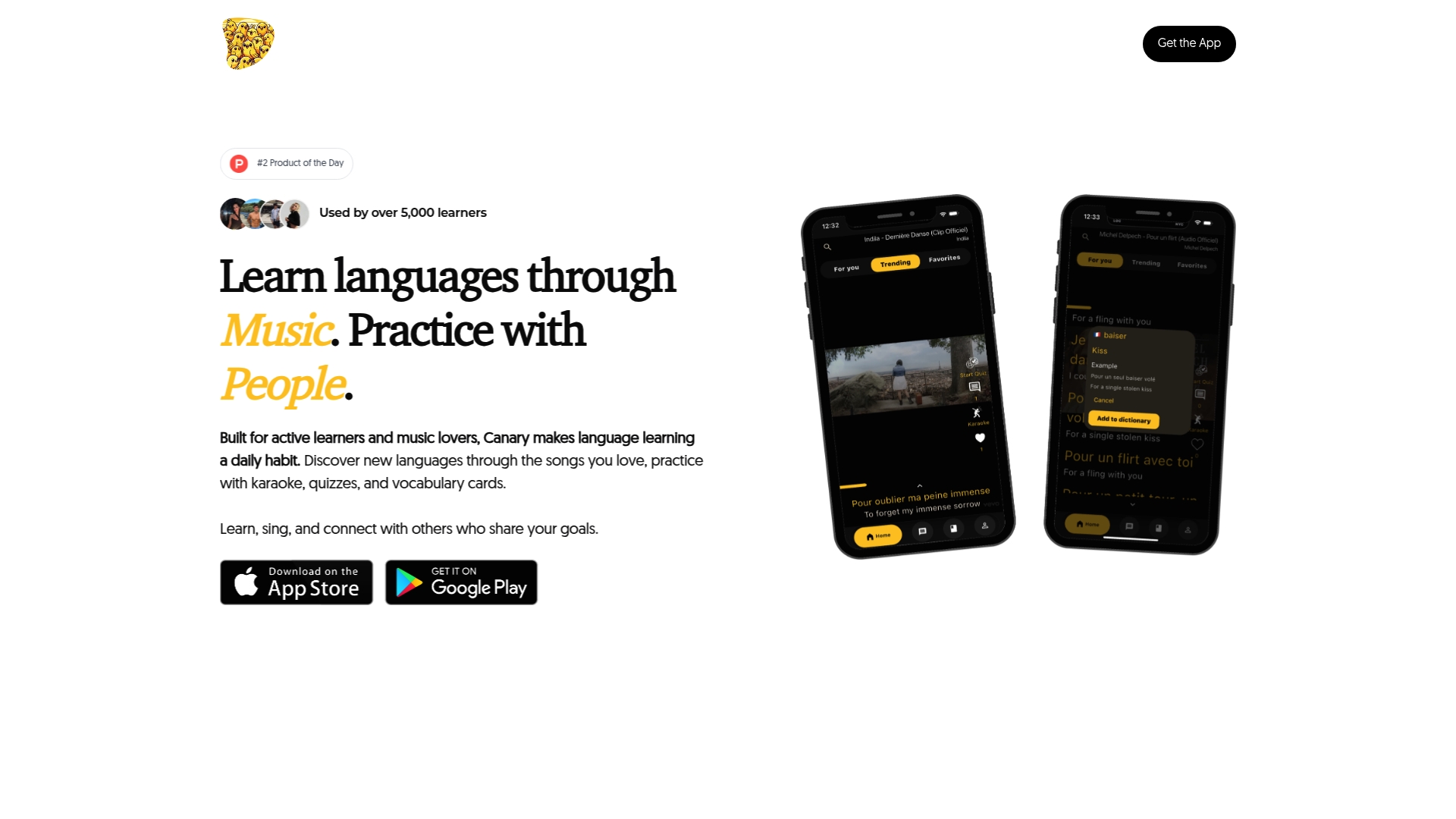
Singwithcanary puts every one of these techniques into a single platform. Song-based lessons, karaoke practice, vocabulary cards, and a global community of learners all in one place. If you want to learn languages with music the way the research actually recommends, Singwithcanary is where to start.