Finding a music-based French learning tool that actually turns songs into effective vocabulary, listening, and pronunciation drills is harder than most language apps admit. Many platforms either make music a secondary feature, limit social or performance practice, or restrict access behind inconsistent pricing and thin support. This article compares song-first language apps, karaoke coaches, and memory-driven study platforms so you can choose the best fit for your budget, practice style, and feedback needs without wasting time on the wrong tools.
Table of Contents
Canary
At a Glance
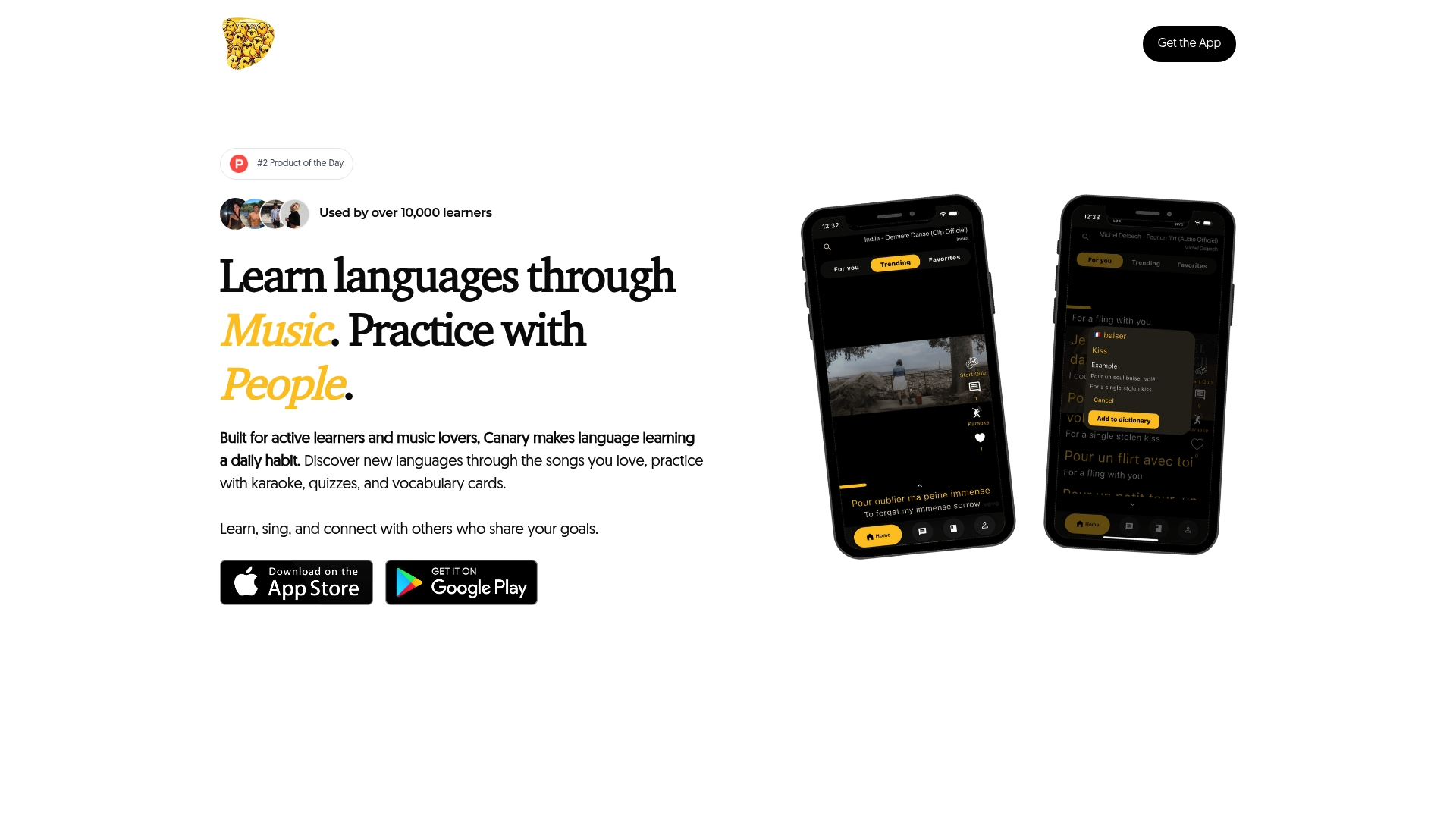
Sandbox content and site errors currently block public pricing and a full feature list, so some details are unavailable on the live site. Still, the materials show a music-first workflow where songs, karaoke, quizzes, and vocabulary tools form the learning core.
Core Features
- Karaoke mode for active pronunciation practice while following real song lyrics.
- Vocabulary cards and quizzes that extract phrases from songs for targeted review.
- Community connection tools that let you practice with other learners and get spoken feedback.
- Mobile access via app store integration so you can sing and revise on the go.
Key Differentiator
The product pairs short song-based exercises with social practice rather than only offering drills. That pairing turns listening into performance practice and gives learners a structured way to repeat lines aloud, compare pronunciation, and get corrections from peers.
Pros
- Music makes repetition less tedious. Songs create melodic hooks that help vocabulary stick for musical and visual learners.
- The karaoke workflow targets pronunciation directly. Singing the lines forces timing, stress, and vowel shapes in ways passive listening does not.
- Social components let you trade short performances and corrections. Practicing with others reduces the friction of speaking alone.
- The combination of quizzes and vocabulary cards ties lyric snippets to focused review, which helps transfer phrases from songs into usable speech.
Cons
- Page errors on the site currently prevent access to full feature documentation and any pricing information, suggesting the public pages are incomplete or under maintenance.
Who It’s For
Music-loving language learners who prefer active, social practice over textbook drills. Ideal if you want to sharpen pronunciation and listening by singing, trading short performances, and reviewing lyric-based flashcards during daily routines.
Unique Value Proposition
Karaoke plus immediate peer practice turns a three minute chorus into a repeatable study block you can fit into a commute or coffee break. That workflow makes daily repetition more likely than long passive sessions because practice becomes performative and social.
Real World Use Case
You pick a French pop chorus, run it in karaoke mode, record two takes, review highlighted vocab cards for unfamiliar phrases, then drop your clip into a learner group for pronunciation tips. Ten minutes later you have targeted review and corrective feedback.
Pricing
Pricing pages are not available on the site right now. The product data labels pricing as not applicable and notes informational limits due to page errors, so expect to check the site later or contact the team for current plans.
Website: https://singwithcanary.com
Sounter
At a Glance
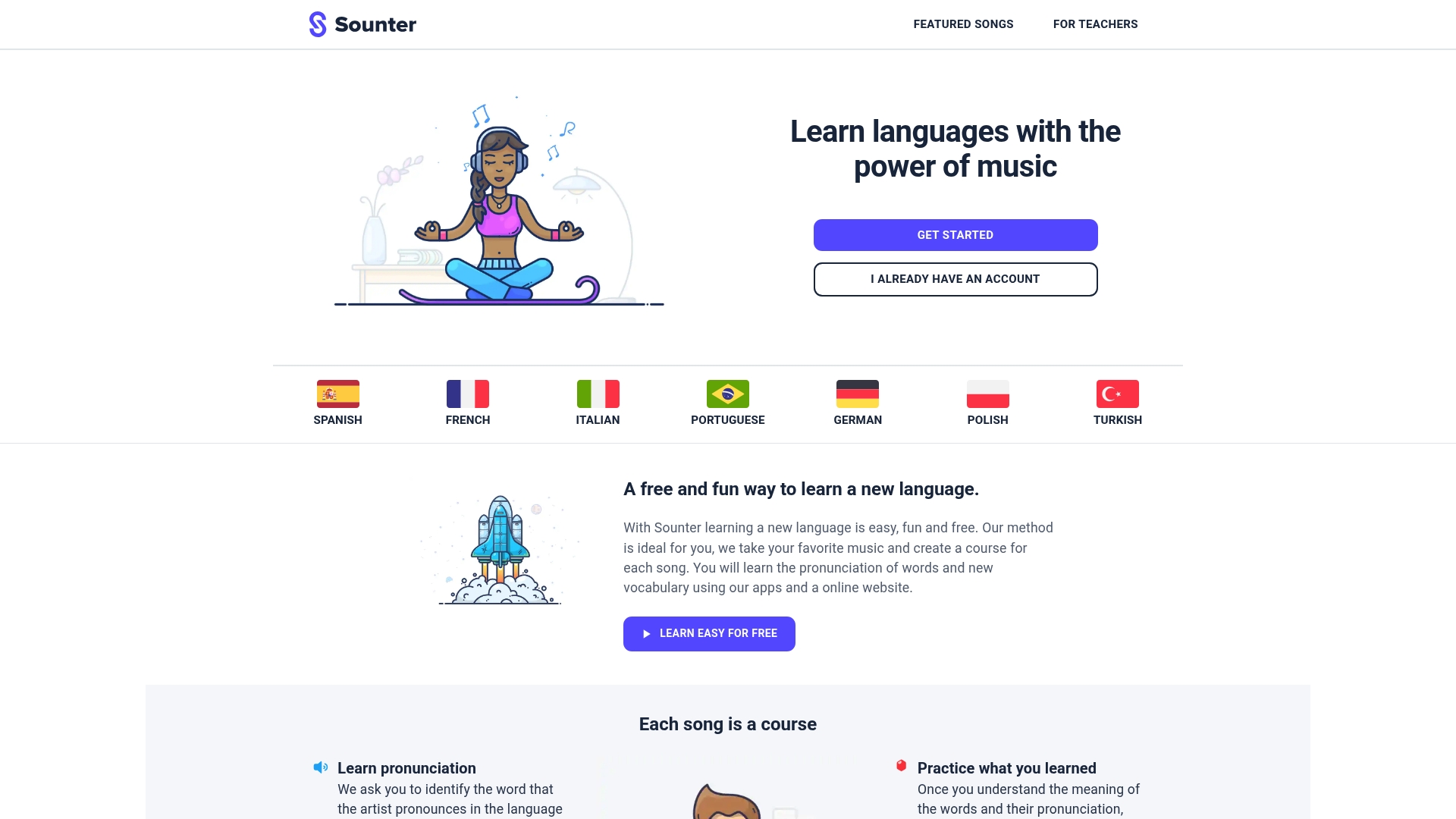
Free to use with optional premium features, Sounter pairs popular songs and community contributions into language lessons across multiple languages including French. The platform ships mobile apps and teacher tools so both classroom instructors and casual learners can use music, lyrics, and practice exercises on the go.
Core Features
- Music based courses built from song lyrics that present vocabulary and context through real tracks.
- Pronunciation exercises that compare your speaking to the recording and highlight problem syllables.
- Vocabulary building pulled directly from lyrics with translated lines for study and review.
- Practice modes using translated lyrics and short drills to reinforce phrases.
- Mobile apps on iOS and Android plus teacher tools and community pages for creators and contributors.
Key Differentiator
Sounter centers on popular music and member created lessons rather than instructor curated sequences. That model favors learners who want habit forming, short daily practice tied to songs and teachers who want ready made, music powered activities rather than lengthy, linear courses that map every grammar checkpoint.
Pros
- Engaging method: Music based lessons make listening and repetition feel like entertainment instead of study, which helps you practice more often.
- Free access: A no cost entry point lowers the barrier for learners and classroom pilots; optional premium features remove ads and enable offline use.
- Teacher tooling: Tools for educators let teachers import songs and craft classroom activities from lyric segments.
- Community content: Members can create and correct lessons, which increases the song library and gives niche tracks a chance to shine.
- Contributions model speeds content growth when active members submit high quality entries.
Cons
- Lack of third party reviews or external validation makes it hard to judge learning outcomes beyond anecdote.
- The platform does not publish detailed curriculum quality indicators or standardized progression metrics.
- Community generated content causes variability; some lessons feel polished while others lack clear explanation or editing.
- If a song has licensing issues contributors may avoid it, leaving gaps in popular repertoire.
When It May Not Fit
If you want a tightly structured pathway with guaranteed level gates and instructor verified outcomes, Sounter’s community first approach is the wrong fit. Also avoid it if you require peer reviewed study materials or long form grammar sequences used in exam prep.
Who It’s For
Learners who enjoy music and want daily practice without a subscription fee, teachers looking for quick music activities, and community members who like creating lyric based lessons and giving feedback on pronunciation and vocabulary.
Real World Use Case
You download the app, pick a French pop song, and run pronunciation exercises on the chorus. You save unfamiliar words to a vocabulary list, replay short lyric drills on your commute, and share a corrected line with the community for feedback. The habit sticks because practice feels like listening.
Website: https://sounter.com
Lyrigo
At a Glance
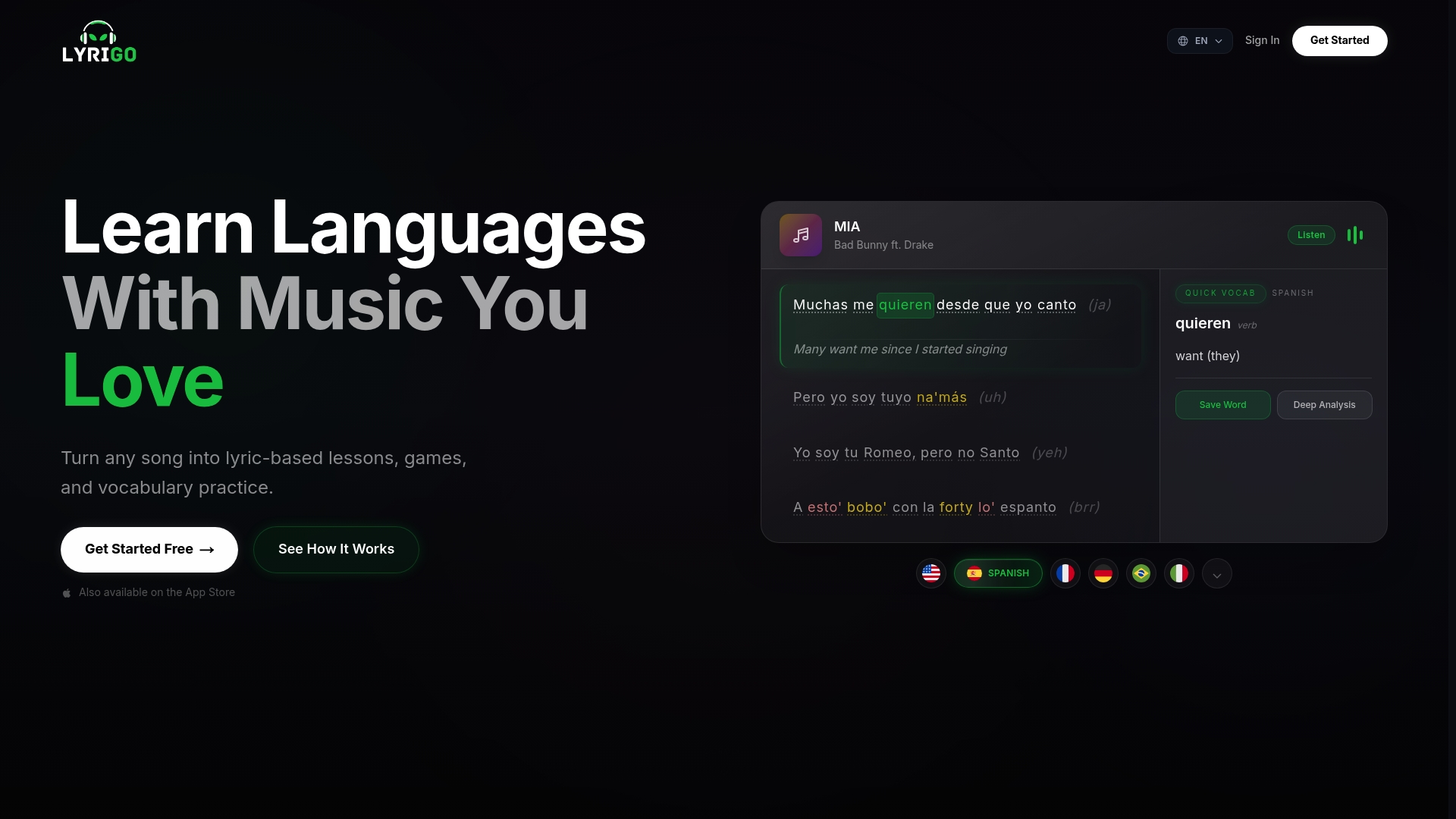
According to third-party reviews, Lyrigo faces widespread reports of scam-like behavior, with many users alleging promised tutoring never materialized and refunds were hard to obtain. The app still advertises lyric-based lessons, vocabulary analysis, and interactive games for multiple languages.
Core Features
Lyrigo centers learning around songs and lyrics to teach vocabulary and cultural context.
- Lyric-based lessons that break down phrases and pronunciation.
- Auto-generated flashcards and spaced repetition for vocabulary practice.
- Music discovery that matches songs to your target language and preferences.
- Interactive games such as crossword puzzles and word searches to reinforce learning.
- Listening exercises with dictation mode to train ear and transcription skills.
Key Differentiator
Lyrigo’s main angle is music-driven vocabulary and cultural contextual learning through lyric analysis and games. That focus makes it more lesson and content driven than platforms that emphasize live social practice or group karaoke. It fits learners who want song analysis over social features.
Pros
- Some learners report knowledgeable tutors and friendly staff, showing the platform can work well for individuals who do get proper support.
- The lyric-first approach makes grammar and idiom learning feel natural because you see words used in real songs.
- Auto-generated flashcards speed up vocabulary review without manual card creation, which saves time for busy learners.
- Games and discovery features keep sessions short and engaging, useful for daily practice routines.
Cons
- Third-party review sites describe repeated failures to deliver promised tutoring and unresolved refund requests, creating a significant trust issue.
- Customer support is often reported as unresponsive, which means problems can take weeks to address or never be resolved.
- Communication practices reported by users appear suspicious in several cases, reducing transparency around billing and service delivery.
- Service quality and reliability vary widely between users, so your experience may depend heavily on luck.
When It May Not Fit
If you need dependable paid tutoring or a clear refund policy, Lyrigo is a risky choice based on the complaint record above. Avoid it when you require verified teacher availability, reliable support channels, or corporate billing clarity.
Who It’s For
Learners motivated by music and culture who prioritize self-guided lyric study over live instruction. Lyrigo can suit learners who want quick vocabulary hits, ear training, and musical discovery, but only if they accept service inconsistency and the potential for support issues.
Real World Use Case
A Spanish learner uses Lyrigo to decode pop songs. They use lyric lessons to map idioms to translations, run dictation mode to practice listening, and drill new words with the flashcard stack. Discovery features surface new artists, turning passive listening into intentional study.
Website: https://lyrigo.com
Lingoclip
At a Glance
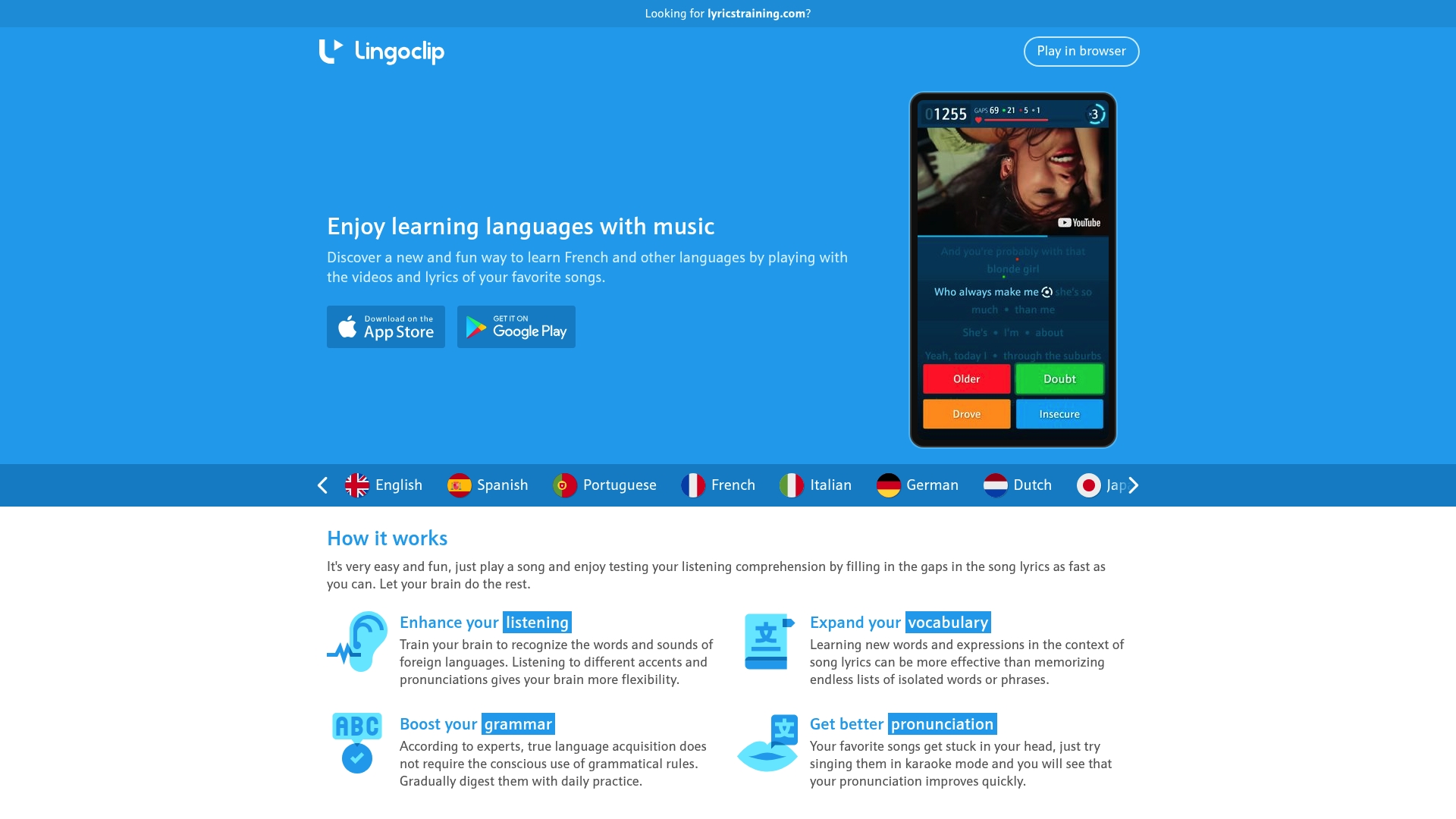
Free access to gamified karaoke practice pairs song lyrics with fill-in-the-blank and sing-along modes for over a dozen languages. The app mixes short exercises with competitive scoring so practice feels like play rather than a set of drills.
Core Features
- Learning through music and lyrics with timed clips and synced subtitles that keep you focused on actual speech rhythms.
- Multiple game modes including selecting options, filling missing words, and karaoke mode for active pronunciation practice.
- Built-in translator for words and expressions so you can check meanings without leaving the exercise.
- Competitive scoring and progress leveling to track streaks and compare results with friends.
- Wide language selection and level based practice across beginner to intermediate content.
Key Differentiator
Lingoclip trains language skills by putting popular songs at the center of every exercise. That focus on authentic audio and lyric-driven tasks sets it apart from platforms that use scripted dialogues or flashcards. Compared with Singwithcanary, Lingoclip narrows its scope to music gameplay rather than community social practice, which suits solo learners and classroom warmups.
Pros
- Engaging format keeps motivation high by turning listening practice into short, replayable challenges that feel like mini games.
- Improves listening comprehension and pronunciation through repeated exposure to natural speech patterns inside songs.
- The karaoke mode forces active output which helps with rhythm and stress patterns in a way passive listening does not.
- Fast feedback from scores and translations makes sessions efficient for busy learners who want measurable progress.
- Broad language catalog lets polyglots and multilingual classrooms pick less common targets like Catalan or Finnish alongside major European languages.
Cons
- The method favors learners who enjoy music based practice, so it will not suit learners who prefer grammar first or textbook driven study.
- Not a full course. You will need supplementary lessons for systematic grammar, writing, and higher level speaking practice.
- Song choices and lyric difficulty can vary, so advanced learners seeking tight grammatical progression may find the path uneven.
Who It’s For
Learners who want a music driven, playful way to boost listening and pronunciation will get the most value. Teachers can use short clips as classroom activities. If you dislike singing or prefer strictly graded grammar, this will feel like the wrong fit.
Real World Use Case
A French learner uses karaoke mode for ten minutes a day to target liaison and nasal vowels that text alone misses. They replay troublesome lines, check translations, and watch their accuracy score improve across sessions while enjoying the music.
Website: https://lingoclip.com/fr
La Mélodie du Français
At a Glance
The course charges €89,95 per language version, a single price for either the English or Spanish track. La Mélodie du Français pairs music and focused phonetic training under Lina dS to push pronunciation practice away from drills and into song.
Core Features
Guided lessons that combine sung phrases, spoken drills, and short video breakdowns. The material targets rhythm, intonation, and vowel quality with exercises you can repeat at your own pace.
- Video lessons and downloadable audio for repeated practice.
- Interactive exercises designed around musical phrases rather than isolated words.
- Versions delivered in English and Spanish so instructions match your native language.
- Expert guidance from Lina dS, who mixes phonetics and musical direction.
Key Differentiator
The method makes music the primary teaching tool rather than an add on. Lessons use melody and rhythmic patterns to make French prosody tangible and repeatable, which changes how learners perceive stress and vowel length compared with standard pronunciation drills.
Pros
-
The musical approach turns repetitive pronunciation work into short, memorable listening and singing tasks that you will actually repeat.
-
Fully online access means practice fits around your schedule; videos and audio download for offline use when travel interrupts Wi Fi.
-
Materials are tailored for anglophones and hispanophones, so examples and explanations are framed against likely interference from English or Spanish.
-
Instruction is led by an experienced teacher in both phonetics and music, which shows in clear breakdowns of tricky sounds.
-
The single price per language version keeps purchase decisions simple if you prefer one native language for instruction.
Cons
-
No substantial third party reviews or independent critiques are available to corroborate the course claims.
-
The course does not list formal certification or external accreditation, so it may not satisfy institutions that require documented credits.
-
The site does not specify content update cadence or a defined support SLA, leaving unclear how long resources remain current.
Who It’s For
Learners who prioritize sounding natural over strictly passing written exams. Students, frequent travelers, and professionals who want to polish accent and rhythm will benefit most. Beginners and advanced speakers both get level-appropriate musical drills.
Real World Use Case
An English speaker preparing for a client presentation uses short audio drills during commutes and sings target phrases to lock in liaison and intonation. Within weeks colleagues notice clearer pronunciation and more confident delivery.
Pricing
A single purchase of €89,95 unlocks one language version, English or Spanish. The model is straightforward: buy the track that matches your native language and practice on your schedule.
Website: https://melodieuse.fr/p/the_melody_of_french
Lingualyrical
At a Glance
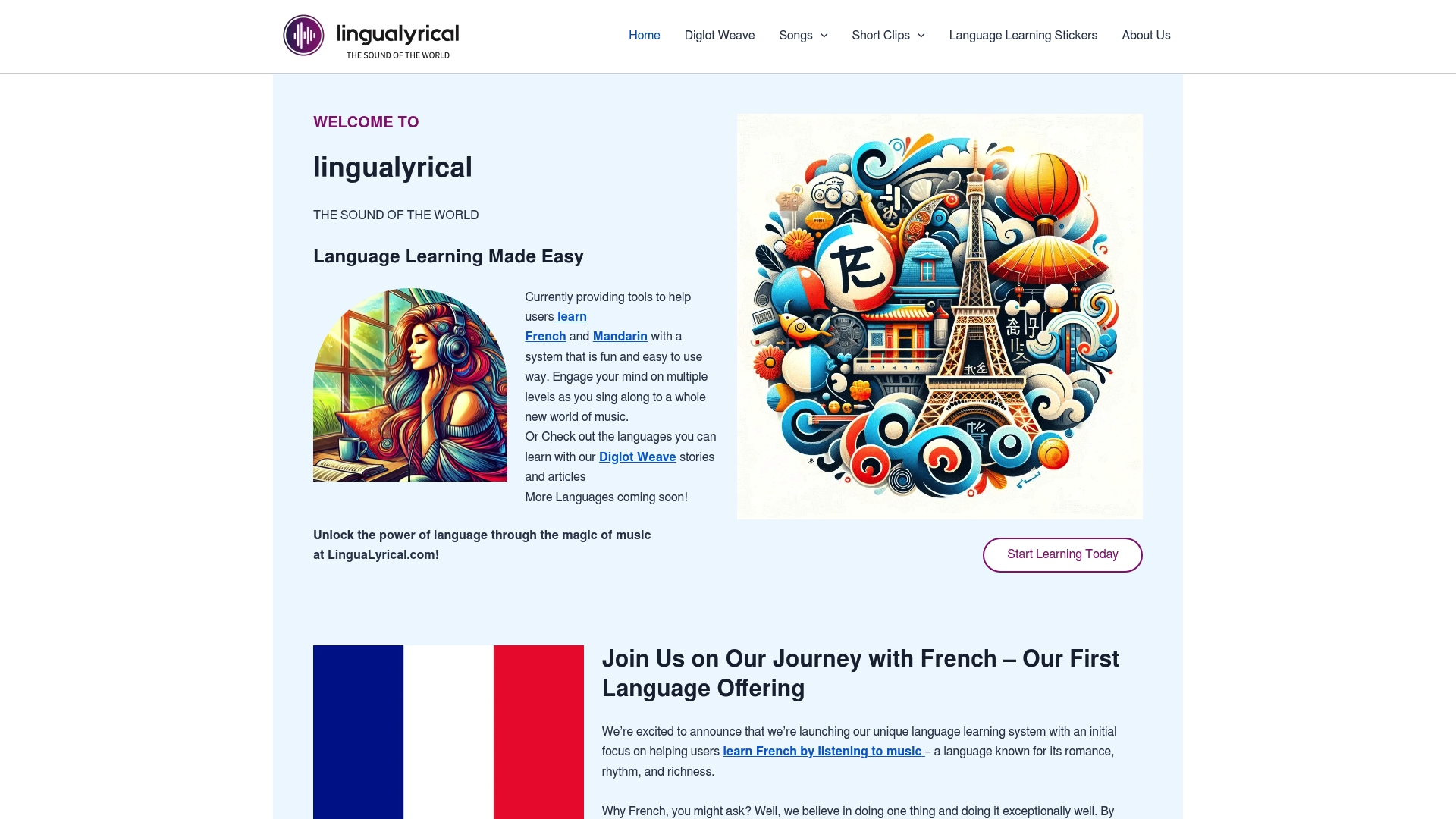
Lingualyrical pairs Diglot Weave and the Method of Loci with music to teach French and Mandarin, using songs and memory stickers to anchor vocabulary and pronunciation. Free short stories, articles, and audio backed stickers add cultural context and extra practice without a paywall.
Core Features
-
Music based listening, singing, and cultural immersion exercises that emphasize pronunciation and rhythm.
-
Diglot Weave bilingual text integration so learners see parallel language lines while listening or singing.
-
Method of Loci applied with physical stickers and audio cues to link words to locations and images for recall.
-
Free online resources including short stories, articles, and vocabulary stickers with audio support.
-
Initial focus on French and Mandarin with plans to add more languages over time.
Key Differentiator
The platform intentionally blends song based practice with two mnemonic techniques to create layered memory traces. Diglot Weave ties bilingual text to melody while the Method of Loci ties words to physical sticker cues and spatial memory.
That combination targets auditory patterning, speaking imitation, and spatial recall in one practice loop.
Pros
-
Engages several senses at once. Listening, singing, and tactile stickers work together to make words more memorable than passive repetition.
-
Grounded in memory techniques. The use of proven mnemonic approaches gives each exercise a clear cognitive aim rather than random activities.
-
Substantial free content. Short stories, articles, and audio backed stickers lower the barrier to daily practice for budget conscious learners.
-
Cultural material woven into lessons. Songs and articles help you learn phrases in context, which speeds understanding and keeps motivation high.
-
Clear focus on pronunciation and ear training through repeated singing and shadowing of native audio.
Cons
-
No third party reviews are available to validate user satisfaction or expose common pain points. That lack of external feedback makes it harder to judge long term results.
-
Language selection is narrow at launch. If you want Spanish, German, or other languages today, Lingualyrical will feel limited until expansion arrives.
-
Public details about paid features or long term subscriptions are sparse. Some core materials are free but the overall pricing picture is not documented clearly.
When It May Not Fit
If you need broad language coverage immediately, this product will frustrate you because it concentrates on French and Mandarin for now. If your study style relies on grammar first or exam drills, the music and mnemonic emphasis may feel like the wrong fit.
Who It’s For
Learners who enjoy music and playful, sensory practice and want to build pronunciation and vocabulary retention. Teachers who want culturally rich classroom activities will find the stickers and songs useful for beginner and intermediate levels.
Real World Use Case
A learner listens to a French track every morning, reads the Diglot Weave lyrics side by side, and places stickers around the apartment to tag new vocabulary. After several weeks, pronunciation improves and recalled words surface naturally during conversations.
Website: https://lingualyrical.com
Comparative Analysis
In exploring music-based tools for French language learning, this analysis highlights the unique strengths and limitations of each reviewed platform.
Pronunciation Enhancement through Singing Practices
While singwithcanary.com efficiently connects learners through social singing practice, both Lingoclip and La Mélodie du Français cater specifically to developing pronunciation through rhythmic repetition and phonetic focus. Lingualyrical makes use of mnemonic techniques like the Method of Loci, adding sensory depth to vocabulary retention. Singwithcanary.com’s advantage arises from its integration of user-generated feedback within its karaoke-mode exercises, elevating real-world conversational parity. However, its feature set requires full site stability to completely assess its capabilities.
Structured Versus Flexible Learning Pathways
Platforms demonstrate varied approaches to curriculum structuring: Lingualyrical and Sounter offer contributory content, favoring adaptable studies with community-generated material. Conversely, products like La Mélodie du Français and Lingoclip adhere more closely to predetermined lessons, serving users who thrive under a guided methodology. Users prioritizing structured immersion might resonate more with La Mélodie du Français’s concise phonetics drills crafted under expert supervision.
Best Fit Scenarios
- For learners prioritizing peer engagement and active song-based practices, singwithcanary.com offers structured karaoke exercises supplemented by feedback loops.
- Educators seeking scalable tools for multi-language environments will appreciate Lingualyrical, for its free resources alongside proven mnemonic methodologies.
- Individuals desiring phonetic refinement via culturally contextual songs are well-served by La Mélodie du Français, due to its expert-led lessons focusing on rhythm, intonation, and stress.
Our Pick
Among these platforms, singwithcanary.com distinguishes itself through combining karaoke-based learning with real-time peer interaction, providing both immediate feedback and social encouragement. However, for learners needing solely autonomous or guided methods due to preference or learning constraints, platforms like La Mélodie du Français may align more closely to their goals.
Music-Based French Learning Tools Compared
Choosing the right music-oriented language learning tool depends on features like interactive exercises, social components, and pricing transparency. See the comparison below to find the best fit for your needs.
| Product | Core Feature | Key Differentiator | Best For | Notable Limitation |
|---|---|---|---|---|
| Canary | Karaoke mode for learning pronunciation | Combines music exercises with peer feedback | Music enthusiasts seeking active language practice | Limited information due to website errors |
| Sounter | Music-based courses with integrated pronunciation tools | Community contributions enrich the song library | Learners preferring free access and casual study | Variable quality due to member-submitted content |
| Lyrigo | Lyric-focused lessons with auto-generated flashcards | Contextual cultural exposure through song analysis | Self-guided learners prioritizing vocabulary | Reports of unfulfilled services and lack of support |
| Lingoclip | Gamified karaoke and fill-in-the-blank exercises | Competitive scoring with a broad language catalog | Casual learners wanting a fun, diverse experience | Limited systematic grammar or progressive structure |
| La Mélodie du Français | Musical support for pronunciation improvement | Guided lessons tailored to specific native languages | Learners aiming to refine accent and intonation | No independent reviews or formal credentials |
| Lingualyrical | Music-based learning with mnemonic techniques | Combines songs with spatial and auditory memory aids | Interactive learners who enjoy exploratory practice | Narrow language selection initially available |
Experience Music-Based French Learning with Singwithcanary
Many music-based French learning tools struggle with incomplete feature access or lack social interaction that helps build speaking confidence. If you want a fresh approach combining lively karaoke practice, interactive quizzes, and community feedback, Singwithcanary stands apart. It tackles challenges like improving pronunciation and vocabulary retention through active singing and peer support rather than passive listening alone.
Why choose Singwithcanary?
- Karaoke mode for real-time pronunciation practice
- Vocabulary cards and quizzes tied directly to song lyrics
- A global learner community offering spoken feedback
Discover Singwithcanary and turn your daily commute or coffee break into a focused study session where music meets conversation. Don’t wait to practice more effectively; try singing, recording, and sharing your progress with others today!
Frequently Asked Questions
What makes Singwithcanary effective for pronunciation practice?
Singwithcanary utilizes a karaoke mode that allows users to actively practice pronunciation by singing along with real song lyrics. This feature targets stress, rhythm, and vowel pronunciation directly, turning passive listening into effective speaking practice. To effectively enhance your French pronunciation, consider trying this interactive approach.
How does Sounter differ from Singwithcanary in terms of community features?
Sounter allows users to create and correct lessons, fostering a sense of community while providing music-based language exercises. While this contributes to content variety, Singwithcanary focuses more on structured song-based exercises paired with social practice. This tailoring makes Singwithcanary ideal for learners looking for a guided practice environment over community-generated content.
Can I learn vocabulary with Lingoclip and how does it compare to Singwithcanary?
Lingoclip offers timed clips and karaoke modes for vocabulary learning, focusing on a more gamified experience. In contrast, Singwithcanary combines song-based exercises with peer collaboration to reinforce vocabulary retention. Depending on your preferred learning style, you might choose Singwithcanary for a more structured and social approach.
Why might someone choose La Mélodie du Français over Singwithcanary?
La Mélodie du Français emphasizes phonetics training through guided lessons that incorporate video and audio exercises. For learners seeking less structured, music-focused training without the interactive social elements of Singwithcanary, this option provides a more immersive experience dedicated solely to pronunciation practice.
What unique feature does Lyrigo offer that may appeal to learners?
Lyrigo provides a lyric-based learning experience that includes auto-generated flashcards and interactive games, which can make vocabulary acquisition feel more engaging. However, if you’re looking for social practice alongside music-based learning, Singwithcanary serves that purpose more effectively with its community interactions.