Learning a new language gets frustrating fast when progress stalls and practice feels like a chore. Music changes that equation completely. Songs give you real language in context, packed with rhythm, emotion, and repetition that your brain actually wants to hold onto. Whether you’re working on vocabulary, pronunciation, or just trying to stay motivated, music-based activities offer a path that feels less like studying and more like living inside the language. This article walks you through five practical, research-backed activities designed for music lovers who want real results.
Table of Contents
- How to choose music for language learning activities
- Gap-fill lyric activities
- Speaking and singing for fluency boost
- Mondegreen games for smarter listening
- Memory, vocabulary, and the edge cases
- Take your music learning further with Canary
- Frequently asked questions
Key Takeaways
| Point | Details |
|---|---|
| Music makes learning fun | Interactive activities with songs boost motivation and help you remember new words easily. |
| Gap-fills sharpen listening | Filling in missing lyrics trains your ear for details and builds vocabulary fast. |
| Singing grows fluency | Regular singing or speaking along with songs improves pronunciation and confidence. |
| Mondegreen games challenge comprehension | Spotting misheard lyrics turns real-world listening struggles into playful practice. |
| Music isn’t one-size-fits-all | Some learners may benefit more from speech-based techniques, especially at very early stages. |
How to choose music for language learning activities
Picking the right song is the foundation of every effective music-based session. A track that’s too fast, too slang-heavy, or too abstract will frustrate you before you even start. The goal is to find music that challenges you just enough without shutting you down.
Here’s a simple framework for choosing well:
- Prioritize clarity. Ballads and mid-tempo pop songs tend to have cleaner pronunciation and slower delivery. Avoid heavy accents or rapid-fire rap until you’re at an intermediate level.
- Check lyric appropriateness. Make sure the vocabulary and themes match your current level and learning goals. A song about everyday life teaches more practical language than abstract poetry.
- Look for repetition. Choruses repeat. That repetition is your friend. It gives you multiple chances to hear, process, and absorb the same words and phrases.
- Match the song to your goal. Targeting pronunciation? Choose a singer known for clear diction. Building vocabulary? Pick songs with rich, descriptive lyrics.
Structuring your session matters just as much as the song itself. Level-appropriate songs with pre-taught vocab and a pre/during/post-listening structure consistently produce better outcomes than just pressing play and hoping for the best. Pre-listening builds context, active listening sharpens focus, and post-listening locks in what you learned.
For more ideas on pairing music with your personal learning style, check out these language learning tips for music lovers that go deeper into building a sustainable routine.
Pro Tip: Use lyric videos on YouTube instead of audio-only tracks. Seeing the words as you hear them dramatically reduces confusion and helps you connect spelling to sound from day one.
Gap-fill lyric activities
Gap-fill exercises are exactly what they sound like: you listen to a song while reading the lyrics, but certain words are blanked out. Your job is to fill them in as you hear them. Simple concept, powerful results.
Here’s how to run a gap-fill session effectively:
- Select your song and prepare the lyrics. Remove 15 to 20 words from the text, focusing on content words like nouns, verbs, and adjectives rather than articles or prepositions.
- Listen once without filling anything in. Get a feel for the melody, tempo, and general meaning before you try to catch specific words.
- Listen again and fill in the gaps. Pause if you need to. Don’t guess randomly. Use context clues from the surrounding lyrics.
- Check your answers and study the misses. Every word you got wrong is a vocabulary or listening gap worth exploring.
Gap-fill activities directly practice listening comprehension and vocabulary in a way that feels active rather than passive. You’re not just hearing the language. You’re hunting for it.
For beginners, start with the chorus. It repeats, which means you get multiple attempts at the same gaps. That repetition builds confidence fast.
Pro Tip: After completing the gap-fill, try singing the full song from memory. The act of retrieving those words in rhythm reinforces them far more than re-reading ever could.
The educational benefits of music extend well beyond vocabulary. Gap-fills also train your ear to distinguish similar sounds, a skill that pays off in real conversations.
Speaking and singing for fluency boost
Written exercises build a foundation, but speaking is where fluency actually lives. Singing along to songs forces your mouth, breath, and brain to work together in real time, which is exactly what happens in natural conversation.

A 15-week English songs intervention showed significant improvements in EFL learners’ speaking performance across lexical density, accuracy (p<.05), and fluency (p<.001). Those aren’t small gains. That’s measurable, statistically significant progress from singing.
Here’s what the data looked like across key speaking metrics:
| Metric | Before intervention | After intervention |
|---|---|---|
| Lexical density | Low | Significantly higher |
| Accuracy | Baseline | Improved (p<.05) |
| Fluency | Baseline | Improved (p<.001) |
To get started with speaking and singing practice:
- Choose slow to mid-tempo songs with clear pronunciation
- Repeat individual verses until they feel natural in your mouth
- Record yourself singing or speaking along, then listen back critically
- Shadow the artist: mimic their rhythm, stress, and intonation exactly
- Gradually increase tempo as your comfort grows
“Music reduces the affective filter, boosting motivation and confidence through emotional engagement, making it ideal for language enthusiasts.”
The affective filter is a concept from language acquisition theory. When anxiety is high, learning slows. Music lowers that anxiety, which means your brain stays open and receptive. Explore the benefits of learning languages with songs and real music for language success stories to see how other learners have applied this.
Mondegreen games for smarter listening
A mondegreen is a misheard lyric. The word comes from a 1954 essay where the author misheard a Scottish ballad line as “Lady Mondegreen” instead of the actual words. We’ve all done it. Turning that experience into a structured game is one of the most underrated listening activities available.
Here’s how to run a mondegreen game:
- Listen to a song without reading the lyrics
- Write down exactly what you think you hear, word for word
- Compare your version to the actual lyrics
- Identify every gap between what you heard and what was said
That gap is where your listening skill grows. Mondegreen activities train detailed listening comprehension by forcing you to confront the difference between what you expect to hear and what’s actually there.
Skills you build through mondegreen games:
- Attention to phonetic detail
- Real-world listening comprehension under natural speech conditions
- Awareness of connected speech, where words blur together
- Vocabulary expansion through discovering the correct words
How does this compare to gap-fill activities? Here’s a quick breakdown:
| Feature | Gap-fill | Mondegreen game |
|---|---|---|
| Structure | High | Low |
| Fun factor | Medium | High |
| Listening challenge | Moderate | Advanced |
| Focus | Vocabulary | Phonetic accuracy |
| Best for | Beginners to intermediate | Intermediate to advanced |
For building this into a consistent habit, the music language learning habits guide offers a practical weekly structure you can follow.
Memory, vocabulary, and the edge cases
Singing doesn’t just feel good. It changes how your brain stores language. When you attach words to melody, rhythm, and emotion, you create multiple memory pathways to the same information. That redundancy is what makes recall faster and more reliable.
Singing facilitates foreign language learning and improves vocabulary retention, according to multiple studies reviewed in the research literature. Here’s why that matters in practice:
- Retention improves because melody acts as a retrieval cue. You remember the word because you remember the tune.
- Recall becomes faster under pressure, like in real conversations, because the emotional memory tied to the song activates quickly.
- Error reduction increases over time as repeated singing reinforces correct pronunciation and word order.
- Motivation stays higher because the activity itself is enjoyable, which means you practice more often.
That said, music isn’t a universal solution. Research on young children found that songs aren’t always superior to speech for word learning, particularly when the prosody (the natural rise and fall of spoken language) in the song distorts how words normally sound.
“For preschoolers, spoken language may match or outperform song for certain vocabulary types, depending on how the melody affects natural word stress.”
For adult learners and music enthusiasts, the evidence strongly favors music-based methods. But if you’re helping a young child learn, balance singing with clear, natural speech. The two approaches work best together. Dive deeper into how music boosts vocabulary retention to understand the cognitive mechanics behind these gains.
Take your music learning further with Canary
Everything covered in this article, gap-fills, singing for fluency, mondegreen games, and vocabulary building through song, comes together in one place on Canary. The platform is built specifically for music lovers who want to learn languages the way they actually enjoy spending time.
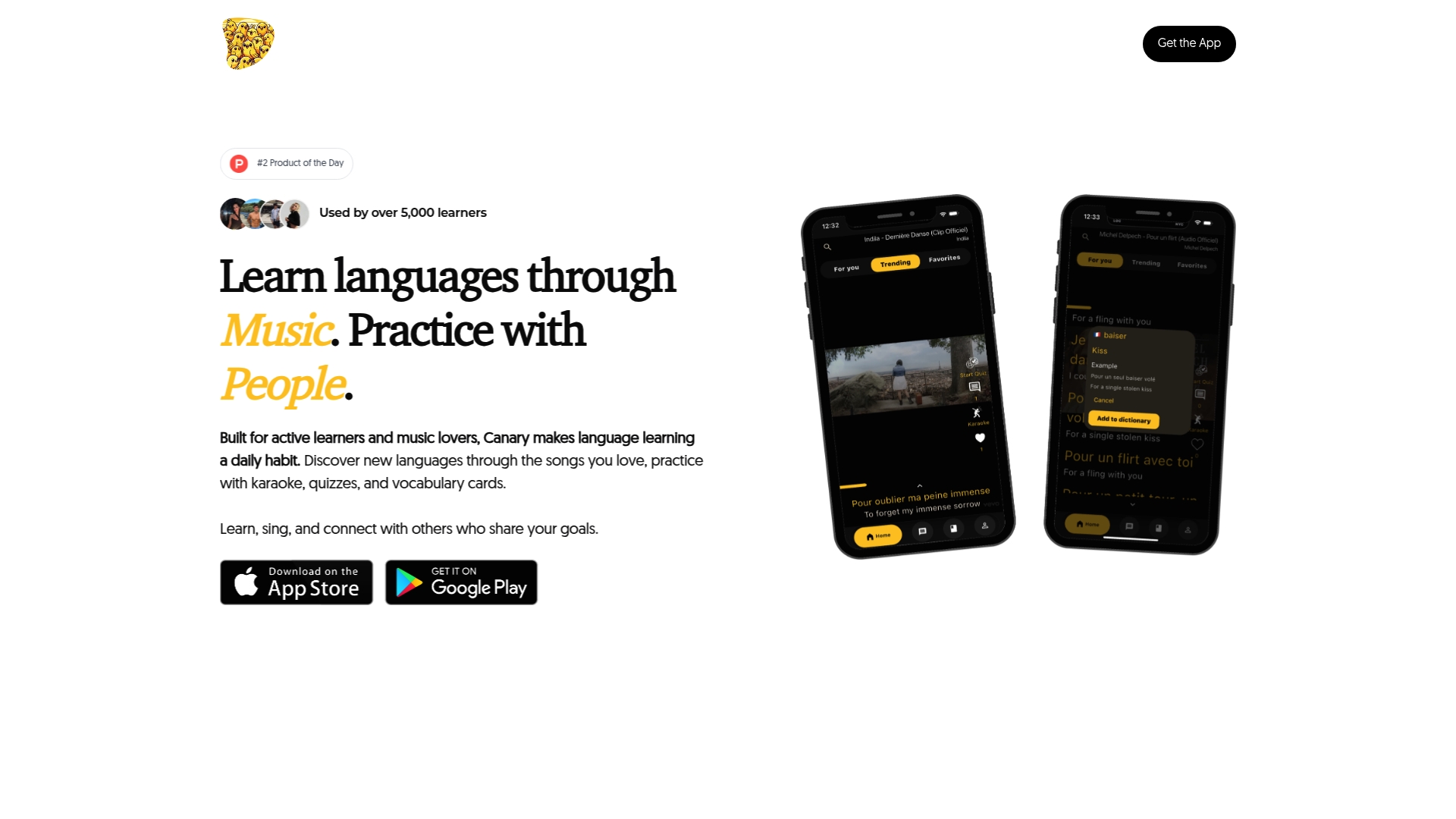
With Canary, you get karaoke-style lyric practice, vocabulary cards pulled directly from song lyrics, and quizzes that test what you’ve absorbed. You also get access to a global community of learners who practice together, which means the social confidence-building happens naturally alongside the language work. If you’ve been looking for a way to make daily practice feel less like a task and more like something you look forward to, Canary is worth exploring today.
Frequently asked questions
What is a gap-fill lyric activity?
It’s a listening exercise where you fill in missing words from song lyrics as you hear them, directly practicing vocabulary and comprehension in context. It works for all levels and can be adjusted by changing how many words you remove.
How does singing help with pronunciation?
Singing models native-like rhythm and sound patterns, training your mouth and ear to replicate natural speech. Singing facilitates language learning by reinforcing correct stress, intonation, and enunciation through repetition.
Are music-based activities suitable for beginners?
Absolutely. The key is choosing clear, level-appropriate songs and pre-teaching key vocabulary before listening. Pop ballads with simple lyrics are an ideal starting point for new learners.
Is music always more effective than speech for learning words?
Not always. For young children, spoken language may match or outperform song for certain vocabulary types, depending on how melody affects natural word stress. Adult learners generally benefit more consistently from music-based methods.
What are the social benefits of music-based language activities?
Group singing and song games reduce the affective filter, which lowers anxiety and raises motivation. Practicing with others builds real confidence that transfers directly to everyday conversations.