TL;DR:
- Music-based language games enhance vocabulary, pronunciation, and fluency through active, social, and emotionally engaging tasks. They are effective because they reduce anxiety, motivate participation, and require cognitive effort in meaningful contexts. Choosing the right game depends on your skill level, goals, and preferred social or solo practice, with consistency being key.
You love music, you want to learn a new language, and every conventional app feels like homework dressed up with a progress bar. That tension is real, and it has a solution. Examples of music-based language games exist across a spectrum, from lyric detective sessions to full tournament brackets built around song competitions, and research backs their effectiveness. These are not novelty distractions. They target vocabulary retention, pronunciation, listening accuracy, and social fluency in ways that rote study simply cannot replicate. This article breaks down the best options by type, time commitment, and skill focus so you can pick what fits your life.
Table of Contents
- Criteria for selecting effective examples of music-based language games
- Musical Cliffhanger: transforming songs into engaging ESL narratives
- Locura de Marzo: a competitive music tournament for language practice
- Lyric gap-fill and shadowing games for rapid vocabulary and pronunciation gains
- Comparison table: key features of top music-based language games
- How to choose the right music-based language game for you
- Why music-based language games are a game-changer for adult learners
- Discover more ways to learn languages with music
- Frequently asked questions
Key Takeaways
| Point | Details |
|---|---|
| Music boosts vocabulary | Structured music-based games improve vocabulary retention by engaging learners in active song-related tasks. |
| Reduces anxiety | Collaborative singing and rhythmic games lower learner anxiety, increasing participation and confidence. |
| Enhances pronunciation | Shadowing and chanting games develop prosody and pronunciation through repeated practice. |
| Social interaction matters | Music games that incorporate social competition or collaboration maximize motivation and fluency. |
| Game choice matters | Selecting the right music-based game depends on your goals, available time, and preferred learning style. |
Criteria for selecting effective examples of music-based language games
Not every activity that plays a song qualifies as a genuine musical language activity. Before you invest your time, it helps to know what separates the games that produce measurable gains from those that feel fun but fade fast.
The strongest music-based learning games share a few defining traits:
- Active retrieval over passive listening. The game must force you to recall, produce, or manipulate language, not just absorb it. Structured repetition with dopaminergic reward from music improves vocabulary retention by 20 to 30%, but only when paired with active recall tasks.
- Anxiety reduction built into the format. When learners feel judged, they clam up. Games that use humor, rhythm, or team structures lower that barrier dramatically. You can read more about the benefits of song-based language learning and why the emotional container matters as much as the content.
- Social interaction as a core mechanic, not an add-on. Games requiring group decisions, peer debate, or collective performance push fluency in ways solo study cannot.
- Flexible time investment. The best educational music games scale from a 10-minute micro-session to a 60-minute deep dive, depending on the activity.
- Cognitive challenge beyond simple recognition. Guessing, grammar analysis, storytelling, or rhythm-based elimination all keep the brain working at a level that drives retention.
Think of these criteria as your filter. Any game that checks most of these boxes is worth trying. One that checks all of them is worth building a habit around.
Having established what makes a music language game effective, let’s explore specific examples that embody these criteria.
Musical Cliffhanger: transforming songs into engaging ESL narratives
This is one of the most creative examples of language play you will find anywhere. Musical Cliffhanger turns a song into a detective story with a grammatical twist. Learners listen to a track, analyze the lyrics for linguistic clues and visual metaphors in an accompanying video, then debate what the story might mean or where it ends. The grammar is not a worksheet. It becomes the reasoning tool.
Here is how a typical Musical Cliffhanger session runs:
- Choose a song with narrative ambiguity. Tracks with unresolved story arcs or abstract imagery work best. Think breakup songs with no clear resolution, or road-trip anthems that never specify the destination.
- Identify the linguistic clues. Learners scan lyrics for past modals (“could have been,” “might have said”), metaphors, and implied time sequences. Musical Cliffhangers turn passive listening into active grammatical deduction using exactly these structures in 60-minute sessions.
- Form small debate groups. Each group defends a different story interpretation using specific lines from the lyrics as evidence.
- Present and vote. Groups share their readings. The class votes on the most linguistically supported interpretation, not just the most dramatic one.
- Debrief on grammar patterns. The facilitator highlights recurring structures and how they shaped meaning, making the grammar lesson feel like a revelation rather than an instruction.
This works beautifully for adult learners because you are never asked to memorize a rule in isolation. You use the rule to win an argument. Explore more song-based language activities that apply this same reasoning-first philosophy.
Pro Tip: Pick songs from genres you already love. If you are into indie folk, a Phoebe Bridgers track will get you more invested in the debate than a textbook example ever could. Emotional connection to the content sharpens your attention and extends the session naturally.
Locura de Marzo: a competitive music tournament for language practice
March Madness, but for songs. Locura de Marzo is a bracket-style music competition where learners vote on head-to-head song matchups, argue their case in the target language, and work through tournament rounds until one track wins. It started as a Spanish classroom tradition, but the mechanics translate to any language.
What makes it effective as an interactive music game:
- Listening with a purpose. You are not just hearing the song. You are evaluating it for specific qualities and forming an opinion you need to express.
- Vocabulary in context. Describing why you prefer one track over another pulls in adjectives, comparisons, causal connectives, and music-specific vocabulary organically.
- Physical engagement through rhythm elimination. A companion game involves passing a ball or object to a beat. Whoever holds it when the music stops is eliminated. This adds physical stakes that sharpen attention and make the vocabulary practice feel like play, not study.
- Social bonding through competition. Locura de Marzo tournaments increase social bonding and triple repeat play by combining music competitions and beat-based elimination games.
“The game forces you to articulate preferences fast, under mild social pressure, in the target language. That is the closest classroom equivalent to a real conversation at a party.”
If you want to extend this to a self-study or small group context, treat each round as a discussion prompt. Pair it with Spanish speaking activities for ready-made conversational frameworks that complement the tournament format. You can also use this approach for engaging social music practice with international partners online.
Lyric gap-fill and shadowing games for rapid vocabulary and pronunciation gains
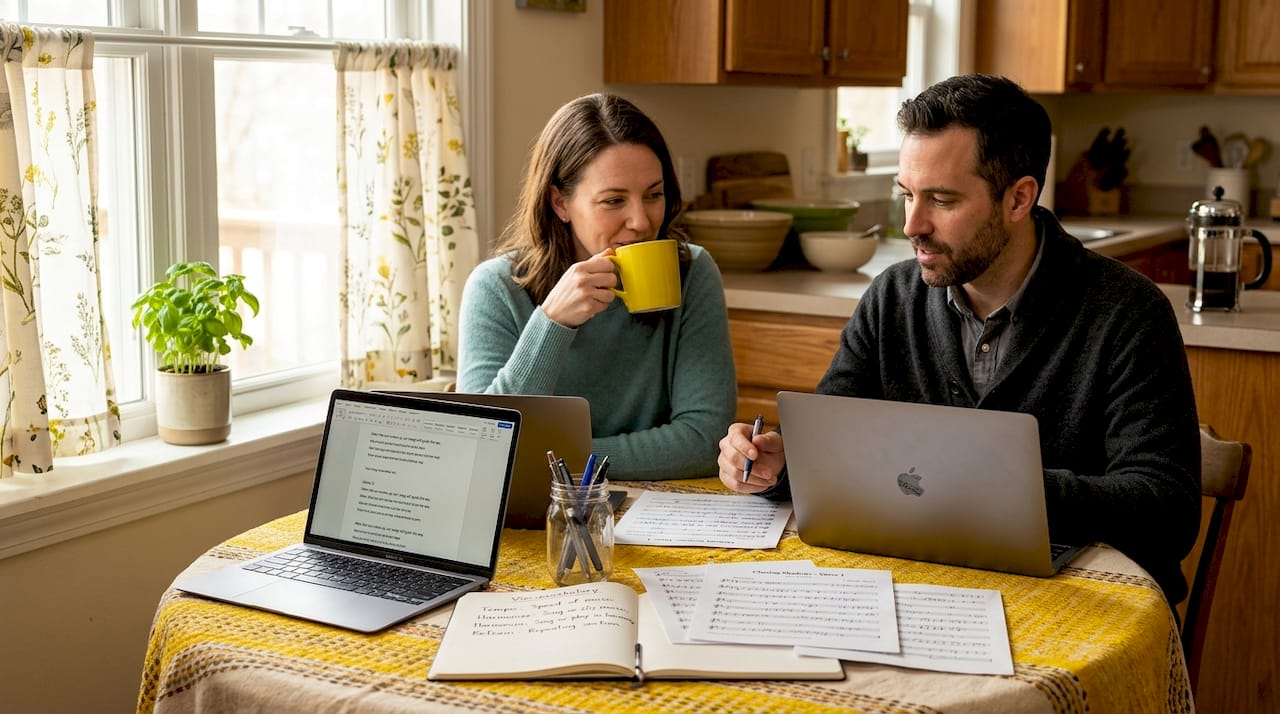
These are the workhorses of music-based learning games. Less theatrical than a tournament, but relentlessly effective when practiced consistently. The core idea is simple: remove words from lyrics, fill them back in by listening, then speak them out loud to match the singer’s rhythm and accent.
Here is what the research and practice show:
- Gap-fill tasks demand active recall. You cannot passively coast through a line when a word is missing. Your brain has to process meaning, predict the word, and confirm it. Song-based micro-sequences like lyric gap-fills and chanting improve vocabulary retention by 20 to 30% in sessions lasting just 10 to 15 minutes daily.
- Shadowing trains your mouth, not just your ear. You mirror the singer’s pronunciation, rhythm, and stress patterns in real time. This builds pronunciation accuracy far faster than phonetic drills alone.
- Chanting locks in prosody. Prosody is the melody of speech, the rise and fall of pitch, the timing of syllables. Chanting a chorus repeatedly trains this at a muscular level. Your mouth learns where the stress lands before your brain has consciously memorized the rule.
- Daily micro-sequences beat weekend marathons. Ten minutes every morning with the same song over a week produces deeper vocabulary retention than a single hour-long cram session.
Pro Tip: After completing a gap-fill, read the lyrics aloud once without the music, then again with it. The difference in your fluency between those two readings is your progress made audible in real time.
Comparison table: key features of top music-based language games
To help you decide, here is a comparison of these games across essential features.
| Game | Skills targeted | Time per session | Social interaction | Cognitive demand | Best for |
|---|---|---|---|---|---|
| Musical Cliffhanger | Grammar, reading, speaking | 45 to 60 minutes | High (group debate) | High | Intermediate to advanced |
| Locura de Marzo | Listening, speaking, vocabulary | 30 to 45 minutes | Very high (competition) | Medium | All levels with prep |
| Lyric gap-fill | Vocabulary, listening | 10 to 15 minutes | Low to medium | Medium | Beginners and up |
| Shadowing | Pronunciation, prosody | 10 to 20 minutes | Solo or paired | Medium | All levels |
| Chanting | Prosody, rhythm, vocabulary | 5 to 15 minutes | Solo or group | Low to medium | Beginners |
How to choose the right music-based language game for you
With this comparison in hand, you can match a game to your current goals, schedule, and personality. Here is a practical decision process:
- Name your priority skill. Pronunciation? Start with shadowing and chanting. Vocabulary? Gap-fill daily. Grammar? Musical Cliffhanger. Social fluency? Locura de Marzo.
- Be honest about your schedule. If you have 15 minutes in the morning, gap-fill and shadowing fit naturally. If you meet a study group weekly, Musical Cliffhanger or a tournament bracket gives that session structure and energy.
- Match the genre to your taste. This sounds obvious, but it is routinely ignored. Pop songs’ repetition and emotion lower affective barriers, making music ideal for adult learners seeking social fluency, but the genre has to be one you would listen to anyway. A K-pop fan doing gap-fills with K-pop learns faster than the same learner grinding through classical texts.
- Decide on solo versus social. If you learn best alone, lean on shadowing and gap-fill. If you thrive in groups, social interaction through Locura de Marzo or Musical Cliffhanger will keep you coming back.
- Start smaller than you think you need to. If music-based learning is new to you, one 10-minute gap-fill session a day for two weeks will show you what works before you commit to longer formats. Check out language learning methods for music lovers for a broader look at how to build a sustainable practice.
Pro Tip: Run a two-week trial with a single game before mixing formats. Consistency with one method reveals your actual progress. Switching too early often feels like variety but functions as avoidance.
Why music-based language games are a game-changer for adult learners
Here is what most language learning content gets wrong: it treats motivation as a personality trait you either have or you do not. “Just stay consistent.” “Find your why.” That advice ignores the structural reasons adult learners quit. The methods are boring, solitary, and emotionally flat.
Music-based games fix this at the structural level. They do not ask you to feel more motivated. They create conditions where motivation is the natural output. Music lowers the affective filter by reducing anxiety and encouraging collaborative singing, which enables higher participation in adult learners. That is not a soft benefit. That is the difference between a learner who speaks up and one who stays silent for three years waiting to feel “ready.”
There is also a mistake we see repeatedly: choosing songs based on what sounds educational rather than what the learner actually enjoys. A textbook publisher’s playlist of “clear pronunciation” tracks produces worse outcomes than a song the learner already sings in the shower, because emotional engagement determines how deeply the brain encodes language. The benefits of song-based language learning compound when the music means something to you personally.
Regional accent in song choice matters more than most people realize. A learner targeting Brazilian Portuguese who only studies European Portuguese pop will absorb phonological patterns that create confusion in real conversations. Match the accent of your songs to the community you want to speak with.
The other underrated factor is game structure. Unstructured “listen to music in French” advice produces minimal results. The games described in this article work because they impose cognitive tasks that force language production, not just reception. Enjoyment sustains the habit. The structure produces the gains.
Discover more ways to learn languages with music
If these music-based games inspire you, Canary offers tailored solutions to continue your learning journey with music-rich activities designed specifically for adult learners like you.
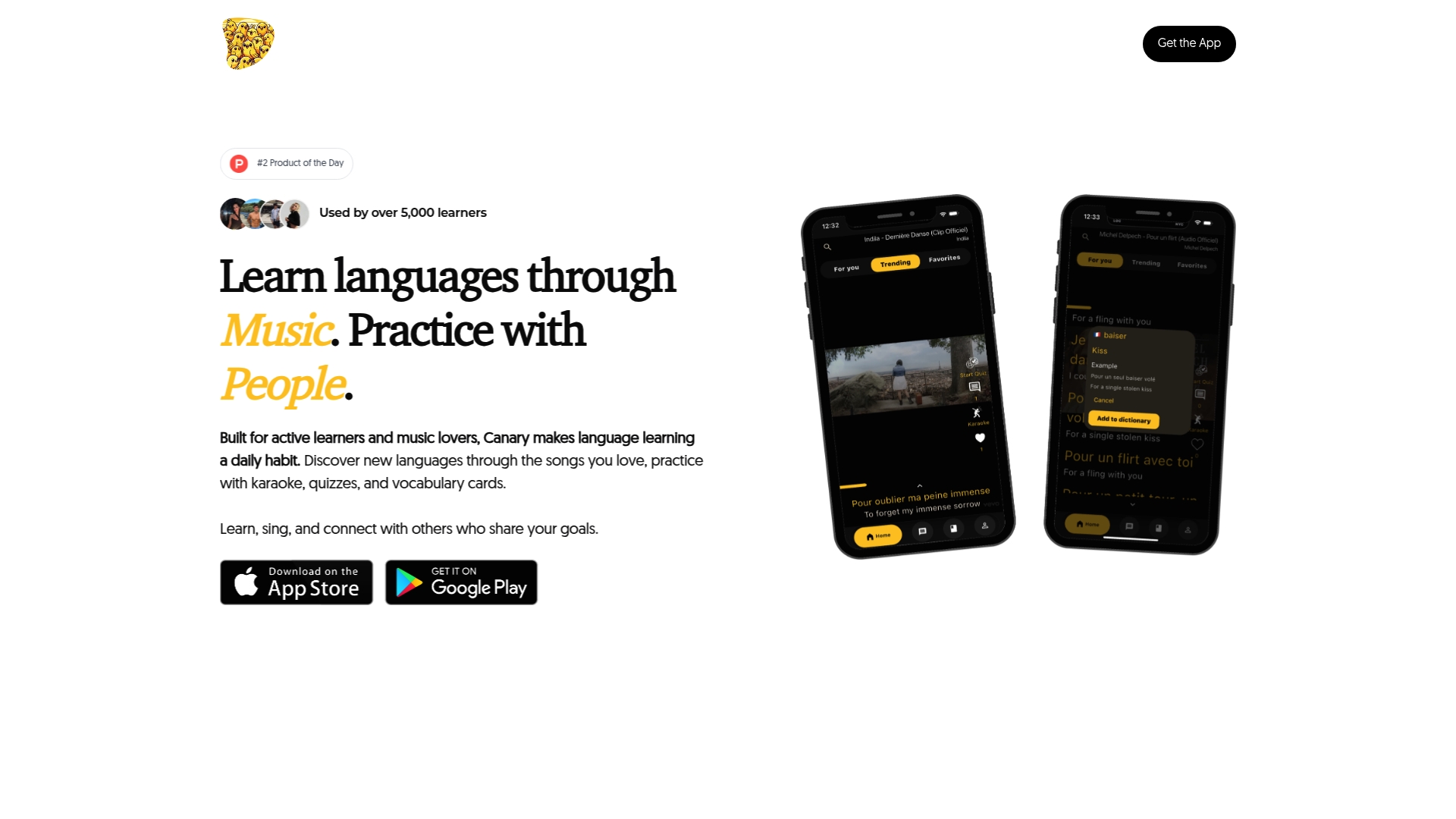
At Canary, you can learn languages with music through curated song-of-the-week lessons, karaoke-style pronunciation practice, vocabulary cards built directly from lyrics, and a global community of music lovers who practice together. Every feature is built around the insight that language sticks when it sounds like something you already love. Whether you want a quick daily gap-fill session or a full interactive language practice experience with international speakers, Canary gives you the tools and the community to make it a daily habit worth keeping.
Frequently asked questions
What are music-based language games?
They are interactive activities that use songs and musical elements like lyrics, rhythm, and melody to teach language skills such as vocabulary, pronunciation, and listening in an engaging way.
How do music-based games improve language learning?
Music aids memory and motivation by combining repetition with emotional engagement, reducing anxiety and boosting participation. Pop songs’ repetition and emotion lower affective barriers, which leads to measurably better vocabulary retention and speaking confidence in adult learners.
Can music-based games help reduce language learning anxiety?
Yes. Collaborative singing and rhythmic activities lower the affective filter, making learners more relaxed and willing to participate. Music reduces anxiety and encourages collaborative singing, which directly enables higher participation in adult learning contexts.
How much time should I dedicate to music-based language games?
It depends on the game. Micro-sequences improve retention with sessions lasting 10 to 15 minutes daily, while more complex formats like Musical Cliffhanger benefit from 60-minute sessions to fully develop the linguistic and narrative analysis involved.
Are these games suitable for all language proficiency levels?
Most music-based games adapt across levels, but grammar-heavy formats like Musical Cliffhanger suit intermediate to advanced learners best. Gap-fill and chanting activities are ideal starting points for beginners and intermediates because they require production without demanding complex grammatical analysis.