For anyone who loves music and dreams of speaking Spanish fluently, finding methods that truly work can feel challenging. Scientific studies confirm that musical skills have a direct link to second-language success by engaging shared cognitive networks. This article uncovers ways music transforms Spanish learning for beginners and intermediates, offering practical activities to improve pronunciation and vocabulary while creating memorable connections to Spanish-speaking cultures.
Table of Contents
- Music’s Impact on Language Acquisition Processes
- Types of Musical Activities for Learning Spanish
- How Song Lyrics Aid Pronunciation and Vocabulary Expansion
- Cultural Immersion and Social Interaction Through Music
- Common Challenges When Learning Spanish With Music
Key Takeaways
| Point | Details |
|---|---|
| Music Enhances Language Learning | Engaging with music activates cognitive processes that significantly improve language acquisition by leveraging shared neural networks. |
| Active Musical Participation is Key | Incorporating interactive musical activities, such as singing and lyric translation, fosters deeper engagement and accelerates learning in Spanish. |
| Cultural Immersion Through Music | Music serves as a powerful tool for cultural connection, providing authentic contexts that enhance linguistic understanding and communicative competence. |
| Navigating Challenges is Essential | Recognizing common obstacles, like deciphering slang and managing accents, allows learners to adopt effective strategies for better retention and comprehension. |
Music’s Impact on Language Acquisition Processes
Understanding how music transforms language learning requires exploring the intricate cognitive connections between musical and linguistic processing. Research reveals that music is far more than entertainment—it’s a powerful cognitive tool that can dramatically enhance language acquisition.
Scientific studies demonstrate compelling links between musical abilities and language learning. Musical skills enhance linguistic processing by activating shared neural networks responsible for processing complex auditory information. This neurological overlap means that musical training can directly improve language learning capabilities.
Key cognitive mechanisms explain music’s remarkable impact on language acquisition:
- Rhythm Processing: Helps learners internalize linguistic cadences and pronunciation patterns
- Melodic Comprehension: Supports semantic understanding and grammatical structure recognition
- Auditory Memory: Enhances ability to retain and reproduce complex sound sequences
- Pattern Recognition: Develops skills for identifying linguistic nuances and syntactic variations
Research indicates that music influences early language development through sophisticated cognitive mechanisms. Musical experiences create neurological pathways that support semantic processing, phonological awareness, and syntactic comprehension. The hierarchical structures inherent in both music and language suggest deep, interconnected cognitive foundations.
Pro tip: Incorporate musical activities like singing, rhythm games, and lyric analysis into your language learning routine to leverage these powerful cognitive connections.
Types of Musical Activities for Learning Spanish
Learning Spanish through music involves more than passive listening—it requires strategic, engaging musical activities that transform language acquisition into an immersive experience. Interdisciplinary musical approaches provide diverse pathways for developing linguistic skills through creative and interactive musical experiences.
Spanish language learners can leverage multiple musical activities to enhance their skills:
- Lyric Translation: Directly translating song lyrics to understand vocabulary and grammatical structures
- Singing Practice: Repeating and mimicking song lyrics to improve pronunciation and intonation
- Rhythm Exercises: Clapping or tapping to Spanish song beats to internalize linguistic rhythms
- Musical Comprehension: Analyzing song meanings to develop contextual understanding
- Karaoke Sessions: Interactive singing that combines performance with language learning
Research identifies specific musical learning techniques that systematically support Spanish language acquisition. These methods go beyond traditional learning by engaging multiple cognitive channels, making language absorption more natural and enjoyable. Music transforms language learning from a structured academic exercise into an emotionally connected, memorable experience.
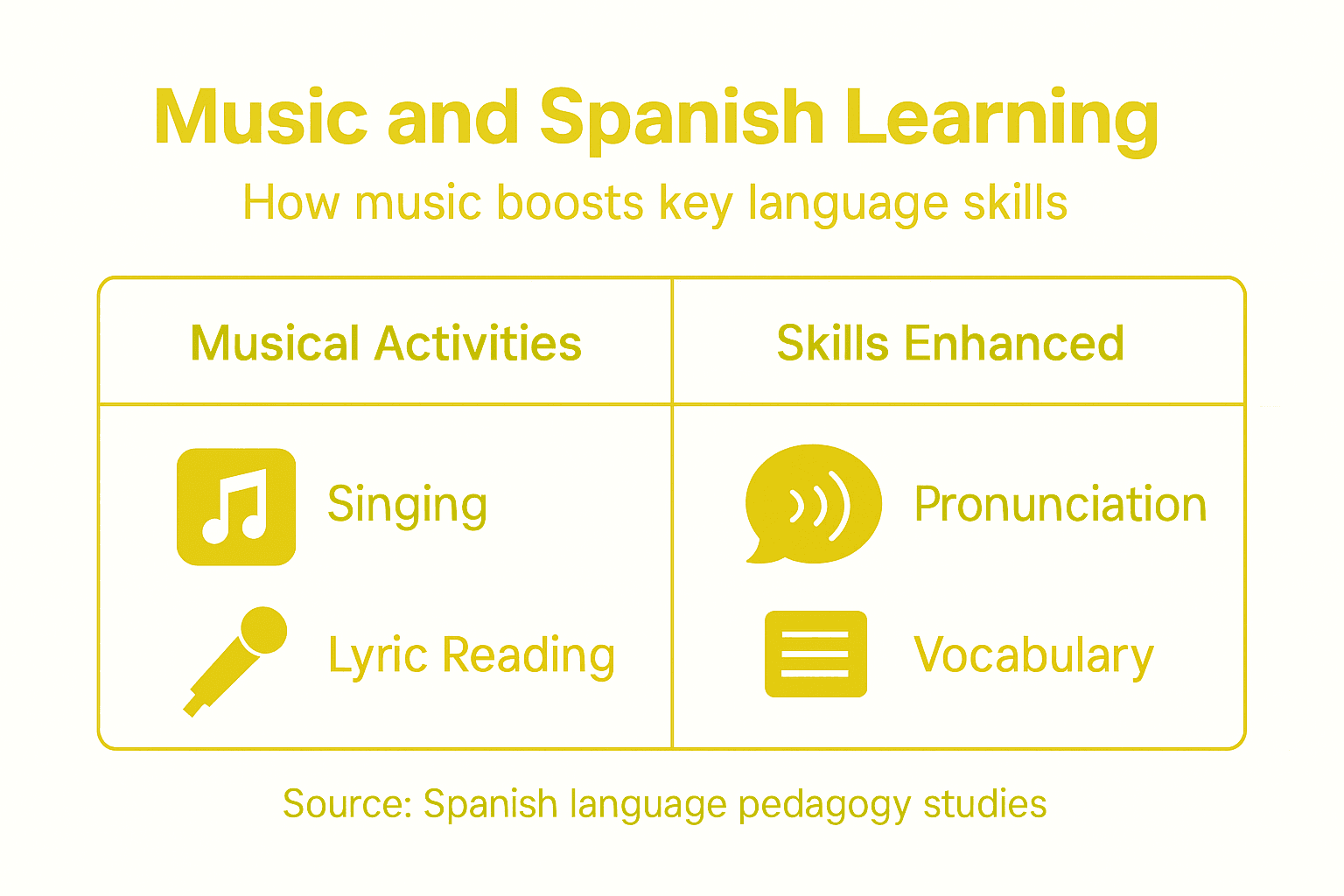
Successful Spanish language learners understand that musical activities are not just supplementary—they’re core learning strategies. By integrating rhythm, melody, and linguistic content, learners can develop a more intuitive understanding of Spanish language nuances, cultural expressions, and communication styles.
Pro tip: Create a personalized Spanish music playlist that gradually increases in complexity, challenging yourself to understand more lyrics with each listening session.
Here’s a summary of how different musical activities contribute to Spanish language skills:
| Musical Activity | Linguistic Skill Enhanced | Typical Learning Outcome |
|---|---|---|
| Lyric Translation | Vocabulary & Grammar | Improved word recognition |
| Singing Practice | Pronunciation & Intonation | More authentic speech patterns |
| Rhythm Exercises | Listening & Accent Accuracy | Better rhythm in spoken Spanish |
| Karaoke Sessions | Fluency & Confidence | More natural conversational flow |
| Musical Comprehension | Cultural Insight | Deeper understanding of context |
How Song Lyrics Aid Pronunciation and Vocabulary Expansion
Song lyrics represent a powerful linguistic tool that transforms language learning from a mechanical process into an engaging, multisensory experience. Contextual vocabulary acquisition occurs naturally when learners immerse themselves in the rhythmic and melodic landscape of Spanish music.
The mechanisms through which song lyrics enhance language skills are multilayered:
- Phonetic Precision: Lyrics expose learners to authentic pronunciation patterns
- Contextual Learning: Words are learned within meaningful emotional and cultural contexts
- Repetition Mechanism: Musical repetition reinforces vocabulary retention
- Emotional Connection: Music creates memorable associations with language
- Pronunciation Modeling: Native singer’s articulation serves as a direct learning template
Music activates multiple brain regions responsible for language processing, making vocabulary acquisition more intuitive and long-lasting. By engaging both hemispheres of the brain simultaneously, song lyrics create robust neural pathways that support comprehensive language learning.

Successful language learners understand that lyrics are more than simple word collections—they’re dynamic linguistic landscapes that capture cultural nuances, emotional expressions, and grammatical subtleties. The rhythmic structure of songs provides a natural scaffolding for understanding complex linguistic patterns, making vocabulary expansion feel effortless and enjoyable.
Pro tip: Choose song lyrics from different Spanish-speaking regions to expose yourself to varied pronunciations and colloquial expressions.
Cultural Immersion and Social Interaction Through Music
Music transcends traditional language learning by creating dynamic spaces for cultural connection and social interaction. Music listening fosters cultural immersion by providing authentic linguistic contexts that go far beyond textbook conversations and structured classroom interactions.
Key dimensions of cultural engagement through music include:
- Emotional Resonance: Connecting with Spanish-speaking cultures through shared musical experiences
- Linguistic Authenticity: Experiencing language as native speakers truly communicate
- Regional Diversity: Exploring musical styles from different Spanish-speaking countries
- Social Context: Understanding cultural nuances embedded in musical expressions
- Communicative Competence: Developing real-world language skills through musical interactions
Integrating music in language education transforms learning from an academic exercise into a vibrant, socially connected experience. Music breaks down linguistic barriers by creating emotional pathways that invite learners to engage more deeply with Spanish language and culture.
Successful language learners recognize that music is a powerful social bridge. By exploring different musical genres—from Argentine tango to Mexican mariachi, Colombian salsa to Spanish flamenco—learners gain insights into the rich, diverse cultural landscapes of Spanish-speaking communities. These musical journeys provide context, emotion, and depth that traditional language learning methods often miss.
Pro tip: Join online music communities or language exchange groups focused on Spanish music to practice listening and conversational skills with native speakers.
Common Challenges When Learning Spanish With Music
Learning Spanish through music is an exciting journey, but it’s not without its complexities. Music learning obstacles present unique challenges that require strategic navigation and thoughtful approach.
Key challenges Spanish language learners encounter include:
- Linguistic Complexity: Deciphering colloquial expressions and regional slang
- Pronunciation Nuances: Managing diverse accent variations across Spanish-speaking regions
- Song Selection: Identifying educationally appropriate musical content
- Cultural Context: Understanding deeper cultural meanings embedded in lyrics
- Technical Comprehension: Distinguishing rapid speech patterns in musical performances
Comprehensive music integration strategies reveal that successful language learning requires more than passive music consumption. Learners must develop critical listening skills, contextual understanding, and systematic approaches to extracting linguistic knowledge from musical experiences.
Effective Spanish music learning demands active engagement and structured methodology. Learners must balance entertainment with educational objectives, recognizing that not all musical content serves equal linguistic value. This requires developing discernment in song selection, understanding cultural nuances, and maintaining consistent learning practices that transform musical experiences into meaningful language acquisition opportunities.
Pro tip: Create a structured listening journal to systematically track new vocabulary, grammatical structures, and cultural insights discovered through Spanish music.
The table below compares the benefits and common challenges of learning Spanish through music:
| Aspect | Key Benefit | Typical Challenge |
|---|---|---|
| Pronunciation | Access to authentic accent patterns | Managing diverse regional accents |
| Vocabulary | Context-rich word retention | Deciphering colloquialisms and slang |
| Cultural Insight | Exposure to real-world expressions | Interpreting deep cultural references |
| Motivation | Makes learning enjoyable and memorable | Choosing educationally relevant content |
| Listening | Trains the ear for native speed | Distinguishing fast, lyric-dense vocals |
Unlock Spanish Mastery Through Music and Social Connection
The article highlights how challenges like managing diverse regional accents and decoding colloquial Spanish expressions can make learning with music complex. If you want to overcome those obstacles and deepen your pronunciation, vocabulary, and cultural understanding through engaging, song-based learning, Canary is made for you. Designed for active learners who want to transform musical insights into real communication skills, the platform makes mastering Spanish enjoyable and immersive by combining authentic song lyrics with interactive features like karaoke and quizzes.
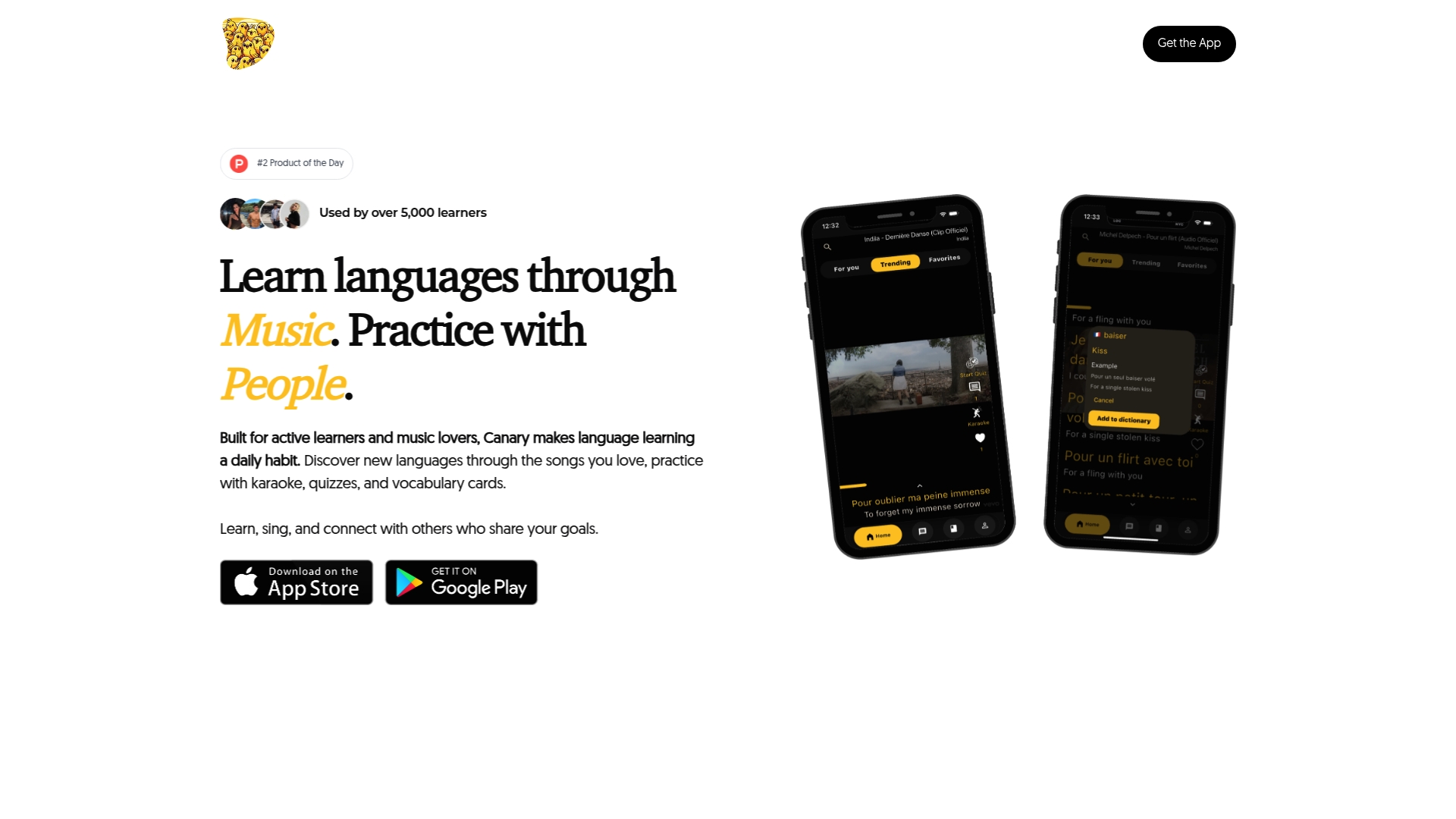
Experience how music can accelerate your Spanish learning journey today by joining Canary. Build a habit of daily practice with a passionate community, improve your ear training, and gain confidence speaking by interacting with international learners. Don’t just listen to Spanish music—learn with it and practice in context through fun, proven methods. Start now on our landing page and see the difference that a music-driven, socially interactive approach can make.
Frequently Asked Questions
How does music aid in learning Spanish?
Music enhances Spanish acquisition by improving cognitive skills such as rhythm processing, melodic comprehension, auditory memory, and pattern recognition, which are essential for understanding and producing language.
What types of musical activities are effective for Spanish learners?
Effective musical activities include lyric translation, singing practice, rhythm exercises, karaoke sessions, and analyzing song meanings, all of which help reinforce vocabulary and improve pronunciation.
How do song lyrics contribute to vocabulary retention?
Song lyrics aid vocabulary retention through phonetic precision, contextual learning, repetitive exposure, emotional connections, and pronunciation modeling, making new words easier to remember.
What challenges might learners face when using music to learn Spanish?
Common challenges include deciphering complex colloquial expressions, managing diverse pronunciation accents, choosing appropriate songs, understanding cultural nuances, and distinguishing rapid speech patterns in lyrics.