The most effective music-themed vocabulary boosters are short, retrieval-focused song micro-sequences: lyric gap-fill with immediate recall, chorus repetition cycling into sing-then-speak, and karaoke with caption and tempo control, all spaced across multiple sessions. A 2026 mini-review of Scopus-indexed studies confirms that vocabulary gains are strongest when lyric exposure is paired with prompted retrieval and spacing, not passive listening. The three highest-impact activities are:
- Chorus/refrain repetition with a deliberate switch from singing to speaking the same line
- Lyric gap-fill with recall prompts (cover the lyric, retrieve the missing word aloud)
- Karaoke with caption and tempo control, followed by a delayed recall check 24 hours later
Singwithcanary is built around exactly this workflow, combining karaoke, lyric quizzes, and vocabulary cards in one platform designed for adult learners.
Key Takeaways
Song-based micro-sequences combining active retrieval, spaced re-listening, and sing-then-speak cycles produce the strongest vocabulary and pronunciation gains from music-themed practice.
| Point | Details |
|---|---|
| Retrieval beats passive listening | Gap-fill and forced recall convert lyric exposure into durable vocabulary; passive listening alone does not. |
| Sing-then-speak is the core cycle | Singing a line then immediately speaking it without melody transfers prosodic gains into real speech. |
| Space your practice across the week | Re-listen at 24–48 hours, test at 7–10 days, and run a delayed speaking check at 3+ weeks. |
| Song choice shapes outcomes | Pick tracks with a clear vocal mix, moderate tempo, and a repeated chorus; learner enjoyment amplifies memory consolidation. |
| Singwithcanary | Covers the full checklist: karaoke, lyric quizzes, vocabulary cards, spaced repetition, and social practice partners. |
Table of Contents
- What does the research say about music and language learning?
- How music helps: three mechanisms you can use
- High-impact micro-sequences to use every week
- How to pick songs that actually boost vocabulary learning
- A simple spacing schedule and how to test whether it worked
- A repeatable 15-minute daily routine for busy adults
- What to look for in apps and tools for music-based vocabulary practice
- Why we built Singwithcanary around these methods
- Singwithcanary puts this method into practice for you
- Sources
What does the research say about music and language learning?
Three mechanisms show up consistently across recent peer-reviewed work. First, music lowers what researchers call the “affective filter,” reducing the anxiety that stops learners from attempting repetition exercises. Second, rhythm and melody create prosodic entrainment: learners absorb stress patterns and intonation contours more accurately when they are embedded in song. Third, the repetitive structure of choruses and refrains generates multiple exposures to the same words, and when those exposures are paired with active retrieval, items move into long-term memory.
A scoping review of song-based interventions found that pairing songs with targeted activities such as gap-fill, dictation, and lyric analysis consistently produced measurable gains in listening comprehension and oral fluency. A classroom-controlled study comparing singing with rhythmic recitation found that singing familiar melodies produced larger vocabulary and pronunciation gains on post-tests. The role of music in vocabulary retention is well-documented: melody and repetition work together to make new words stick in ways that text alone cannot replicate.
One honest caveat: most studies use short-term post-tests, and durability data is still limited. That is exactly why a spacing schedule with delayed tests matters, and why the routines below build one in.
How music helps: three mechanisms you can use
Affective regulation
Music reduces performance anxiety. Learners who hesitate to repeat a phrase aloud will often sing the same phrase without hesitation. Choral repetition and karaoke sessions exploit this directly: the melody carries the learner through words they would otherwise stumble over, building the confidence to attempt them in speech.
Rhythmic-prosodic entrainment
Rhythm and melody make stress, timing, and intonation physically perceptible. When you sing a line, you feel where the stress falls. Chant-then-speak cycles transfer that physical awareness into ordinary speech. Movement amplifies this further: studies show that gesture-supported rhythm work, stepping or tapping the beat while chanting a line, improves stress timing and intonation production. For learners studying tonal languages, a review of melodic intonation approaches shows that mapping melody onto lexical tone categories makes pitch distinctions more perceptible.

Memory through repetition and retrieval
A chorus repeats the same words four or five times per song. That repetition is free exposure. The problem is that exposure alone does not build durable knowledge. Pair it with active retrieval: cover the lyric sheet, recall the missing word, check, repeat. That single addition converts passive familiarity into retrievable vocabulary.
Pro Tip: Design your micro-sequence so that every singing moment is followed by a speaking moment. Sing the chorus, then immediately speak the same lines without melody. That transition is where pronunciation gains happen.
High-impact micro-sequences to use every week
These are the activity patterns with the strongest evidence base. Each sequence runs 8–10 minutes and can be repeated with any song.
-
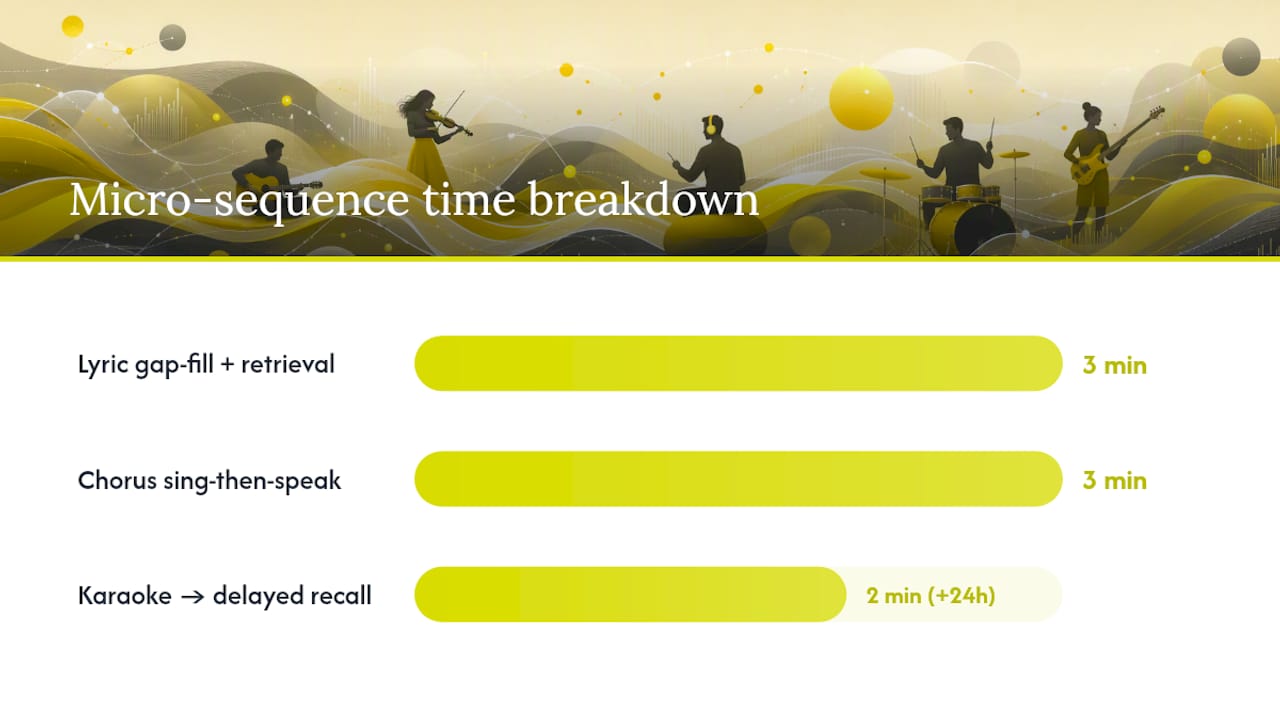
Lyric gap-fill + immediate retrieval (3 min). Pull up the lyrics with 5–8 words blanked out. Listen once, fill the gaps. Cover the sheet and retrieve each missing word aloud. Check. This forces form-meaning connections and works the incidental vocabulary gains that passive listening misses.
-
Chorus repeat → sing-then-speak (3 min). Play the chorus twice, singing along. On the third pass, pause the track after each line and speak it without melody. Notice where your stress and timing differ from the original. Adjust and repeat.
-
Karaoke with caption and tempo control → delayed recall (2 min active + 24-hour gap). Slow the track to 80–85% speed, sing with captions on. The next day, without the lyrics, write or say the chorus from memory. That 24-hour gap is the first spacing interval.
Layer your retrieval schedule: immediate recall in the session, a short re-listen at 24–48 hours, and a cold recall test at 7–10 days. This mirrors the spacing pattern the mini-review identifies as most effective.
For solo practice, the gap-fill and sing-then-speak steps work with any streaming platform and a printed or screen lyric sheet. For social sessions, karaoke-style practice with a partner adds the affective benefit of performing for someone else, which raises stakes just enough to sharpen attention.
Pro Tip: Try music-based language games as a warm-up before the gap-fill step. A 90-second word-association game with vocabulary from the song primes retrieval and makes the gap-fill noticeably easier.
How to pick songs that actually boost vocabulary learning
Not every song works equally well. Use this checklist before committing to a track:
- Clear vocal mix. The voice should sit above the instrumentation. Heavily produced tracks with buried vocals make gap-fill and pronunciation modeling unreliable.
- Moderate tempo. Roughly 80–120 BPM gives you time to process each word. Very fast rap or dense spoken-word tracks are better saved for advanced practice.
- Repeated chorus. A chorus that appears four or more times gives you multiple free exposures per listen.
- Manageable vocabulary load. Aim for no more than 8–10 unfamiliar words per song at your current level. More than that and the cognitive load crowds out retention.
- High learner choice. Pick a song you actually like. Neuroscience research links music-evoked reward to memory consolidation, and enjoyment amplifies that effect. A song you love will become an earworm; an earworm is free spaced repetition.
For target vocabulary, concrete verbs and high-frequency collocations (“pick up,” “run out,” “fall apart”) transfer directly to conversation. Abstract vocabulary, philosophical or metaphorical lyrics, often needs supplementary context before it sticks through song alone.
A simple spacing schedule and how to test whether it worked
Spacing your practice is what separates short-term familiarity from durable vocabulary knowledge. Here is a compact schedule that fits around a busy week:
| Session type | Timing | Activity |
|---|---|---|
| Micro-sequence (full) | 3× per week | Gap-fill, chorus repeat, sing-then-speak |
| Short re-listen | 24–48 hours after each session | Play the chorus once, no lyrics, recall target words |
| Spaced recall test | 7–10 days after first session | Write or say target words from memory, check form and meaning |
| Delayed speaking check | 3+ weeks after first session | Record yourself using target words in a short spoken response |
For pronunciation, record a 30-second speaking sample using two or three target words in natural sentences. Compare it to the original track. Specific things to check: stress placement on multi-syllable words, vowel length, and whether collocations sound natural at speed. Interactive vocabulary practice works best when you build this kind of self-monitoring into the routine from the start.
A repeatable 15-minute daily routine for busy adults
This sequence works with a single song and a lyric sheet. Repeat it three times a week with the same song before switching.
- Minutes 1–2: Warm-up listen. Play the song once, no task. Just listen and notice words you recognize and words you do not.
- Minutes 3–10: Focused micro-sequence. Gap-fill (3 min), chorus repeat with sing-then-speak transition (3 min), karaoke pass at reduced tempo (2 min).
- Minutes 11–12: Active recall. Cover the lyrics. Say or write the chorus from memory. Check and note errors.
- Minutes 13–15: Pronunciation check. Speak two target lines without melody. Record on your phone. Play back and compare to the original.
For a 10-minute window: cut the warm-up and reduce the karaoke pass to one run-through. Keep the active recall step; it is the highest-yield two minutes in the sequence.
For a 5-minute window: gap-fill only, then one chorus repeat with the sing-then-speak switch. Log the target words for your next session.
Developing a consistent daily habit matters more than session length. Three 10-minute sessions beat one 30-minute session done irregularly.
Pro Tip: During the chorus repeat step, add a physical gesture for each stressed syllable: a small tap on a table, a nod, or a step. This externalizes the beat and makes stress patterns easier to transfer into your spoken output.
What to look for in apps and tools for music-based vocabulary practice
Before downloading any app, run it against this checklist:
- Caption and tempo control. You need to slow the track and read along simultaneously.
- Karaoke mode. Active singing, not just passive listening, is what drives pronunciation gains.
- Lyric gap-fill quizzes. The app should force retrieval, not just display lyrics.
- Spaced-repetition support. Vocabulary cards or quiz scheduling that revisits items at increasing intervals.
- Recording and playback. You need to hear yourself to self-correct.
- Social or practice partners. Performing for another person raises engagement and mirrors real communication.
- Exportable vocabulary cards. Target words should be reviewable outside the app.
For US learners, check that the app stores data in compliance with standard privacy expectations and offers at least some offline functionality for commute or travel use.
Singwithcanary covers every item on this list: karaoke with lyric display, gap-fill quizzes, vocabulary cards, social practice with other learners, and ear training built into the song-based workflow. That is not a coincidence; the platform was designed around the same micro-sequence evidence base this article draws from. Karaoke benefits for language learners are most fully realized when the app pairs singing with structured retrieval tasks, which is exactly what Singwithcanary does.
Why we built Singwithcanary around these methods
The evidence for music-based language learning is not new, but most apps treat it as a novelty rather than a method. What the research actually shows is specific: singing beats recitation, retrieval beats exposure, and spacing beats cramming. Those three findings shaped every design decision behind Singwithcanary.
The karaoke feature is not there because karaoke is fun (though it is). It is there because singing familiar melodies produces measurably larger vocabulary and pronunciation gains than reading or reciting the same lines. The quiz and vocabulary card features exist because passive lyric exposure, without forced recall, produces weak long-term retention. The social layer, practicing with other learners and native speakers, addresses the affective dimension: community practice lowers the anxiety that keeps learners from attempting difficult words aloud.
Users consistently report improvements in accent clarity, vocabulary recall, and listening comprehension after regular sessions. The platform is designed so that a 15-minute daily routine, the kind described in this article, is the natural unit of practice.
Singwithcanary puts this method into practice for you
Most language apps give you content. Singwithcanary gives you a method. The karaoke mode, lyric quizzes, vocabulary cards, and social practice partners map directly onto the micro-sequence workflow this article describes: sing, retrieve, space, speak. You get the affective benefit of music, the cognitive benefit of retrieval, and the social benefit of practicing with real people, all inside one app.
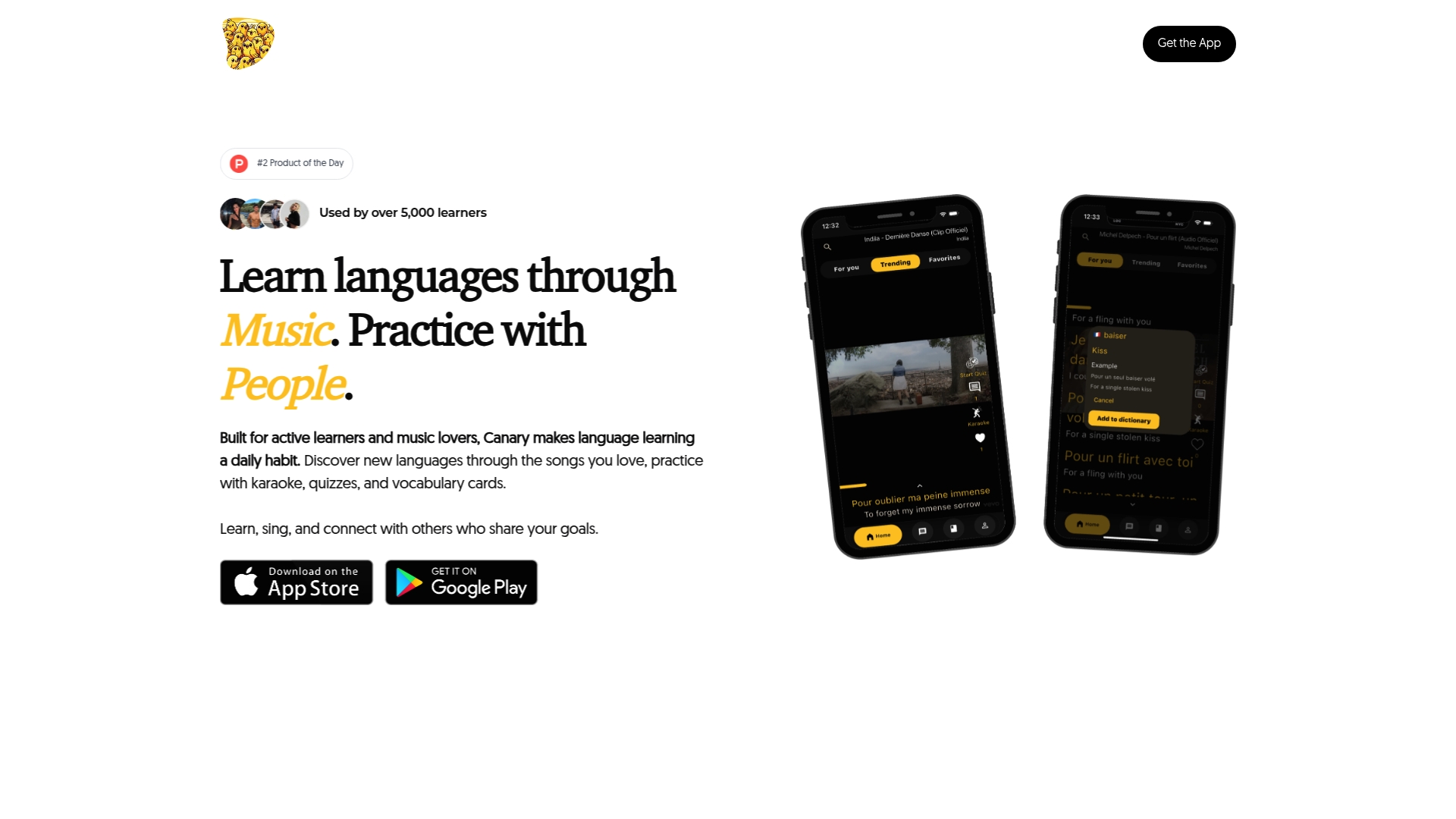
The free tier gets you started with song-based practice and vocabulary cards. Premium unlocks the full quiz library, spaced-repetition scheduling, and the social karaoke features that make the routine genuinely repeatable. Start your free account and run your first micro-sequence today, or try the song of the week for a ready-made 15-minute session.
Sources
- Music as pedagogy in ELT: mechanisms, micro-sequences, and measured gains—a mini-review
- Music-mediated pedagogy to boost EFL learners’ listening engagement and oral fluency: a scoping review
- Effects of singing vs. reciting familiar melodies on L2 pronunciation and vocabulary learning (MDPI Languages)
- Enhancing tonal-language learning through music: a review of experimental methods and melodic intonation therapy influences