Language learners practicing socially with music improve pronunciation 15% faster than those using traditional methods. This approach combines interactive community engagement with music integration to create an immersive, motivating learning experience. If you’re a music enthusiast seeking to learn a new language, understanding social language learning principles can transform your journey from frustrating to fulfilling while accelerating your progress.
Table of Contents
- Understanding Social Language Learning
- Role Of Music In Social Language Learning
- Benefits Of Social Practice Through Music
- Interactive Features Enhancing Social Language Learning
- Common Misconceptions About Social Language Learning
- Comparison With Traditional Language Learning Methods
- Practical Implementation In Music-Integrated Platforms
- Explore Canary’s Music-Driven Language Learning Platform
- FAQ
Key takeaways
| Point | Details |
|---|---|
| Interactive communication | Social language learning prioritizes active conversation and community feedback over solitary study. |
| Music enhances memory | Songs improve vocabulary retention by 20 to 30% through emotional and cognitive engagement. |
| Social practice builds confidence | Community interaction reduces dropout rates by 30% and accelerates speaking skills. |
| Interactive tools boost engagement | Karaoke, quizzes, and vocabulary cards increase learner participation by 40%. |
| Structure beats casual chat | Effective social learning requires organized activities, not just informal conversation. |
Understanding social language learning
Social language learning centers on active communication within a community rather than passive memorization. This method recognizes that language exists for human connection, making interaction the foundation of acquisition. Research shows interactive social learning improves retention rates by over 50% compared to solitary methods.
The power of community transforms motivation. When learners share goals and practice together, consistency improves dramatically. Shared accountability keeps you engaged during challenging phases when solo learners often quit. Studies confirm that social interaction reduces dropout rates by 30% compared to solitary users.
Interaction develops practical skills textbooks can’t teach. Real conversations force you to think quickly, adapt to accents, and use context clues. These experiences build listening comprehension and speaking fluency simultaneously. Your brain processes language differently when responding to real people versus completing exercises alone.
Key benefits of social interaction in language learning include:
- Immediate feedback corrects pronunciation and grammar errors in real time
- Emotional connections to conversation partners strengthen memory formation
- Exposure to diverse accents and speaking styles prepares you for real-world use
- Collaborative learning builds problem-solving skills as you navigate meaning together
Community support sustains language learning motivation through inevitable plateaus. Fellow learners understand your struggles and celebrate your progress. This emotional backing creates positive associations with practice, making daily engagement feel rewarding rather than obligatory.
“Language learning thrives in social contexts where meaningful interaction drives both motivation and skill development through authentic communication experiences.”
Role of music in social language learning
Music activates multiple brain regions simultaneously, creating powerful learning conditions. When you engage with songs, emotional and cognitive centers work together to encode language patterns deeply. This multisensory experience makes vocabulary stick far better than rote memorization.
Research demonstrates that music improves vocabulary retention by 20 to 30% compared to traditional study methods. The rhythm, melody, and emotional content create strong memory anchors. You’ve likely experienced this yourself when remembering lyrics years after hearing a song once.
Musical training sharpens auditory discrimination essential for pronunciation accuracy. Studies show auditory training with music improves phonological awareness by 22% compared to control groups. This enhanced sensitivity helps you distinguish subtle sound differences between your native language and your target language.
Songs provide natural, enjoyable practice opportunities. Unlike drills that feel tedious, singing along to favorite tracks creates positive emotional states that enhance learning. This enjoyment sustains motivation far longer than willpower-driven study sessions.
The role music plays in language learning extends to cultural understanding:
- Lyrics expose you to idioms, slang, and colloquial expressions used by native speakers
- Song themes reflect cultural values, history, and contemporary issues
- Musical styles introduce you to different regional accents and dialects
- Artists’ storytelling provides context that makes language meaningful and memorable
Contextual learning through music in language learning beats isolated vocabulary lists. When you learn words within a story or emotional narrative, your brain forms richer associations. These connections help you recall and use words appropriately in conversations.
The combination of melody and repetition in songs creates ideal conditions for automaticity. Phrases become ingrained through repeated listening and singing, eventually flowing naturally without conscious effort. This mirrors how children acquire their first language through repetitive exposure and musical speech patterns.
Music training enhances phonological processing by strengthening neural pathways involved in sound discrimination. These same pathways support accurate pronunciation and listening comprehension in your target language.
Benefits of social practice through music
Social singing and karaoke sessions accelerate pronunciation improvement through immediate feedback. When you practice with others, you hear your mistakes and corrections in real time. Group environments create safe spaces to experiment with sounds you find challenging.
Learning languages with music in community settings builds speaking confidence faster than solo practice. Performing songs, even informally, reduces fear of making mistakes. This psychological shift helps you speak more freely in everyday conversations.

Community interaction sustains long-term engagement. Research confirms that community learning reduces dropout rates by 30% compared to isolated study. Fellow learners provide encouragement during difficult phases and celebrate milestones with you.
Cultural immersion through song lyrics teaches practical, contextual language use. You learn how native speakers actually communicate, including emotional nuance and cultural references. This knowledge bridges the gap between textbook language and real-world conversation.
Regular social practice establishes consistent habits:
- Scheduled group sessions create accountability that maintains practice frequency
- Shared challenges motivate you to prepare and participate actively
- Social rewards like praise and camaraderie make practice intrinsically enjoyable
- Community resources provide song recommendations and learning strategies
Pro Tip: Sign up for social practice platforms offering weekly challenges to maintain engagement. Regular events prevent the motivation dips that derail solitary learners.
Singing with international partners exposes you to diverse accents and cultural perspectives. This variety prepares you for real-world communication better than single-accent instruction. You develop flexibility in understanding different speakers.
The song of the week program format creates structured progression while maintaining novelty. Each new song introduces fresh vocabulary and grammatical structures within an engaging context. This combination of structure and variety optimizes learning.
Social learning motivation stems from both external accountability and internal enjoyment. When practice feels like social connection rather than obligation, consistency becomes natural.
Interactive features enhancing social language learning
Interactive quizzes transform passive listening into active engagement. Research shows quizzes increase engagement by 40% compared to passive content consumption. Testing yourself immediately after learning reinforces memory formation.
Vocabulary cards linked to specific songs create powerful contextual associations. When you review a word, you recall the melody, emotion, and story connected to it. These rich associations make retrieval easier during conversations.
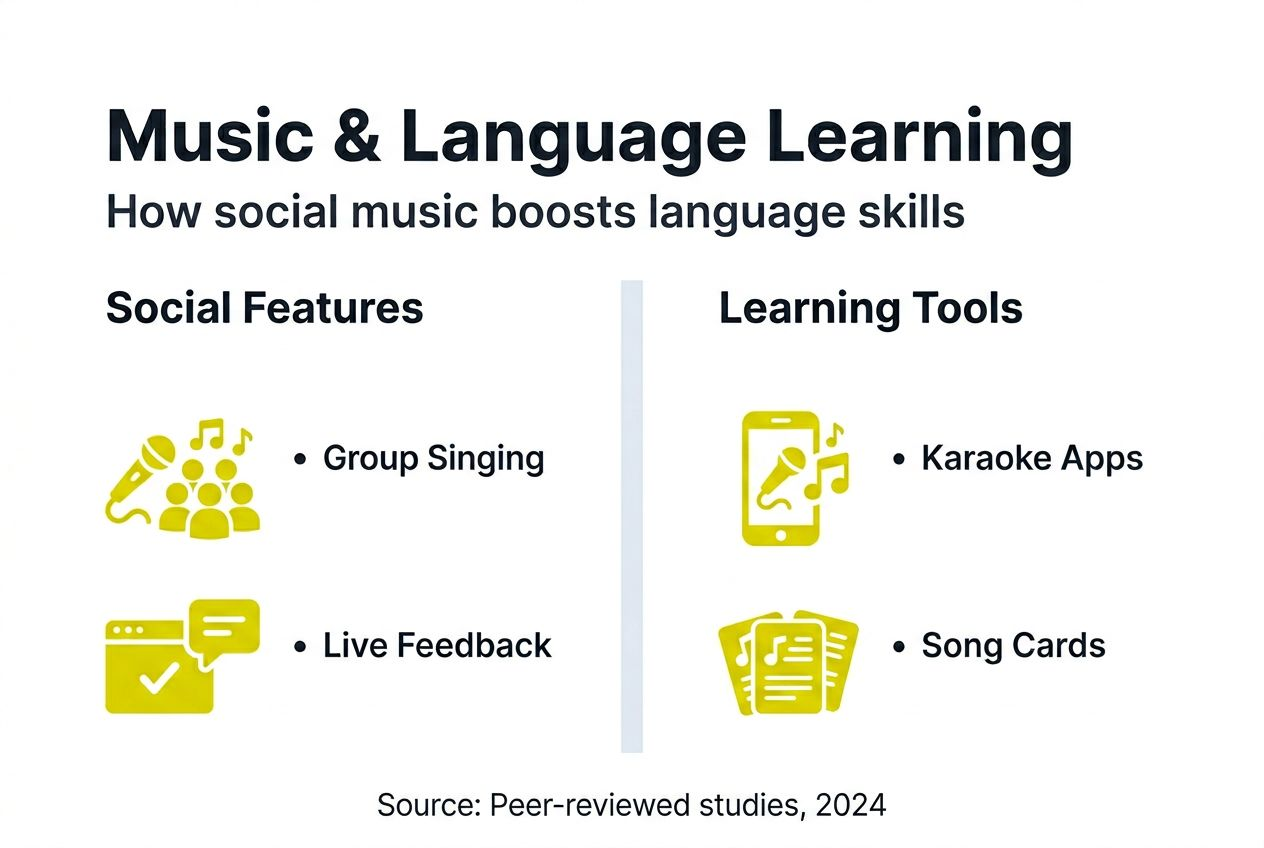
Real-time pronunciation feedback accelerates skill development. Technology can now analyze your speech and highlight areas needing improvement. This immediate correction shortens the learning curve dramatically compared to delayed feedback.
Karaoke platforms enable practice in fun, low-pressure social environments:
- Lyrics display reduces reading anxiety while building literacy skills
- Scoring systems gamify practice, making repetition enjoyable
- Group karaoke creates bonding experiences that motivate continued participation
- Recording features let you track pronunciation progress over time
Language learning methods for music lovers benefit from comparing different approaches:
| Feature | Interactive Tools | Passive Listening |
|---|---|---|
| Engagement Level | High through quizzes, feedback | Low without interaction |
| Pronunciation Practice | Active with karaoke, recording | Minimal without speaking |
| Vocabulary Retention | Strong with flashcards, context | Moderate through exposure alone |
| Speaking Confidence | Builds through social practice | Limited without conversation |
| Motivation | Sustained through gamification | Drops without structure |
Pro Tip: Combine multiple interactive features in each practice session. Use vocabulary cards before singing, then take a quiz afterward to maximize retention.
Community features like discussion boards and live sessions add social dimensions to technology. You can ask questions, share discoveries, and encourage fellow learners. These interactions mirror natural language use while providing learning support.
Progress tracking visualizes your improvement over time. Seeing concrete evidence of advancement, like expanding vocabulary counts or improving pronunciation scores, reinforces motivation during plateaus.
Common misconceptions about social language learning
Many assume social language learning simply means casual conversation with native speakers. While conversation helps, effective social learning requires structured interactive activities with clear learning objectives. Random chats lack the systematic progression needed for comprehensive skill development.
Another misconception treats music as merely a mnemonic device for memorizing vocabulary. Research reveals music actively trains auditory discrimination and phonological processing essential for accurate pronunciation. Music shapes foundational language skills, not just memory.
Some learners believe social practice works only for extroverts. In reality, structured group activities accommodate different personality types. Online platforms allow introverts to participate comfortably while still gaining social learning benefits.
Top three misconceptions and corrections:
-
Misconception: Social learning equals unstructured conversation practice. Reality: Effective programs combine structured activities like guided discussions, role plays, and collaborative exercises with clear language goals.
-
Misconception: Music only helps with memorization through catchy tunes. Reality: Musical engagement develops critical auditory processing skills that improve pronunciation, listening comprehension, and natural speech rhythm.
-
Misconception: You need native-speaker partners for social learning to work. Reality: Practicing with fellow learners at similar levels provides valuable interaction while reducing performance anxiety that inhibits speaking with advanced speakers.
Effective social language learning combines music and structured practice for optimal results. Neither element alone delivers the full benefits. Music provides engaging content and cognitive advantages, while social structure ensures consistent progression and practical application.
“Music doesn’t just help you remember words. It fundamentally enhances your brain’s ability to process and produce the sounds that make up fluent, natural speech in any language.”
Social learning misconceptions often stem from comparing it to traditional methods. Understanding that social approaches require different structures, not less structure, helps learners implement them effectively.
Phonological processing with music represents a scientifically validated cognitive benefit, not just a fun addition to language study.
Comparison with traditional language learning methods
Social music-based learning builds speaking confidence 25% faster than traditional classroom methods. This acceleration comes from regular speaking practice in supportive environments. Traditional classes often emphasize reading and grammar over conversation, delaying practical fluency.
Traditional methods frequently lack community and motivation for consistent practice. Students attend scheduled classes but rarely practice between sessions. Social approaches encourage daily language use through community engagement and enjoyable activities.
Social learning fosters better long-term retention through emotional connections. When you associate language with positive social experiences and beloved songs, memories form more strongly than with textbook exercises. Emotional engagement is a powerful learning catalyst.
| Aspect | Social Music Learning | Traditional Classroom | Solitary Study |
|---|---|---|---|
| Speaking Confidence | High, builds 25% faster | Moderate, limited practice time | Low, no conversation practice |
| Motivation | Sustained through community | Variable, depends on instructor | Often drops without accountability |
| Pronunciation | Excellent via music, feedback | Good with quality instruction | Poor without correction |
| Cultural Knowledge | Deep through songs, interaction | Moderate through textbooks | Limited to written materials |
| Daily Practice Habit | Strong through enjoyable activities | Weak between classes | Difficult to maintain alone |
| Cost | Often affordable or free | Expensive tuition, materials | Low cost but high dropout |
Traditional methods offer advantages in grammar instruction and structured curriculum. Teachers can explain complex rules systematically. However, this knowledge doesn’t automatically translate to conversational fluency without practice.
Solitary study provides flexibility but lacks accountability. Most learners struggle to maintain consistent practice without external motivation. Apps and books can’t replicate the social dynamics that make language learning stick.
Key differences in practice approaches:
- Social music learning: Prioritizes practical communication skills through enjoyable, interactive activities that build automatic fluency
- Traditional classroom: Emphasizes explicit grammar knowledge and reading comprehension with some speaking practice
- Solitary study: Focuses on individual pace and convenience but often results in passive knowledge without active speaking ability
Combining approaches can be effective. Use social music learning for motivation and speaking practice while supplementing with traditional resources for grammar explanations when needed. This hybrid approach addresses different learning needs.
Practical implementation in music-integrated platforms
Establishing a daily social music language practice routine creates consistency that drives results. Start with 15 to 20 minutes each day rather than sporadic longer sessions. Regular exposure builds automatic language processing more effectively than cramming.
Step-by-step implementation strategy:
-
Choose songs matching your current level to avoid frustration while still challenging yourself with new vocabulary and structures.
-
Join scheduled community singing sessions to practice pronunciation with immediate feedback from others.
-
Use interactive quizzes after each song to test comprehension and reinforce new vocabulary in context.
-
Review vocabulary cards featuring song phrases during short breaks throughout your day for spaced repetition benefits.
-
Engage with lyric discussions to understand cultural context, idioms, and deeper meanings that enhance your language intuition.
Karaoke features provide low-pressure speaking practice. Singing along builds pronunciation muscle memory while following displayed lyrics improves reading fluency. Recording yourself reveals specific areas needing improvement.
Leveraging vocabulary cards tied to songs creates stronger retention than isolated word lists. Each card triggers memories of the melody, story, and emotional content, providing multiple retrieval cues. Review these cards before and after singing sessions.
Pro Tip: Combine social interaction with music for maximum learning synergy. Discuss song meanings with fellow learners, then practice singing together to reinforce both understanding and pronunciation.
Engaging with educational benefits of music and language requires active participation. Analyze lyrics for grammar patterns, cultural references, and expressive language use. This analytical approach deepens learning beyond passive listening.
The benefits of learning languages with songs multiply when you practice socially. Sharing song recommendations, explaining meanings to others, and collaborative translation exercises all reinforce your knowledge while building community.
Learning languages with music on dedicated platforms provides structure that maximizes these benefits. Organized challenges, progress tracking, and community features transform casual listening into systematic language development.
Explore Canary’s music-driven language learning platform
Ready to experience social language learning through music? Canary combines karaoke, interactive quizzes, and vocabulary cards with vibrant community support specifically designed for music enthusiasts. The platform makes consistent practice enjoyable rather than obligatory, addressing the motivation challenges that derail traditional language learning.
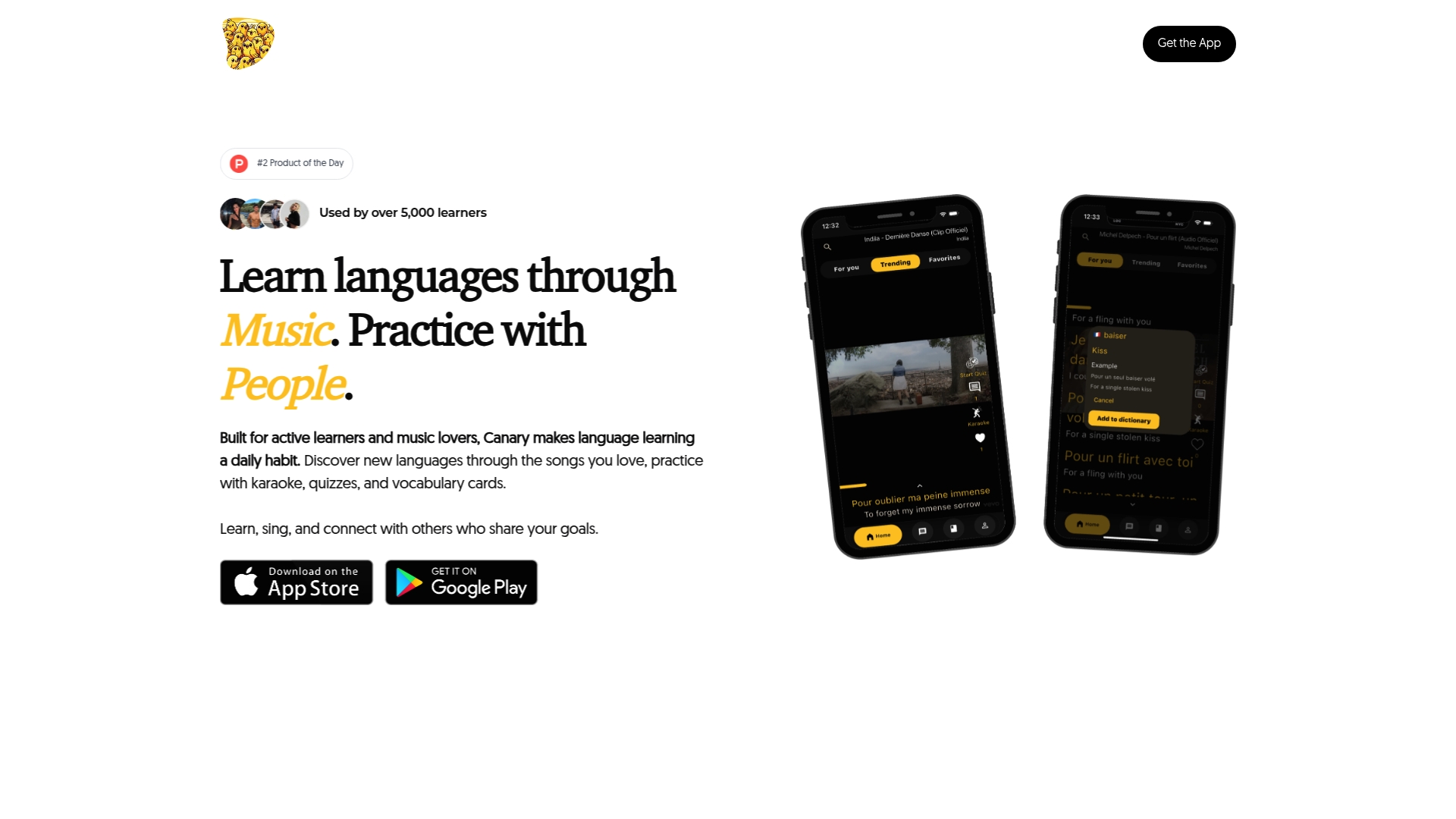
Canary’s features target the skills music lovers value most: pronunciation accuracy, cultural understanding, and conversational confidence. Weekly song challenges keep content fresh while building systematic progression. Real-time feedback and community interaction accelerate your improvement through the social learning advantages discussed throughout this article.
Joining Canary connects you with international learners who share your passion for music and language. Practice singing together, discuss song meanings, and celebrate progress within a supportive community. This social dimension transforms isolated study into engaging cultural exchange.
Learn languages with music on a platform built specifically for this purpose. Sign up for Canary today to access the song of the week program and start building the daily practice habit that leads to fluency.
FAQ
What is social language learning?
Social language learning emphasizes acquiring language through interactive communication within a community rather than solitary study. This method combines structured activities like group discussions, collaborative exercises, and shared learning goals with music integration to create engaging, practical skill development. Community support sustains motivation while providing real-world practice opportunities.
How does music improve language learning?
Music activates brain regions responsible for memory formation and auditory processing simultaneously, creating powerful learning conditions. Songs improve vocabulary retention by 20 to 30% through emotional engagement and contextual associations. Musical training also enhances phonological awareness, helping you distinguish and produce sounds accurately in your target language.
Can social language learning help me speak more confidently?
Yes, absolutely. Social interaction combined with music practice builds speaking confidence 25% faster than traditional methods by providing regular speaking opportunities with immediate feedback. Community support reduces fear of making mistakes, while shared singing experiences create comfortable practice environments. This combination accelerates the transition from hesitant to fluent speaking.
What interactive tools support social language learning with music?
Effective platforms offer karaoke features with lyrics display and pronunciation feedback, interactive quizzes testing comprehension after songs, vocabulary flashcards linked to specific song phrases, and live group singing sessions. Progress tracking visualizes improvement over time, while community discussion boards enable learners to share insights and encourage each other throughout their language journey.
Is social language learning better than classroom methods?
Social learning with music often produces faster speaking skills and stronger motivation than traditional classrooms because it prioritizes practical conversation and enjoyable activities. However, combining approaches can be most effective depending on your goals. Use social music learning for daily practice and speaking confidence while supplementing with classroom instruction for systematic grammar explanations when needed.