TL;DR:
- Song-based activities make language practice engaging and improve pronunciation, vocabulary, and fluency.
- Effective activities require interactivity, purposeful repetition, vocabulary focus, and accessible lyrics.
- Incorporating music weekly helps sustain motivation and supports long-term language learning progress.
Repeating the same flashcard deck for the hundredth time is nobody’s idea of fun. If vocabulary drills feel like a chore you keep skipping, you’re not alone. Most language learners quit not because the material is too hard, but because the practice feels disconnected from real life. Songs change that equation completely. They give words rhythm, emotion, and context, making them stick far longer than rote memorization ever could. The activities below are grounded in research, built for groups and solo learners alike, and designed to make speaking and vocabulary practice feel less like homework and a lot more like a good time.
Table of Contents
- What makes a great song-based language activity?
- Top 5 song-based activities for language learners
- Comparing different activity types
- How to adapt song-based activities for your needs
- Our perspective: Why song-based practice belongs in every modern language routine
- Take your music-driven language learning to the next level
- Frequently asked questions
Key Takeaways
| Point | Details |
|---|---|
| Songs supercharge learning | Song-based activities make vocabulary and pronunciation practice more memorable and enjoyable for all levels. |
| Interactivity is key | Activities that encourage speaking, movement, or collaboration boost language gains more than passive listening. |
| Choose songs wisely | Simple lyrics and familiar tunes work best for beginners, while advanced learners should seek genre variety for more challenge. |
| Customize for your group | It’s easy to adapt song-based activities for different group sizes, experience levels, or learning styles. |
| Music builds motivation | Fun, social song routines keep language learners engaged and coming back for more. |
What makes a great song-based language activity?
Not every karaoke session doubles as a language lesson. The best song-based activities share a few specific qualities that separate them from passive listening. Understanding those qualities helps you pick the right activity for your goal, whether that’s sharper pronunciation, a bigger vocabulary, or more confidence speaking with others.
Here’s what separates effective activities from time-wasters:
- Interactivity: Learners produce language, not just consume it. Speaking aloud, singing, or writing forces active processing.
- Repetition with purpose: Songs are naturally repetitive, but the activity should use that repetition to reinforce specific target words or sounds.
- Vocabulary focus: The best activities draw attention to meaningful words in context, not just melody.
- Accessible lyrics: Songs should match the learner’s level. Overly complex lyrics shut beginners down fast.
- Group and solo flexibility: A great activity works in a class, with a partner, or alone at home.
Research backs this up. Fluency and accuracy gains are strongest when tasks require speaking aloud and repeated output, especially in interactive settings. As one language educator put it, “Songs offer the biggest gains when tasks require speaking out loud and interacting.”
The benefits of music in language learning go beyond fun. Music activates memory, reduces anxiety, and provides a natural context for new words. But it’s worth being honest: not every activity hits every goal equally. Some are better for pronunciation, others for word retention, and a few shine specifically in group settings. That’s exactly why the comparison section below matters. First, though, here are TESOL music teaching strategies worth knowing before you design your first session.
Top 5 song-based activities for language learners
Now that you know what makes an activity effective, here are five that consistently deliver results across different skill levels and settings.
-
Lyric gap fill. Remove key words from printed lyrics and have learners listen and fill them in. This trains focused listening and vocabulary recognition simultaneously. Works great solo or in pairs. Try it with Adele’s Hello or Ed Sheeran’s Shape of You for high-frequency vocabulary.
-
Draw the scene. Learners listen to a song and sketch what the lyrics describe. Then the group compares drawings and discusses vocabulary choices. This visual approach to practical music activities works especially well for concrete nouns and action verbs.
-
Find rhyming pairs. Learners identify and list rhyming words from a song, then practice pronouncing each pair. This sharpens phonological awareness, which is the ability to hear and produce individual sounds in a language. Great for beginners.
-
Perform with movements. Learners create gestures for key vocabulary words, then perform the song with those movements. Kinesthetic memory (body-based memory) makes words stick faster. Boosting confidence with music is especially strong here because performance reduces self-consciousness over time.
-
Paraphrase the song. Learners rewrite a verse in their own words without rhyming. This pushes them to understand meaning deeply and produce original output, the highest level of language processing.
Research confirms that group activities like these build vocabulary and social interaction skills at the same time. And pop song vocabulary analysis shows that chart hits carry surprisingly teachable word banks.
Pro Tip: Choose songs your learners already recognize. Familiarity lowers anxiety and lets attention shift from decoding the melody to processing the language.
Comparing different activity types
With several creative options available, it helps to compare them side by side so you can match the right activity to your goal and group.
| Activity | Best proficiency | Main skill | Solo or group | Best genres |
|---|---|---|---|---|
| Lyric gap fill | Beginner to intermediate | Listening and vocabulary | Both | Pop, ballads |
| Draw the scene | Beginner to intermediate | Vocabulary and speaking | Group | Kids’ songs, storytelling pop |
| Find rhyming pairs | Beginner | Pronunciation | Both | Pop, nursery rhymes |
| Perform with movements | Beginner to intermediate | Vocabulary and fluency | Group | Upbeat pop, children’s songs |
| Paraphrase the song | Intermediate to advanced | Speaking and writing | Both | Any genre with narrative lyrics |
Song choice matters more than most people realize. Taylor Swift songs contain 41.44% A1-level vocabulary, making them a smart pick for beginners who want to feel the win of understanding a real song. Ballads work well for paraphrasing because their storytelling structure mirrors natural speech. Upbeat tracks with short, punchy lines suit movement activities and rhyming tasks.
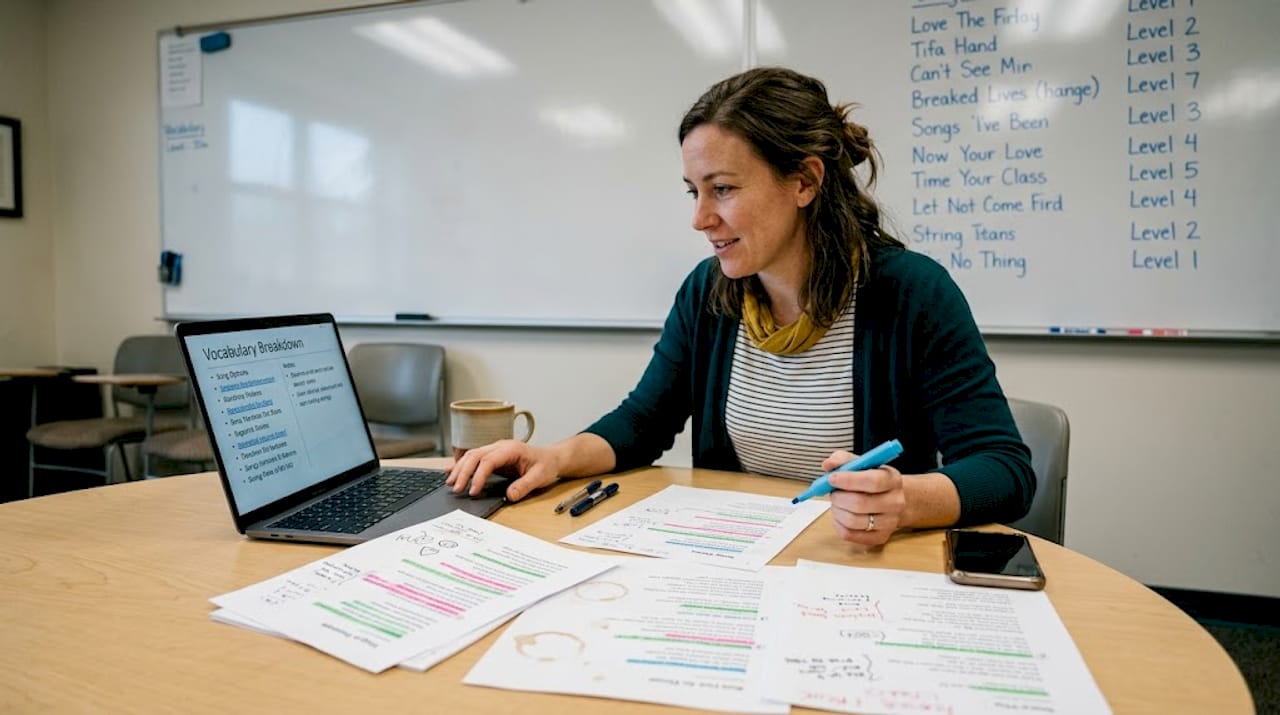
For beginner learners, gap fills and rhyming pairs are the lowest-friction starting points. For intermediate and advanced learners, paraphrasing pushes deeper cognitive engagement. Expanding your vocabulary through songs requires matching song complexity to your current level so that new words appear in a context you can almost understand without help.
Studies measuring EFL speaking improvements show that accuracy and fluency grow fastest when learners engage with song content repeatedly and actively, not just once through.
How to adapt song-based activities for your needs
Choosing a method is step one. Making it fit your actual situation is where most learners stumble. Here’s how to customize any of these activities for different group sizes, language levels, or specific goals.
Adaptation ideas:
- Slow the song down using a music player with pitch-lock so beginners can catch every word without losing comprehension.
- For solo practice, record yourself singing or paraphrasing and play it back. Hearing your own voice is surprisingly effective for catching pronunciation gaps.
- Add gestures to any activity to anchor new words in physical memory, even in an online group session.
- For advanced learners, swap pop songs for genre-specific tracks like jazz standards or spoken word to expose them to more varied vocabulary structures.
- Let learners pick the songs. Motivation jumps when the music feels personal.
Pro Tip: Record a group performance once a month. Watching earlier recordings later shows real progress and keeps motivation high during slow weeks.
Common pitfalls to avoid:
- Using songs with lyrics that are too advanced creates frustration, not learning. If learners understand less than 70% of the words, the song is probably too hard.
- Unclear or heavily distorted vocals make phonological modeling difficult. Clean studio versions beat live recordings for pronunciation work.
- Skipping repetition is the biggest mistake. One listen through a song does almost nothing. Multiple encounters with the same vocabulary, in different tasks, is what creates retention.
Research notes that music-based learning is strong for pronunciation gains but works best when it’s supplemented for advanced vocabulary. And exploring how music speeds up language learning can help you build a smarter, more balanced routine.
Our perspective: Why song-based practice belongs in every modern language routine
There’s a stubborn myth in language learning circles: that only serious, structured drills produce real results. Textbook exercises. Grammar tables. Timed reading tests. These have their place, but they miss something critical. Learners who don’t enjoy the process quit. And quitting is the only way to guarantee you never learn the language.
In our experience watching thousands of learners progress through music-based methods, the ones who stick around longest are almost always the ones who practice with others through music. Not because it’s easier. Because it’s worth showing up for.
Song-based activities may plateau for highly advanced vocabulary development. That’s a real limitation worth acknowledging. But for pronunciation, spoken output, and building the habit of daily practice? Music wins every time. The educational benefits of music extend far beyond fun. They lower the psychological cost of making mistakes, which is the single biggest barrier most learners face.
Our honest recommendation: add at least one group music activity to your week. Every week. Not as a reward for doing the serious work. As the serious work itself.
Take your music-driven language learning to the next level
If any of these activities sparked something for you, there’s a whole community of music-driven language learners ready to practice alongside you. Canary was built specifically for people who find traditional apps boring and believe learning a language should feel alive.
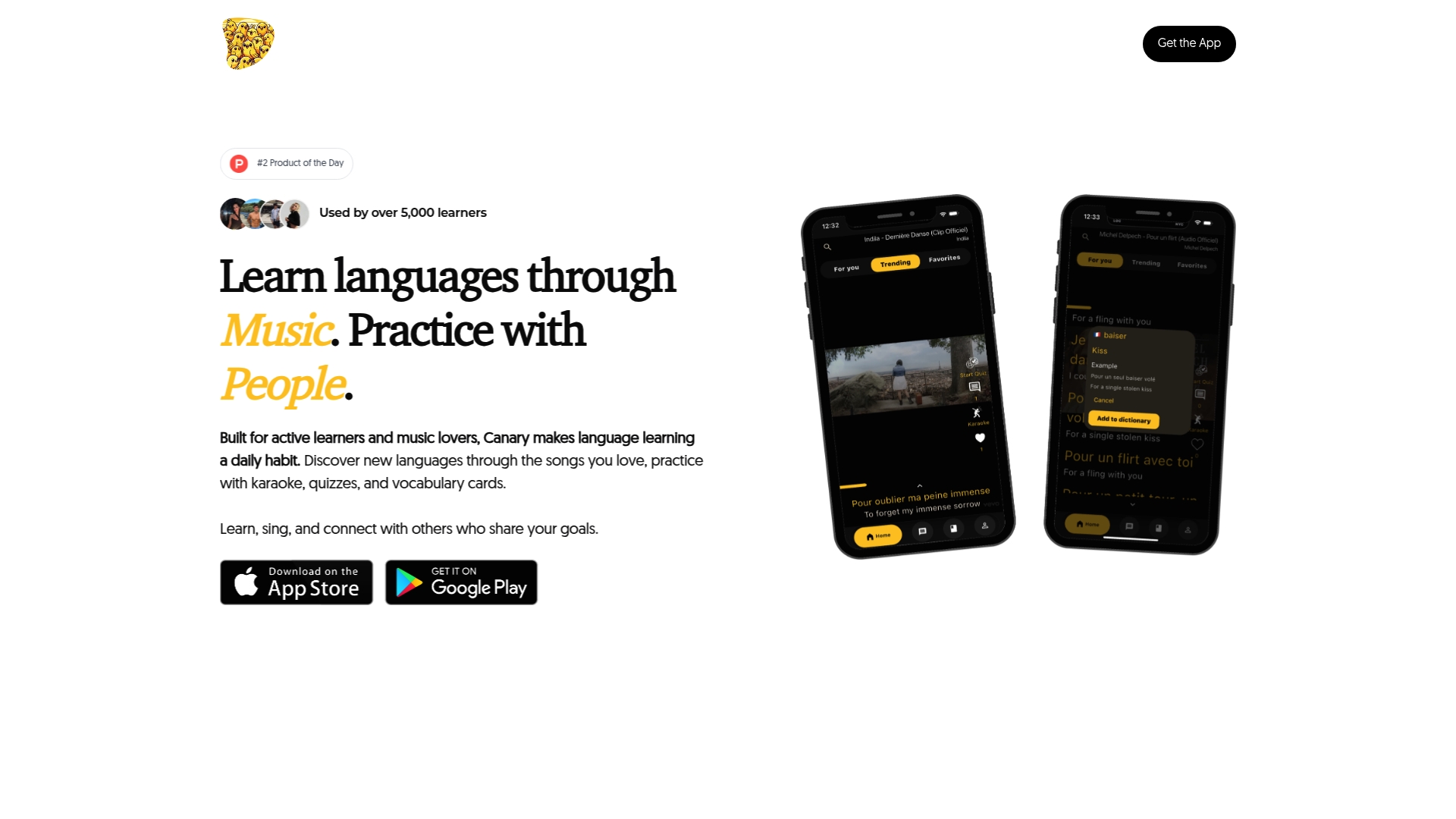
On Canary, you can practice with real songs, build vocabulary through interactive lyrics, and connect with learners from around the world who share your taste in music. Join the weekly music learning challenges to stay consistent without it feeling like a chore. Ready to make music your method? Create your free account and start singing your way to fluency today.
Frequently asked questions
Which songs are best for beginner language learners?
Songs with simple, repetitive lyrics and high A1-level vocabulary are ideal. For example, 41.44% of Taylor Swift’s vocabulary sits at the A1 level, making her catalog a practical starting point alongside children’s songs.
How do song-based activities help with pronunciation?
Singing trains you to mimic rhythm, stress, and sound patterns naturally. Research confirms music is strong for phonological gains, outperforming silent reading for pronunciation development.
Do song-based activities improve speaking fluency?
Yes. Studies show that interactive, repeated group tasks using songs produce significant fluency improvements in speaking accuracy and lexical density over time.
Can I use song-based activities to learn advanced vocabulary?
Most popular songs are better for general and beginner vocabulary. Advanced learners benefit from supplementing with genre-specific tracks or targeted content, since mainstream songs are less suited for upper-level vocabulary development.