TL;DR:
- Practicing daily with song-based drills, self-recordings, and social feedback greatly improves French pronunciation.
- Focusing on meaningful sounds like nasal vowels and U versus OU leads to clearer speech faster than perfecting the R.
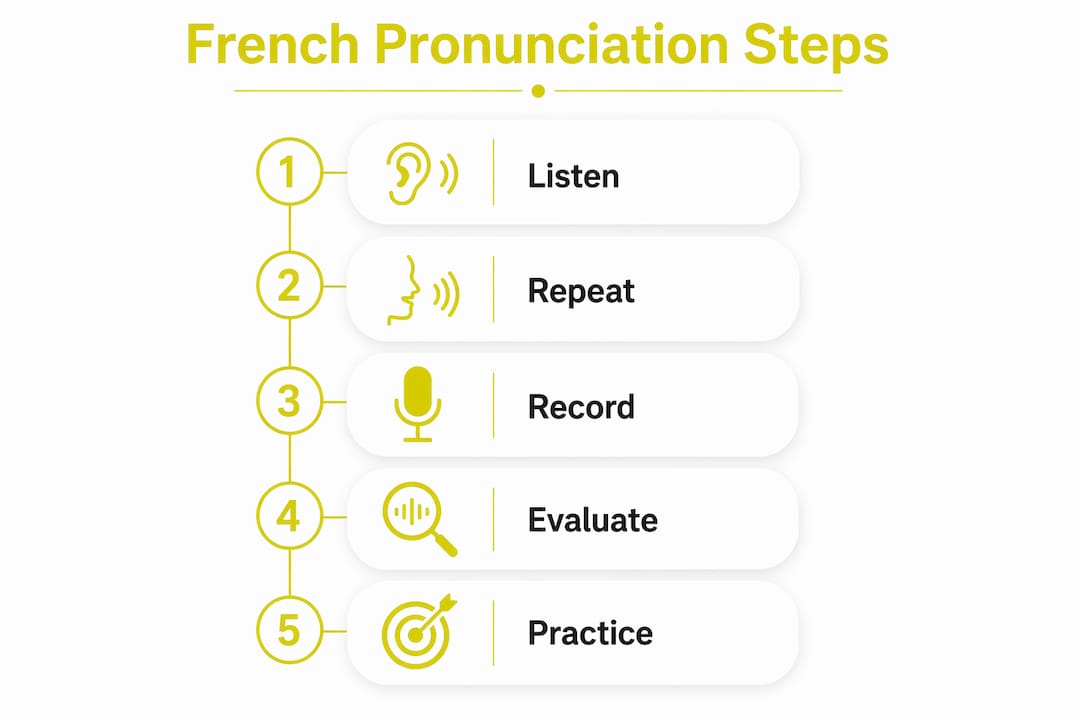
Start now. Use this six-step music-first routine to make your French pronunciation intelligible in weeks, not months.
- Diagnose: Record yourself reading three French sentences. Note where you stumble.
- Drill one sound: Pick one target (nasal vowel, U vs. OU, or É/È) and spend five minutes on it.
- Pair with a song: Find a 20–40 second clip where that sound appears in the chorus or hook.
- Shadow: Play the clip, sing along, and match the rhythm syllable by syllable.
- Record again: Compare your take to the original. Note one specific difference.
- Get social feedback: Share your recording with a native speaker or fellow learner and ask one focused question.
Do this daily for about one month. Many learners notice a real shift in clarity after a short period of focused practice, especially on the sounds that cause the most confusion for English speakers.
Table of Contents
- Why does rhythm matter more than a perfect R?
- A repeatable practice system you can follow every day
- Which French sounds should you prioritize first?
- What does a 4-week practice roadmap look like?
- How do you record, evaluate, and get useful feedback?
- Common mistakes English speakers make and how to fix them fast
- Key Takeaways
- Why music and social practice changed how I think about pronunciation
- Singwithcanary puts song-based pronunciation practice in one place
- Useful sources and further practice
Why does rhythm matter more than a perfect R?
The biggest misconception in French pronunciation is that the guttural R is the hardest thing to fix and the most urgent. It is not. Expert teachers report that an imperfect R is almost always understandable in context, while mispronounced nasal vowels or a confused U/OU contrast cause immediate comprehension breakdown. Native speakers will follow your meaning with a slightly off R. They will lose you entirely if “tu” sounds like “tout.”
The second thing English speakers get wrong is stress. French is syllable-timed, meaning every syllable gets roughly equal weight. English is stress-timed, so we naturally punch certain syllables and swallow others. Carry that habit into French and your speech sounds choppy and foreign, even when every individual sound is correct.
Pro Tip: Before your next practice session, say a French sentence out loud and tap your finger once per syllable. If some taps are harder than others, you are importing English stress. Flatten it out.
A repeatable practice system you can follow every day
The system has four phases: diagnose, focused drills, song integration, and review. Veteran instructors recommend daily repetition of high-impact sounds combined with consistent listening and self-recording. That combination builds muscle memory faster than any scattered tip collection.
Here is how to structure a single session:
- Diagnose (2 min): Read two sentences aloud and record. Listen back for one specific error.
- Focused drill (5 min): Repeat the target sound in isolation, then in a minimal pair (e.g., “tu” vs. “tout”), then in a full word.
- Song integration (8 min): Find a 20–40 second clip that features your target sound. Loop it. Sing along three times, then record yourself singing it once.
- Compare (3 min): Play your recording next to the original. Note one mouth or breath difference.
- Corrective review (2 min): Repeat the corrected version five times slowly, then five times at normal speed.
Weekly rhythm: Five micro-sessions (20 min each) plus one longer Saturday session (45 min) where you review the week’s recordings side by side.
When to move on: If you can produce the target sound correctly in a sung phrase consistently over multiple sessions, shift to the next sound on your list.

Pro Tip: Pick songs you actually enjoy. Motivation drops fast when the clip feels like homework. A chorus you want to sing is a drill you will repeat.
For a deeper look at pronunciation training methods that support this kind of structured practice, the research on iterative repetition is consistent: frequency beats duration every time.
Which French sounds should you prioritize first?
A focused set of six targets accounts for most “I can’t understand you” moments in French. Training these consistently improves clarity in weeks.
| Sound | Why it matters | Quick song-based drill |
|---|---|---|
| Nasal vowels (AN/ON/UN) | Confusing “bon” and “beau” changes meaning entirely | Sustain the nasal on a held note; find a ballad with “on” in the chorus |
| U vs. OU | “tu” (you) vs. “tout” (all) — instant confusion | Alternate “tu/tout” on two notes; pick a pop hook with both sounds |
| É vs. È/Ê | “chanter” vs. “chanté” — tense/meaning shift | Sing the word with each accent; find a verb-heavy chorus |
| Liaison and enchaînement | Ignoring liaison makes speech sound choppy | Practice linking “les amis” across a melody line |
| Mute E | Dropping or keeping it changes rhythm | Count syllables in a lyric line; check which E’s disappear in the recording |
| The R | Less urgent than the above, but worth gradual work | Hum the R on a note at the back of the throat; do not force it |
For each sound, use minimal pairs in your drill before moving to a full lyric line. “Tu” vs. “tout” for two minutes, then find those words in a chorus and sing the contrast. That sequence, isolation to context, is what makes song-based drills stick.
Practicing French accents effectively also means understanding why É and È look similar but sound distinct. The acute accent (é) gives a closed, tense “ay” sound; the grave (è) opens into something closer to “air.” Singing both in the same phrase locks in the contrast faster than any written rule.
What does a 4-week practice roadmap look like?
| Week | Daily focus (20 min) | Weekly milestone |
|---|---|---|
| 1 | Rhythm + nasal vowels | Produce AN/ON/UN correctly in some common words |
| 2 | U vs. OU + É/È | Reliably distinguish U and OU in common words |
| 3 | Liaison + mute E | Link words smoothly across a full sung phrase |
| 4 | R + full-sentence review | Record a clip and hear clear improvement versus the start of practice |
Each week, add one Saturday session where you listen to your Week 1 recording and compare it to your most recent one. That contrast is motivating and diagnostic at the same time.
If Week 2 feels shaky, repeat it. There is no penalty for an extra week on U vs. OU. Rushing to Week 3 with an unresolved contrast just layers confusion. Developing a consistent daily habit matters more than hitting an arbitrary weekly deadline.
How do you record, evaluate, and get useful feedback?
Recording yourself daily and comparing that recording directly to native audio is the single fastest ear-training method available. The gap between what you think you sound like and what you actually produce closes quickly once you hear it.
Self-evaluation checklist (listen for these in order):
- Rhythm: does every syllable get equal weight, or are some swallowed?
- Target sound: did you produce the nasal, U, or É correctly?
- Liaison: did you link words across boundaries, or did you pause between them?
- Mute E: did you drop the right E’s, or did you add extra syllables?
Quick comparison method: Isolate a single sentence from the native clip. Loop it three times. Record yourself saying the same sentence. Play both back to back. Note one specific difference, not five. Fix that one thing tomorrow.
Feedback prompts for peers or tutors:
- “Does my rhythm sound choppy or smooth?”
- “Can you tell the difference when I say ‘tu’ versus ‘tout’?”
- “Which word sounds most foreign to you?”
Ignore general comments like “your accent is good.” Ask for the one word or sound that still sounds off. That specificity is what moves the needle. For structured ear training exercises built around music, the same principle applies: one target per session, not ten.
Common mistakes English speakers make and how to fix them fast
- Word-by-word stress: You are punching random syllables. Fix: tap once per syllable before speaking and flatten the rhythm deliberately.
- Mixing U and OU: Say “ee” with rounded lips for U. If your mouth is open, you are saying OU. Practice in a mirror.
- Ignoring nasal vowels: You are pronouncing the N as a full consonant. Fix: let the sound come through your nose before the N fully closes. The N should almost disappear.
- Dropping liaison: You are treating each word as an island. Fix: when a word ends in a consonant and the next starts with a vowel, link them. “Les amis” becomes “lay-za-mee.”
- Over-drilling the R: Spending 20 minutes on R while ignoring nasals is the most common time-waster. Focus on meaning-changers first. The R can be imperfect and still be understood.
A small imperfection is acceptable when it does not change the word’s meaning and a native speaker can still follow you. It needs focused practice when it causes a real communication breakdown, like U vs. OU or a missing nasal. Knowing how to get rid of accent habits that come from English requires identifying which habits actually block comprehension, not just which ones sound foreign.
Key Takeaways
Rhythm and a handful of meaning-changing sounds, trained daily through song-based drills and self-recording, produce faster French pronunciation gains than chasing a perfect R.
| Point | Details |
|---|---|
| Prioritize meaning-changers | Train nasal vowels, U vs. OU, and É/È before spending time on the R. |
| Rhythm first | French is syllable-timed; flatten English stress patterns from day one. |
| Daily recording wins | Compare one sentence to native audio each session to close the gap between perceived and actual production. |
| Song drills stick | Loop a 20–40 second clip, shadow it, then record yourself; repetition in context beats isolated drills. |
| Singwithcanary | Combines karaoke clips, social feedback, and ear training in one music-first platform for daily practice. |
Why music and social practice changed how I think about pronunciation
The conventional wisdom says pronunciation is a solo grind: repeat sounds, drill minimal pairs, and eventually your mouth figures it out. That is partly true. But it misses the single biggest accelerant, which is feedback from a real listener in a low-stakes context.
Singing a French lyric and then sharing that recording with someone who speaks the language is a fundamentally different experience from drilling in isolation. You hear yourself differently when you know someone else will hear it too. And the social element, the actual back-and-forth with a native speaker or fellow learner, catches errors that no self-evaluation checklist will surface. You cannot hear your own blind spots.
Music also solves the repetition problem. Nobody wants to say “tu/tout” fifty times in a row. But singing a chorus that contains both sounds? That happens naturally, without counting reps. The motor memory builds the same way, but the experience is completely different.
Singwithcanary puts song-based pronunciation practice in one place
If the system above sounds like exactly what you need but you want it structured and social from day one, Singwithcanary is built for that.
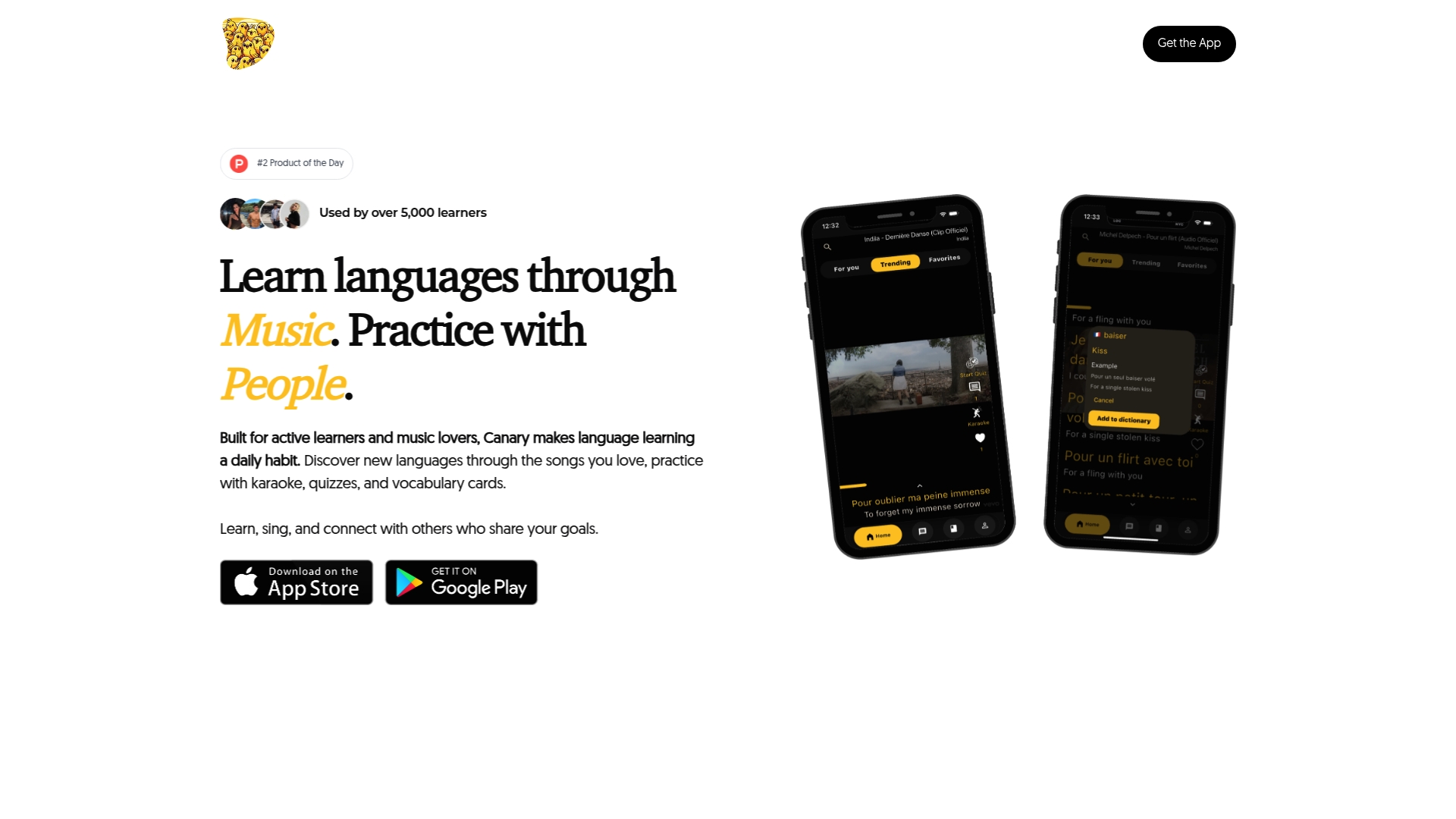
The platform pairs karaoke-style lyric practice with vocabulary cards, quizzes, and ear training, all built around real songs. You drill your target sounds inside actual music, not invented sentences. The social layer connects you with native speakers and other learners so you get the focused feedback this guide recommends, without hunting for a language partner on your own. Singwithcanary runs on a freemium model, so you can start learning with music for free and upgrade to Premium when you want the full song library and social features.
Check out the song of the week for a ready-made pronunciation drill, or sign up now and start your first session today.
Useful sources and further practice
- Lawless French Pronunciation Lessons — sound files and phonetic breakdowns for every French letter and combination; excellent for audio reference.
- Collins Easy Learning French Pronunciation — 20-episode podcast with illustrated mouth diagrams; strong for beginners who want guided audio.
- Talk in French Pronunciation Guide — free PDF and audio download covering vowels, consonants, nasals, and liaison with example sentences.
- FrenchToday Audio Pronunciation Guide — phonetic breakdowns with recordings and sample sentences; useful for repeatable listening drills.
- Singwithcanary: learn French with music — music-integrated platform for daily pronunciation and ear-training practice with social feedback.