TL;DR:
- A daily 15-minute routine using mouth warm-ups, sound drills, shadowing, and recording can significantly improve pronunciation in six to eight weeks. Shadowing and singing with targeted app features help learners develop natural rhythm, stress, and intonation efficiently and with consistent feedback. Tracking progress with recordings and focusing on targeted sounds accelerates mastery and reduces plateauing.
A compact daily routine combining mouth-muscle warm-ups, focused sound drills, shadowing with song lines, and a quick end-of-day recording produces measurable pronunciation gains in 6–8 weeks. That is the roadmap. Everything below unpacks how to run it.
Start today with this checklist:
- Pick one target sound (a vowel or consonant you consistently miss)
- Find a song line that contains that sound at least twice
- Set a 15-minute timer and follow the warm-up → drill → shadow → record sequence
- Play back your recording and note one specific difference from the native model
- Repeat the same sound target for three days before switching
Shadowing trains rhythm, stress, and intonation simultaneously and is widely cited as the most effective method for natural-sounding speech. Pairing it with song lines keeps practice short and repeatable. Singwithcanary is built around exactly this approach: karaoke mode, lyric cards, and ear-training exercises that slot into a 15-minute session without needing a classroom or a tutor.
Table of Contents
- What does a step-by-step pronunciation improvement plan actually look like?
- How to do the core exercises correctly
- How music apps accelerate your pronunciation practice
- How do you measure pronunciation progress and fix plateaus?
- Key Takeaways
- Why the “just listen more” advice keeps failing adult learners
- Singwithcanary makes the 15-minute routine stick
What does a step-by-step pronunciation improvement plan actually look like?
Short, daily sessions outperform irregular long ones because mouth muscles need consistent repetition to form durable speech motor patterns. Fifteen minutes a day beats ninety minutes on Saturday.
The daily 15-minute session structure
| Minutes | Activity | Purpose |
|---|---|---|
| 1–3 | Lip buzzes, tongue stretches, jaw rolls | Warm up articulators |
| 3–7 | Focused sound drill (one target phoneme) | Build muscle memory |
| 7–10 | Minimal pairs practice | Sharpen perception and production |
| 10–13 | Read-aloud or shadow a song line | Connect sounds to natural speech |
| 13–15 | Record yourself, compare to model | Identify gaps and track progress |
The 6–8 week progression
Weeks 1–2 (Foundations): Identify your three weakest sounds by recording a short paragraph and comparing it to a native speaker. Learn the IPA symbols for those sounds so you can decode any dictionary entry or lyric card. Spend each session on one sound only.

Weeks 3–4 (Focused sound building): Rotate through a weekly target sequence: vowels → fricatives → long vowels → plosives → r/l contrasts → consonant clusters → review. Each pattern gets distributed practice across multiple days rather than one marathon session.
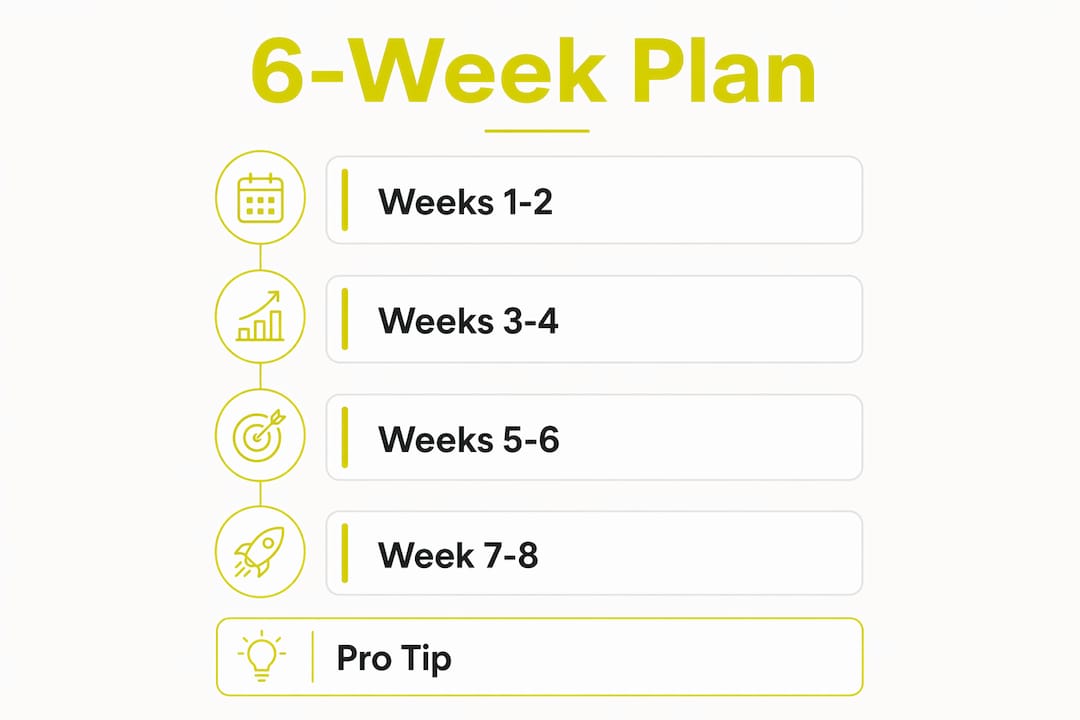
Weeks 5–6 (Prosody and connected speech): Shift focus from individual phonemes to word stress, sentence rhythm, and intonation. Shadow full song phrases rather than isolated words. Clap or tap the beat of a sentence to feel where stress falls.
Weeks 7–8 (Real-world fluency, optional): Use the full session for connected speech: shadow a 30-second clip, record a short monologue on a familiar topic, and compare it to your Week 1 baseline.
Pro Tip: Habit-stack your practice onto something you already do daily, like morning coffee or a commute. Set a two-minute timer for the warm-up only; once you start, the rest follows naturally. If your voice feels strained after a session, shorten the read-aloud segment first rather than skipping the whole routine.
How to do the core exercises correctly
Shadowing
Shadowing means listening to a native audio clip and repeating it in real time, matching rhythm, stress, and intonation rather than just words. The steps:
- Choose a clip of 10–20 seconds with clear enunciation and moderate tempo.
- Listen once without speaking to absorb the melody of the sentence.
- Play it again and speak simultaneously, staying half a beat behind the speaker.
- Replay and focus on one feature: stress pattern, then linking, then intonation rise or fall.
- Repeat the same clip three times before moving on.
Common mistake: trying to shadow too fast. Slow the playback to 75–80% speed until your mouth catches up with the pattern.
Mouth-muscle warm-ups
Pronunciation is a physical skill, and targeted articulator training shortens the time needed to produce unfamiliar sounds. Run these before every session:
- Lip buzzes: Press lips together and exhale steadily to create a vibration for 5 seconds. Loosens lip tension.
- Tongue stretches: Push the tongue tip to the roof of the mouth, then to each corner of the lips. Hold each position for 3 seconds.
- Jaw rolls: Open the jaw wide, then circle it slowly left and right. Three rotations each direction.
- Exaggerated vowel shapes: Say /iː/, /æ/, /ɑː/, /ɔː/, /uː/ in sequence, holding each for 2 seconds and feeling the jaw and tongue position change.
Minimal pairs for precision
Minimal pairs sharpen perception and production of closely related phonemes, which directly reduces misunderstandings in real conversation. Select pairs that target your identified weak sounds (ship/sheep, bit/beat, cat/cut). Practice in three stages: hear the difference, produce the difference, then embed both words in a sentence. Aim for 10 reps per pair before moving to sentence-level practice.
Pro Tip: Exaggerate prosody early. When practicing intonation, make your pitch rises and falls twice as dramatic as they need to be. It feels theatrical, but it trains the muscle range. You can dial it back once the pattern is automatic.
How music apps accelerate your pronunciation practice
Songs force you to match rhythm and intonation naturally, bypassing the stiffness of formal drills. The low-pressure setting of singing also lets you attempt sounds you would avoid in conversation. For a deeper look at integrating songs into your routine, the guide on improving pronunciation with music covers the method in full.
What app features actually matter
- Adjustable playback speed: Slow a song line to 70% to hear consonant cues clearly before matching full tempo.
- Looping short sections: Repeat a two-bar phrase until your articulation matches the model, not just the words.
- Lyrics display with syllable timing: Seeing which syllable lands on the beat makes stress patterns visible, not just audible.
- Recording and comparison: Hearing yourself next to the model is the fastest feedback loop available without a teacher.
- Scoring or real-time feedback: Apps that provide instant feedback help maintain motivation within short sessions.
How to pick song lines for practice
Choose lines with clear consonant cues, moderate tempo, and no more than eight syllables. When you find a line that contains your target sound, select it deliberately: do a slow first pass to nail articulation, then increase speed to match the song while keeping each consonant deliberate. Sequence song practice across the week by pairing Monday’s target sound with a line that features it prominently, then revisiting the same line on Thursday at full tempo.
How Singwithcanary supports the routine
Singwithcanary’s karaoke mode, lyric timing cards, and ear-training exercises map directly onto the 15-minute session structure. The social layer, practicing with other learners or native speakers through duets and challenges, adds the kind of gamified consistency that keeps mouth-muscle learning on track day after day. The Song of the Week feature gives you a pre-selected practice track with clear pronunciation targets built in, so you spend zero time hunting for material.
Learners who practice with Singwithcanary’s karaoke and lyric features report noticeably better rhythm and accent clarity after consistent use, with many describing the app as the first tool that made daily pronunciation practice feel worth returning to.
How do you measure pronunciation progress and fix plateaus?
Simple, repeatable measures
- Record a 30-second paragraph at the start of each week and compare it to the previous week’s recording.
- Run a minimal pairs self-test: say both words in a pair aloud and check whether a listener (or speech-recognition software) distinguishes them correctly.
- Track intelligibility in real conversations: if people stop asking you to repeat yourself, that is a concrete signal.
- Use app-based scores as a secondary metric, not the primary one.
Milestone checkpoints
| Checkpoint | Expected signs of progress |
|---|---|
| 2 weeks | Clearer vowel shapes; you can hear your own errors on playback |
| 4 weeks | Improved word stress; fewer misunderstandings in short exchanges |
| 8 weeks | Better sentence rhythm and linking; target sounds feel automatic in familiar phrases |
Common stalls and quick fixes
Vocal fatigue: Shorten the read-aloud segment and add an extra warm-up day. Never push through a strained voice.
Over-focus on accent: Accent reduction is a byproduct of clear articulation, not a goal in itself. Redirect attention to specific phonemes and stress patterns rather than “sounding native.”
Jumping topics too fast: If a sound is not automatic in isolated words, it will not transfer to sentences. Stay on one target until it holds under mild time pressure.
Pro Tip: When you get feedback from a native speaker or a teacher, ask them to name one specific sound or pattern to fix, not general impressions. A single targeted correction is worth more than ten rounds of “you sound better.”
When to get targeted help
Persistent intelligibility issues after eight weeks, phonemes that simply do not exist in your native language (English /θ/, tonal distinctions in Mandarin or Thai), or a professional context where accent clarity matters directly, all warrant a session with a pronunciation coach or a structured course. For tone-language learners, a resource like this guide to Thai pronunciation shows how the same step-by-step logic applies to a very different sound system.
Key Takeaways
A daily 15-minute routine combining mouth-muscle warm-ups, shadowing, minimal pairs, and song-line practice produces measurable pronunciation gains when repeated consistently over 6–8 weeks.
| Point | Details |
|---|---|
| Daily 15 minutes beats long sessions | Consistent short practice builds durable speech motor patterns faster than occasional long ones. |
| Shadowing is the priority method | Matching rhythm, stress, and intonation in real time trains natural-sounding speech more directly than reading alone. |
| Songs bypass drill stiffness | Singing forces prosody practice in a low-pressure setting, making intonation and rhythm feel natural rather than mechanical. |
| Measure progress at 2, 4, and 8 weeks | Recorded comparisons and intelligibility checks give concrete evidence of gains and reveal where to focus next. |
| Singwithcanary fits the routine | Karaoke mode, lyric timing, ear training, and social practice make the 15-minute daily structure easy to maintain. |
Why the “just listen more” advice keeps failing adult learners
Most pronunciation guides tell you to immerse yourself: watch more TV, listen to podcasts, absorb the language. That advice is not wrong, but it is incomplete in a way that costs motivated adult learners months of wasted effort.
Passive listening builds recognition. It does not build production. Your mouth muscles have no idea what your ears just heard. The gap between understanding a sound and reliably producing it is a physical one, and it closes only through deliberate repetition with feedback.
The music-first approach addresses this directly. Singing a line forces your articulators into specific positions at a specific tempo. You cannot fake it the way you can fake comprehension. That is why learners who add structured song practice to their routine tend to see faster gains in rhythm and stress than those who only drill isolated phonemes. The song provides the prosodic frame; the drill provides the precision.
The other underrated piece is the recording habit. Most learners skip it because listening to yourself is uncomfortable. That discomfort is the point. Your ear calibrates to your own voice over time, and the gap between what you think you sound like and what you actually sound like narrows only when you confront the recording regularly.
Singwithcanary makes the 15-minute routine stick
Knowing the routine is one thing. Having a tool that makes it frictionless is another. Singwithcanary is built for exactly the learner this article describes: motivated, short on time, and looking for a practice environment that does not feel like homework.
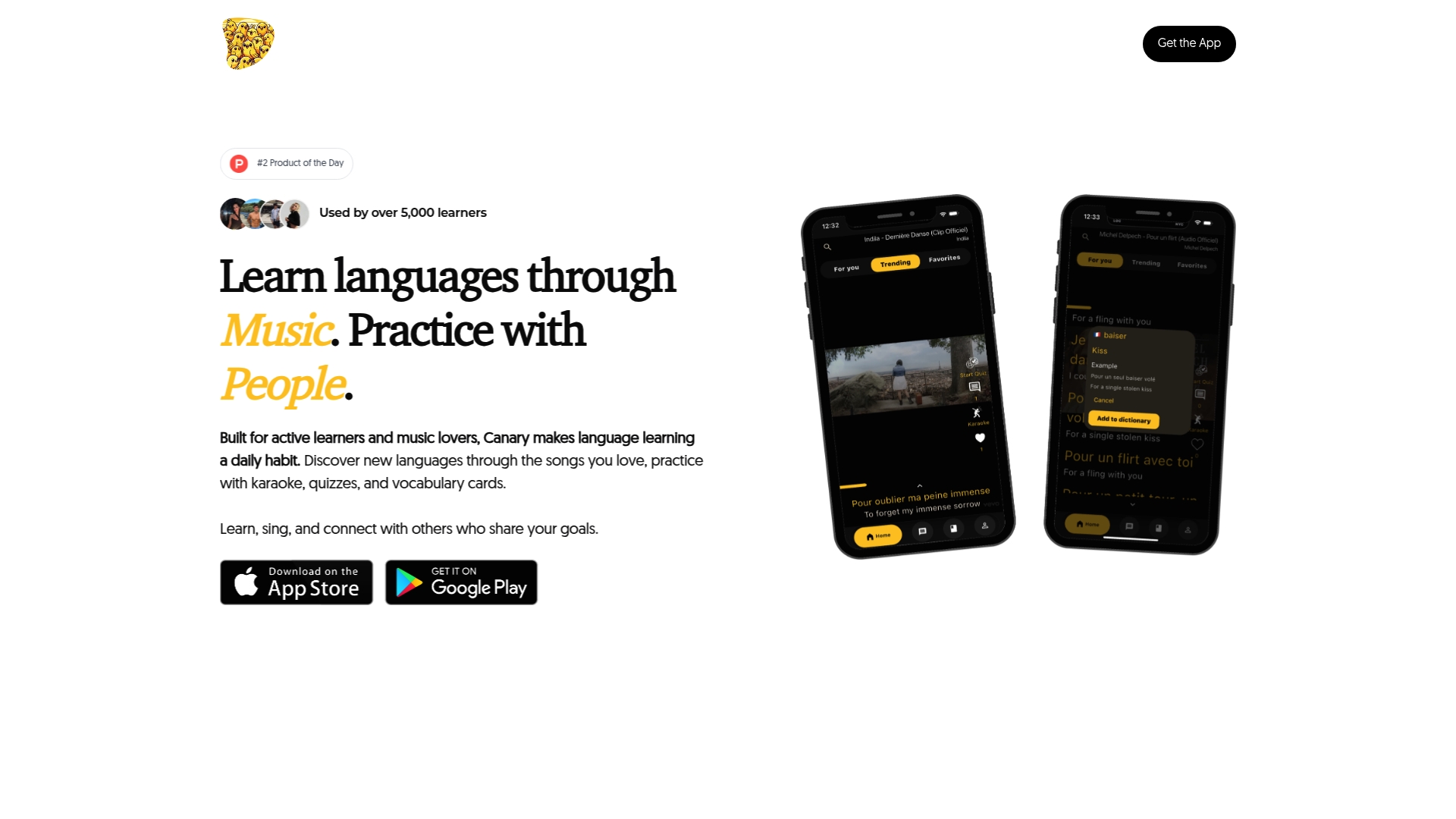
The karaoke mode gives you real-time lyric timing so you can shadow song lines the way this plan describes. Ear-training exercises target the specific phonemes you are working on. The Song of the Week gives you a pre-selected track with clear pronunciation targets, so your Monday session starts in seconds rather than minutes of searching. And the social layer, practicing with other learners and native speakers through duets and challenges, adds the accountability that keeps a 15-minute habit alive past week two.
Learn languages with music on Singwithcanary, or sign up today and start your first 15-minute session with this week’s featured song.