TL;DR:
- Using songs for language learning enhances vocabulary, pronunciation, and cultural understanding through active analysis and social practice. Consistent engagement with tailored songs, drills, and community interaction accelerates cultural fluency faster than passive listening alone. Singwithcanary offers tools that integrate all seven steps for effective, immersive language development.
Seven concrete steps will move you from passive listener to culturally fluent speaker: choose songs intentionally, analyze lyrics actively, drill pronunciation through karaoke and shadowing, decode register and slang, practice socially, build a measurable habit, and handle cultural material with care. A quasi-experimental study found song-based learners gained a mean vocabulary score of +33 versus +15 for traditional instruction. That gap is the whole argument for this method.
Your seven steps at a glance:
-
Pick songs with clear lyrics, cultural weight, and genre variety
-
Annotate lyrics using a three-pass method (gist → translation → cultural questions)
-
Drill pronunciation: karaoke runs, 30-second micro-sequences, shadowing
-
Extract register, slang, and pragmatic norms from lyrics
-
Move into socially authentic practice with native speakers and community
-
Build a low-anxiety daily habit and track measurable gains
-
Practice cultural sensitivity and ethical use of songs
Start in the next 10 minutes: Open Singwithcanary, pick one song in your target language, and do a single gist-listen before reading the lyrics. That first pass is Step 1.
Table of Contents
- How do you choose songs that actually teach you culture?
- How do you decode meaning and cultural context from lyrics?
- Can karaoke and shadowing really improve your pronunciation?
- What can song lyrics teach you about register and slang?
- How do you turn song practice into real social interaction?
- How do you build a daily habit and measure whether it’s working?
- What do you need to know about cultural sensitivity when using songs?
- How Singwithcanary applies all seven steps in one workflow
- A 4-week music-driven practice plan
- Why songs connect to history, customs, and festivals
- How do you balance language skill and cultural learning in one session?
- How do music videos and live performances deepen cultural understanding?
- How do you avoid regional and genre bias in your music choices?
- Key Takeaways
- What actually changes when a song clicks culturally
- Singwithcanary puts these seven steps in one place
- Recommended resources and further reading
How do you choose songs that actually teach you culture?
Most learners grab whatever is trending. That works for motivation, but it misses the point. Music carries emotion, slang, politics, and regional identity that textbooks rarely touch, so your selection criteria matter.

Three song types cover the cultural spectrum: one slow ballad (clear diction, emotional vocabulary), one current pop track (contemporary slang, everyday register), and one traditional or folk piece (historical references, regional dialect). Rotate these weekly so you never get stuck in one cultural corner.
Quick checks before you commit to a song: official lyrics exist somewhere reliable, the release year is visible (context shifts fast), and the artist’s regional background is findable. A cumbia from Medellín and one from Mexico City carry different slang and social references even when the genre label is identical.
Pro Tip: Use Singwithcanary’s Song of the Week feature to get a pre-vetted track with cultural context already attached. It removes the selection paralysis and guarantees genre variety over time.
How do you decode meaning and cultural context from lyrics?
A single listen does almost nothing. The three-pass method forces real attention:
- Gist pass — listen without the lyrics. What is the mood? What topic do you think it covers? Write two sentences.
- Line-by-line pass — read the official lyrics while listening. Timestamp any phrase you cannot translate immediately. Note register: is this formal, casual, or intimate?
- Cultural questions pass — for each flagged phrase, ask: Who would say this? When? Is there a historical event, festival, or social custom behind it? Write the answer in a short annotation.
Dual coding — reading lyrics while listening — engages both auditory and visual memory, producing stronger retention than either mode alone. Save flagged vocabulary as cards in Singwithcanary’s vocabulary feature so they resurface during review. Understanding why cultural context matters in language learning is what separates a learner who memorizes words from one who actually communicates.
Can karaoke and shadowing really improve your pronunciation?
Yes, and the mechanism is specific. Music lowers the affective filter — the anxiety barrier that makes learners freeze before attempting a difficult sound. When you are singing, the social stakes feel lower, so you take phonetic risks you would avoid in conversation.
Three drills that produce results:
Karaoke run: Sing the full song in Singwithcanary’s karaoke mode. Do not stop to correct yourself. The goal is prosody and rhythm, not perfection.
30-second micro-sequence drill: Pick one chorus. Replay it three times in a row, reading the lyrics simultaneously. On the third pass, cover the text and sing from memory.
Shadowing with tempo reduction: Use a slowed playback setting. Match the singer’s mouth shape and stress pattern, not just the words. Record a 30-second clip of yourself, then compare it to the original. The gap you hear is your next target.
Aim for two 10-minute drill blocks per day. That is enough to see measurable pronunciation shifts within four weeks.
What can song lyrics teach you about register and slang?
Register is the social dial between formal and intimate, and songs move across it constantly. A love ballad might open with poetic, elevated language and drop into street slang by the bridge. That shift is a lesson in itself.
Practical exercise: take one chorus line and rewrite it three ways.
- Formal version: the kind of phrasing you would use in a job interview or with a professor
- Neutral version: everyday polite conversation with a stranger
- Casual version: texting a close friend
This forces you to understand the original’s register rather than just memorize it. Learning about music-infused language skills shows why pragmatic context is as important as vocabulary count.
One firm warning: do not lift slang from songs and drop it into real conversations without checking its current social weight. Some expressions are regional, dated, or offensive outside their original context. Verify with a native speaker before using anything that felt edgy in the lyrics.
How do you turn song practice into real social interaction?
Passive listening builds recognition. Speaking builds fluency. Sociocultural theory is clear that language develops through participation in cultural activities and dialogue, not through consumption alone.
Three formats that work:
Duet singing: Sing a song with a language partner in Singwithcanary’s social features. The shared reference gives you an immediate conversation topic.
Lyric discussion: Post a line from the song in a community space and ask what it means culturally. The answers teach you more than any dictionary.
Conversation prompts tied to the song: “What historical event does this lyric reference?” “Would you say this phrase to your grandmother?” These questions move the exchange from language mechanics to authentic cultural interaction.
A learners-as-ethnographers approach — treating every social interaction as field observation — accelerates the move from peripheral participation to full community membership. Watch how native speakers respond to the song. Notice what they find funny, moving, or politically charged. That reaction is cultural data.
How do you build a daily habit and measure whether it’s working?
Consistency beats intensity. A 15-minute daily session outperforms a two-hour weekend session for vocabulary retention and pronunciation accuracy.
Weekly habit template:
- Monday/Wednesday/Friday: 10-minute pronunciation drill (karaoke + micro-sequence)
- Tuesday/Thursday: 15-minute lyric annotation and vocabulary card review
- Saturday: 20-minute social practice (duet, discussion, or language exchange)
- Sunday: reflection — log three new words used correctly in conversation
Metrics to track:
- New lexical items retained (test yourself: can you use the word in a sentence without looking?)
- Pronunciation accuracy (compare your recordings week over week)
- Instances of correct pragmatic use in real conversation
Music-based instruction increases motivation and lowers speaking anxiety, which means you are more likely to attempt authentic speech. Use that lowered anxiety deliberately: set one speaking risk per session, something you would normally avoid saying because you are unsure of the pronunciation or register.
By week 4, expect to recognize and use new lexical items from your songs through consistent practice. By week 12, pragmatic accuracy in conversation can improve with ongoing practice and social interaction.
What do you need to know about cultural sensitivity when using songs?
Some songs carry weight that is not obvious from the melody. A folk song might be a protest anthem. A lullaby might reference a historical trauma. Singing it casually in a community space can land badly.
Before performing or sharing any song publicly, run this checklist:
- Is this song associated with a religious ceremony or sacred tradition?
- Does it reference a specific political conflict or historical event?
- Is the dialect or accent in the song tied to a marginalized community?
- Have you verified the translation with a native speaker, not just a machine?
If the answer to any of these is yes or uncertain, listen and learn privately before sharing. When you do discuss sensitive material in community spaces, lead with a question rather than a performance: “I noticed this lyric references X — can someone help me understand the context?” That posture signals respect and usually generates the richest cultural explanation.
Never mimic a dialect for comedic effect. Caricaturing an accent, even unintentionally, signals that you see the culture as a costume rather than a community.
How Singwithcanary applies all seven steps in one workflow
Singwithcanary maps directly onto every step above. Here is how the features line up:
- Song selection: Browse by language, genre, and cultural region; the Song of the Week feature provides a pre-contextualized track with background notes
- Lyric annotation: Read synchronized lyrics during playback; save flagged phrases as vocabulary cards that resurface in spaced-repetition quizzes
- Karaoke and micro-sequences: Karaoke mode with real-time feedback; replay any 30-second segment in loop mode for focused drilling
- Register and slang: Vocabulary cards include usage notes and register labels (formal/casual/slang)
- Social practice: Duet features, community lyric discussions, and language exchange matching with native speakers
- Progress tracking: Vocabulary retention logs and pronunciation comparison tools
- Cultural sensitivity: Community guidelines built into discussion spaces; moderators flag culturally sensitive material
A typical 20-minute Singwithcanary session: pick a song → gist-listen → annotate two flagged phrases → run the chorus micro-sequence three times → post one cultural question in the community → save new vocabulary cards. That single session touches five of the seven steps.
Users report improved accent accuracy and stronger vocabulary retention after consistent use, with the social features cited most often as the element that pushed passive knowledge into active speech.
A 4-week music-driven practice plan
| Week | Focus | Daily Activity | Weekly Checkpoint |
|---|---|---|---|
| 1 | Song selection and lyric analysis | Gist listen + three-pass annotation (15 min) | 10 new vocabulary cards saved; cultural notes written for 3 phrases |
| 2 | Pronunciation drills | Karaoke run + micro-sequence drill (15 min) | Recording comparison shows 2+ target sounds improved |
| 3 | Social practice | Duet or lyric discussion + conversation prompt (20 min) | 3 socially authentic exchanges completed |
| 4 | Consolidation | Full session combining annotation, drill, and social practice (20 min) | 20–30 new lexical items usable in conversation; pragmatic accuracy self-assessed |
At the end of each week, ask three questions: Did I retain the vocabulary I targeted? Did my pronunciation recording improve? Did I complete at least one social interaction in the target language? If two of three are yes, progress to the next week. If not, repeat with a new song in the same genre.
Why songs connect to history, customs, and festivals
Lyrics are rarely just words. A song released during a political movement carries the tension of that moment. A festival anthem encodes the rituals, foods, and social expectations of the event it celebrates. When you research the release context of a song — the year, the artist’s background, the social climate — you get a compressed cultural history lesson.
Practical approach: after your annotation pass, spend five minutes searching the song’s release year and the artist’s region. What was happening socially or politically? Is the song tied to a specific holiday or ceremony? That five-minute search often unlocks the meaning of lines that seemed opaque. Interactive language teaching methods consistently show that contextual anchoring like this accelerates retention and cultural comprehension simultaneously.
How do you balance language skill and cultural learning in one session?
The temptation is to treat them as separate tracks: grammar one day, culture the next. That split actually slows both. Language and culture are the same thing at the level of pragmatics — knowing what to say is inseparable from knowing when and to whom.
A practical balance: spend 60% of each session on language mechanics (pronunciation, vocabulary, grammar patterns in the lyrics) and 40% on cultural questions (who says this, why, in what context). Over a four-week plan, that ratio naturally shifts toward cultural depth as the mechanics become more automatic. Music-based language games are one way to keep both tracks active without the session feeling like a split curriculum.
How do music videos and live performances deepen cultural understanding?
Audio alone gives you sound. Video gives you gesture, setting, costume, and social context. A music video shot in a specific neighborhood, featuring particular clothing or dance styles, is a documentary as much as a performance. Watch it twice: once for the music, once with the sound off to study the visual cultural codes.
Live performance recordings add another layer. Notice how the audience responds. Which lines get the loudest reaction? That crowd response tells you which phrases carry the most cultural charge. A lyric that seems neutral on paper might land as deeply political or emotionally loaded when you see 50,000 people singing it with tears.
How do you avoid regional and genre bias in your music choices?
If you only listen to mainstream pop in your target language, you are learning the cultural vocabulary of one demographic: young, urban, commercially oriented. That is a narrow slice.
Deliberately rotate across: regional folk traditions, protest and political music, religious or ceremonial songs (for listening and cultural study, not performance), comedy and satirical music, and music from different decades. Each genre surfaces a different social register and a different community’s values.
A practical rule: no more than two consecutive songs from the same genre or decade. If Singwithcanary’s Song of the Week is a contemporary pop track, pair it with something traditional from the same language community that week. The contrast between the two is itself a cultural lesson.
Key Takeaways
Music-centered cultural fluency develops fastest when intentional song selection, active lyric analysis, pronunciation drilling, and socially authentic practice combine into a consistent daily habit.
| Point | Details |
|---|---|
| Song selection drives depth | Pick one slow, one pop, and one traditional track weekly to cover the full cultural register. |
| Vocabulary gains are measurable | A quasi-experimental study found that song-based learners gained a mean vocabulary score of +33 compared to +15 for traditional instruction. |
| Micro-sequences beat passive listening | Replay a focused 30-second chorus three times per session for stronger long-term fluency. |
| Social practice closes the gap | Move from annotation to duet singing or lyric discussion to convert passive knowledge into active speech. |
| Singwithcanary covers all seven steps | Karaoke feedback, vocabulary cards, social features, and progress logs map directly onto the full seven-step plan. |
What actually changes when a song clicks culturally
There is a moment most music-based learners describe the same way: you hear a line you have annotated, analyzed, and drilled, and then a native speaker uses it in exactly the right context, and something locks into place. Not just the meaning. The weight of it.
That moment does not come from grammar drills. It comes from the combination of lyric work and social practice — the annotation that made you curious, the community discussion that gave you the speaker’s perspective, and the repeated listening that made the phrase feel natural in your mouth before you ever said it aloud.
The conventional wisdom says cultural fluency takes years of immersion. What the research actually shows is that the bottleneck is not time, it is the quality of engagement. Passive playlist listening for two years produces less cultural competence than six weeks of intentional annotation, drilling, and social interaction. The seven steps in this article are not a shortcut. They are the actual mechanism.
Persistence with this method pays off because it mirrors how native speakers internalize culture: through repetition, social feedback, and emotional resonance. Songs provide all three in a format you can access anywhere, in 15-minute blocks, every day.
Singwithcanary puts these seven steps in one place
Learning a language through music works. Getting the most out of it requires the right tools in the right sequence. Singwithcanary combines lyric annotation, karaoke feedback, spaced-repetition vocabulary cards, and a live community of learners and native speakers into a single app built around exactly this method.
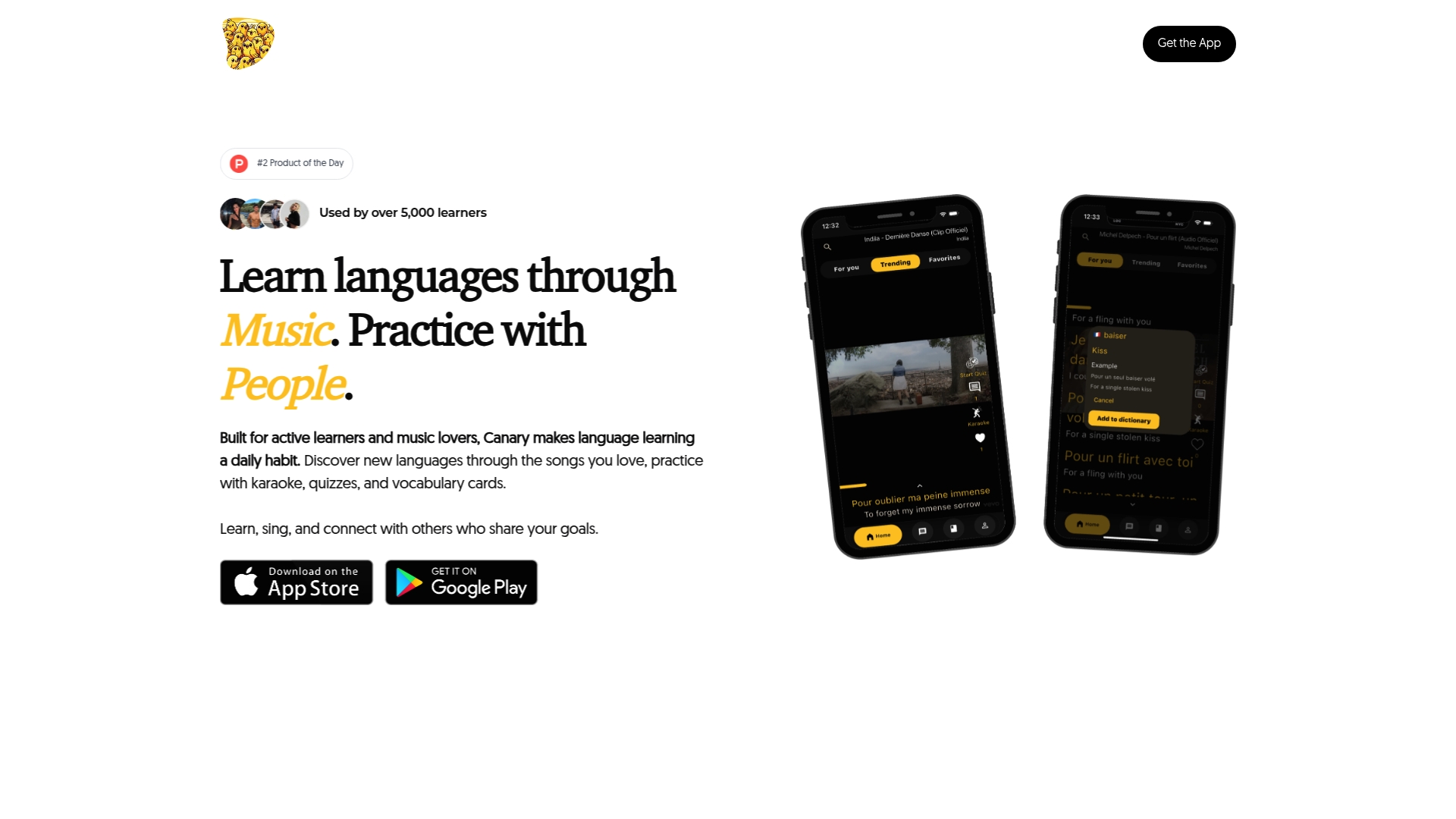
You get song-based pronunciation drills with real-time feedback, vocabulary cards that surface cultural usage notes alongside definitions, duet and discussion features that turn a solo listening session into a social exchange, and progress logs that show you exactly which sounds and words are sticking. The social layer is what most music apps miss entirely. Singwithcanary’s community features mean you can post a lyric question and get a native speaker’s cultural explanation within hours.
Start with the Song of the Week — a pre-vetted track with cultural context already attached — or create a free account and pick your first song in under two minutes.
Recommended resources and further reading
Academic research:
- Learning Languages Through Music and Songs: Cognitive, Pedagogical, and Affective Dimensions — the quasi-experimental study behind the vocabulary gain figures; essential reading for understanding what song-based instruction actually produces
- Micro-Sequences in Music-Based Language Learning — the research behind the 30-second chorus drill; useful for designing your own practice blocks
Practical guides:
- Rationale: Social Networking Sites for Intercultural Competence — ACTFL-aligned framework for why social participation is the core of cultural fluency
- Why Cultural Context Matters in Language Learning — practical explanation of how cultural anchoring accelerates comprehension
Singwithcanary resources:
- What Is Music-Infused Learning for Language Skills — Singwithcanary’s own explanation of the science behind the method
- Why Musicians Learn Languages Faster: The Science — cognitive mechanisms that explain why the drills in this article work