TL;DR:
- Music enhances vocabulary retention by activating multiple brain regions, increasing recall by up to 40 percent.
- Active musical engagement, such as singing and movement, produces better results than passive listening for language learning.
You already know that vocabulary is the backbone of language fluency, yet word lists and flashcard drills rarely stick the way you need them to. The role of music in vocabulary retention is bigger than most learners realize. Research shows that singing recall outperforms rote speaking by a wide margin, and the neuroscience behind that gap is both fascinating and immediately practical. This article breaks down exactly why music works, what kinds of activities deliver the best results, and how you can build a music-infused vocabulary practice today.
Table of Contents
- Key takeaways
- The role of music in vocabulary retention: what the brain is actually doing
- Musical activity types and their effect on word acquisition
- How music compares to traditional vocabulary methods
- Practical strategies for using music in your vocabulary practice
- My honest take on music and vocabulary retention
- Learn vocabulary through music with Singwithcanary
- FAQ
Key takeaways
| Point | Details |
|---|---|
| Music beats rote memorization | Rhythmic pairing increases word recall by up to 40% compared to traditional study methods. |
| Active engagement is what counts | Singing, shadowing, and movement-based activities outperform passive listening for vocabulary gains. |
| Song structure aids repetition | Choruses and refrains create natural spaced retrieval, reinforcing new words without conscious effort. |
| Music lowers learning anxiety | Short musical sessions reduce stress and make learners more willing to practice and retain words. |
| Song selection matters | Songs with clear enunciation and repetitive lyric structures produce the strongest vocabulary outcomes. |
The role of music in vocabulary retention: what the brain is actually doing
Most vocabulary methods treat memory as a single-track process. You read a word, repeat it, and hope it lands. Music treats memory as a whole-brain event, and that difference is enormous.
When you listen to or sing a song, your brain does not stay in one region. It fires across areas responsible for emotion, movement, language processing, and reward simultaneously. Music activates dopaminergic reward centers, flooding your brain with motivation signals that mark the learning experience as worth remembering. That is not a metaphor. It is a measurable biological process that gives musical memories a durability rote repetition simply cannot match.
Here is what makes that useful for vocabulary learning specifically:
- Rhythmic entrainment: The beat of a song trains your brain to anticipate patterns. When a new word lands on a strong beat, your brain tags it with timing and stress, which helps you recall both pronunciation and meaning later.
- Emotional encoding: Words tied to emotionally charged melodies are stored with richer context. Context is what separates passive recognition from active recall.
- Repetition without fatigue: A chorus repeats the same phrase four to six times per song without feeling like a drill. Repetitive lyric structures give your brain high-exposure retrieval practice that feels like entertainment.
- Prosody training: Melody teaches stress and intonation patterns that are almost impossible to absorb from a grammar table. You hear how the language breathes.
- Multi-region memory traces: Because music engages emotion, movement, and language at once, the resulting memory has more retrieval hooks. Pull on any one of those threads and the whole word comes with it.
The practical implication is simple. Students who use music for vocabulary retain information 22% longer and see recall increase by up to 40% compared to non-musical methods.
Pro Tip: Do not just listen. Mouth the words, tap the beat, or trace syllables on your desk. Even minimal physical engagement activates the motor cortex and deepens memory encoding.

Musical activity types and their effect on word acquisition
Knowing that music helps is one thing. Knowing which musical activities deliver the biggest vocabulary payoff is where real progress happens. Not all music-based learning is created equal, and the difference between active and passive approaches is significant.
Here are four activity types ranked by cognitive engagement and vocabulary impact:
-
Sing-along with lyrics in view. Reading and singing simultaneously forces your brain to connect the written form, the sound, and the melodic hook at once. Adults learning foreign phrases through singing recalled twice as many words as those who only spoke the phrases. This is the highest-yield activity in a music-based vocabulary practice.
-
Lyric gap fills and cloze exercises. You listen to a song and fill in missing words from memory or context. This turns passive listening into active retrieval practice. The emotional stakes of getting the lyric right create a mild productive tension that sharpens attention and cements the target word.
-
Shadowing and call-and-response. Play a short phrase, pause, repeat it aloud. Then play the next. This technique mirrors how you naturally learned your first language, and it is particularly effective for words with tricky stress patterns or sounds that do not exist in your native tongue.
-
Movement and gesture to syllables. Clap or tap each syllable as you sing. Stomp on stressed beats. This kinesthetic layer sounds simple, but it recruits the motor cortex and gives your body a physical memory of the word’s rhythm. Many learners find that they can recall the gesture even when the word itself feels out of reach, and the gesture pulls the word back up.
Choosing the right songs matters as much as choosing the right activity. Songs with clear enunciation, moderate tempo, and repetitive linguistic structures produce measurably stronger outcomes than songs chosen purely for cultural familiarity.
Pro Tip: Start with songs whose choruses repeat the same five to ten words you are actively studying. When the hook is your target vocabulary, every replay of the song is an unplanned retrieval session.
How music compares to traditional vocabulary methods
Flashcards, word lists, translation drills. These methods work, but they operate on a narrow cognitive channel. Music and vocabulary learning occupy a much wider bandwidth. Here is a side-by-side look at where each approach excels and where it falls short.
| Method | Retention after 1 week | Emotional engagement | Prosody development | Anxiety impact | Best use case |
|---|---|---|---|---|---|
| Rote word lists | Low to moderate | Minimal | None | Neutral to negative | Grammar-focused drilling |
| Flashcards with spaced repetition | Moderate to high | Low | None | Neutral | High-volume vocabulary coverage |
| Music-based activities | High | Strong | Strong | Positive | Pronunciation and deep retention |
| Multisensory (music + gesture) | Highest | Very strong | Very strong | Very positive | Long-term acquisition |
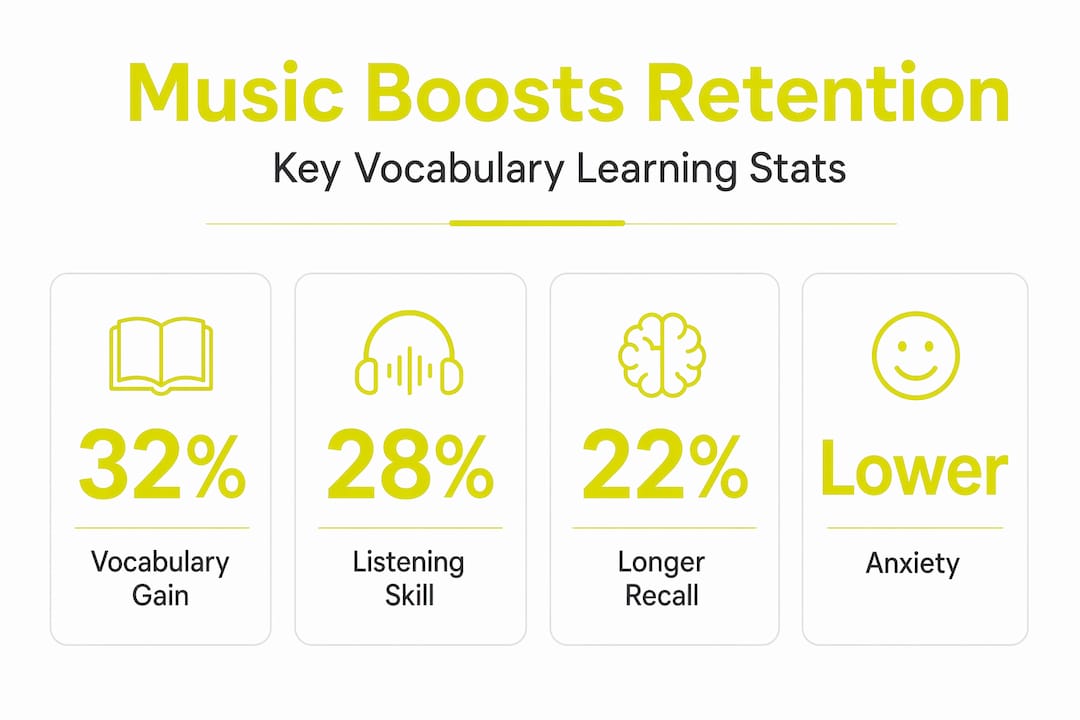
Structured music activities improve vocabulary scores by 32%, listening comprehension by 28%, and pronunciation accuracy by 22% after just four weeks. Those are significant numbers for any single instructional change. And music reduces anxiety through affective regulation, which matters more than learners often admit. Anxious learners avoid speaking. Avoidance kills retention. Music breaks that cycle.
That said, music-based learning has real limitations. Songs do not cover every grammatical structure you need. Highly idiomatic or dated lyrics can teach wrong register. And passive listening, where you play songs in the background while doing other things, delivers almost no measurable vocabulary benefit. Active engagement with lyrics through retrieval, movement, and focused repetition is what produces the gains. Background music is not a strategy.
The strongest approach treats music as a retention layer on top of broader language study, not as a replacement for grammar instruction or reading practice.
Practical strategies for using music in your vocabulary practice
Whether you are a self-directed learner or an educator building a curriculum, the following strategies give you a workable framework for music-based vocabulary learning. The goal is structured repetition that feels nothing like studying.
- Map songs to your vocabulary goals. Do not pick songs randomly. Choose tracks that feature your current target words in natural context. Music-based lessons mapped to specific linguistic goals consistently outperform open-ended musical exposure.
- Use lyric teasers before full listening. Give yourself or your students three to five key words from the song before pressing play. Ask for predictions about meaning or context. This primes semantic attention and deepens comprehension when the song plays.
- Build a 10-minute daily session. Short daily contact beats long weekly sessions. Play one song, complete one gap fill, sing the chorus twice. Teachers using music in core subjects see retention improvements of up to 22% without formal music training. Ten minutes a day is enough to replicate that effect.
- Pair songs with visual vocabulary cards. After singing a chorus, flash a vocabulary card for each target word. The card re-activates what the music encoded and anchors it to visual recognition as well.
- Schedule retrieval, not just exposure. Sing the song on day one, do the gap fill on day three, and test yourself by writing the lyrics from memory on day seven. This spacing mirrors proven retrieval practice and gives music-aided memory time to consolidate.
- Embrace karaoke format for speaking confidence. Karaoke removes the fear of silence. When the melody carries the sentence, learners take risks with pronunciation they would never attempt in a flat speaking drill. For educators, tools like those highlighted by the TEFL Institute show that song-based engagement produces a 35% boost in student participation, which directly feeds retention.
Pro Tip: Record yourself singing the target song on day one and again on day fourteen. Listening back gives you concrete evidence of pronunciation improvement and keeps motivation high when progress feels invisible.
My honest take on music and vocabulary retention
I have watched learners spend hours on vocabulary apps and still blank on a word the moment they need it in conversation. Then I have seen that same learner recall an obscure phrase perfectly because it showed up in a song they loved three months earlier.
In my experience, the biggest missed opportunity is not passive listening. Most learners know by now that background music does not cut it. The real gap is that even motivated learners treat musical activities as warm-up, not as the main event. They spend ten minutes on a song and four hours on grammar exercises, then wonder why their vocabulary does not stick.
What I have learned is that enjoyment is not a side effect of good music-based learning. It is the mechanism. When you genuinely like a song, you replay it without being told to. You notice words you missed before. You start humming it in the shower and suddenly a tricky phrase is in long-term memory with zero deliberate effort. That automatic re-exposure is something no flashcard app can manufacture.
I also want to be direct about one thing. The learners who see the biggest gains are the ones who sing out loud, even badly. Especially badly. The act of producing sound is what activates the motor memory layer that makes words retrievable under pressure. Lip-syncing in your head is not enough. Give the song your voice and it will give you the vocabulary back when you need it most.
— Ben
Learn vocabulary through music with Singwithcanary
If this approach resonates with you, Singwithcanary puts all of it into one place. The platform combines song-based vocabulary learning with karaoke, lyric gap fills, and vocabulary cards so you are always actively engaging with the language rather than just absorbing it passively.
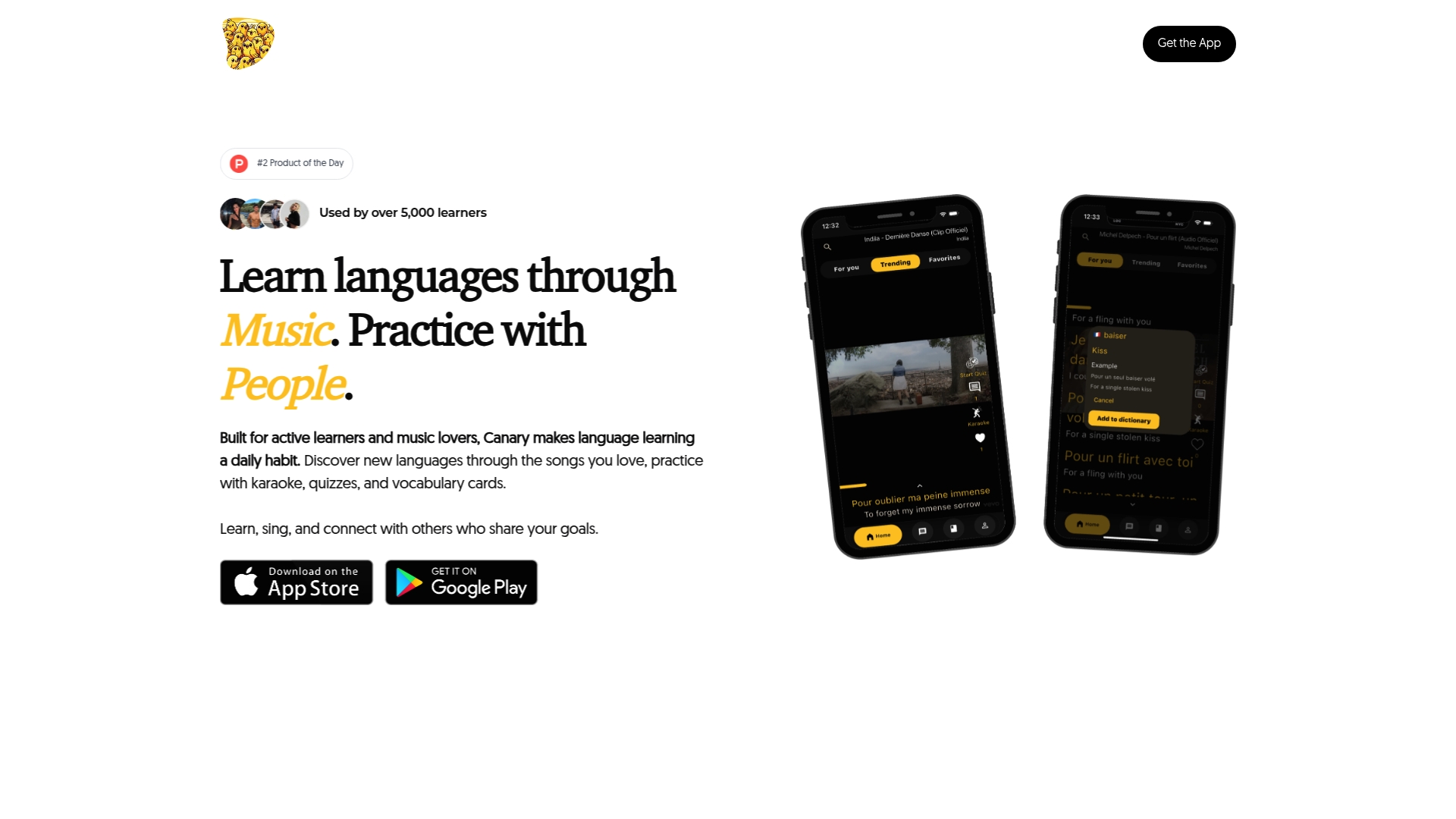
Each week, Singwithcanary features a curated song for practice so you always have a fresh vocabulary target and a structured activity to go with it. Whether you are a solo learner or an educator looking for ready-made musical lessons, the platform connects you with a global community of learners so every session includes real speaking practice. Start learning languages with music and discover how fast new words stick when the method is actually enjoyable.
FAQ
How does music improve vocabulary retention?
Music activates multiple brain regions simultaneously, including areas for emotion, language, and movement, creating stronger and more durable memory traces than rote study. Research shows rhythmic pairing can increase word recall by up to 40% compared to traditional methods.
Is passive listening to songs enough to learn vocabulary?
No. Passive background listening delivers minimal vocabulary benefit. The gains come from active lyric engagement through singing, gap fills, shadowing, and movement-based activities that force retrieval and attention.
What types of songs work best for vocabulary practice?
Songs with clear enunciation, moderate tempo, and repetitive lyric structures produce the strongest results. Choosing tracks that feature your current target words in context maximizes the overlap between musical exposure and vocabulary goals.
Can music really reduce language learning anxiety?
Yes. Short musical interventions of under eight weeks show moderate to large anxiety-reducing effects in language learners. Lower anxiety means more willingness to speak, and more speaking means stronger retention.
How quickly can music-based learning show vocabulary results?
Structured music activities show measurable vocabulary score improvements of up to 32% within four weeks. Consistent daily sessions of ten minutes are enough to produce noticeable gains in recall and pronunciation accuracy.