TL;DR:
- Face-to-face communication strengthens trust, clarity, and emotional connection better than digital methods.
- In-person interactions are vital for building social bonds, empathy, and professional competence.
Real-world communication is the process through which people build meaningful relationships, convey intentions, and navigate social and professional environments. It goes far beyond exchanging words. It includes tone, body language, facial expressions, and the shared physical presence that digital tools simply cannot replicate. The role of real-world communication shapes how you connect with others, how you perform at work, and how you feel about yourself. Research confirms that communication is both symbolic and relational, meaning every conversation you have actively constructs your understanding of the world around you.
What are the key benefits of face-to-face communication?
Face-to-face communication delivers seven primary benefits that digital methods consistently fail to match, including stronger trust, clearer nonverbal understanding, and higher persuasion effectiveness. Industry standards identify these seven benefits as the core reasons why in-person interaction remains the gold standard in professional and personal settings. Each benefit compounds the others. When you can see someone’s face, hear their tone, and read their posture simultaneously, you process far more information than any text message or video call can carry.
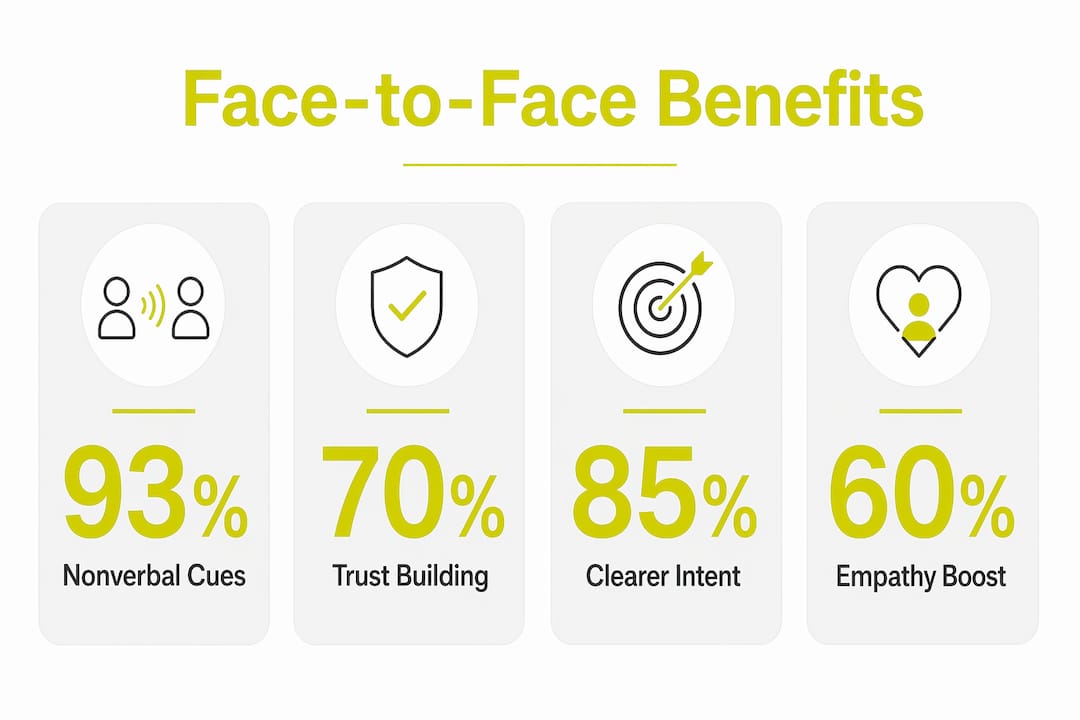
Nonverbal communication accounts for a significant portion of how meaning is transmitted between people. A raised eyebrow, a pause before answering, or a slight shift in posture all carry emotional data that words alone cannot convey. Effective interpersonal communication requires moving beyond surface-level information to understand the emotions and intentions underneath. Digital communication strips most of this away, leaving gaps that people fill with assumptions, often incorrect ones.
The contrast with digital communication is stark in high-stakes situations. Negotiating a salary, resolving a conflict, or building a new friendship all depend on reading the full picture. Text-based exchanges create ambiguity because the receiver cannot verify tone or intent. That ambiguity breeds misunderstanding, which weakens social bonds over time.
- Trust building: Physical presence signals commitment and sincerity in ways that a typed message cannot.
- Nonverbal clarity: Body language and facial expressions add layers of meaning that text removes.
- Active engagement: In-person settings demand attention and reduce the temptation to multitask.
- Faster feedback: Real-time responses allow immediate clarification and course correction.
- Stronger memory: People retain information better when it is delivered in person with emotional context.
- Deeper empathy: Seeing someone’s reaction in real time activates emotional attunement.
- Greater persuasion: Physical presence increases credibility and the likelihood of agreement.
Pro Tip: When you are in a face-to-face conversation, watch for mismatches between what someone says and how their body responds. A smile that does not reach the eyes, or a “yes” delivered with a slow nod, often signals hesitation. Catching these cues early prevents misunderstandings before they grow.
How does real-world communication impact personal relationships?
Replacing face-to-face interaction with online communication weakens social connections and increases loneliness. A BYU psychologist reviewing over 1,000 studies confirmed that physical presence is crucial for forming and maintaining strong social bonds. That finding is not a minor footnote. It means that the shift toward digital-only socializing carries a measurable psychological cost, one that accumulates quietly over months and years.
Shared physical presence does something that a video call cannot replicate. It activates a sense of co-presence, the feeling of genuinely being with another person. That feeling reduces isolation, signals belonging, and supports emotional regulation. Spontaneous interactions, a conversation that starts in a hallway or a laugh shared over coffee, build the texture of close relationships in ways that scheduled video calls rarely achieve.
“Everyday communication is not just information exchange. It is the relational space where understanding the world happens. The connections formed through in-person interaction carry emotional weight that digital substitutes consistently underdeliver.”
Real-world communication also builds empathy more effectively than digital channels. When you sit across from someone who is struggling, you feel the weight of their situation. You adjust your tone, slow down, and respond to what you see, not just what you read. That responsiveness is the foundation of genuine emotional understanding.
The practical implications are clear:
- Prioritize in-person meetups over purely digital check-ins for close relationships.
- Use spontaneous interactions as opportunities to strengthen bonds, not just scheduled calls.
- Practice active listening in face-to-face settings by maintaining eye contact and minimizing distractions.
- Recognize isolation signals early. Relying exclusively on digital communication often masks growing loneliness.
Understanding social interaction in language learning also reveals how the same principles apply when building connections across cultures and languages.
What role does real-world communication play in professional settings?
Authentic, in-person communication skills are not optional in professional environments. They are the foundation of career advancement, effective teamwork, and leadership credibility. Authentic materials develop four core sub-competences of professional communicative competence: linguistic, sociolinguistic, pragmatic, and strategic. Each one matters in the workplace, and each one requires real-world practice to develop fully.

Sociolinguistic awareness deserves particular attention. Knowing how to adjust language to social context is often more critical than grammar accuracy in professional settings. A technically correct sentence delivered with the wrong tone in the wrong context can damage a professional relationship. Choosing the right register for a client meeting versus a team brainstorm versus a performance review requires judgment that only comes from real-world exposure.
The table below maps each communicative competence to its professional application.
| Competence | What it means | Professional application |
|---|---|---|
| Linguistic | Accurate use of grammar and vocabulary | Clear written and spoken reports |
| Sociolinguistic | Adjusting language to social context | Appropriate tone in meetings and emails |
| Pragmatic | Understanding implied meaning and intent | Reading between the lines in negotiations |
| Strategic | Managing communication breakdowns | Recovering from misunderstandings in real time |
Real-life communication tasks enhance pragmatic sensitivity, enabling flexible and confident language use across professional situations. That flexibility is what separates competent communicators from exceptional ones. The ability to read a room, shift your approach mid-conversation, and recover gracefully from a miscommunication is a skill built through practice, not theory.
Pro Tip: Before a high-stakes meeting, spend two minutes reviewing the social context. Who is in the room? What is their relationship to you? What outcome do they want? Adjusting your register before you walk in dramatically improves how your message lands.
For learners building these skills across languages, key communication skills for career and life offer a practical framework that applies well beyond any single language.
How can you improve your real-life communication skills?
Improving real-life communication skills requires active participation in communication-rich environments, not passive study. Practicing in real-world settings combined with targeted feedback uncovers blind spots that self-assessment alone never reveals. You cannot improve what you cannot see, and feedback from others gives you the external perspective that makes growth possible.
The most effective path forward combines structured practice with genuine social exposure. Here is a practical sequence:
- Join group discussions or community events. Regular participation in group settings builds comfort with spontaneous, unscripted conversation. Book clubs, professional meetups, and community organizations all work well.
- Seek direct, specific feedback. Ask a trusted colleague or friend to identify one communication habit you should change. Vague feedback produces vague improvement. Ask for specifics.
- Practice active listening deliberately. In your next conversation, focus entirely on the speaker before forming your response. Resist the urge to plan what you will say while the other person is still talking.
- Develop assertiveness through low-stakes practice. Express a preference, disagree politely, or ask a clarifying question in a low-pressure setting. Assertiveness is a muscle that grows with use.
- Use authentic language environments. Engage in conversations where the stakes are real, whether that is a networking event, a volunteer role, or a language exchange. Sanitized practice environments do not prepare you for real interaction.
- Reflect after conversations. Spend two minutes after a significant interaction noting what worked and what you would change. Reflection accelerates learning faster than repetition alone.
Group language learning activities offer a structured way to practice many of these skills simultaneously, especially for learners building confidence in a second language.
Key Takeaways
Real-world communication builds trust, empathy, and professional competence in ways that digital interaction cannot replicate, making in-person practice the single most effective investment in your social and career success.
| Point | Details |
|---|---|
| Face-to-face beats digital | In-person interaction builds stronger trust and clearer understanding through nonverbal cues. |
| Physical presence reduces loneliness | Over 1,000 studies confirm that co-presence is essential for strong social bonds. |
| Four competences drive professional success | Linguistic, sociolinguistic, pragmatic, and strategic skills all require real-world practice. |
| Feedback accelerates skill growth | Targeted external feedback reveals blind spots that self-assessment misses. |
| Sociolinguistic awareness outweighs grammar | Adjusting language to context matters more than technical accuracy in most professional settings. |
Why I think we are undervaluing in-person communication
Digital tools are genuinely useful. I use them every day, and I am not arguing against them. What I have noticed, though, is that people increasingly treat digital communication as a full substitute for in-person interaction rather than a supplement to it. That is where the problem starts.
The most important conversations I have ever had, the ones that changed how I think or how I work, happened in person. There was something in the room that a video call could not have carried. A pause. A look. A moment of shared silence that communicated more than words. You cannot engineer that through a screen.
The other thing I have observed is that people who rely exclusively on digital communication tend to lose their tolerance for ambiguity in real conversations. They expect the clarity of a typed message in a live setting, and when they do not get it, they misread the situation. In-person communication is inherently messier and richer. Learning to sit with that complexity is a skill, and it atrophies when you stop practicing it.
My honest advice: treat face-to-face interaction as a discipline, not a default. Schedule it intentionally. Practice it the way you would practice any other professional skill. The returns compound in ways that are hard to quantify but impossible to ignore.
— Ben
Build real communication confidence with Singwithcanary
Real-world communication skills grow through authentic practice with real people, not through passive study or isolated drills.
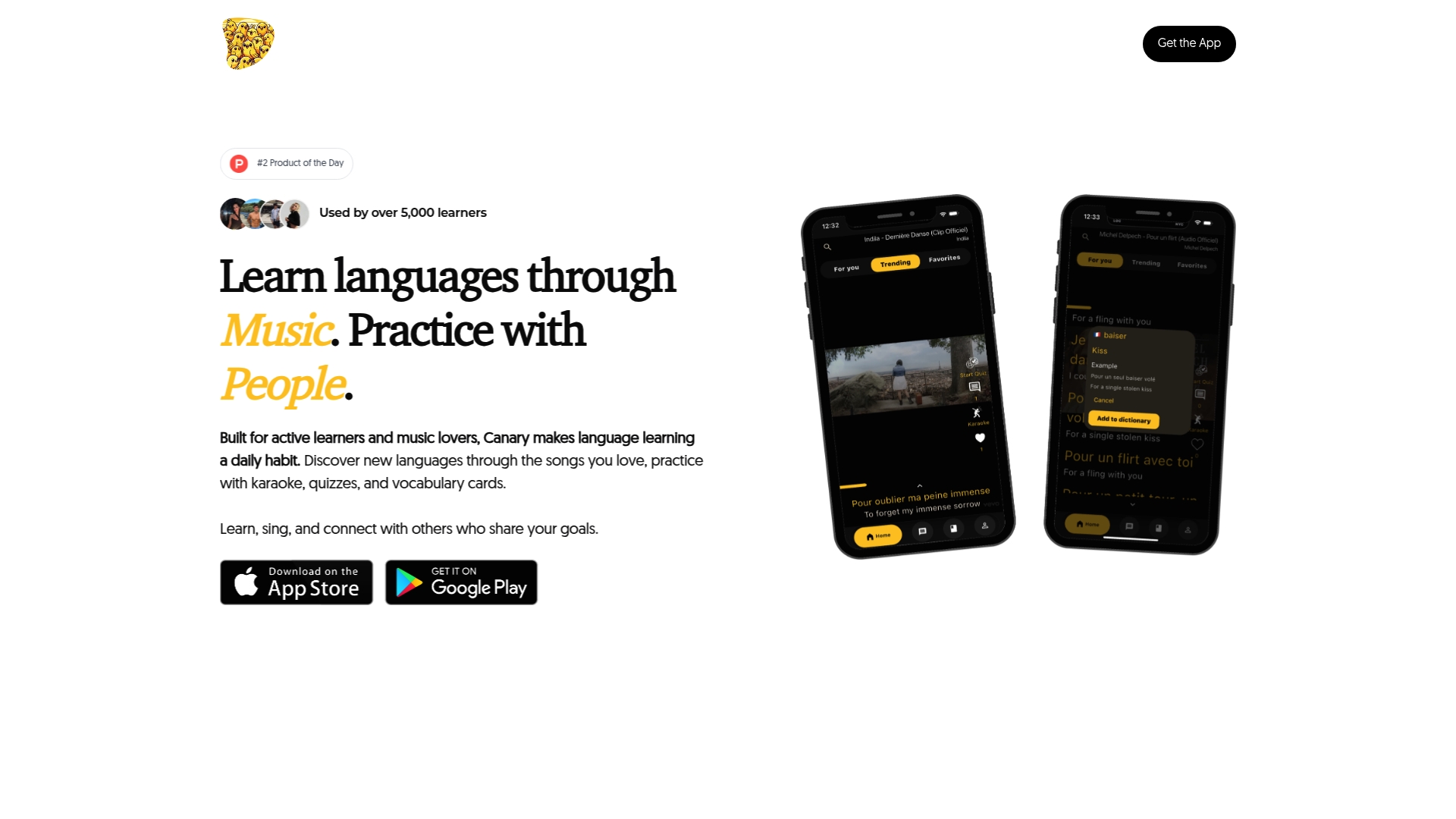
Singwithcanary is built around exactly that principle. The platform combines music-based language learning with social interaction, connecting you with international learners through karaoke, vocabulary challenges, and live practice sessions. Every feature is designed to build the kind of confidence that transfers directly into real conversations, whether you are navigating a professional meeting, a social gathering, or a new friendship across cultures. If you are ready to practice language the way it is actually used, sign up and start practicing with Singwithcanary today.
FAQ
What is real-world communication?
Real-world communication is the exchange of meaning between people through verbal and nonverbal channels in live, in-person settings. It includes tone, body language, facial expressions, and shared physical presence, all of which digital tools only partially replicate.
Why is face-to-face communication better for relationships?
Physical presence activates a sense of co-presence that reduces loneliness and strengthens social bonds. A BYU review of over 1,000 studies confirmed that in-person interaction is irreplaceable for building strong, lasting connections.
How does communication affect professional success?
Professional success depends on four communicative competences: linguistic, sociolinguistic, pragmatic, and strategic. Sociolinguistic awareness, the ability to adjust language to context, often matters more than grammar accuracy in workplace settings.
What is the fastest way to improve interpersonal communication skills?
Active practice in real-world settings combined with specific, targeted feedback is the most effective method. Seeking constructive feedback from others reveals blind spots that self-assessment consistently misses.
How does digital communication fall short compared to in-person interaction?
Digital communication removes most nonverbal cues, creating ambiguity that leads to misunderstanding. Effective interpersonal communication requires understanding emotional content and intent, which text-based exchanges routinely fail to deliver.