TL;DR:
- Social interaction is essential for effective learning, grounding abstract concepts and boosting motivation. It improves academic outcomes through peer engagement, enhances vocabulary processing, and supports behavioral regulation. Contingent, real-time social feedback is critical for meaningful language acquisition and retention.
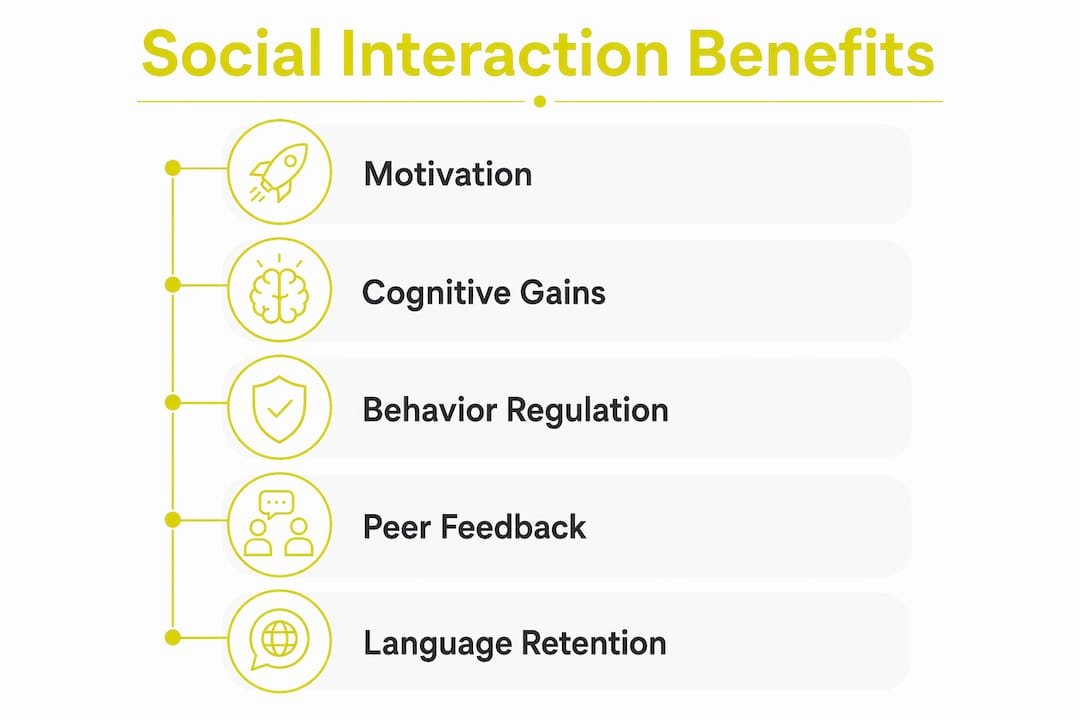
Social interaction is defined as the dynamic, contingent exchange between learners and peers that drives cognitive development, emotional engagement, and motivation. The role of social interaction in learning goes far beyond simple conversation practice. It reshapes how the brain processes information, grounds abstract concepts in lived experience, and builds the psychological safety learners need to take risks. Research from 2026 confirms that social connection is not a supplement to learning. It is the mechanism through which learning happens most effectively. Educators and learners who understand this can design environments that produce real, lasting results.
How does social interaction enhance learning and academic outcomes?
Social interaction produces measurable gains in academic performance. A study of 2,609 adolescents aged 12–13 found that social exclusion links directly to lower academic achievement, while strong peer friendships increase both engagement and resilience. That finding matters because it shows academic outcomes are not purely a function of instruction quality. The social environment shapes them just as powerfully.

The cognitive benefits go deeper than motivation. Research shows that dyadic interaction improves processing of abstract social words compared to working alone. When 60 French speakers categorized abstract social concepts in pairs, they outperformed individuals working solo. Shared context gives abstract ideas a concrete anchor, which is exactly what language learners need when acquiring vocabulary that does not map neatly to their first language.
Neuroeducational research adds another layer. Social signals help students regulate behavior, while social stress leads to disengagement. The brain treats social belonging as a prerequisite for learning, not a bonus. When learners feel connected, intrinsic motivation rises. When they feel excluded or judged, cognitive resources shift toward managing anxiety instead of acquiring knowledge.
| Learning Factor | Effect of Social Interaction |
|---|---|
| Abstract concept processing | Improved through dyadic exchange and shared context |
| Academic achievement | Strengthened by peer friendships and inclusion |
| Intrinsic motivation | Raised by social belonging and positive peer signals |
| Behavioral regulation | Supported by responsive social feedback |
Pro Tip: Pair learners on abstract vocabulary tasks rather than assigning solo study. The social context does cognitive work that individual review cannot replicate.
What are the key theories explaining social interaction’s role in learning?
Three theoretical frameworks explain why peer engagement works so well. Each approaches the impact of social interaction on education from a different angle, and together they form a complete picture.
Vygotsky’s Sociocultural Theory is the most widely cited framework in this space. Vygotsky argued that learning occurs in the Zone of Proximal Development, the gap between what a learner can do alone and what they can do with guidance. A more capable peer or teacher provides scaffolding that pulls the learner forward. In language acquisition, this plays out every time a native speaker corrects pronunciation or completes a sentence a learner struggles to finish.
Bandura’s Social Cognitive Theory focuses on four processes: attention, retention, reproduction, and motivation. Learners observe others, retain what they see, attempt to reproduce it, and stay motivated when the environment rewards their effort. Motivation is crucial for learners to reproduce observed behavior, which explains why supportive, socially rewarding environments produce better outcomes than isolated study.
Piaget’s perspective adds a useful contrast. Piaget emphasized that social-arbitrary knowledge, such as vocabulary and grammar conventions, must be acquired through social transmission rather than individual discovery. You cannot figure out that “table” means table by examining the object alone. Someone has to tell you. Social interaction is the delivery mechanism for this entire category of knowledge.
Key distinctions across these three frameworks:
- Vygotsky centers the role of a more knowledgeable other in pulling learners forward
- Bandura emphasizes the motivational environment and the power of observed, rewarded behavior
- Piaget identifies social transmission as the only path to acquiring language conventions
- All three converge on one point: isolated learning misses the mechanism that makes knowledge stick
What are the real challenges of social interaction in learning environments?
Social interaction does not automatically produce good learning. The quality of the interaction matters as much as its presence. Passive interaction occurs when students are physically present in a group but mentally disengaged. They nod, they sit, and they contribute nothing. Research on vocational education students shows this pattern is common and significantly reduces learning outcomes.
The tradeoff between fluency and precision is another real tension. Social interaction increases concrete interpretation of abstract terms but can lower definition accuracy in testing. A learner who picks up a word through conversation may use it confidently but imprecisely. For language acquisition, this is a genuine challenge. Fluency and accuracy do not always develop at the same pace through social channels.
Class composition also shapes outcomes. Larger classes can weaken positive peer behaviors, and network-specific heterogeneity affects student achievement. An educator cannot simply put learners in groups and expect results. The structure of those groups, and the willingness of members to engage, determines whether interaction produces learning or just noise.
Effective strategies for managing these challenges:
- Assess willingness to interact before forming groups. Grouping by interaction willingness improves classroom atmosphere and learning outcomes in measurable ways.
- Build psychological safety first. Learners who fear judgment divert cognitive resources to anxiety management rather than knowledge acquisition.
- Use structured tasks that require genuine exchange. Open-ended group time often defaults to passive participation.
- Rotate group compositions regularly to prevent social hierarchies from calcifying.
- Monitor for passive participation and address it directly with targeted prompts or role assignments.
Pro Tip: Before assigning group work, ask learners to rate their comfort with speaking in the group on a simple 1–5 scale. Use those ratings to build balanced groups where at least one high-willingness learner anchors each team.
Practical strategies for using social interaction in language acquisition
The most effective social learning environments share one feature: contingency. Contingency means the interaction is responsive and timely. A reply that comes seconds after a learner speaks does more for memory and engagement than a correction delivered the next day. Children learn better from socially contingent video chats than from passive video exposure, and the same principle applies to adult language learners.
Educators can build contingency into their programs through several methods:
- Live conversation practice with native speakers or advanced peers creates the real-time feedback loop that drives retention
- Karaoke and song-based activities lower inhibition and create a shared emotional context, making learners more willing to speak and repeat
- Peer vocabulary quizzes require active retrieval in a social setting, which strengthens memory more than solo flashcard review
- Responsive video chat programs with international partners provide authentic contingent interaction outside the classroom
- Role-play tasks tied to real scenarios give learners a reason to use target vocabulary with precision
Measuring interaction willingness is a practical step most educators skip. A short pre-activity survey asking learners how comfortable they feel speaking in the group takes two minutes and produces grouping data that improves outcomes for the entire session. Platforms that track participation patterns can surface this data automatically, making it easier to intervene before passive interaction becomes the norm.
Music deserves special attention as a social learning tool. Songs provide shared cultural context, repeatable exposure to pronunciation patterns, and a low-stakes environment for practicing sounds that feel embarrassing in direct conversation. When learners sing together or discuss lyrics with peers, they engage in exactly the kind of collaborative language practice that research links to stronger vocabulary retention and accent improvement. The social dimension of music is not incidental. It is the mechanism.
Key Takeaways
Social interaction is the primary mechanism through which language learners build vocabulary, accuracy, motivation, and the confidence to use a new language in real life.
| Point | Details |
|---|---|
| Social connection drives motivation | Belonging raises intrinsic motivation; exclusion diverts cognitive resources to anxiety. |
| Dyadic interaction grounds abstract concepts | Pairs outperform solo learners when processing abstract vocabulary in a new language. |
| Interaction quality beats quantity | Passive group presence produces no learning gains; willingness to engage is the key variable. |
| Contingency is the active ingredient | Timely, responsive feedback from peers or partners drives memory and retention far better than passive exposure. |
| Music and social practice reinforce each other | Song-based activities lower inhibition and create the shared context that makes social vocabulary practice stick. |
Why I think we underestimate the social brain in language education
Most language programs treat social interaction as a feature, something you add after the grammar lessons and vocabulary drills are done. That framing gets it exactly backward. The social brain is core infrastructure for learning, not an optional module. When learners feel socially unsafe, their brains are not available for language acquisition. They are busy managing threat.
What I have seen consistently is that learners who connect with real people early, even imperfectly, outpace those who wait until they feel “ready.” Readiness is a myth in language learning. Confidence comes from doing, and doing requires a social environment that tolerates mistakes. The learners who progress fastest are not the ones with the best grammar. They are the ones willing to be wrong in front of someone else.
Technology has changed what is possible here. Platforms that combine music, real-time interaction, and community feedback give learners access to contingent social practice at a scale that was not available a decade ago. The research on social connections as learning capital supports exactly this kind of environment. The security to make mistakes, the feedback to correct them, and the community to keep you coming back are not soft benefits. They are the mechanism.
— Ben
Singwithcanary puts social interaction at the center of language learning
Language learning works best when it feels like a conversation, not a test. Singwithcanary combines music, karaoke, lyric-based quizzes, and vocabulary cards with a global community of learners who practice together in real time.
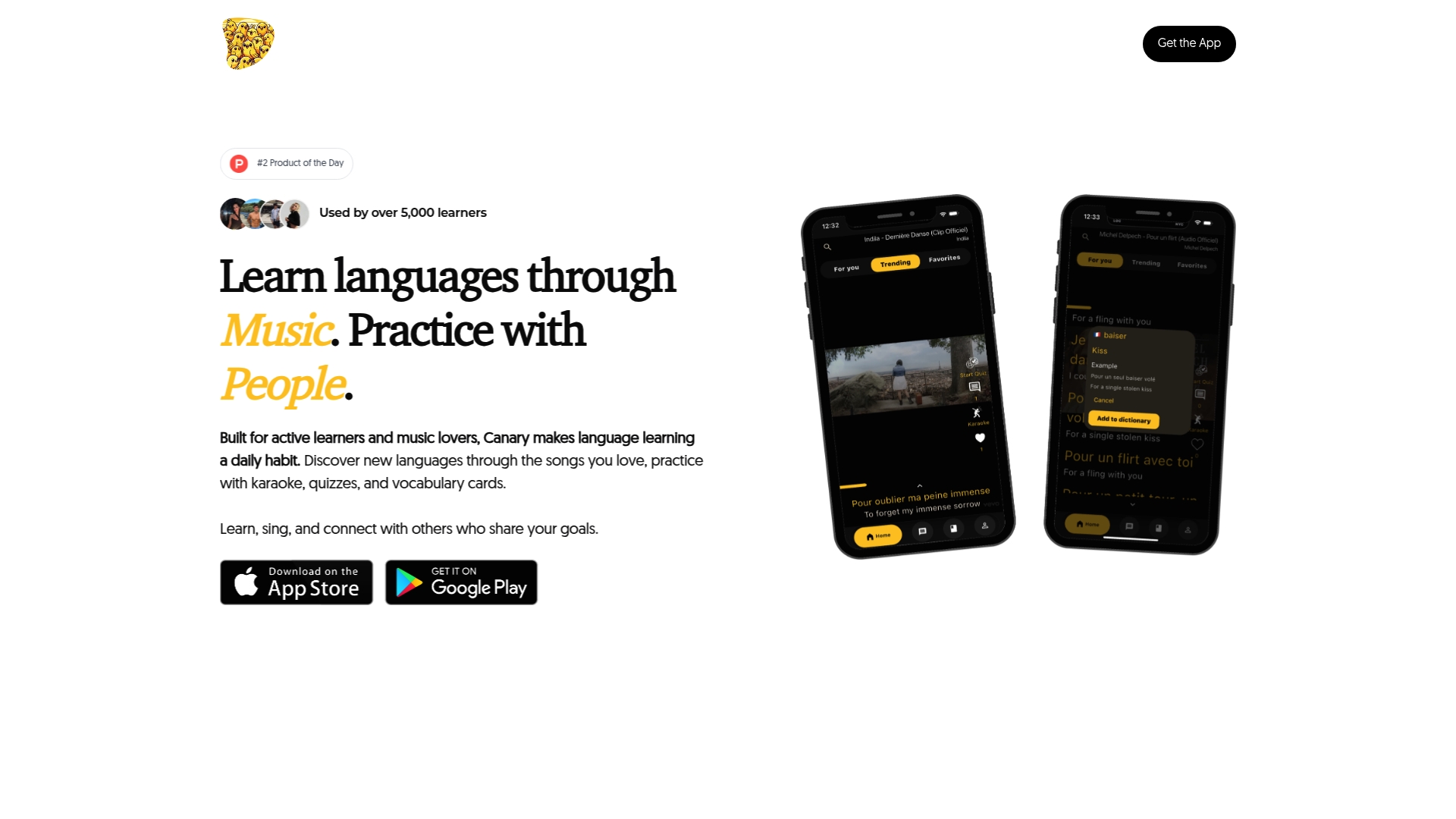
The platform is built around the same principles this article covers: contingent social feedback, low-inhibition practice through song, and a community that makes daily practice feel worth showing up for. Learners report real gains in accent accuracy, vocabulary retention, and listening comprehension. If you want to learn languages with music and practice with international people who are just as motivated as you are, Singwithcanary is worth exploring. You can also check out the song of the week to see the platform’s approach in action.
FAQ
What is the role of social interaction in learning?
Social interaction is the mechanism through which learners process abstract concepts, build motivation, and receive the contingent feedback that drives memory. It is not supplementary to learning. It is the core process.
How does social interaction enhance language acquisition specifically?
Peer interaction grounds abstract vocabulary in shared context, improves pronunciation through real-time feedback, and builds the psychological safety learners need to practice without fear of judgment.
What is social learning theory?
Social learning theory, developed by Albert Bandura, holds that learners acquire skills by observing others, retaining what they see, and reproducing behaviors when motivation and environmental rewards support it.
Why does passive interaction fail in group learning?
Passive interaction occurs when learners are physically present but not genuinely engaged. Research shows it produces no measurable learning gains and can be addressed by grouping learners based on their willingness to interact.
How does contingency improve social learning outcomes?
Contingency refers to timely, responsive feedback during interaction. Studies show learners retain more from socially contingent exchanges, such as live conversation, than from passive exposure to the same content.