TL;DR:
- Several apps like HelloTalk, Moji, and Canary effectively combine music and social interaction to improve language learning. These platforms promote vocabulary retention and speaking confidence through enjoyable, community-driven experiences. Each offers free tiers, allowing learners to test-fit their goals before subscribing to premium features.
If you’re hunting for TheLodyApp.com alternatives that actually blend music with real social interaction, the short list is: HelloTalk, Moji, Vovea, Roxxem, Flashia, and Singwithcanary (Canary). Each takes a different angle on the same core idea: language sticks better when it’s tied to music, community, and genuine conversation rather than flashcard drills.
Here’s a quick snapshot of what each brings:
- HelloTalk — native speaker connections through voice chat, text correction, and live language exchange, free at the basic tier
- Moji — a social chat app pairing you with global friends for real-time conversation, voice messages, and translation support
- Vovea — guided conversational rooms with AI or community hosts, designed specifically to reduce speaking anxiety
- Roxxem — music-driven lyric interaction with a focus on pronunciation and ear training through popular songs
- Flashia — vocabulary-in-context learning across 12+ languages using stories and themed decks rather than isolated flashcards
- Singwithcanary (Canary) — karaoke-style song learning, vocabulary cards, quizzes, and a community of international learners, all inside one platform
All six are available in the US on iOS and Android, and most offer a free entry point before any paid commitment.
Table of Contents
- What are the best TheLodyApp.com alternatives compared side by side?
- Why music and social interaction make language learning work
- How to choose the right TheLodyApp.com replacement for your goals
- What does TheLodyApp.com actually offer?
- How do the pricing models compare across these platforms?
- How active are the communities on each platform?
- Which languages and content types do these apps support?
- What kind of customer support can you expect from each app?
- Singwithcanary brings music and community together in one place
- Key Takeaways
What are the best TheLodyApp.com alternatives compared side by side?
| Platform | Feature Set | User Experience | Music Integration | Social Interactivity | Pricing |
|---|---|---|---|---|---|
| HelloTalk | Correction tools, voice/text chat, translation | Clean, beginner-friendly | Minimal | High — live native exchange | Free basic; premium subscription |
| Moji | Voice messages, Moji Map, translation | Casual, social-first | Low | High — global friend matching | Free download |
| Vovea | AI-hosted rooms, structured conversation | Focused, low-friction | Low | High — guided output practice | Free with optional upgrades |
| Roxxem | Lyric-based exercises, pronunciation drills | Gamified, music-forward | High | Moderate | Free tier available |
| Flashia | Stories, themed decks, spaced repetition | Polished, readable | Low | Low | Free core; premium unlocks unlimited content |
| Canary | Karaoke, quizzes, vocabulary cards, community | Engaging, habit-forming | High | High — international community | Free access; premium features |
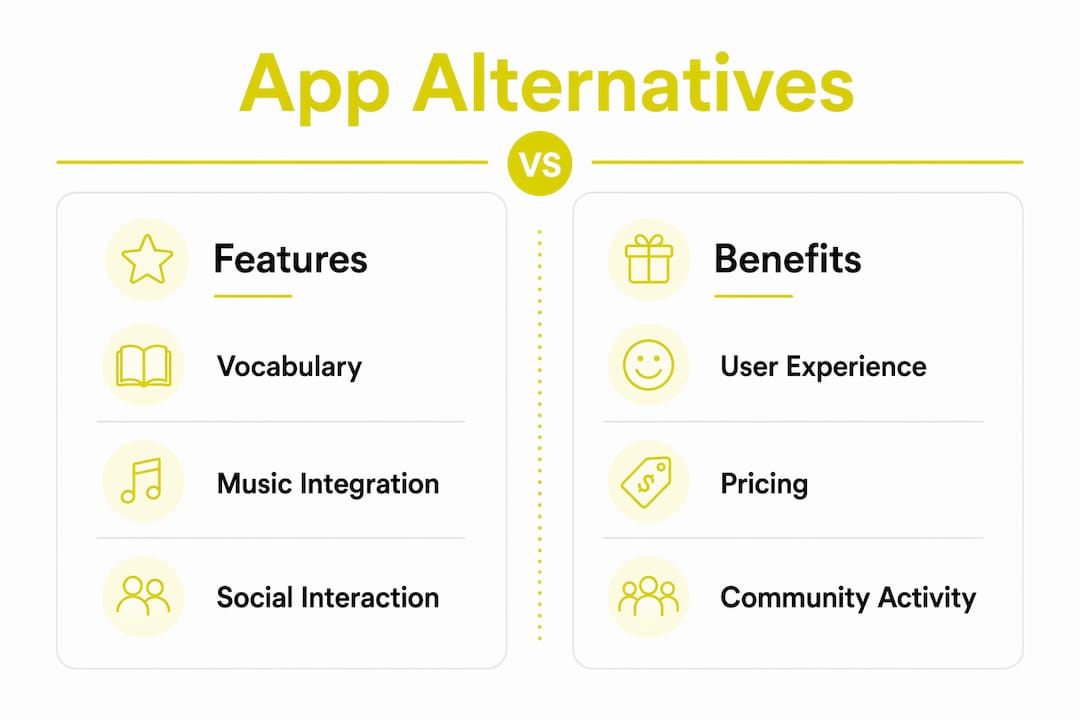
Flashia stands out for pure vocabulary depth, supporting 12+ languages including Spanish, French, German, Korean, and Portuguese, with Japanese and Mandarin on the way. HelloTalk and Moji lead on raw social reach. Canary and Roxxem are the two that genuinely put music at the center of every session rather than treating it as a bonus feature.
Why music and social interaction make language learning work
The research behind these platforms isn’t new, but it’s consistently underused in mainstream apps. Stephen Krashen’s Input Hypothesis argues that relaxed, enjoyable learning environments accelerate acquisition far more than rote drilling. Music is one of the most reliable ways to create that environment.
A few reasons this matters in practice:
- Melody encodes vocabulary. Words tied to a tune are processed differently than isolated text, which is why song lyrics stay in your head long after a grammar rule fades.
- Repetition without boredom. Listening to a song ten times feels natural; drilling a word ten times feels like punishment.
- Social output converts passive knowledge. Knowing a word and being able to use it under conversational pressure are two different skills. Platforms like Vovea address this directly through guided conversational spaces that reduce the anxiety of speaking with strangers.
- Community reduces dropout. Learners who practice with others consistently show longer engagement than solo app users.
The benefits of learning languages with music go beyond enjoyment. They address the two biggest failure points in language learning: losing motivation and never developing spoken confidence.

How to choose the right TheLodyApp.com replacement for your goals
Not every platform fits every learner. Before committing, run through these criteria:
- Music priority: If hearing and reproducing authentic pronunciation through songs is your main goal, Roxxem or Canary are the natural fit. If music is secondary, HelloTalk or Flashia may serve you better.
- Social priority: For live conversation practice with real people, HelloTalk and Moji offer the widest global reach. For structured, lower-anxiety speaking practice, Vovea’s hosted rooms are worth trying first.
- Device compatibility: All six platforms offer iOS and Android apps. Flashia and HelloTalk also have web access, which matters if you switch between phone and desktop.
- Budget: Every platform on this list has a free tier. Premium plans unlock unlimited content, advanced AI features, or ad-free experiences, but you can meaningfully test each one before spending anything.
- Language coverage: Flashia covers 12+ languages with strong European and East Asian options. HelloTalk and Moji support dozens of languages. Canary focuses on a curated set with deep song libraries per language.
Pro Tip: Spend one week on the free tier of your top two choices before upgrading. The platform that pulls you back daily without reminders is the one that will actually build your habit.
Pairing an app with real-world immersion accelerates results. Educational music tours offer a way to extend music-based language practice beyond the screen entirely.
What does TheLodyApp.com actually offer?
TheLodyApp.com positions itself as a music-based language learning platform that uses song lyrics as the primary learning vehicle. Its core features center on listening exercises tied to real songs, lyric-gap fills that train both comprehension and pronunciation, and a social layer where learners can interact around shared musical content.
The platform targets learners who find traditional apps too dry and want music woven into every exercise rather than added as a reward. Its social component encourages community interaction around songs, which creates a shared context for conversation that pure chat apps lack.
Where TheLodyApp.com has limitations, the alternatives above fill specific gaps: deeper vocabulary tools (Flashia), broader global community (HelloTalk, Moji), structured speaking practice (Vovea), and a more developed music-plus-social combination (Canary).
How do the pricing models compare across these platforms?
Pricing across these apps follows a consistent pattern: free access to core features, with premium subscriptions unlocking the full experience.
- HelloTalk offers a functional free tier covering text correction and basic voice chat. Its premium plan removes limits on translation and adds advanced correction tools.
- Moji is free to download with no publicly listed premium tier, making it one of the most accessible options for social practice.
- Vovea provides free access to conversational rooms, with optional upgrades for additional features.
- Flashia is free to start with core vocabulary tools. Its premium plan unlocks unlimited stories, AI-generated content, and full deck libraries, with no credit card required to begin.
- Roxxem offers a free tier for lyric-based exercises, with premium access expanding the song library and removing restrictions.
- Canary provides free access to its music and community features, with premium unlocking the full catalog of songs, quizzes, and vocabulary tools.
None of these platforms require a long-term contract to access meaningful features, which makes it practical to test several before settling on one.
How active are the communities on each platform?
Community size shapes how quickly you find a conversation partner and how much variety you get in social interactions.
HelloTalk has one of the largest established user bases among language exchange apps, with active communities across dozens of languages. Finding a native speaker of a major language takes minutes. Moji emphasizes global friend connections with its Moji Map feature, which visualizes where your contacts are located worldwide, giving the social layer a geographic dimension most apps skip.
Vovea’s community is smaller but more structured. Its hosted rooms mean you’re never dropped into an empty chat. Flashia and Roxxem have growing communities but are more content-focused than socially driven. Canary’s community is built around shared songs and cultural exchange, which creates a specific kind of engagement: learners connect over music taste as much as language goals.
Which languages and content types do these apps support?
Language coverage varies significantly across these thelodyapp.com similar apps:
- HelloTalk supports 150+ languages, making it the broadest option for less common language pairs.
- Moji covers major world languages including English, French, Spanish, Korean, Japanese, and Portuguese.
- Flashia supports 12+ languages with content structured around real-life vocabulary themes and stories.
- Roxxem focuses on languages with large popular music catalogs, primarily English, Spanish, and French.
- Canary offers song-based learning across its supported languages, with content tied to actual charting and culturally relevant music rather than generic recordings.
For learners pursuing less common languages, HelloTalk is the clear leader. For depth of content in a focused set of languages, Flashia and Canary offer more structured material per language than the broader social platforms.
What kind of customer support can you expect from each app?
Support quality across these platforms reflects their size and business model. HelloTalk, as one of the more established apps, offers in-app help documentation and a community forum, though direct support response times vary. Moji provides standard app-store support channels. Vovea, being a smaller platform, tends toward community-driven help and direct contact options.
Flashia is transparent about its support approach, with in-app FAQ and email contact. Roxxem’s support is primarily self-serve through its help center. Canary offers community support alongside direct contact options, with responsiveness tied to its growing user base.
For learners who need reliable troubleshooting, Flashia and HelloTalk have the most developed help resources. For social language practice questions specifically, Canary’s community often answers faster than any support ticket.
Singwithcanary brings music and community together in one place
If the alternatives above left you wishing one platform did it all, that’s exactly where Singwithcanary fits. While HelloTalk excels at finding conversation partners and Flashia goes deep on vocabulary, Canary is built around the specific combination of music-driven learning and social interaction from the ground up.
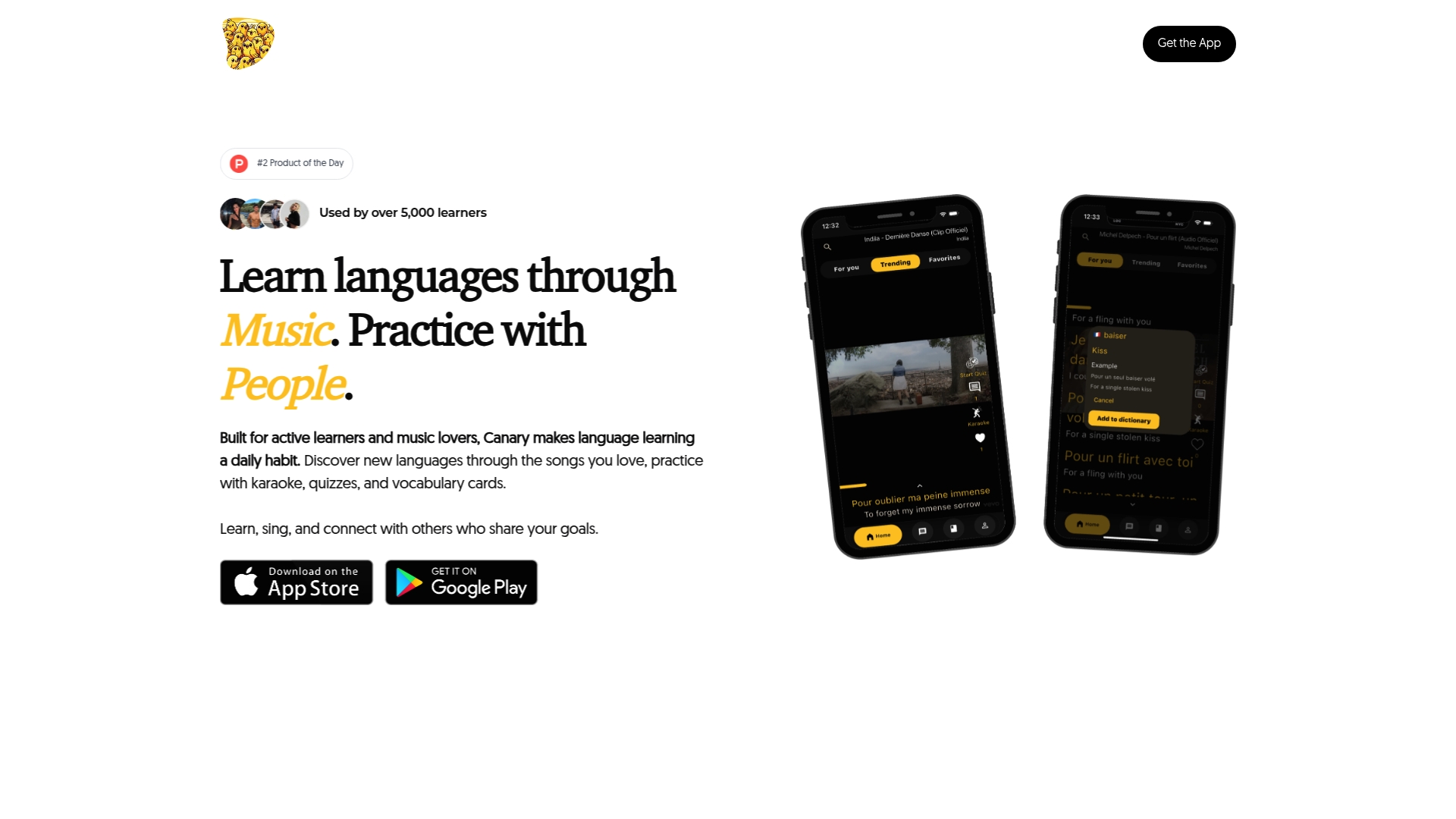
Canary’s approach: you learn through real songs using karaoke-style exercises, vocabulary cards pulled from lyrics, and quizzes that test comprehension in context. Then you practice with a global community of learners who share your musical taste and language goals. Users consistently report improvements in accent accuracy, vocabulary retention, and ear training, not because the content is harder, but because singing along to a song you actually like is a fundamentally different experience than grinding through a flashcard deck.
The platform is designed to learn languages with music in a way that builds a daily habit without requiring willpower. If you’ve burned out on traditional apps, Canary’s song-of-the-week format gives you a fresh entry point every week. Start with a free account and see which song pulls you in first.
Key Takeaways
Music-based social platforms outperform traditional apps for learners who need both vocabulary input and spoken output practice in an engaging, low-anxiety environment.
| Point | Details |
|---|---|
| Top alternatives identified | HelloTalk, Moji, Vovea, Roxxem, Flashia, and Canary each cover different aspects of music and social language learning. |
| Music lowers the affective filter | Melody and repetition reduce learner anxiety, improving vocabulary retention and long-term engagement. |
| Social output is non-optional | Converting passive knowledge into spoken fluency requires real interaction, not just more listening or reading. |
| Free tiers let you test before committing | Every platform on this list offers meaningful free access, so there’s no reason to pay before you’ve found your fit. |
| Singwithcanary combines both pillars | Canary integrates karaoke, quizzes, vocabulary cards, and a global community into one music-first learning platform. |