TL;DR:
- Vocabulary cards utilize active recall and spaced repetition for long-term retention.
- Adding music provides emotional context, improves pronunciation, and enhances memory pathways.
- Combining cards with songs accelerates motivation and bridges the gap to real conversational fluency.
Most language learners forget up to 80% of new words within 24 hours of first exposure. That’s not a personal failing. It’s just how memory works without the right system. Vocabulary cards leverage active recall and spaced repetition, two of the most powerful memory tools available, to fight that forgetting curve head-on. When you add music to the mix, something remarkable happens: words stop feeling like data to memorize and start feeling like experiences to remember. This article walks you through the science, the strategy, and the practical steps to make vocabulary cards work harder for you.
Table of Contents
- How vocabulary cards supercharge language retention
- Why music and vocabulary cards are a winning combination
- Step-by-step: How to create and use vocabulary cards effectively
- Limits and misconceptions: What vocabulary cards can and can’t do
- Why we believe vocabulary cards and music change the game
- Ready to elevate your language journey?
- Frequently asked questions
Key Takeaways
| Point | Details |
|---|---|
| Superior retention | Vocabulary cards boost long-term memory more than passive study methods for language learners. |
| Music amplifies results | Integrating music and rhythm with vocabulary cards sharply improves retention and pronunciation. |
| Balanced approach needed | For true fluency, use vocabulary cards with conversation practice and real contexts. |
| Practical steps | Making and using cards is easy and effective, especially when matched with your favorite songs. |
How vocabulary cards supercharge language retention
Your brain is not a hard drive. It doesn’t store information just because you looked at it. It stores what you work to retrieve. That’s the core idea behind active recall: instead of re-reading a word and its translation, you force your brain to produce the answer from scratch. Every time you do that, the memory trace gets stronger.
Spaced repetition takes this further. Rather than reviewing all your cards every day, a spaced repetition system (SRS) shows you a card right before you’re about to forget it. The intervals grow longer as you get more confident. The result is that you spend less time reviewing words you already know and more time reinforcing the ones you’re close to losing.
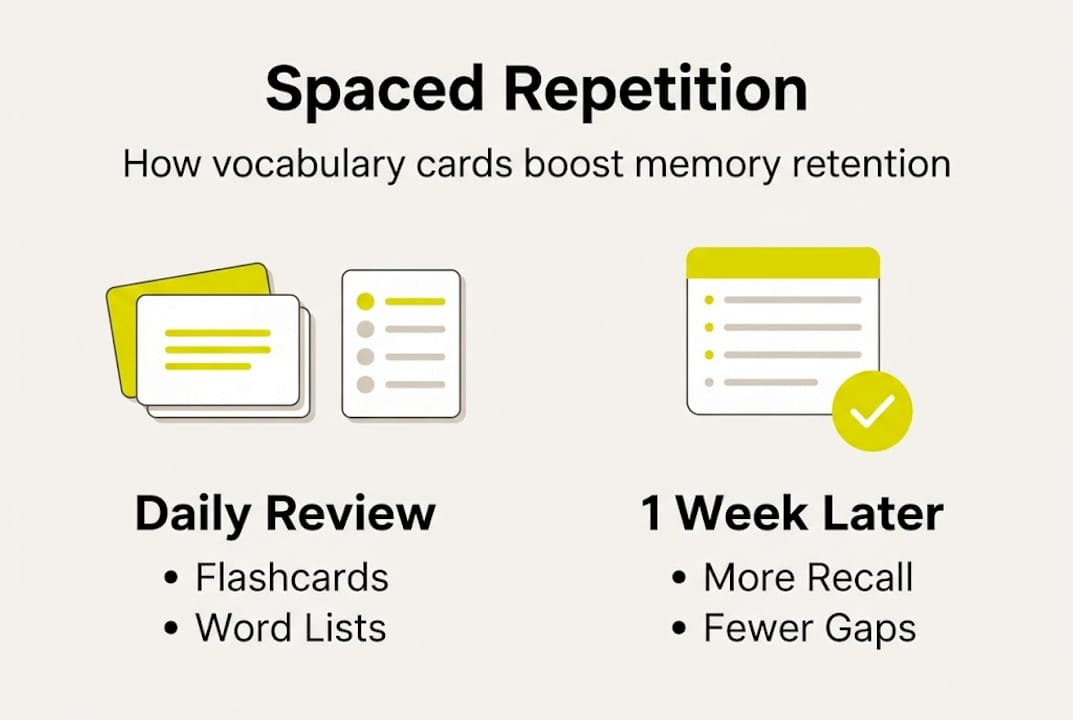
Research confirms this is not just theory. Flashcards outperform word lists, writing exercises, and fill-in-the-blank tasks as the most effective intentional method for building form-meaning connections in a new language. In practical terms, learners using spaced repetition flashcards retain vocabulary 2 to 3 times longer than those who cram.
Here’s how vocabulary cards compare to common alternatives:
| Method | Retention after 1 week | Engagement level | Context provided |
|---|---|---|---|
| Vocabulary cards (SRS) | High | Active | Optional |
| Word lists | Low | Passive | Minimal |
| Writing exercises | Medium | Active | Some |
| Fill-in-the-blank | Medium | Semi-active | Moderate |
The gap between passive and active methods is significant. When you expand vocabulary with songs, you’re already adding emotional and contextual layers that passive lists simply can’t match.
Key advantages of vocabulary cards over other methods:
- They force production, not just recognition
- They adapt to your personal forgetting curve
- They work in short sessions, making daily practice realistic
- They can include images, audio, and example sentences for richer context
The educational benefits of music and language study are well documented, and cards are the perfect vehicle for organizing what you pick up from songs, podcasts, or conversations.
Pro Tip: Start with no more than 10 new cards per day. Frequent, small retrieval sessions build stronger long-term recall than occasional large batches.
Why music and vocabulary cards are a winning combination
Once you understand why cards work, the next question is how to make them even more effective. Music is the answer most learners overlook.
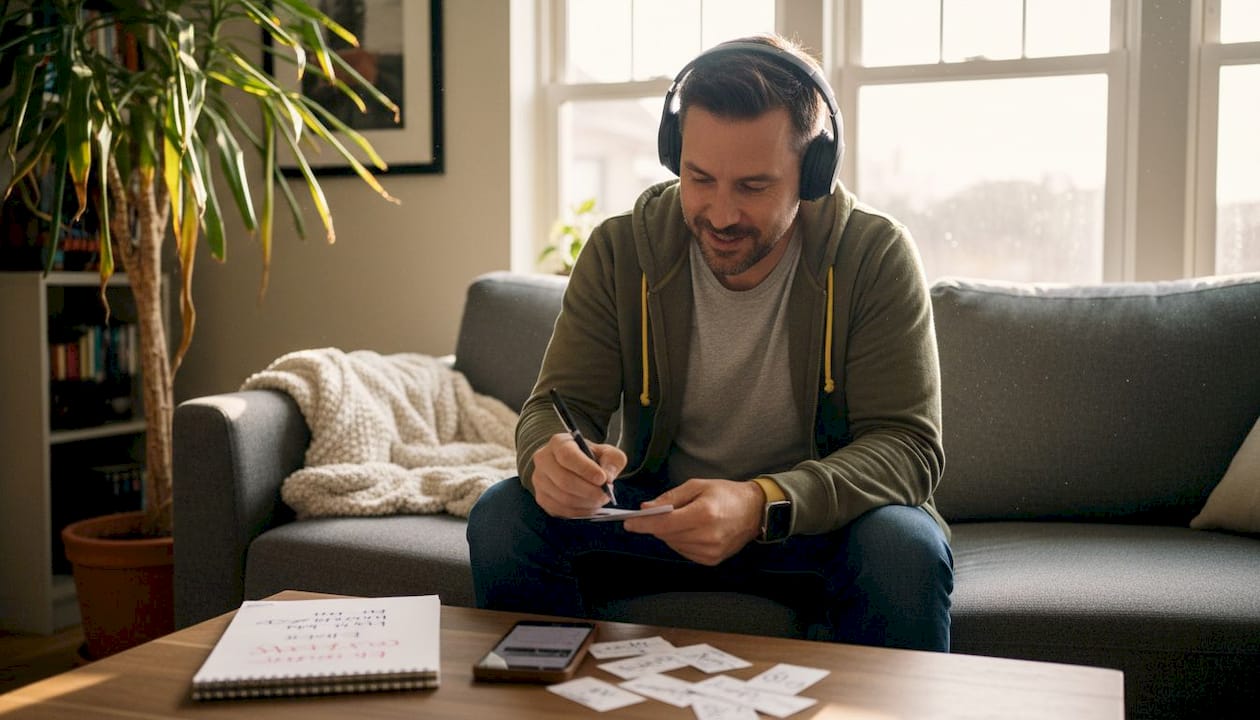
Rhythm and repetition are two of the oldest memory tools humans have. Before writing existed, cultures passed down knowledge through songs and chants. Your brain is literally wired to hold onto information that arrives with a melody. Music enhances vocabulary through rhythm and repetition, directly aiding both retention and pronunciation in ways that silent reading cannot replicate.
When you attach a song lyric to a vocabulary card, you’re not just adding a sentence for context. You’re attaching a sound, a rhythm, and often an emotion. That combination creates multiple memory pathways to the same word. The next time you hear that song, the word comes back. The next time you see the word, the melody surfaces.
The numbers back this up. Studies show learners who use song-based methods see a 32% vocabulary gain and a 22% improvement in pronunciation compared to traditional methods. That’s a meaningful edge, especially for learners who struggle with accent and natural-sounding speech.
“Music gives language a heartbeat. When learners connect words to songs they love, vocabulary stops being a chore and starts being a conversation.”
Here’s what music-integrated vocabulary cards look like in practice:
| Card element | Standard card | Music-enhanced card |
|---|---|---|
| Front | Target word | Target word + song title |
| Back | Translation | Translation + lyric snippet |
| Audio | None | Song clip or pronunciation audio |
| Context | Example sentence | Real lyric in context |
You can explore examples of music-powered language learning to see how real learners structure this. For those who want a broader view, language learning for music lovers covers the full range of approaches available.
Pro Tip: After finishing a song you enjoy, pull out 5 to 8 unfamiliar words from the lyrics and turn them into cards immediately. The emotional connection from the song is freshest right after listening.
The benefits of song-based language learning go beyond vocabulary. Pronunciation, rhythm, and natural phrasing all improve when music is part of your regular practice.
Step-by-step: How to create and use vocabulary cards effectively
Knowing that music enhances card learning is one thing. Building a system that actually sticks is another. Here’s a practical process you can start today.
1. Choose your format. Digital apps like Anki, Quizlet, or Canary’s built-in vocabulary cards let you add audio and images easily. Paper cards work just as well for retention. The retrieval practice effect is robust across both paper and digital formats, so pick what fits your lifestyle.
2. Write one word per card. Avoid cramming phrases or grammar rules onto a single card. One concept per card keeps retrieval clean and measurable.
3. Add rich context. Include an example sentence, a song lyric, or a short audio clip. The more pathways to the word, the stronger the memory.
4. Use the target language on both sides. Instead of putting the English translation on the back, try writing a definition in the language you’re learning. This pushes your brain to think in the new language rather than translate.
5. Organize by theme or song. Group cards by topic (food, travel, emotions) or by the song they came from. Themed clusters make review sessions feel coherent, not random.
6. Review daily, not weekly. Even 10 minutes a day beats a two-hour session once a week. Consistency is what builds the habit. A clear language learning workflow helps you slot card review into your existing routine without friction.
7. Test yourself out loud. Don’t just think the answer. Say it. Speaking activates different memory pathways than silent recall and directly improves pronunciation. Pairing cards with pronunciation quiz apps adds another layer of active practice.
8. Retire cards you’ve mastered. Once a card feels automatic, archive it. Keeping your active deck lean keeps motivation high.
Pro Tip: Schedule your card review right after you listen to music in your target language. The vocabulary is warm in your mind, and new words from the session can go straight onto fresh cards.
Limits and misconceptions: What vocabulary cards can and can’t do
Vocabulary cards are powerful. They’re not magic. Understanding their limits helps you use them as part of a balanced approach rather than a shortcut to fluency.
The biggest misconception is that building a large vocabulary through cards will automatically make you fluent. It won’t. Fluency requires output, real-time listening, and the ability to navigate unexpected conversations. Cards build the raw material. You still need to use it.
Flashcards excel at retention but must be paired with immersion and real output for genuine communication skills. Extensive reading, for example, produces positive vocabulary gains, though smaller than spaced repetition alone. The best learners combine both.
Here’s what vocabulary cards do well and where they need support:
- Cards are great for: Building a strong recognition vocabulary, drilling pronunciation of individual words, reviewing high-frequency terms, and organizing new input from songs or reading
- Cards fall short for: Practicing natural conversation flow, understanding connected speech at full speed, developing grammar intuition, and building the confidence to speak spontaneously
“Vocabulary is the bricks. Cards help you collect them. But fluency is the house, and that requires conversation, context, and time.”
The benefits of learning languages with songs address exactly this gap. Songs expose you to connected speech, natural phrasing, and emotional context all at once, which is why pairing them with cards is so effective. Cards give you the words. Songs show you how those words live in real language.
Balance your card practice with at least one listening session and one speaking opportunity each day. Even a short karaoke session or a voice message to a language partner counts.
Why we believe vocabulary cards and music change the game
We’ve worked with a lot of language learners, and the pattern is consistent: most people don’t quit because learning is too hard. They quit because it feels boring and disconnected from anything they care about.
Vocabulary cards get abandoned when they’re just lists of words with no emotional anchor. Music fixes that. When a learner builds cards from a song they genuinely love, every review session carries a trace of that feeling. The word isn’t just data anymore. It’s part of something meaningful.
We’ve seen learners go from dreading their daily review to looking forward to it, simply because they tied their cards to a playlist. That motivational shift is not a small thing. It’s what separates people who study for three weeks from people who study for three years.
The uncomfortable truth about fluency is that it’s social. No amount of solo card review will prepare you for the speed and unpredictability of a real conversation. But cards built from authentic input, especially songs, do something important: they close the gap between memorization and real use. You’ve heard the word in context. You’ve felt its rhythm. When it shows up in conversation, it’s already familiar.
That’s the loop we believe in: music builds context, cards build recall, and together they build confidence in real communication. The learners who combine both consistently outperform those who rely on either alone.
Ready to elevate your language journey?
If this approach resonates with you, Canary was built for exactly this kind of learning. It’s a platform where music and vocabulary practice aren’t separate activities. They’re the same activity.
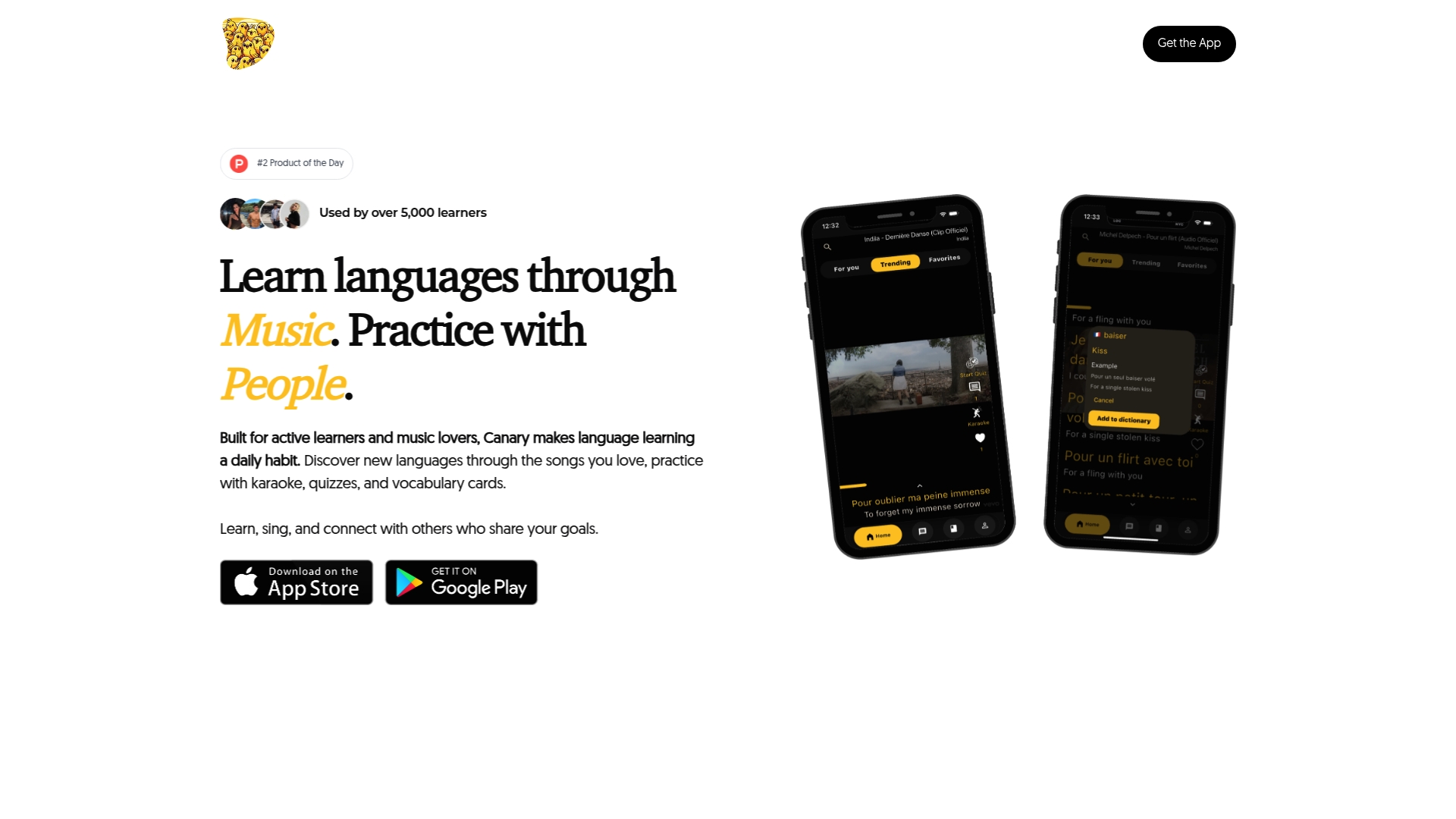
With Canary, you can learn languages with music through karaoke, quizzes, and vocabulary cards all tied directly to real song lyrics. Every week, a new Song of the Week gives you fresh vocabulary in context, with pronunciation practice built in. You also get to practice with real people from around the world, which is exactly the social output piece that cards alone can’t provide. Sign up for Canary and turn your music taste into your most powerful language learning tool.
Frequently asked questions
What makes vocabulary cards better than word lists for language learning?
Vocabulary cards use active recall and spaced repetition, which produce significantly longer-lasting retention than passively reading through a word list. The act of retrieving the answer strengthens the memory in a way that passive review simply doesn’t.
How do I add music to my vocabulary card practice?
Include a short lyric or audio clip from a song on each card so that rhythm and context reinforce both the meaning and pronunciation of the word. Hearing the word in a melody creates multiple memory pathways at once.
Are digital vocabulary cards as effective as paper ones?
Yes. The retrieval practice effect is consistent across both paper and digital formats, meaning your results depend on how regularly you practice, not which medium you choose.
Will using vocabulary cards alone make me fluent?
No. Cards build retention but must be combined with real conversation, listening practice, and immersion to develop the full communication skills fluency requires.