TL;DR:
- Vocabulary retention involves long-term ability to recall and use words, not just recognition.
- Active engagement, retrieval practice, and spaced repetition significantly improve long-term vocabulary retention.
- Combining music with active recall activities enhances retention through rhythm, emotion, and meaningful context.
You study ten new words, feel confident, then blank on them three days later. Sound familiar? That frustrating cycle happens because most study methods train short-term recognition, not real vocabulary retention, which is the durable ability to remember and actually use words long after the initial study session. Vocabulary retention is not about how many words you can recognize in a single sitting. It is about what stays in your head weeks later when you need those words in a real conversation. This article breaks down what retention really means, what the science says about building it, and how music-based learning can become your most powerful tool.
Table of Contents
- Defining vocabulary retention: Beyond memorization
- How vocabulary retention works: Science and strategies
- Music, songs, and interactive learning: How melody shapes retention
- Active recall with music: Practical activities for lasting vocabulary
- A fresh perspective: Why combining science with music makes vocabulary truly stick
- Turn vocabulary retention into real results with music-driven learning
- Frequently asked questions
Key Takeaways
| Point | Details |
|---|---|
| Retention vs memorization | True vocabulary retention means being able to recall and use new words after time passes, not just remember them briefly. |
| Active recall works best | Using techniques like quizzes, gap-fills, and spaced repetition helps you remember words far better than passive review. |
| Music boosts learning | Embedding new vocabulary in music and interactive activities makes words stick when you engage deeply, not just listen passively. |
| Meaning over form | Learning vocabulary in meaningful, real-world contexts creates stronger memory than rote word lists. |
Defining vocabulary retention: Beyond memorization
Most learners treat vocabulary study the same way they would cram for a quiz: read a word list, cover the translations, test yourself once, and move on. That approach can get you a passing grade, but it rarely builds the kind of memory that lets you use a word naturally in a conversation six weeks later.
Vocabulary retention is technically defined as the durable ability to remember and use words across delayed intervals. The keyword there is durable. Retention is not about recognizing a word the next morning. It is about whether you can recall and use that word correctly after days, weeks, or even months have passed. That standard is significantly harder to meet than simple memorization, and it requires fundamentally different learning strategies.
Here is the key distinction:
- Short-term memorization means you can recognize or match a word right after studying it. It is surface-level, heavily dependent on context cues, and fades fast without reinforcement.
- Vocabulary retention means you can recall, recognize, and produce the word unprompted, well after the study session has ended. This is the level you need for real communication.
Researchers measure retention using delayed tests, not immediate quizzes. A benchmark for evaluating retention is whether a learner can recall or recognize a word after a significant time gap, and whether active retrieval during study produces stronger long-term results than passive re-exposure does. That second point is critical. Simply rereading a word list over and over again is passive re-exposure. It feels productive, but it does not build the deep memory traces that retention requires.
Why does passive exposure fall short? Because your brain encodes information based on how deeply you process it. Seeing a word repeatedly without engaging with its meaning, use, or context creates only a shallow trace. Your brain does not prioritize that trace as “important to keep.” As a result, the word fades.
“Retention is not about how many times you see a word. It is about how meaningfully you engage with it each time you do.”
Understanding this distinction completely changes how you should approach vocabulary study. It is not about studying more. It is about studying smarter, using strategies that force your brain to process words at a deeper level. That is why tools like vocabulary cards are so effective when used with active recall rather than passive review. You need to close the card and retrieve the word from memory, not just flip through cards and nod when you recognize the answer.
With that definition in mind, let’s dig into the science of how we actually keep new words in our heads for the long term.
How vocabulary retention works: Science and strategies
Now that you know what vocabulary retention means, let’s see why certain learning techniques, backed by cognitive science, work better than others.
The science comes down to two major principles: depth of processing and retrieval practice. Both of them have strong research backing, and both of them point toward the same conclusion: engaging actively with meaning produces better retention than drilling forms.
Retention improves significantly when learners process words deeply and practice retrieving them. Retrieval practice, the act of pulling a word from memory rather than simply reviewing it, outperforms passive re-exposure by a wide margin. Every time you successfully recall a word, you strengthen its memory trace and make it easier to access in the future.
Meaning-first approaches may support longer retention than form-first methods because focusing on what a word means and how it is used activates deeper semantic processing. When you connect a word to a concept, an emotion, or a situation, your brain stores it with more associations, making retrieval far easier later.
Here is a practical comparison of common study methods and their impact on retention:
| Study method | Processing depth | Retention impact |
|---|---|---|
| Reading a word list | Shallow | Low |
| Flashcard with translation | Medium | Moderate |
| Flashcard with active recall | Deep | High |
| Using the word in a sentence | Deep | High |
| Song-based context plus quiz | Very deep | Very high |
To build real retention, structure your practice around these steps:
- Learn the meaning first. Before worrying about spelling or pronunciation, understand what the word actually means and when someone would use it.
- Use retrieval practice. Test yourself without looking at the answer. The struggle to recall is where the memory gets built.
- Space out your repetitions. Reviewing a word right after learning it, then again after two days, then a week later, then a month later, gives you far better retention than massed repetition in one session.
- Produce the word. Do not just recognize it. Write a sentence with it, say it out loud, or use it in a conversation. Production forces deeper processing.
- Connect words to song-based language skills. Embedding vocabulary in a musical and lyrical context adds emotional and rhythmic associations that make recall more natural.
Pro Tip: Set a reminder to revisit new words 48 hours after first learning them, not the same evening. Your brain consolidates memories during sleep, so giving yourself a day gap before the first review takes advantage of that process and strengthens retention much faster.
The good news is that none of these strategies require hours of extra study. They just require intentional practice. Twenty minutes of active recall beats two hours of passive review every single time.
Music, songs, and interactive learning: How melody shapes retention
Having covered the science of memory, let’s see how music-driven techniques stack up for vocabulary retention.
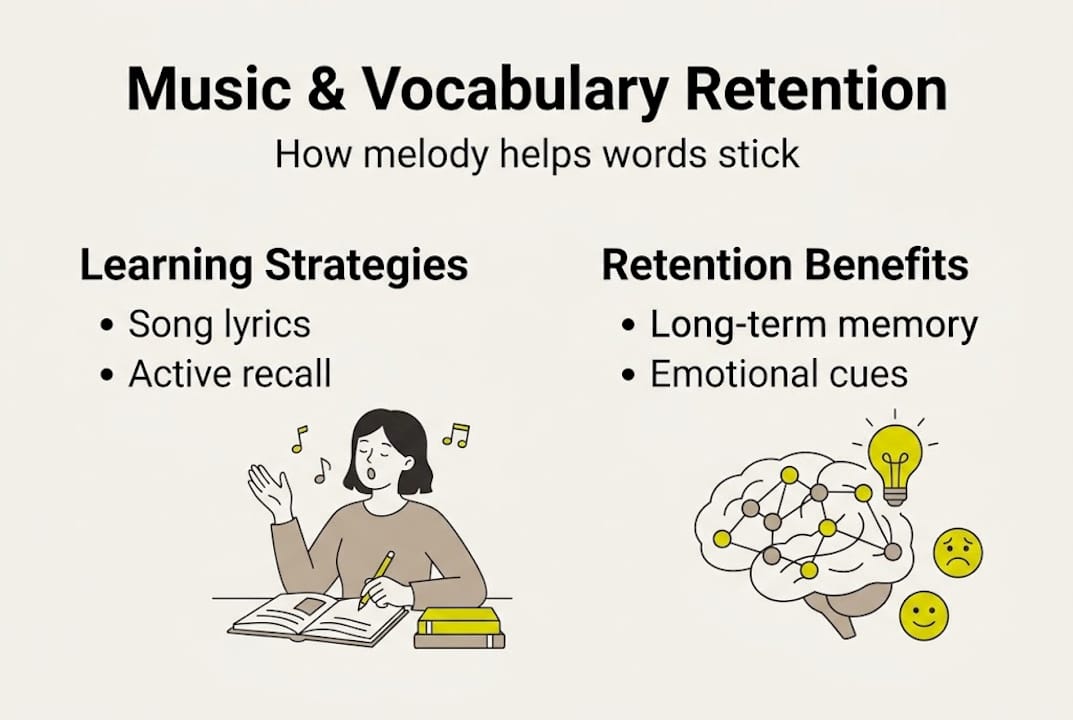
Music has a unique ability to carry language. Think about song lyrics you have not heard in ten years that you can still sing word for word. That is melody doing what plain repetition cannot: encoding language into memory through rhythm, emotion, and pattern. For language learners, that quality is genuinely valuable.
Song-based, interactive methods pair vocabulary with rhythm and melody, and they embed words in a repeated, emotionally loaded context. The research also shows that effects vary by the age of the learner and the specific structure of the activity, which means not every musical approach works equally well for adult learners. The key differentiator is active engagement.
Here is how song-based learning compares to traditional spoken methods:
| Method | Context richness | Emotional engagement | Retention potential |
|---|---|---|---|
| Word list study | Low | Low | Low |
| Spoken dialogue practice | Medium | Medium | Medium |
| Passive song listening | High | High | Moderate |
| Interactive song activities | High | Very high | High |
The pattern is clear: passive listening to songs has real value for building familiarity, but it is the interactive element that drives retention. When you sing along, fill in missing lyrics, or answer questions about what words mean in context, you shift from passive exposure to active processing.
Why does melody help so much? A few reasons:
- Rhythm gives structure. Words that fit into a rhythmic pattern are easier to recall because the beat acts as a retrieval cue.
- Repetition feels natural. Songs repeat choruses and hooks dozens of times, giving you spaced exposure without the tedium of a word list.
- Emotion deepens encoding. When a song moves you, your brain releases chemicals that strengthen memory formation. Words attached to emotional moments are harder to forget.
- Context is built in. Lyrics put words into real situations with real meaning, which supports the meaning-first approach that research backs up.
Understanding the benefits of song-based learning goes beyond simply enjoying a catchy tune. The structure of musical language, its repetition, its narrative context, and its emotional charge, creates the conditions your brain needs to form lasting vocabulary memories.
Pro Tip: When you find a song in your target language that you genuinely enjoy, do not just listen. Print or pull up the lyrics, circle words you do not know, look them up, then listen again and try to expand vocabulary with songs by predicting meaning from context before you check the definition.

Active recall with music: Practical activities for lasting vocabulary
So, what are the best, proven strategies to boost your vocabulary retention with music? Here’s how to combine active recall with song-driven methods.
The research is clear that intentional, structured recall beats passive exposure. Vocabulary instruction that uses delayed tests and repeated active recall with digital flashcards or structured repetition produces significantly better retention outcomes than unstructured review. When you combine that retrieval-first approach with music, the results compound.
Here are five practical activities you can start using today:
- Lyric gap-fills. Listen to a song and read the lyrics with certain words blanked out. Try to fill in the gaps from memory before checking. This forces active recall in a musical context and is one of the most effective listening and vocabulary exercises available.
- Sing-and-recall rounds. Listen to a verse once, then try to sing it back without looking at the lyrics. Do not worry about being perfect. The effort of trying to remember is where the retention happens.
- Post-song vocabulary quizzes for vocabulary growth. After engaging with a song, close the lyrics and answer questions about what specific words meant in context. This tests both comprehension and word retention at the same time.
- Production tasks. Take three words from a song’s lyrics and write your own sentences using them. Then, record yourself saying those sentences out loud. This hits both the meaning-first processing and the production requirement that research supports.
- Spaced song review. Come back to the same song after two days, then a week, then a month. Each time, do a gap-fill or recall exercise. The spaced intervals reinforce the vocabulary across time, building the durable retention you actually want.
“The goal is not to passively enjoy the music and hope the vocabulary seeps in. The goal is to use the music as a scaffold for intentional, effortful retrieval.”
Structure matters as much as the activities themselves. Try to build vocabulary with music through a consistent weekly workflow: pick a song on Monday, do a lyric study and gap-fill on Tuesday, revisit and do a recall quiz on Thursday, and do a spaced repetition review the following week. That rhythm of engagement, spaced across multiple sessions, is what separates learners who actually retain vocabulary from those who keep re-learning the same words.
Pro Tip: Track the words you get wrong in gap-fill exercises. Those are your “high-priority” words, the ones your brain has not encoded deeply yet. Build a custom list of them and create a short quiz at the end of every week until they feel automatic.
One more thing worth noting: do not skip speaking. Reading and listening activities are great, but producing words out loud, especially while singing or reciting lyrics, activates different neural pathways and dramatically strengthens the memory trace for pronunciation, not just meaning.
A fresh perspective: Why combining science with music makes vocabulary truly stick
Here is something most people, and even some language experts, get backwards about music and vocabulary learning: they assume that if you enjoy a song and listen to it often, the vocabulary will naturally stick. That assumption is mostly wrong.
Passive enjoyment does not create strong retention. What creates retention is the struggle to retrieve a word from memory, especially when you are not sure you remember it correctly. Music’s real power is not that it magically transfers vocabulary into your long-term memory. Its power is that it makes you want to engage repeatedly with the same content, giving you more retrieval opportunities without the boredom that kills motivation.
The learners who actually retain vocabulary through music are the ones who treat songs as structured study material, not just background entertainment. They pause. They test themselves. They write things down. They come back to the same song days later and do it again. Understanding how music speeds up language learning means recognizing that the speed comes from the engagement frequency music enables, not from some passive absorption effect.
So if you have been listening to songs in your target language and wondering why your vocabulary is not growing, this is probably why. The music is doing its job. You just need to meet it halfway with intentional recall.
Turn vocabulary retention into real results with music-driven learning
If everything in this article resonated with you, the next step is putting it into practice with tools designed to do exactly that.
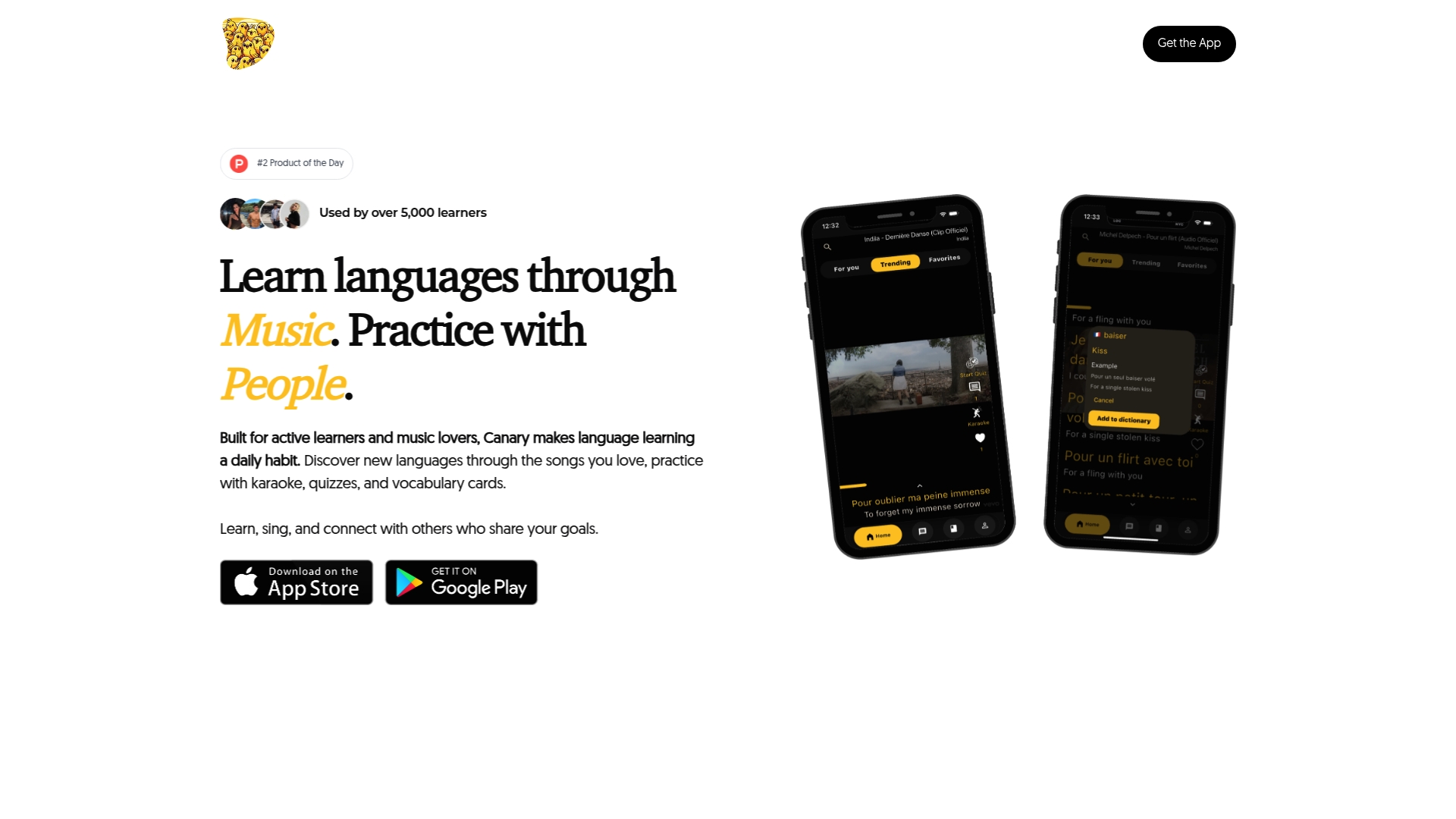
Canary is built for music lovers who want real language results. The platform combines song-based vocabulary learning with interactive features like karaoke, gap-fill quizzes, and spaced vocabulary cards so every session involves active recall, not passive listening. You can learn languages with music in a community of international learners who share your passion, practice pronunciation with real songs, and track your vocabulary growth over time. Start with the Song of the Week activities to experience exactly the kind of structured, recall-focused, music-driven learning this article describes. It is a genuinely different way to study.
Frequently asked questions
What is the difference between vocabulary retention and memorization?
Vocabulary retention is about remembering and using words long after you first learn them, while memorization often refers to short-term or surface-level recognition that fades quickly without reinforcement.
Does listening to songs really help with vocabulary retention?
Yes, but only when paired with active engagement. Song-based methods support retention best when you sing along, fill in gaps, or answer questions about the lyrics rather than just listening passively.
What are the most effective activities for improving vocabulary retention?
Retrieval practice and spaced repetition consistently outperform passive restudy, so activities like flashcards with active recall, lyric gap-fills, and music-based quizzes are your best bets for lasting results.
Is it better to learn vocabulary through meaning or by memorizing word lists?
Focusing on meaning wins every time. Meaning-first approaches create deeper semantic processing and longer-lasting retention than drilling isolated word-to-translation pairs without context.