TL;DR:
- Music-driven active listening, combined with social feedback, accelerates Italian comprehension more effectively than passive listening. Regular exercises like lyric dictation, shadowing, and micro-repeat loops improve sound recognition and pronunciation skills quickly. Using tools like Singwithcanary consolidates these methods, making consistent progress accessible and engaging.
Music-driven active listening is the fastest route to real Italian comprehension. Specifically: karaoke shadowing, lyric dictation, and targeted ear-training drills produce measurable gains faster than passive listening alone. The comprehensible-input guideline recommends that you aim to understand at least 70% of what you hear — so your materials need to be challenging but not crushing. Singwithcanary is built around exactly this principle, combining song-based practice with social feedback so every session counts.
Start today with these:
- 3-minute lyric dictation: Write what you hear, then check the transcript.
- 5-minute shadowing: Speak along with a 30-second phrase three times.
- Short karaoke session: Sing along to a song you’ve already transcribed.
- Minimal-pair drill: Distinguish similar sounds (e.g., pesca/pesa, vino/fino) for 5 minutes.
- Micro-repeat loop: Isolate a 5–10 second phrase and replay it until you can write it from memory.
Table of Contents
- Why does music speed up Italian listening and pronunciation?
- Seven music-based exercises you can do today
- How do social features build real listening confidence?
- Ear-training drills that complement your music practice
- A compact 4-week plan that stacks music and ear training
- How do you measure progress and fix plateaus?
- How Singwithcanary’s tools map to these methods
- Why varied accents matter for real comprehension
- Integrating listening with speaking and reading
- Key Takeaways
- Music works — but only if you use it actively
- Singwithcanary puts these methods in one place
- Useful sources and further reading
Why does music speed up Italian listening and pronunciation?
Music naturally repeats and frames phrases in rhythm, which is especially useful for adult learners building pronunciation and retention through enjoyable, repeatable practice. Melody anchors sound-to-spelling mappings in phonological memory, so you stop hearing Italian as a blur of connected syllables and start hearing distinct words. Rhythm also trains prosody — the rise and fall of speech — which is what makes Italian sound Italian rather than accented English.
The 70% comprehensibility rule applies here directly. Pick songs where you already understand at least 70% of the vocabulary. Festival di Sanremo pop songs are a reliable starting point for learners at intermediate levels: the lyrics are clear, the diction is close to standard Italian, and the melodies make repetition feel natural rather than tedious. As you learn Italian with music at progressively harder levels, the same song-based framework scales with you.
Seven music-based exercises you can do today
-
Lyric dictation (A2–B2, 5–10 min daily) Play a song, write every word you hear, then compare with the official lyrics. Focus on the gaps. Equipment: headphones, a transcript source.
-
Karaoke shadowing (A2–B2, 5 min daily) Sing along with the lyrics on screen. The goal is matching rhythm and vowel quality, not a perfect voice. Singwithcanary’s karaoke feature is built for this.
-
Micro-repeat loop (A2–B1, 5 min) Isolate a 5–10 second phrase. Replay it until you can write it without looking. Then check. Then replay again.
-
Slow-to-normal speed drilling (A2–B1, 5–10 min) Use a player that allows 0.75x speed. Listen slow, transcribe, then play at full speed and confirm.
-
Phrase chunking with typed transcripts (B1–B2, 10 min) Break a verse into 3–5 word chunks. Type each chunk from memory after one listen. This trains working memory for connected speech.
-
Record and compare (B1–B2, 5–10 min) Record yourself reading or singing a lyric extract. Play it back against the original. Note where your vowels or rhythm diverge.
-
Lyric-based vocabulary flashcards (all levels, 5 min) Pull 5–8 unfamiliar words from a song. Add them to a flashcard deck with the lyric as context. Expand Italian vocabulary this way and retention sticks far longer than word-list drilling.
Pro Tip: Start each exercise with an isolated phrase at 0.75x speed, confirm you can transcribe it accurately, then increase to 1x. Grading tempo upward in small steps prevents the frustration that kills consistency.
How do social features build real listening confidence?
Social features change the feedback loop entirely. Real-time correction from another person — even a peer, not just a teacher — forces you to process Italian at conversational speed rather than the controlled pace of a recording. Social language practice accelerates learning because it adds stakes, variety, and motivation that solo drills cannot replicate.
Practical ways to use them:
- Duet sessions: Sing or read a lyric extract with a partner. Each person takes a verse. Compare phrasing after.
- Peer feedback prompts: When you post a recording, ask specifically: “Listen for my vowel quality in the second line” or “Mark any segment where my rhythm breaks.”
- Weekly micro-challenges: Community voting on pronunciation clips creates low-stakes accountability without the anxiety of a live conversation.
Pro Tip: Before a duet session, write down one specific thing you want feedback on. Vague requests get vague answers. “Did my double consonants sound distinct?” gets you something you can actually use.
Ear-training drills that complement your music practice
When you can read a transcript but still miss the audio, the problem is sound recognition, not vocabulary. These drills fix that gap directly:
- Slow and replay small segments: Under 10 seconds. Replay until the ear maps the sound to the spelling. This is the single most effective fix for the transcript-audio mismatch.
- Minimal-pair discrimination: Pairs like bello/vello, cane/pane, sera/cera. Ten minutes of focused discrimination rewires phoneme recognition faster than an hour of passive listening.
- Keyword spotting: Play a 60-second clip. Write only the nouns and verbs you catch. Don’t try to get everything.
- Backward dictation: Write what you hear starting from the last phrase and working forward. Forces attention to every syllable.
- Focused shadowing with short clips: Shadowing works best on extracts under 30 seconds. Scale length only after you can match rhythm and stress accurately.
The same listening-skill framework applies across languages. Ear-training techniques for spoken Japanese follow nearly identical principles — isolate, slow, repeat, confirm — which tells you something about how universal the underlying process is.
Pro Tip: Alternate active ear-training days with passive listening days. Two days of intense minimal-pair work followed by a day of background Italian music prevents fatigue and lets the brain consolidate what it’s learned.

A compact 4-week plan that stacks music and ear training
Consistent short sessions beat occasional long ones. Aim for a consistent daily practice session of reasonable duration. Here’s how to build across four weeks:
| Week | Daily Focus | Minutes/Day | Measurable Goal |
|---|---|---|---|
| 1 | Lyric dictation + comprehensible input | A short daily practice | Transcribe a majority of a short song without transcript |
| 2 | Add shadowing + minimal-pair drills | Moderate daily practice | Shadow short extracts at reduced speed accurately |
| 3 | Full speed shadowing + social duets | Increased daily practice | Understand the majority of a short song without transcript |
| 4 | Unscripted audio + performance tasks | Further increased daily practice | Summarize a short podcast clip in a few sentences |
Start Week 1 with Singwithcanary’s Song of the Week — it’s a ready-made, level-appropriate entry point that removes the friction of choosing material. The free tier covers dictation and karaoke basics; Premium unlocks additional song libraries and social features. If 30 minutes feels like too much, cut each session to 10 minutes and extend the plan to six weeks. Consistency matters more than duration.
Gradual exposure from graded audio to native podcasts and radio builds the flexibility you need for real-world comprehension — so by Week 4, start mixing in a short podcast or news clip alongside your song practice.
How do you measure progress and fix plateaus?
Quick self-tests tell you more than a streak counter:
- 60-second transcript test: Transcribe a new clip cold. Track your accuracy percentage week over week.
- 3-minute summary test: Listen once, then summarize in Italian (or English at lower levels). Gaps in your summary reveal gaps in comprehension.
- Shadow speed test: Note the maximum tempo at which you can shadow accurately. If it’s not moving, the drill is too easy or too hard.
| Problem | Likely Cause | Fix |
|---|---|---|
| Anxiety blocks comprehension | Material too hard | Drop one level; use 60-second clips with transcript support |
| Transcript fine, audio confusing | Sound recognition gap | Slow and replay segments under 10 seconds |
| Progress stalled for 2+ weeks | Lack of variety | Add a new accent source or switch song genre |
| Shadowing feels impossible | Extracts too long | Cut to 15-second clips; master those first |
When you hit a wall, return to graded material for one or two sessions. The drop in difficulty feels like regression but actually resets your confidence and lets you climb again with better technique.
How Singwithcanary’s tools map to these methods
Singwithcanary bundles karaoke, lyric dictation, shadowing, vocabulary quizzes, and social feedback in one place — which means the seven exercises above map directly to features you can use without hunting for separate tools.
- Karaoke → shadowing and fluency practice
- Lyrics dictation → focused listening and sound recognition
- Vocabulary cards → lyric-based flashcard retention
- Duet and feedback features → social correction and confidence
- Quizzes → comprehension checks after each song
Singwithcanary users report improvements in accent accuracy, vocabulary retention, and ear training — the same three outcomes the exercises in this article target directly.
Available on iOS and Android, with a freemium model that lets you start the 4-week plan at no cost. The music-based pronunciation guide on the Singwithcanary site goes deeper on the research behind why this approach works for adult learners specifically.
Why varied accents matter for real comprehension
Standard Italian — the kind you hear in learning materials — is a narrow slice of how the language actually sounds. A Roman speaker clips vowels differently than a Milanese one. Neapolitan speech has rhythmic patterns that can make even B2 learners feel like beginners. Exposure to this variety is not optional if you want to understand real conversations.
Start with content close to standard pronunciation (RAI news broadcasts, Festival di Sanremo), then deliberately introduce regional variation. Italian interview shows like Che tempo che fa mix guests from different regions. Rai News 24 is available in the US through several providers and gives you fast, information-dense speech in near-standard Italian. The goal is to build a flexible phonological map, not just a single accent template.
Integrating listening with speaking and reading
Listening does not improve in isolation. The three-pass cycle — listen for global meaning, then with transcript, then without support — already integrates reading. Adding a speaking component closes the loop: paraphrase what you heard out loud, even alone, and you force your brain to process the audio at a deeper level than passive listening ever achieves.
Reading Italian song lyrics before you listen primes your ear for the vocabulary and syntax you’re about to hear. After listening, writing a short summary in Italian connects the audio to production. These three skills reinforce each other, and music is one of the few formats where all three can happen in a single 15-minute session.
Key Takeaways
Music-driven active listening — lyric dictation, karaoke shadowing, and social feedback — produces faster, more measurable Italian comprehension gains than passive exposure alone.
| Point | Details |
|---|---|
| Start with the 70% rule | Choose songs and clips where you understand at least 70% of the content to keep practice productive. |
| Prioritize sound recognition | When transcripts make sense but audio doesn’t, slow and replay segments under 10 seconds until the ear maps them. |
| Use the 4-week plan | Progress from 15 min/day of lyric dictation in Week 1 to 30 min/day of unscripted audio by Week 4. |
| Add social feedback | Ask for specific feedback (vowel quality, rhythm, double consonants) — vague requests get vague answers. |
| Use Singwithcanary | Karaoke, dictation, vocabulary cards, and duet features cover all seven exercises in one freemium app. |
Music works — but only if you use it actively
The most common mistake adult learners make is treating Italian music as background noise. Passive listening has its place — it keeps your ear tuned and your motivation up — but it does not build the sound-recognition precision that closes the gap between understanding lyrics on paper and catching them at native speed. That gap closes through active work: writing, shadowing, comparing, and getting corrected.
The exercises in this article are not complicated. A 10-minute lyric dictation session before work, a 5-minute shadowing drill at lunch, and a weekly duet session add up to real progress inside a month. The learners who improve fastest are not the ones who study the longest — they are the ones who make every minute count by staying active and getting feedback.
Singwithcanary puts these methods in one place
Every exercise in this article — lyric dictation, karaoke shadowing, vocabulary flashcards, social duets — is available inside Singwithcanary without stitching together separate apps. The freemium tier gets you started immediately; Premium opens the full song library and social features that make the 4-week plan run smoothly.
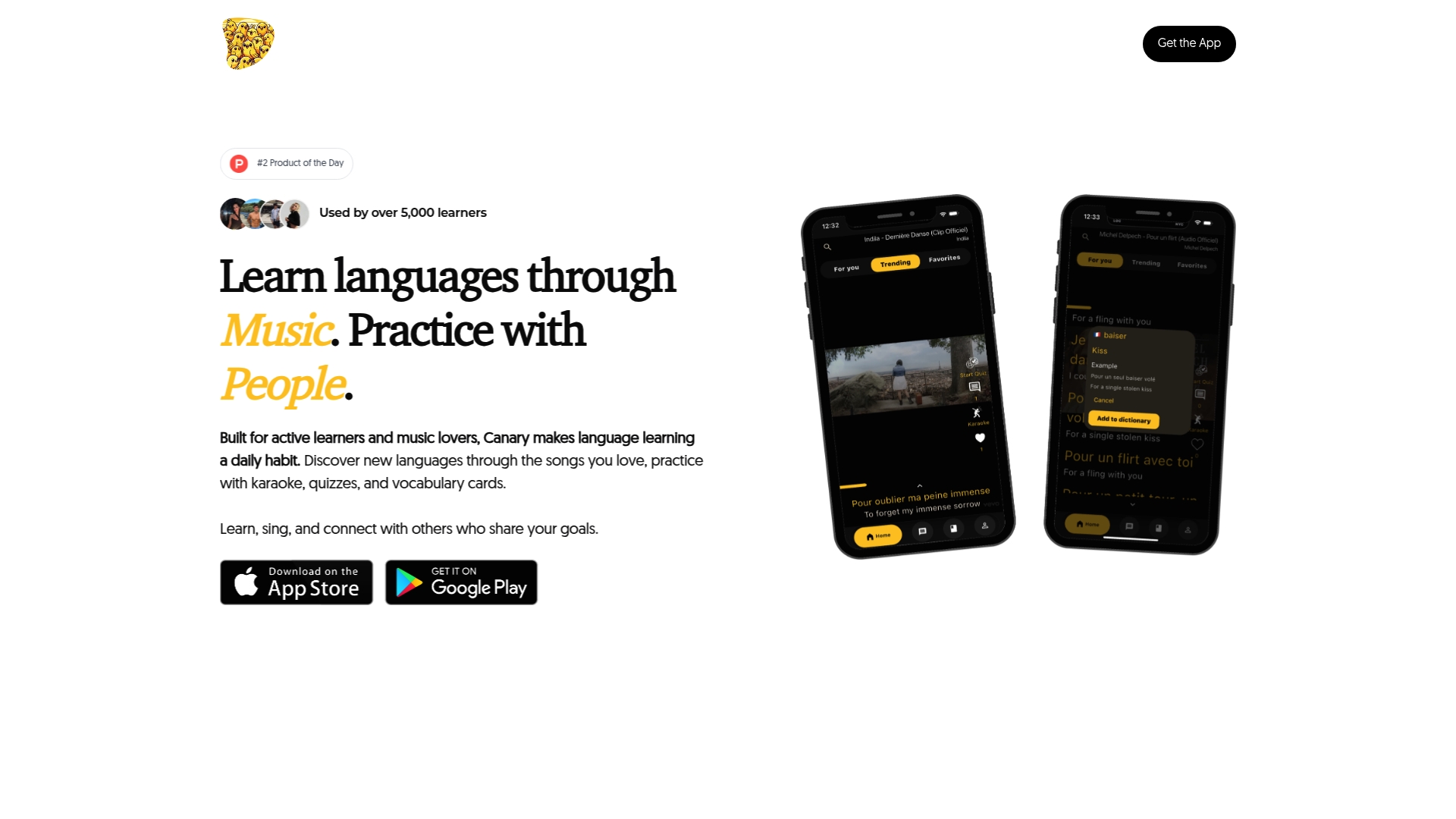
The fastest way to begin is the Song of the Week: a curated, level-appropriate track with built-in dictation and karaoke tools, updated weekly. Or go straight to the sign-up page and start your first session today. Available on iOS and Android, free to try.
Useful sources and further reading
- How to Train Your Ear for Real Italian Conversations — Polyglottist Language Academy
- Italian Listening Practice with Transcripts — The Italian Lesson
- How to Improve Your Italian Listening Skills — ItalianPills
- How to Improve Your Listening Skills in Italian — LearnAmo
- Best Tools for Italian Listening Practice — The Italian Lesson
- Italian Listening Practice for All Learning Levels — Rosetta Stone Blog
- Improving Italian Pronunciation: A Practical Guide — Singwithcanary
- Unlock Italian Fluency: 7 Benefits of Learning with Songs — Singwithcanary
- Song of the Week — Singwithcanary