Music trains your accent faster than most traditional methods because it locks melody, stress, and intonation into muscle memory simultaneously. A controlled study with 108 students found that listening to songs and singing both reduced accentedness significantly more than rhythmic speech listening alone, even in sessions as short as four minutes. That’s not a small finding. It means the ways to learn accents with music you’ll read here aren’t just fun alternatives to grammar drills; they’re backed by measurable pronunciation gains.
The core insight is this: language has a “music” of its own, and melody, stress, and intonation are just as vital as grammar for sounding natural. Songs force you to engage with all three at once, which is exactly why they work.
The most effective ways to learn accents with music
The methods below target different pronunciation skills. Use them in combination for the fastest results.
- Sing along actively. Don’t just listen. Mouth the words, match the singer’s pace, and focus on how vowels feel in your mouth.
- Shadow song lyrics. Play a line, pause, repeat it out loud. Match the rhythm and pitch, not just the words.
- Analyze lyric phonetics. Read lyrics while listening and mark sounds that differ from your native language.
- Record yourself singing. Play it back against the original. The gap between the two tells you exactly where to focus.
- Study mouth movements. Watch live performances or music videos. A singer’s articulation is visible in a way that normal conversation rarely is.
- Use rap for speed training. Rap compresses syllables and stress patterns into dense, fast sequences, which forces your mouth to adapt quickly.
- Repeat difficult phrases with backchaining. Start from the end of a hard phrase and work backward, one syllable at a time.
Each of these methods targets a specific layer of accent: vowel shaping, rhythm, intonation, or motor memory. The next section explains why those layers matter and how music reaches them.
How music trains vowel shaping, rhythm, and intonation
Singing forces your mouth into positions that casual listening never demands. When you hold a vowel on a sustained note, you can’t rush through it the way you might in speech. That extended contact time trains the exact lip and tongue positions that define a foreign vowel sound, which is why accent improvement with musical practice often shows up first in vowel accuracy.

Rhythm is where music does something speech drills can’t replicate easily. Songs have a fixed beat, which means stressed syllables land in predictable places. Your brain starts to internalize where stress falls in a language, and that pattern carries over into your spoken sentences. English, for example, is a stress-timed language, meaning unstressed syllables get compressed. Singing English songs trains that compression instinctively.
Intonation shapes meaning. A rising pitch at the end of a sentence signals a question; a falling one signals certainty. Singers exaggerate these contours, which makes them easier to hear and copy. Experts point out that prosody and melody in accent acquisition are not decorative features of language but the primary signals listeners use to judge whether a speaker sounds native.
- Vowel shaping: Sustained notes give you time to feel and correct mouth position.
- Rhythm: The beat locks stress patterns into physical habit.
- Intonation: Melodic contours make pitch movement audible and imitable.
- Phrasing: Songs group words into natural breath units, mirroring real speech flow.
- Emotional expression: Singers convey feeling through tone, which trains you to read and produce emotional cues in speech.
Pro Tip: Watch a music video with the sound off first. Study the singer’s mouth shape, jaw movement, and facial expressions. Then watch again with sound and try to match what you saw. This two-pass method accelerates mimicry because you’ve already mapped the physical movements before adding the audio layer.
Practical steps to reduce your accent using music
1. Select songs that match your target accent and level
Pick songs performed by native speakers of the accent you’re targeting. A learner working on a General American accent should start with artists like Taylor Swift or John Legend, whose diction is clear and relatively unmodified. Someone targeting British Received Pronunciation might choose Adele or Coldplay. Avoid songs with heavy vocal processing or extreme regional slang until your ear is trained.

2. Listen actively without distractions
Play the song once with no lyrics in front of you. Focus on where the singer breathes, which syllables get punched, and where the pitch rises or falls. This first pass is about hearing the music of the language, not decoding the words.
3. Follow lyrics and shadow the song
On the second listen, read along with the lyrics. On the third, sing along out loud. This three-pass approach, listening alone, then with lyrics, then singing, is a method that language learning experts recommend specifically for pronunciation work. Repeat the phrases that feel awkward until they stop feeling foreign.
4. Record yourself and compare
Record a short clip of yourself singing a verse. Play the original immediately after. Listen for vowel differences, stress mismatches, and intonation gaps. This feedback loop is more useful than any grammar correction because it’s specific to your mouth and your habits.
5. Use lyric analysis to understand pronunciation nuances
Print or pull up the lyrics and mark every word where the pronunciation surprises you. Look up the International Phonetic Alphabet (IPA) transcription for those words. The IPA assigns one symbol per sound, so it removes the ambiguity of English spelling entirely. Connecting the written symbol to the sung sound builds a mental map you can apply across new vocabulary.
6. Apply backchaining to difficult sounds
When a phrase trips you up repeatedly, use backchaining: start by pronouncing only the final syllable, then add the one before it, and keep extending toward the front of the phrase. This technique reduces the motor learning load by building the sequence from a stable endpoint. Tongue twisters work on the same principle and pair well with this method for building muscle memory.
7. Integrate with shadowing and phonetic drills
Music practice works best alongside other methods. Shadowing native speaker videos, where you match pace and intonation in real time, extends the skills you build with songs into natural speech. You can blend music with language study by alternating song sessions with shadowing sessions on the same day.
8. Customize song selection by dialect
If your goal is a specific regional accent, go narrow. For a Southern American accent, look for country artists from Tennessee or Georgia. For Australian English, choose artists like Tones and I or Courtney Barnett. The more specific your song selection, the more targeted your ear training becomes.
9. Increase difficulty gradually
Start with slow, clear ballads where every word is audible. Move to mid-tempo pop once your ear adjusts. Then tackle rap, which compresses syllables and stress patterns into fast sequences that push pronunciation accuracy and speed simultaneously. The progression matters because jumping to fast speech too early trains sloppy habits.
10. Practice consistently, not intensively
Short daily sessions beat long weekly ones. Your mouth is learning a physical skill, and physical skills require repetition spread over time, not crammed into a single sitting. Ten minutes of active singing practice every day will outperform an hour on weekends.
Songs that work well for English accent practice
The songs below are chosen for specific phonetic features, not just general listenability. Each one targets something concrete.
- “Someone Like You” by Adele. Slow tempo, clear British vowels, and emotionally sustained phrases. Excellent for learners targeting British pronunciation, particularly the open front vowels in words like “last” and “past.”
- “Lose Yourself” by Eminem. Dense, fast American English with heavy stress-timing. Challenging but highly effective for training syllable compression and consonant clusters. Rap is one of the best songs for language learning when speed and accuracy are the goal.
- “Shallow” by Lady Gaga and Bradley Cooper. The contrast between two singers gives you two models of American English phrasing in one track. The chorus is slow enough to shadow comfortably.
- “Let Her Go” by Passenger. British folk-pop with clean diction and a moderate pace. Good for practicing the schwa sound, which appears constantly in unstressed English syllables.
- “Thinking Out Loud” by Ed Sheeran. Smooth, conversational phrasing with clear British vowels. The melody follows natural speech rhythm closely, which makes it easier to transfer what you sing into what you say.
- “God’s Plan” by Drake. Canadian English with a relaxed, low-pitch delivery. Useful for practicing reduced vowels and the informal connected speech patterns common in North American English.
- “Hello” by Adele. Slower than most pop, with long vowel holds and dramatic intonation swings. Perfect for isolating and practicing specific British vowel sounds.
- “Old Town Road” by Lil Nas X. Short, repetitive phrases with clear American Southern vowel features. The repetition makes it easy to drill specific sounds without losing your place.
Pro Tip: Use the master pronunciation with lyrics approach: print the lyrics, circle every vowel sound that differs from your native language, and work through those specific sounds before you try to sing the whole song. Targeted drilling beats passive repetition every time.
Common myths about using music for accent reduction
Myth: Singing doesn’t transfer to speaking. The research says otherwise. Learners who sang or listened to songs reduced their accentedness measurably compared to those who only listened to rhythmic speech. The phonetic patterns practiced in singing do carry over into spoken output, particularly vowel accuracy and intonation.
Myth: You need musical talent to benefit. You don’t. The gains come from active engagement with sound patterns, not from singing well. A learner who sings off-key but pays close attention to vowel shapes and stress will improve their accent. The voice quality is irrelevant; the attention is everything.
Myth: Accent reduction happens quickly. Speech patterns fossilize over time, meaning small pronunciation habits that go uncorrected early can become permanent. Consistent early practice prevents this. Expecting noticeable change in a week sets you up for frustration; expecting it over months of daily practice is realistic.
Myth: Passive listening is enough. Putting a song on in the background while you cook does almost nothing for your accent. The gains come from active engagement: reading lyrics, repeating phrases, recording yourself, and analyzing the gaps. Passive exposure builds familiarity with sounds but doesn’t train your mouth to produce them.
Myth: Any song in the target language will do. Song selection matters. A heavily autotuned track or a song with extreme regional slang gives your ear confusing input at the wrong stage. Match the song to your level and your target accent, and the learning is far more efficient.
What the research says about singing and accent improvement
The clearest evidence comes from a study published in the journal Language Learning, which tested 108 Chinese students learning French. Participants were split into groups: one listened to rhythmic speech, one listened to a song, and one sang along. After just four minutes of training, both the song-listening group and the singing group reduced their accentedness significantly more than the rhythmic speech group. The singing and listening groups performed similarly, which tells us that even attentive listening to music, without singing, produces real phonetic gains.
What the study also found is that individual working memory and imitation ability influenced results. Learners with stronger imitation skills benefited most, which points to a practical takeaway: the more deliberately you try to copy what you hear, the more you get out of the session. Passive exposure and active mimicry are not the same thing.
Experts in prosody, the study of melody, stress, and rhythm in speech, emphasize that these features are not secondary to grammar and vocabulary. They are the primary signals that mark a speaker as native or foreign. A learner who knows every word but speaks in their native intonation pattern will still sound foreign. Music trains prosody directly because it is, structurally, a system of organized pitch, rhythm, and stress.
Pro Tip: After a singing session, immediately record yourself speaking a few sentences on the same topic as the song’s lyrics. You’ll often notice your spoken intonation has shifted toward the target accent. Capturing that window of transfer, right after active singing, reinforces the connection between musical and spoken output.
The benefits of song-based language learning extend beyond pronunciation. Vocabulary retention improves when words are learned in a musical context, and natural phrasing becomes more intuitive when you’ve heard it set to a melody dozens of times. The phonetic and lexical gains compound each other.
Why accent training with music is often misunderstood
One persistent misunderstanding is that music-based accent training is a passive or casual activity, something you do when you don’t feel like studying. That framing undersells it and leads learners to use it wrong. Singing along to a song without paying attention to phonetics is entertainment. Singing along while analyzing vowel shapes, marking stress, and recording yourself is a high-intensity pronunciation drill.
Another misunderstanding is that music only helps with the sounds of a language, not the rhythm. In fact, rhythm may be the bigger gain. English is stress-timed, meaning the intervals between stressed syllables stay roughly equal regardless of how many unstressed syllables fall between them. That pattern is almost impossible to teach through grammar rules but becomes physically intuitive after hours of singing English songs where the beat enforces it.
Learners also sometimes assume that accent training with music is only useful at the beginner stage. The opposite is often true. Intermediate and advanced learners who have already fossilized some pronunciation habits can use music to break those habits, because the melodic context forces them to produce sounds differently than they would in automatic speech. The song creates a new motor context, and that novelty is exactly what disrupts an entrenched habit.
Finally, many learners treat accent training as separate from vocabulary or grammar study. Music collapses that separation. When you learn accents through songs, you’re absorbing pronunciation, phrasing, vocabulary, and cultural context simultaneously, which is why the method feels efficient even when it feels like play.
Key Takeaways
Music-based accent training works because it targets melody, stress, and intonation simultaneously, the exact features that mark a speaker as native or foreign.
| Point | Details |
|---|---|
| Singing reduces accentedness | A study with 108 students showed singing and song listening cut accentedness more than rhythmic speech in four-minute sessions. |
| Active engagement drives gains | Passive listening produces minimal accent improvement; recording yourself and analyzing gaps is what moves the needle. |
| Song selection shapes results | Match songs to your target accent and level; rap builds speed, ballads build vowel accuracy, and folk-pop builds natural phrasing. |
| Backchaining breaks hard sounds | Starting from the end of a difficult phrase and building forward reduces motor load and builds lasting muscle memory. |
| Music trains prosody directly | Melody, stress, and intonation are the primary signals of a native accent, and songs engage all three at once. |
Practice your accent with Singwithcanary
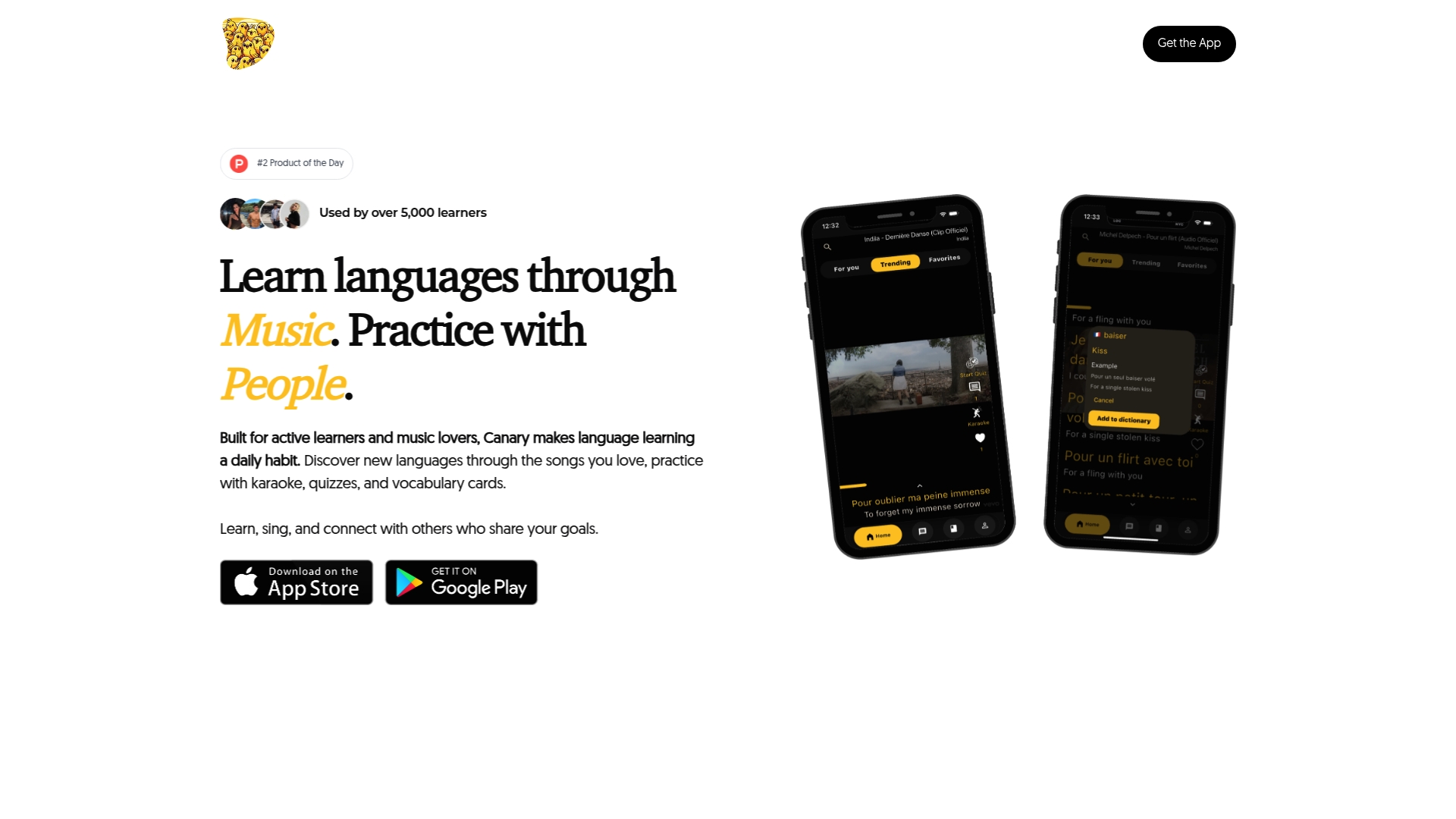
Singwithcanary is built around exactly this approach. The platform combines song-based language learning with karaoke-style practice, vocabulary cards, and a global community of learners who practice together. Every song on the platform is selected to target specific pronunciation features, so you’re not just singing for fun. You’re drilling the sounds that matter. The social layer means you can practice accents with other learners in real time, which adds the conversational feedback loop that solo music practice can’t provide. Check out the song of the week to start with a track already optimized for accent practice.